August 6, 2026
The Geology That Froze Time: Why Some of the World's Best Ore Bodies Stay Hidden for Decades
Across global mining history, some of the most consequential resource discoveries have not been defined by what geologists found, but by what they could not reach. Ancient rock systems, deformed by tectonic forces over hundreds of millions of years, routinely produce geological structures that defeat conventional drilling technology. These are not failures of knowledge or ambition. They are failures of mechanical compatibility between drilling equipment and structurally compromised rock.
This is the lens through which the story of the Broken Hill Centenary Zone must be understood. The deposit was not overlooked. It was not forgotten. It was geologically barricaded, sitting beneath one of Australia's most historically significant mining cities for more than four decades while the industry waited for someone to engineer their way through the lock.
That solution, the Broken Hill Centenary Zone mining technique developed by the geology team at Broken Hill Mines, has now potentially changed the calculus for one of the most intriguing unexplored zinc accumulations in Australian mining history.
When big ASX news breaks, our subscribers know first
A Zinc Deposit Beneath the Streets: What the Centenary Zone Actually Is
The Centenary Zone takes its name from the year of its discovery. In 1983, during the centennial celebrations of Broken Hill's founding, initial drilling programs intercepted a significant zinc-rich mineralised body sitting more than one kilometre below the city's surface. Approximately 13 boreholes were drilled from the surface to evaluate the deposit, each penetrating well beyond 1,000 metres of rock.
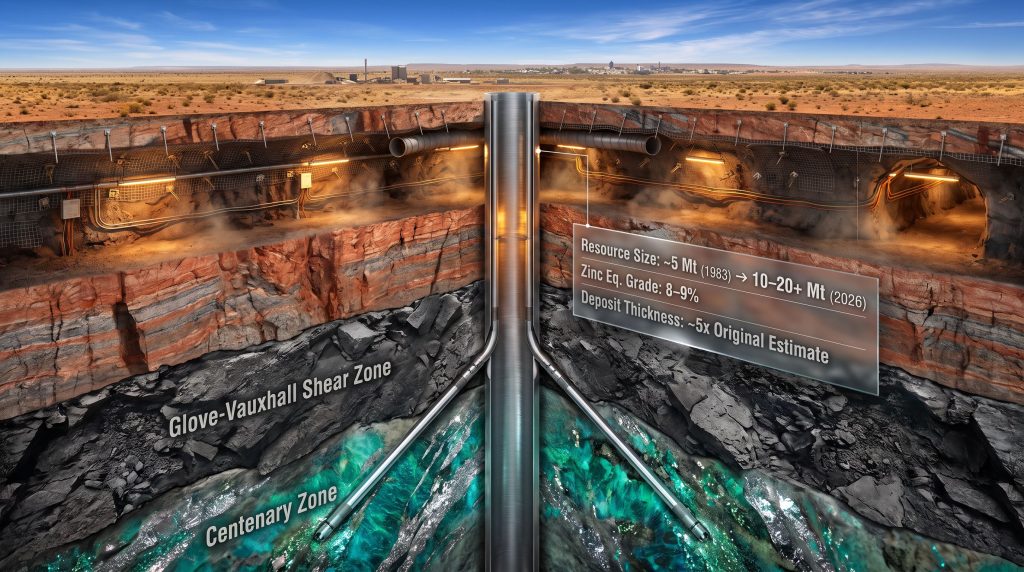
The results were encouraging. Early resource estimates placed the deposit at roughly 5 million tonnes at a zinc equivalent grade of 8 to 9 percent. In the context of global base metal exploration, that is a meaningful discovery. Zinc equivalent grades above 8 percent at meaningful tonnage scales are considered commercially attractive, particularly when located near existing processing infrastructure.
However, the promise was almost immediately eclipsed by a geological problem that no drilling team could overcome with the technology available at the time.
The Glove-Vauxhall Shear Zone: A Rock Structure That Defeats Drill Rods
Sitting directly between the existing Rasp Mine workings and the Centenary deposit is the Glove-Vauxhall Shear Zone, a band of intensely deformed rock produced by ancient tectonic stress events that affected the Broken Hill Block millions of years ago.
Understanding what a shear zone is at a mechanical level is critical to appreciating why this deposit remained untested for so long. In stable, competent rock, a rotating drill string transmits torque cleanly along its length, advancing predictably into the ore body below. In a shear zone, the rock has been crushed and pulverised into structurally chaotic material spanning several metres of thickness.
When a drill rod enters this material, the lateral forces exerted by the unstable walls cause the string to bind, deflect, or become permanently seized. Furthermore, interpreting drill results from such compromised zones adds another layer of analytical complexity for geologists attempting to understand the deposit beneath.
Geologist Dr Sandra Close, speaking to ABC News, described the shear zone material as having been crushed and pulverised to the point where drilling through it causes rods to become stuck, making it effectively impenetrable for conventional methods across the 43 years since the deposit's discovery.
This is not a problem unique to Broken Hill. Shear zones are a well-documented geological hazard in ancient orogenic terranes worldwide. The Broken Hill Block, one of Australia's oldest geological sequences dating back approximately 1.7 billion years, has produced some of the world's highest-grade base metal deposits, but its structural complexity is equally exceptional. The same tectonic history that created the mineralisation also created the barriers protecting it.
How the Broken Hill Centenary Zone Mining Technique Was Engineered
The solution developed by the Broken Hill Mines geology team represents a purpose-built mechanical workaround to a problem that had stumped exploration teams for over four decades. Rather than attempting to force standard drilling equipment through structurally hostile rock, the team approached the shear zone as an engineering challenge to be managed rather than a geological obstacle to be drilled through directly.
The Broken Hill Centenary Zone mining technique works through the following sequence:
- A wide-diameter pilot hole is drilled from an underground position within the existing Rasp Mine workings, targeting the shear zone from below rather than from the surface.
- Steel casing is installed into the wide-diameter hole, stabilising the crushed and pulverised shear material and preventing wall collapse.
- Smaller directional holes, referred to as daughter holes, are then threaded through the protected corridor created by the cased section.
- Targeted drilling continues from the base of the cased hole into the Centenary Zone below, free from the structural interference that previously caused drill string failure.
The elegance of this approach lies in its separation of two distinct mechanical problems. Penetrating the shear zone is handled by the wide-diameter casing installation. Evaluating the ore body beneath it is handled by the daughter hole drilling programme. By decoupling these tasks, the team eliminated the core failure mode that had blocked access for generations.
Comparing Underground Drilling Methods: Why Conventional Approaches Failed Here
| Method | Shear Zone Compatibility | Depth Capability | Cost Profile |
|---|---|---|---|
| Standard rotary drilling | Low: rods bind in crushed material | High | Moderate |
| Directional drilling (wedging) | Moderate: deviation possible but limited | High | Moderate-high |
| Wide-diameter cased hole + daughter holes | High: engineered corridor through shear | High | Higher upfront, uniquely effective |
| Diamond core drilling (HQ/NQ) | Low in shear: core loss, jamming risk | High | High |
| RC percussion drilling | Very low in shear: sample integrity lost | Moderate | Moderate |
The wide-diameter cased hole method is not widely documented as a standard technique in exploration drilling literature, which underscores the genuinely innovative nature of what the Broken Hill Mines team developed. Most published solutions to shear zone drilling challenges involve trajectory management or alternative hole diameters, not the construction of a structural casing conduit through which daughter holes are subsequently directed.
In addition, considerations around true widths vs apparent widths become particularly important when evaluating intersections through structurally deformed zones such as this, where dip and orientation of the ore body relative to the drill hole can materially affect reported intercept thicknesses.
What the New Drilling Results Are Revealing
The implications of successfully penetrating the Glove-Vauxhall Shear Zone are being borne out in the early drilling data from the Centenary Zone below. High-grade intersections reported by Broken Hill Mines have significantly altered the understood geometry and grade profile of the deposit.
Key findings from the new drilling programme include:
- The deposit appears to be approximately five times thicker than the original 1983 estimates indicated, representing a fundamental revision of the deposit's physical scale.
- Zinc purity readings from the new holes are tracking at levels approaching double the grade predicted by earlier geological modelling.
- The revised resource potential is now being discussed in the range of 10 million to 20 million tonnes or more, compared to the original 5 million tonne estimate.
- Critically, the deposit remains open along strike and at depth, meaning its full lateral and vertical extent has not yet been constrained by drilling.
That final point carries particular weight in resource evaluation. An open-ended deposit, one where the mineralisation has not been closed off by drilling on any boundary, is still in its discovery phase. The current figures are intercepts, not a formally classified mineral resource under the JORC Code or equivalent reporting standards. Investors and observers should treat these numbers as indicative of potential scale, not as confirmed reserve figures.
Disclaimer: Resource projections and tonnage estimates discussed here are based on exploration drilling intercepts and have not yet been formally classified under the JORC Code. These figures should not be relied upon as confirmed mineral resources. All forward-looking estimates involve material uncertainty and may differ significantly from eventual outcomes.
Zinc's Industrial Position: Why High Grades at Scale Matter
Zinc occupies a specific and durable role in the global materials economy. Its primary industrial application is galvanising, the process of coating steel with a thin zinc layer to prevent oxidation and corrosion. Galvanised steel underpins construction, automotive manufacturing, infrastructure, and appliance production across virtually every developed and developing economy.
Unlike some critical minerals whose demand projections depend heavily on energy transition scenarios, zinc demand is driven by longstanding industrial processes. This gives high-grade zinc deposits a degree of demand certainty that some newer critical mineral categories lack.
A zinc equivalent grade of 8 to 9 percent sits comfortably within the category of high-grade base metal mineralisation. For context, global average zinc head grades at operating mines have been declining over recent decades as higher-grade deposits are depleted, making the discovery of new high-grade resources at meaningful scale increasingly commercially significant. Australia ranks among the world's leading zinc-producing nations, and the Broken Hill region has been central to that position since the late 19th century.
The Path From Drill Intercepts to Production: Key Hurdles Remaining
Despite the technical achievement represented by the Broken Hill Centenary Zone mining technique, the distance between successful exploration drilling and actual production is substantial. Several major work streams must be completed before any production scenario can be evaluated.
Geotechnical Assessment of the Shear Zone for Development Access
Drilling daughter holes through a cased conduit is a very different engineering challenge from constructing permanent underground infrastructure through the same material. Any production scenario requires the excavation of access drives, ore passes, ventilation raises, and equipment pathways through or around the shear zone. The geotechnical properties of the Glove-Vauxhall material must be fully characterised to determine whether such development is feasible and at what cost.
Dr Sandra Close has noted that developing through structurally hostile shear ground represents a significant challenge, requiring solutions for both equipment access and ventilation infrastructure. The cost of development through highly deformed rock can be multiples of the cost through competent ground, and these realities will feed directly into economic feasibility assessments.
Resource Definition and JORC Classification
Before the Centenary Zone can be formally valued, the current drilling intercepts must be converted into a classified mineral resource. Meticulous geological logging codes applied consistently across all drill holes form a foundational part of this process, ensuring that geological data is captured and interpreted in a way that supports robust resource estimation. This requires:
- Sufficient drill hole density to support geological confidence categories (Inferred, Indicated, or Measured under JORC)
- Competent Person sign-off on the geological interpretation and grade estimation methodology
- A resource estimate prepared in compliance with the JORC Code 2012 or equivalent standard
Mining Method Selection and Economic Feasibility
The geometry, grade distribution, and ground conditions confirmed by ongoing drilling will determine which underground mining method is appropriate. Candidate methods include:
- Long-hole open stoping suited to wide, structurally competent ore bodies with stable hanging walls
- Cut-and-fill stoping appropriate for narrower or structurally complex zones requiring greater selectivity
- Up-hole stoping applicable in configurations where downhole access is constrained
Each method carries different productivity rates, dilution profiles, and cost structures that must be modelled against the Centenary Zone's specific geometry before a definitive feasibility study can be completed.
The Broader Significance: What a Confirmed Resource Would Mean for Broken Hill
The Rasp Mine and its associated processing plant represent decades of accumulated capital investment. Processing infrastructure of this scale carries substantial fixed costs regardless of ore throughput, meaning the economics of additional ore feed are highly leveraged to the existing asset base. Consequently, a confirmed Centenary Zone resource in the range of 10 to 20-plus million tonnes at high zinc equivalent grades would extend the operational life of the Rasp Mine by potentially decades, fundamentally changing the long-term economic outlook for the operation.
Broken Hill's mining history stretches back to the 1880s, making it one of the longest-running mineral production centres in Australian history. The city's economic and social fabric is inseparable from its mining identity. Regional employment, supply chain activity, and community infrastructure are all directly connected to the operational continuity of active mining. A resource outcome of the scale indicated by current drilling would carry implications that extend well beyond a single company's balance sheet.
The next major ASX story will hit our subscribers first
Key Data Summary: Centenary Zone Before and After
| Parameter | 1983 Estimate | 2026 Drilling Indication |
|---|---|---|
| Resource tonnage | ~5 million tonnes | Potentially 10 to 20+ million tonnes |
| Zinc equivalent grade | ~8 to 9% | Approaching double original modelling |
| Deposit thickness | Baseline measurement | Approximately 5x thicker |
| Deposit boundary status | Partially defined | Open along strike and at depth |
| Accessibility status | Blocked by shear zone | Penetrated via cased daughter-hole method |
| Formal resource classification | Historical estimate | Pending JORC classification |
FAQ: Understanding the Broken Hill Centenary Zone Mining Technique
What makes the Centenary Zone different from other Broken Hill ore bodies?
Most of the Broken Hill ore system has been progressively mined over more than a century. The Centenary Zone is unusual in that it represents a substantial undisturbed accumulation located beneath the city itself, protected from exploration and extraction by a structural geological barrier that defeated conventional drilling for over 40 years.
Why is the shear zone so much harder to drill through than normal rock?
Competent rock transmits the rotational force of a drill string predictably. Shear zone material, having been crushed and recrystallised under extreme tectonic stress, has no structural integrity. It exerts uneven lateral pressure on the drill rods, causing binding, deflection, and in some cases permanent seizure of the drilling equipment.
Has this cased daughter-hole technique been used elsewhere in the world?
The specific configuration of drilling a wide-diameter cased hole as a protected conduit through a shear zone for subsequent daughter hole passage is not widely documented as a standard industry technique, which is part of what makes the Broken Hill Mines geology team's development noteworthy.
What is the timeline for confirming the resource?
No formal timeline has been publicly confirmed. Resource definition drilling must continue, followed by geological modelling, competent person review, and formal JORC classification before a mineral resource estimate can be released. This process typically takes from several months to multiple years depending on drilling density and geological complexity.
What are the main risks to the Centenary Zone becoming a producing mine?
The primary risks include the cost and feasibility of developing permanent underground access through the structurally challenging shear zone, the possibility that further drilling reveals less mineralisation than current intercepts suggest, zinc price movements that could affect project economics, and the time and capital required to complete resource definition and feasibility studies.
Ready to Identify the Next Major Mineral Discovery Before the Market Does?
Discovery Alert's proprietary Discovery IQ model scans ASX announcements in real time, instantly converting complex geological data into actionable investment insights — so subscribers are positioned ahead of the broader market the moment a significant discovery is announced. Explore historic discoveries and the extraordinary returns they have delivered, then begin a 14-day free trial at Discovery Alert to gain a market-leading edge on opportunities like the ones reshaping Broken Hill today.