August 5, 2026
The Hidden Cost of Making Hydrogen: Why the Industry's Economics Are Broken
The global hydrogen economy has spent the better part of two decades searching for a business model that actually works. Tens of billions of dollars in investment, thousands of policy pages, and countless pilot plants later, the uncomfortable truth remains: producing clean hydrogen at competitive cost is still one of the hardest problems in energy. The two dominant pathways, green and gray, each carry structural flaws that no amount of political enthusiasm has yet managed to resolve. A third pathway, one that requires neither electrolysers nor fossil fuel reformers, is now attracting serious scientific and financial attention, and the Philippines geologic hydrogen hub sits at the centre of it.
Green vs. Gray Hydrogen: A Cost Equation That Doesn't Add Up
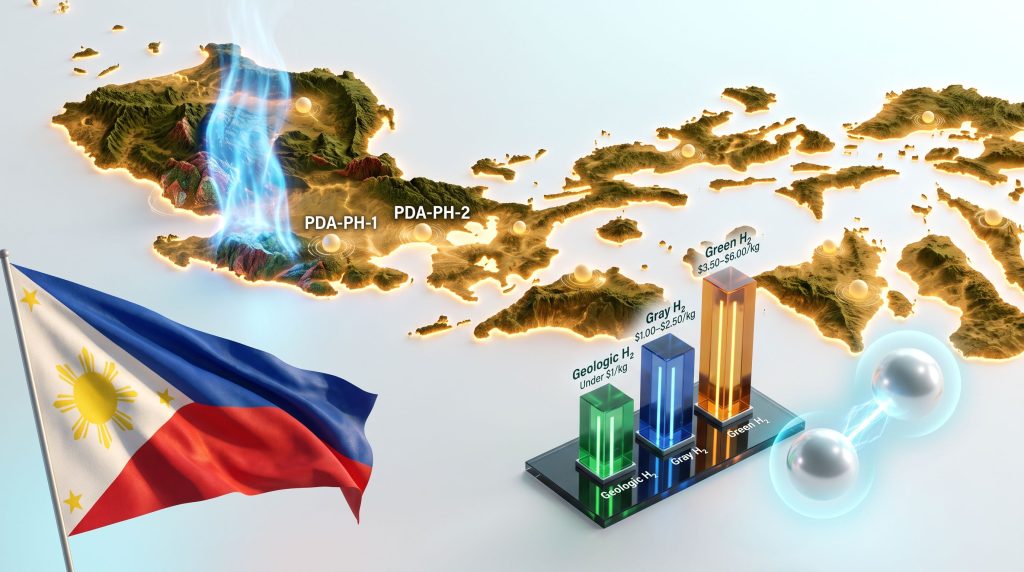
Green hydrogen, produced by splitting water molecules using renewable electricity, carries a production cost of roughly $3.50 to $6.00 per kilogram depending on the electricity source, electrolyser efficiency, and location. Gray hydrogen, made by reforming natural gas through a process called steam methane reforming, costs approximately $1.00 to $2.50 per kilogram but generates significant carbon dioxide emissions as a byproduct.
The economics of green hydrogen contain a structural paradox that is rarely discussed outside specialist circles: when renewable energy is used to manufacture hydrogen rather than being fed directly into the electricity grid, the effective carbon abatement per unit of energy spent is frequently inferior to simply using that renewable electricity as a grid substitute. In other words, building a wind farm to power an electrolyser can produce worse climate outcomes than using that same wind farm to displace coal-fired power generation, depending on the grid context.
This is the clean energy paradox at the heart of hydrogen policy, and it explains why the green hydrogen hype cycle of the early 2020s has largely deflated. Projects have stalled, offtake agreements have collapsed, and cost reductions have been slower than anticipated. Furthermore, the energy transition demand for hydrogen continues to grow even as the economics remain challenging.
How a Third Pathway Is Rewriting the Economics
Geologic hydrogen, also called natural or native hydrogen, bypasses both problems entirely. Rather than manufacturing hydrogen through an industrial process, it involves extracting molecular hydrogen that already exists underground, produced by naturally occurring chemical reactions over geological timescales. The U.S. Department of Energy has projected that geologic hydrogen could potentially be extracted for under $1 per kilogram, a figure that, if proven at commercial scale, would structurally undercut both green and gray hydrogen and fundamentally reshape the entire hydrogen value chain.
What is geologic hydrogen?
Geologic hydrogen is molecular hydrogen (H₂) generated through naturally occurring subsurface chemical reactions, most commonly serpentinization, in which iron and magnesium-rich ultramafic rocks interact with water at depth. Unlike green or gray hydrogen, no industrial production process is required, making it inherently low-cost if large accumulations can be confirmed and sustainably extracted.
When big ASX news breaks, our subscribers know first
Understanding the Geology: How the Earth Manufactures Hydrogen
The core reaction underpinning geologic hydrogen is called serpentinization. When water percolates down into the Earth's crust and contacts iron-rich ultramafic rocks, primarily olivine and pyroxene, a slow exothermic reaction occurs. The iron in these minerals oxidises, and in doing so, releases molecular hydrogen as a byproduct. The reaction happens continuously, producing hydrogen over millions of years in regions where the right rock types and water supply coexist.
The geological structures most associated with high serpentinization potential are ophiolites, sections of ancient oceanic crust that have been thrust onto continental landmasses through tectonic collisions. Ophiolite belts are essentially fossilised ocean floors, and they are dense in the ultramafic rock types that drive hydrogen-generating reactions.
What makes surface seeps so important to exploration scientists is that they function as natural indicators of subsurface activity. When hydrogen migrates upward through fractures in the rock and escapes at the surface, it provides measurable evidence that the underlying geology is actively producing the gas. High seep flux rates suggest either a large source volume, a highly permeable migration pathway, or both, each of which is potentially significant for commercial exploration. The white hydrogen discovery in France has similarly demonstrated how surface indicators can point to significant subsurface potential.
Why the Philippines Geologic Hydrogen Hub Case Is Scientifically Compelling
Few nations on Earth can match the Philippines in terms of the structural criteria required for significant geologic hydrogen prospectivity. The archipelago sits along one of the most tectonically active zones in the world, and the result is an abundance of ophiolite sequences distributed across its major island groups.
The Zambales Ophiolite Complex and Nagsasa Seep
The Zambales Ophiolite Complex, located on the island of Luzon, is the most extensively studied of these formations and the one that has attracted the most international scientific and commercial attention. Within the Zambales complex, the Nagsasa seep has recorded a hydrogen flux rate of approximately 808 tonnes per year, placing it among the highest natural hydrogen seep measurements recorded anywhere on the planet. According to Hydrogen Insight, this seep activity suggests millions of tonnes could be trapped below ground. For context, this figure is not a reserve estimate or a production projection: it is a surface measurement of how much hydrogen is currently escaping to the atmosphere, used by scientists as a proxy indicator of what may exist at depth.
Credibility note: Surface seep flux rates are scientifically significant but do not confirm the existence of a commercially viable subsurface reservoir. The hydrogen measured at the surface may originate from a diffuse, dispersed source rather than a concentrated accumulation. Confirming the latter requires subsurface geological modelling and exploratory drilling.
Nine Ophiolite Belts Across the Archipelago
The Nagsasa seep is not an isolated anomaly. The Philippines hosts at least nine identified ophiolite belts distributed across its islands, from Luzon to Palawan and across the Visayas and Mindanao regions. This gives the country a national-scale geological footprint for hydrogen prospectivity that is exceptional compared to most nations at this stage of exploration.
| Prospective Area | Region | Key Geological Feature | Exploration Block |
|---|---|---|---|
| Zambales Ophiolite Complex | Luzon | Serpentinized ultramafic rocks | PDA-PH-1 |
| Pangasinan Zone | Luzon | Ophiolite-associated structures | PDA-PH-2 |
| Bulacan Belt | Luzon | Mapped ophiolite corridor | Under review |
| Aurora Corridor | Luzon | Emerging prospective zone | Under review |
| Palawan Ophiolite | Palawan | Ultramafic basement exposure | Under review |
| Mindanao Belts | Mindanao | Multiple ophiolite sequences | Under review |
| Leyte Zone | Visayas | Serpentinization indicators | Under review |
How the Philippines Compares to Global Natural Hydrogen Peers
Natural hydrogen exploration is genuinely nascent at a global scale. The only commercially producing natural hydrogen site anywhere in the world is the Bourakébougou field in Mali, which has been supplying a small local power system with hydrogen-fuelled electricity since around 2012, albeit at a very limited scale. Beyond Mali, meaningful exploration activity is concentrated in a small number of geologically favourable nations.
| Country | Key Site | Seep or Discovery Type | Commercial Status |
|---|---|---|---|
| Philippines | Nagsasa, Zambales | Surface seep and ophiolite belt | Exploration and early drilling |
| Mali | Bourakébougou | Subsurface accumulation | Limited local production |
| United States | Various basins | Subsurface mapping | Pre-commercial |
| Australia | Yorke Peninsula | Surface seep | Early exploration |
| Oman | Samail Ophiolite | Serpentinization | Research phase |
What distinguishes the Philippines structurally from most of these peers is the combination of scale, seep activity, and geological diversity. Oman's Samail Ophiolite is one of the world's largest and most studied ophiolite complexes, but Oman's exploration is primarily in research mode. Australia's Yorke Peninsula seeps have attracted interest but lack the documented flux data of Nagsasa. The Philippines currently represents the only location where a leading commercial exploration firm has confirmed bringing hydrogen of greater than 90% purity to the surface in test conditions.
The Role of the Philippine Department of Energy
The Philippine Department of Energy (DOE) has responded to the geological potential by establishing a formal exploration framework. At least two predetermined exploration areas have been officially designated:
- PDA-PH-1, covering the Zambales Ophiolite Complex
- PDA-PH-2, covering the Pangasinan Zone
Commercial bidding rounds have been initiated for both blocks, signalling that the regulatory architecture for geologic hydrogen exploration is already operational rather than merely proposed. This is an important distinction: in most countries with equivalent geology, natural hydrogen remains in an informal or experimental regulatory category with no pathway to commercial licensing.
However, the Philippines still faces meaningful legislative gaps. Existing petroleum and energy legislation was not designed with natural hydrogen in mind, and a coherent legal framework covering ownership rights, royalties, safety standards for hydrogen extraction, and pipeline infrastructure will need to be developed before commercial-scale activity can advance. The speed at which this legislative work progresses will be one of the key determinants of how quickly exploration converts to production.
The Economic Case: Why Energy Import Dependency Makes Domestic Hydrogen Attractive
The Philippines is among Southeast Asia's fastest-expanding economies. This growth trajectory has a significant energy implication: incremental power generation capacity in large parts of the country continues to rely on imported diesel and, increasingly, liquefied natural gas (LNG), two of the most price-volatile fuel categories in global commodity markets.
The current LNG supply outlook and Strait of Hormuz disruptions have driven up LNG spot prices across Asian markets, making this dependency more expensive and more strategically precarious simultaneously. A domestic, low-cost hydrogen source would directly address both dimensions of the problem.
The economic arithmetic is straightforward in principle:
- Diesel and LNG represent ongoing foreign exchange outflows at volatile commodity prices
- Geologic hydrogen, if commercially extractable at sub-$1/kg costs, would be price-stable and domestically sourced
- Substituting even a fraction of imported fuel demand with local geologic hydrogen would structurally reduce the country's energy import bill
- Lower industrial energy costs would enhance manufacturing competitiveness, supporting broader GDP growth objectives
Economic context: The Philippines' energy import dependency is not a marginal problem. In island communities and remote provinces, diesel-fired generation can account for the majority of electricity supply, with fuel costs directly embedded in consumer electricity tariffs. A cheaper domestic energy source would have immediate and broad distributional benefits.
Beyond domestic displacement, a commercially successful Philippines operation would signal to global capital markets that geologic hydrogen is bankable, potentially attracting significant foreign direct investment into the country's energy infrastructure sector.
The next major ASX story will hit our subscribers first
The Technology Readiness Gap: What Science Must Still Prove
The distance between a promising geological observation and a commercially viable production operation is considerable, and the natural hydrogen sector is currently somewhere in the early middle of that journey. The development pathway involves multiple sequential stages, each carrying its own technical and financial risk.
Step-by-Step: The Geologic Hydrogen Development Pathway
- Surface seep identification – Mapping and measuring hydrogen flux at known geological features to prioritise exploration targets
- Subsurface geological modelling – Integrating seismic surveys, geochemical sampling, and structural mapping to infer reservoir geometry
- Exploratory drilling – Testing subsurface accumulations to confirm hydrogen presence, purity, and pressure
- Flow testing and reservoir characterisation – Measuring sustainable extraction rates and understanding the reservoir's replenishment dynamics
- Pilot production – Small-scale extraction to validate surface handling infrastructure and confirm economic viability at modest throughput
- Commercial scale-up – Full field development, contingent on proven reserves and contracted offtake
One aspect of geologic hydrogen that is not widely understood outside specialist geology circles is the question of reservoir replenishment. Unlike conventional oil and gas, where a fixed volume of hydrocarbons sits in a trap, natural hydrogen may be continuously generated by ongoing serpentinization reactions. If extraction rates can be calibrated to match generation rates, the resource could theoretically behave more like a renewable than a depletable reserve. This possibility, while not yet demonstrated at commercial scale, is one of the more intellectually compelling aspects of the geologic hydrogen thesis.
Industry caution: Even where high-purity hydrogen has been confirmed at surface in test conditions, confirming a commercially viable, large-scale accumulation requires years of additional subsurface characterisation. The gap between encouraging geology and bankable reserves remains the sector's defining challenge, and investors should treat current exploration results as indicative rather than conclusive.
Who Is Investing and What Are They Betting On
The leading commercial actor in Philippines geologic hydrogen exploration is Koloma, a Colorado-based natural hydrogen startup that has attracted backing from prominent technology and climate investors including Bill Gates and Amazon's climate fund. Koloma has publicly identified the Philippines as its primary international exploration focus, citing the Nagsasa seep measurements and the Zambales ophiolite geology as evidence of potentially large subsurface accumulations.
The firm has confirmed that it has brought hydrogen of greater than 90% purity to the surface under test conditions and has conducted subsurface verification work, but has not declared a commercial discovery. This distinction matters enormously for investors: a test result demonstrating high-purity hydrogen at surface confirms the geological mechanism is active but says nothing definitive about the scale, recoverability, or economics of what lies beneath.
The resource investment outlook for geologic hydrogen is compelling, however the investment thesis at this stage of the technology curve essentially involves betting on three compounding uncertainties:
- Geological risk: Whether large accumulations actually exist beneath the identified seeps
- Technical risk: Whether extraction engineering can be developed to produce hydrogen at cost and scale
- Regulatory and infrastructure risk: Whether the Philippines' policy and physical infrastructure can support commercial operations within a viable timeframe
Koloma's leadership has been deliberately measured in its public communications, emphasising the importance of methodical scientific work over rapid drilling campaigns. The firm's publicly stated position is that rushing subsurface work before the science is understood would be harmful not just to its own commercial interests but to the credibility of the natural hydrogen sector as a whole.
The Geopolitical Timing: How the Hormuz Crisis Is Reshaping Hydrogen Interest
The resurgence of interest in clean hydrogen is not happening in a geopolitical vacuum. Disruption to tanker traffic through the Strait of Hormuz, one of the world's most critical energy chokepoints, has simultaneously increased LNG import costs across Asia and renewed policymaker anxiety about supply chain concentration. China, the European Union, and the United States have each announced measures to reinvigorate hydrogen research and development in recent months, driven by energy security logic as much as climate motivation.
The Philippines occupies a strategically interesting position in this context. As a nation outside the major geopolitical blocs, it represents a potentially neutral supplier of clean energy to multiple competing markets. Consequently, shifting global energy trade flows mean an export-grade geologic hydrogen capability, while years away from realisation, would position the country differently within Asian energy markets than its current posture as a net energy importer.
Scenario Projections: What Does 2035 Look Like?
The range of outcomes for Philippines geologic hydrogen over the next decade spans an enormous spectrum, from global disruption to scientific case study.
| Scenario | Trigger Conditions | Likely Outcome | Global Impact |
|---|---|---|---|
| A – Full Hub Development | Large subsurface reserves confirmed, strong DOE framework, rapid infrastructure build | Export-grade hydrogen production, LNG displacement in domestic power | Significant disruption to Asian hydrogen and LNG trade flows |
| B – Domestic Deployment | Moderate reserves confirmed, limited export scale | Diesel and LNG substitution in Philippine power generation | Material reduction in national energy import costs |
| C – Exploration Stalls | Seeps not connected to large accumulations, legislative delays | Scientific learnings, no commercial production | Minimal near-term market impact, valuable geological dataset |
The probability weighting across these scenarios is genuinely difficult to assess at this stage of exploration. Scenario B, a moderate domestic outcome, may well represent the most likely near-term trajectory, with Scenario A remaining a longer-horizon possibility contingent on multiple technical and regulatory developments aligning.
Frequently Asked Questions: Philippines Geologic Hydrogen
What is a geologic hydrogen hub?
A geologic hydrogen hub is a region where naturally occurring subsurface hydrogen is extracted, processed, and distributed at sufficient scale to supply industrial, power generation, or export demand, analogous to how conventional oil and gas producing regions function within energy trade networks.
Why does the Philippines have so much natural hydrogen?
The Philippines sits on one of the world's most tectonically active margins, producing an abundance of ultramafic ophiolite rock sequences that are the primary geological driver of serpentinization and natural hydrogen generation. According to the British Geological Survey, UK and Philippines scientists are now investigating these natural hydrogen generation processes at the atomic scale, further validating the country's extraordinary geological credentials.
How does geologic hydrogen compare in cost to green and gray hydrogen?
The U.S. Department of Energy estimates geologic hydrogen could be produced for under $1/kg, compared to $3.50 to $6.00/kg for green hydrogen and $1.00 to $2.50/kg for gray hydrogen.
When could the Philippines begin commercially producing geologic hydrogen?
Based on current exploration timelines, confirming the scale of subsurface accumulations alone is expected to take several years. Commercial production, if the geology supports it, is unlikely before the early-to-mid 2030s at the earliest.
What is the Nagsasa seep and why is it significant?
The Nagsasa seep in Zambales Province records a hydrogen surface flux of approximately 808 tonnes per year, making it one of the highest natural hydrogen seep measurements documented anywhere globally, and a primary reason the Philippines geologic hydrogen hub has attracted leading commercial exploration interest.
Key Metrics at a Glance
| Metric | Detail |
|---|---|
| Nagsasa seep hydrogen flux | ~808 tonnes per year |
| Identified ophiolite belts | 9 across the Philippines archipelago |
| Designated exploration blocks | PDA-PH-1 (Zambales), PDA-PH-2 (Pangasinan) |
| Projected geologic hydrogen cost | Under $1/kg (U.S. DOE estimate) |
| Green hydrogen cost benchmark | $3.50 to $6.00/kg |
| Gray hydrogen cost benchmark | $1.00 to $2.50/kg |
| Confirmed surface purity (test conditions) | 90%+ hydrogen gas |
| Current commercial status | Exploration and early drilling phase |
| Primary geological mechanism | Serpentinization within ophiolite complexes |
The Bottom Line: Extraordinary Geology, Unresolved Science
The Philippines geologic hydrogen hub thesis rests on a foundation that is geologically credible, economically logical, and commercially nascent. The Nagsasa seep measurements are among the most significant of their kind recorded anywhere on Earth. The country's nine ophiolite belts represent a national-scale resource footprint without obvious parallel in the region. The Philippine DOE has moved faster than most governments in establishing a formal exploration licensing framework.
What the Philippines does not yet have is a confirmed commercial discovery. The distinction between a high-flux surface seep and a bankable subsurface reserve is the central question that years of additional geological work must answer. The engineering required to extract, purify, and distribute geologic hydrogen at industrial scale has not yet been demonstrated anywhere in the world at meaningful volume.
For energy investors and policymakers, the Philippines case deserves serious, sustained attention. The geological lottery ticket is real, and the odds are better than most. However, the draw is still years away, and the winning conditions — confirmed accumulations, proven extraction technology, and a mature regulatory framework — must all align before the country's extraordinary subsurface geology translates into an extraordinary energy future.
This article is intended for informational and educational purposes only and does not constitute financial, investment, or legal advice. Exploration-stage geological findings carry substantial uncertainty and should not be interpreted as confirmed resource estimates or production forecasts.
Want to Spot the Next Major Resource Discovery Before the Market Does?
Discovery Alert's proprietary Discovery IQ model scans ASX announcements in real time, instantly identifying significant mineral discoveries across more than 30 commodities — from critical minerals powering the energy transition to emerging natural resource plays like geologic hydrogen. Explore how historic discoveries have generated extraordinary returns and begin your 14-day free trial today to position yourself ahead of the broader market.