August 5, 2026
When the Ground Beneath You Changes: Seismic Risk and the Limits of Deep Mining Knowledge
Underground mining has always operated at the frontier of what geoscience can reliably predict. As extraction pushes deeper into the earth's crust, the stress regimes encountered become increasingly complex, and the assumption that historical seismic patterns will persist becomes progressively less defensible. The deeper a mine goes, the more it disturbs rock masses that have been in equilibrium for millions of years, and the consequences of misreading that disturbance can be catastrophic.
It is within this technical reality that Codelco suspends Andes Norte development amid seismic risk concerns, and this decision must be understood not simply as a news event but as a case study in how the world's largest copper producer navigates the boundary between operational ambition and geomechanical uncertainty — and what that boundary means for the long-term copper supply outlook.
When big ASX news breaks, our subscribers know first
What Is Andes Norte and Where Does It Sit Within El Teniente?
El Teniente, located in Chile's O'Higgins Region approximately 80 kilometres south of Santiago, is widely recognised as the world's largest known underground copper mine. It has been in continuous operation for over a century and sits within a porphyry copper deposit of extraordinary scale, estimated to contain one of the largest undeveloped copper ore bodies in the Southern Hemisphere.
Andes Norte is a development project within the El Teniente division, intended to extend the mine's productive life by accessing deeper ore zones through continued application of the panel caving technique. Panel caving is a large-scale, low-cost underground mining method in which ore is undercut and allowed to collapse under gravity into a series of extraction drawpoints below. It is the method of choice for massive, low-grade deposits where selective mining would be uneconomical.
El Teniente is one of seven operational mining divisions within Codelco's portfolio, alongside Andina, Chuquicamata, Gabriela Mistral, Ministro Hales, Radomiro Tomic, and Salvador, plus the Ventanas Refinery. Together, these assets underpin Codelco's top copper producer status, accounting for roughly 10% of global copper output in recent years.
Codelco's Seven Mining Divisions: Operational Overview
| Division | Primary Commodity | Location |
|---|---|---|
| El Teniente | Copper | O'Higgins Region, Chile |
| Andina | Copper | Valparaíso Region, Chile |
| Chuquicamata | Copper | Antofagasta Region, Chile |
| Gabriela Mistral | Copper | Antofagasta Region, Chile |
| Ministro Hales | Copper | Antofagasta Region, Chile |
| Radomiro Tomic | Copper | Antofagasta Region, Chile |
| Salvador | Copper | Atacama Region, Chile |
Deep Seismicity in Panel Caving Operations: A Technical Primer
Why Deep Seismicity Is Fundamentally Different From Shallow Mining Tremors
Most people are familiar with the concept of mining-induced seismicity in a general sense, but the mechanics of deep seismic activity in block and panel caving environments are substantially more complex than shallow surface tremors. At depth, seismic events are driven by stress redistribution rather than simple vibration from blasting or mechanical equipment.
As a panel cave progresses, it removes the load-bearing capacity of the rock mass above and around the cave. This triggers a process called stress arching, where compressive forces redistribute around the perimeter of the void. Over time, this creates highly stressed regions in the surrounding rock that can fail suddenly if the stress magnitude exceeds the rock mass strength. These failures release seismic energy in ways that differ significantly from shallower events:
- They tend to involve larger rock volumes and higher energy magnitudes
- Their source mechanisms are more likely to involve fault reactivation rather than simple rock fracture
- The seismic waves they generate attenuate differently through the rock column, making surface monitoring less effective
- They are harder to predict using standard seismic hazard models calibrated to shallower conditions
- Novel focal depths indicate that the cave geometry is interacting with geological structures not captured in the existing mine model
The Geomechanical Conditions That Make El Teniente Susceptible
El Teniente is geologically situated within a region of high in-situ stress due to the compressional tectonic setting of the Andes mountain range. The Nazca Plate subducting beneath the South American Plate generates a persistent horizontal stress field that is already elevated before any mining occurs. Furthermore, when panel caving removes rock mass at depth, this pre-existing tectonic stress is liberated and redirected, creating conditions that are inherently more seismically active than mines in cratonic or extensional tectonic settings.
"The combination of high natural tectonic stress and progressive cave propagation creates a feedback loop in which the advancing cave front continuously re-energises adjacent rock masses, making seismic characterisation an ongoing rather than one-time engineering challenge."
Historically, El Teniente has managed seismicity connected to both mining operations and infrastructure construction through established protocols. However, the identification of seismic phenomena at greater depths than previously monitored suggests that the current cave geometry has either intersected a previously unknown fault structure or induced stress changes at a depth horizon that falls outside the resolution of the existing instrumentation network.
Why Codelco Suspended Andes Norte: Unpacking the Engineering Decision
Six Months of Data Collection and What It Likely Revealed
The suspension of Andes Norte followed an intensive six-month seismic monitoring programme. This type of programme typically involves deploying a dense network of triaxial accelerometers and geophones at multiple depth horizons, with continuous waveform data transmitted in real time to surface processing centres where automated algorithms flag anomalous events for further human review.
"A six-month monitoring window in a deep underground environment is often sufficient to characterise baseline seismic behaviour but may simultaneously reveal previously unseen source zones if the cave front is actively advancing during that period. The fact that new phenomena were detected at greater depth is a significant finding, suggesting the cave may be interacting with a deeper geological structure than the mine model anticipated."
The key distinction in Codelco's announcement is that the seismic signals observed differ from the historical patterns managed at El Teniente. This is critical. A seismic event that fits an established pattern can be managed within existing protocols. However, a seismic signature that does not fit any prior model represents an unknown risk, and engineering practice is clear that unknown risks require investigation before work continues.
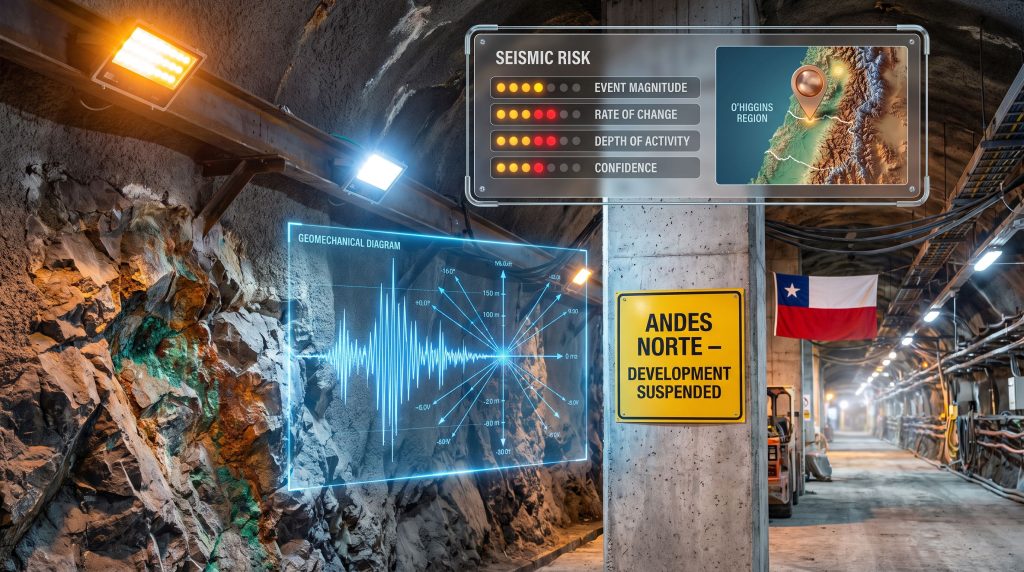
Trigger Conditions for Operational Suspension in Underground Mining (Illustrative Framework)
| Risk Indicator | Acceptable Threshold | Elevated Concern | Suspension Trigger |
|---|---|---|---|
| Seismic event magnitude | < 2.0 ML | 2.0–3.5 ML | > 3.5 ML or novel focal depth |
| Rate of seismicity change | Stable baseline | 20–50% increase | > 50% increase or new source zone |
| Depth of activity | Known mining horizon | Transitional zone | Below known geological model |
| Instrumentation confidence | Full network coverage | Partial gaps | Insufficient resolution at depth |
The July 2025 El Teniente Fatalities and Their Influence on Risk Governance
Context matters enormously in understanding why Codelco moved decisively on this issue. In July 2025, a seismic event measuring 4.2 on the Richter scale triggered a structural collapse at El Teniente that resulted in the deaths of six workers. This incident represented one of the most serious safety failures in Chilean copper mining in recent memory.
Events of this severity rarely occur in isolation from their institutional aftermath. The loss of six lives in a seismic-triggered collapse would almost certainly have prompted a comprehensive internal review of seismic risk governance across all El Teniente sub-projects, including Andes Norte. Consequently, risk tolerance thresholds that might previously have allowed work to continue pending further study would logically be recalibrated in the wake of such a tragedy.
"Mining fatalities in seismically active underground environments carry a particular institutional weight because they are often preventable in retrospect. The gap between what the monitoring system detected and what the event required in terms of response tends to drive significant protocol changes across the affected organisation."
It is within this safety context that a precautionary full suspension, rather than a partial work restriction, becomes the rational engineering and governance response.
Codelco's Seismic Monitoring Infrastructure: What Upgrades Are Now Required
Core Components of a Mine-Scale Seismic Monitoring System
Modern underground seismic monitoring at the scale of El Teniente is a sophisticated geophysical operation. The core instrumentation components typically include:
- Triaxial accelerometers for near-field ground motion recording, capable of capturing the full three-dimensional particle motion of seismic waves
- Geophones deployed at multiple depth horizons, enabling source location algorithms to triangulate the origin of seismic events in three dimensions
- Real-time waveform transmission to surface processing centres, where automated detection and classification algorithms operate continuously
- Automated alert thresholds linked to predefined operational exclusion zones, triggering immediate evacuation or work suspension when magnitude thresholds are breached
- Periodic geomechanical model updates that integrate new seismic data to refine the understanding of how stress is distributed around the cave
The challenge with deep seismic phenomena is that standard surface-focused networks are often insufficiently sensitive at greater depths. Addressing seismic activity below previously monitored horizons requires enhanced instrumentation deployed at deeper borehole locations, combined with more sophisticated source mechanism analysis to distinguish between fault reactivation and other failure modes.
Codelco has indicated that enhanced monitoring, strengthened instrumentation, and ongoing technical analysis are required before construction can resume. This points to a monitoring upgrade programme rather than a simple data review, which suggests the current network lacks adequate resolution at the depths where the new phenomena have been detected.
Operational Continuity and Production Implications
Which Parts of El Teniente Continue Operating?
An important operational distinction in the Andes Norte suspension is that it applies specifically to development and construction activities at the Andes Norte sub-project. Broader production operations across the El Teniente division continue, with the company's seismic monitoring systems, safety protocols, and preventive measures remaining active across all producing areas.
This distinction matters for understanding the near-term copper output implications. Andes Norte is a development project, meaning it is in the process of being built out to enable future production. Its suspension does not immediately curtail copper flowing from existing El Teniente production panels. However, concerns around the Codelco production decline trajectory make this development pause particularly significant to monitor.
The Long-Term Development Schedule Risk
The more significant concern is the compounding timeline risk. Deep underground mining projects of the scale and complexity of Andes Norte typically operate on multi-year development horizons, where each phase of work builds sequentially on the one before. A suspension of even six to twelve months, extended by the time required to complete enhanced monitoring studies and instrumentation upgrades, can shift the entire project schedule materially.
"With no publicly confirmed timeline for resuming construction, investors and analysts assessing Codelco's medium-term production growth trajectory should factor in the possibility that Andes Norte's contribution to future copper output could be delayed by a period that is currently impossible to define with precision. This uncertainty is itself a meaningful variable in any copper supply model that relies on Codelco's development pipeline."
Codelco's broader structural modernisation programme across its seven divisions has already faced scrutiny over cost escalation and timeline slippage. In addition, the Andes Norte suspension introduces an additional variable of unpredictable duration, and the capital allocation implications of a prolonged development halt could influence how the company prioritises resources across its portfolio.
The next major ASX story will hit our subscribers first
Global Benchmarks: Seismic Risk Governance at Deep Block Cave Mines
El Teniente is not unique in confronting this challenge. Several of the world's most productive deep underground copper mines operate in seismically complex environments, and the industry has developed sophisticated governance frameworks for managing this risk. For instance, mines such as Palabora in South Africa and several operations in the Canadian Shield have faced comparable challenges with deep induced seismicity during cave propagation.
What distinguishes world-class operations from those that experience serious incidents is typically the comprehensiveness of the monitoring architecture, the speed with which anomalous data triggers a governance response, and the quality of the geomechanical model underpinning the operational decisions.
Chile's regulatory framework for underground mine safety requires compliance with Decreto Supremo 132, the Reglamento de Seguridad Minera, which sets baseline requirements for seismic monitoring and emergency response in underground operations. However, regulatory minimums are rarely sufficient for operations as geomechanically complex as El Teniente, and leading operators typically exceed statutory requirements by a substantial margin.
The precautionary nature of Codelco's decision to halt Andes Norte development entirely, rather than implementing modified working procedures or exclusion zones, signals that the company is treating this as a Category 1 unknown risk requiring full geomechanical characterisation before any further disturbance of the affected rock mass. This approach also has direct implications for the Chile copper market outlook as project timelines remain uncertain.
Frequently Asked Questions: Codelco Andes Norte Seismic Suspension
What is the Andes Norte project at El Teniente?
Andes Norte is a development project within Codelco's El Teniente mining division, designed to extend the mine's operational life by accessing deeper ore zones through panel caving techniques.
Why did Codelco suspend development at Andes Norte?
Six months of seismic monitoring data identified new seismic phenomena at depths greater than those previously managed under existing protocols. The technical findings recommended further investigation before construction activities resume.
Was the suspension connected to the 2025 El Teniente fatalities?
Codelco has not formally linked the two events. However, the July 2025 fatal collapse triggered by a 4.2-magnitude seismic event almost certainly influenced the organisation's risk tolerance and governance response to any new seismic anomalies at El Teniente sub-projects.
How long will the Andes Norte suspension last?
No confirmed timeline for resumption has been publicly announced. The duration will depend on the findings of enhanced technical analysis and the outcomes of the instrumentation upgrade programme.
Are copper production operations at El Teniente continuing during the suspension?
Yes. The suspension applies specifically to development and construction works at Andes Norte. Existing production areas within El Teniente continue to operate under established safety and monitoring protocols.
What monitoring upgrades is Codelco implementing?
The company has indicated that enhanced monitoring, strengthened instrumentation, and deeper technical analysis are required. This points to new borehole-based sensor deployments and more advanced seismic source mechanism studies to characterise the deep phenomena identified.
How does deep seismicity differ from standard mining-induced seismic activity?
Deep seismicity in panel caving environments is driven by stress redistribution and potential fault reactivation at greater depth, rather than surface-proximal vibration. These events are harder to predict, generate different wave propagation characteristics, and require purpose-built deep instrumentation networks to detect reliably.
Key Takeaways: What This Decision Reveals About Modern Underground Mining Risk
The fact that Codelco suspends Andes Norte development amid seismic risk concerns represents a mature institutional response to geomechanical uncertainty at depth. Furthermore, several lessons emerge for the broader mining industry:
- Precautionary governance is not operationally optional in seismically active deep mines. When monitoring data reveals phenomena that fall outside the validated geological model, the appropriate response is investigation, not continuation under modified protocols.
- Six months of seismic data can be sufficient to justify a full development halt if the signal quality and source characteristics indicate a previously uncharacterised risk at depth. This is a meaningful precedent for how monitoring programmes should be scoped and interpreted.
- The relationship between fatal incidents and subsequent risk calibration is non-linear. Organisations that experience serious seismic events recalibrate their entire risk framework, not just the specific area where the incident occurred.
- Deep mining projects carry inherent schedule uncertainty that conventional capital allocation models often underestimate. The compounding effect of monitoring, analysis, instrumentation upgrade, and re-approval cycles means that even a well-managed suspension can translate into years of schedule delay.
For a global copper market already navigating supply constraints from grade decline, ageing infrastructure, and permitting complexity, Chile's copper supply gap makes the temporary loss of Andes Norte development momentum particularly consequential. Consequently, this situation is a reminder that the path from ore body to copper cathode is rarely as linear as project schedules suggest.
In this context, it is worth noting that major copper development projects elsewhere in the world face their own complex challenges, underscoring just how difficult it is to bring new copper supply online reliably and on schedule. The global copper supply challenge is one that analysts continue to scrutinise as demand projections for the energy transition remain robust.
Disclaimer: This article is intended for informational purposes only and does not constitute financial advice. Forecasts and projections referenced within represent analytical perspectives and are subject to material uncertainty. Readers should conduct independent research before making investment decisions.
Want to Know When the Next Major Copper Discovery Hits the ASX?
Discovery Alert's proprietary Discovery IQ model scans ASX announcements in real time, instantly identifying significant mineral discoveries — including copper — and delivering actionable alerts before the broader market has a chance to react. Explore historic discovery returns on Discovery Alert's dedicated discoveries page and begin your 14-day free trial to position yourself ahead of the next major find.