August 4, 2026
Why Orebody Complexity Is Rewriting the Rules of Mineral Intelligence
The global mining industry is entering a period of structural reckoning. Ore grades across major commodities have been declining for decades, with copper head grades at many large-scale operations falling by more than 25% over the past two decades according to data tracked by the International Council on Mining and Metals. Meanwhile, the mineralogy of what remains is increasingly complex, heterogeneous, and difficult to process using conventional frameworks. In this environment, the competitive advantage no longer belongs exclusively to the company with the largest deposit. It belongs to the one that understands its orebody most completely.
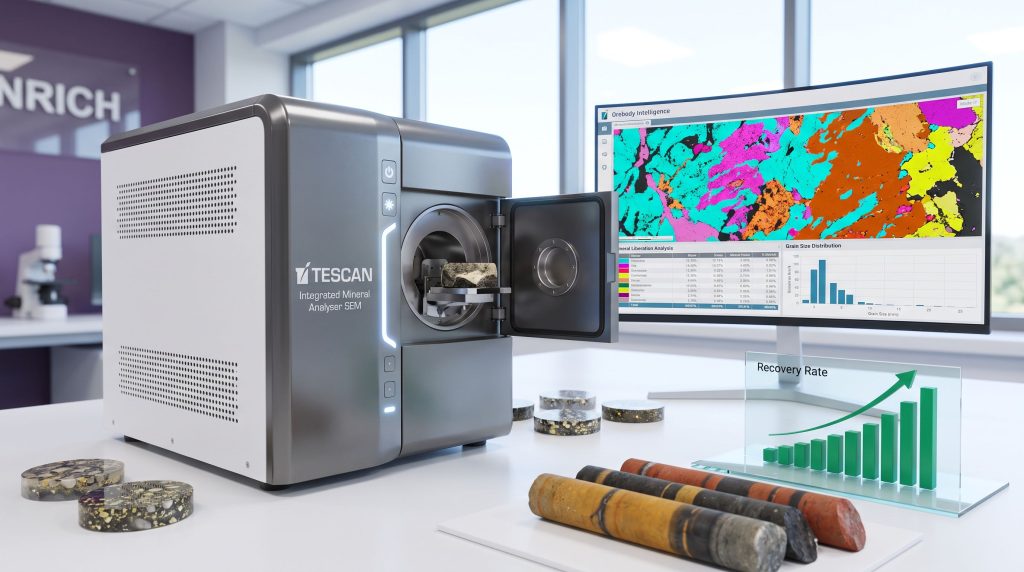
This shift is elevating a discipline that has long operated in the background of mining operations: geometallurgy. And at the University of Queensland, the TESCAN Integrated Mineral Analyser at UQ is helping researchers push the boundaries of what orebody knowledge can actually achieve in practice.
When big ASX news breaks, our subscribers know first
Geometallurgy and the Data Integration Challenge
The Hidden Cost of Fragmented Geological Information
Every mine generates an extraordinary volume of geological data across its operational life. From early-stage diamond drilling and geochemical sampling through to resource estimation, grade control, and plant performance monitoring, the information accumulates continuously. Yet a persistent structural problem within the industry is that this data rarely flows seamlessly between the teams and decision-making frameworks that need it most.
The consequences of this fragmentation are not trivial. Processing engineers may design circuits based on average ore characterisation rather than the full distribution of mineralogical variability across an orebody. Grade control geologists may lack the quantitative mineralogical context needed to interpret assay anomalies. Furthermore, mine planners may sequence ore extraction in ways that inadvertently create processing challenges downstream.
The problem is not a shortage of data. It is the absence of integrated systems and validated methodologies capable of converting that data into actionable intelligence for diverse stakeholders operating under different time pressures and decision frameworks. 3D geological modelling has become an increasingly important tool for addressing this challenge, yet it remains only one piece of the puzzle.
What Geometallurgy Actually Does
Geometallurgy is the applied science of linking geological and mineralogical characteristics of an orebody directly to its expected behaviour in processing. At its most fundamental level, it attempts to answer a deceptively simple question: given what we know about how this ore looks under the microscope, how will it perform in the processing plant?
The discipline draws on several interconnected analytical pillars:
- Mineralogical characterisation to identify which minerals are present, in what proportions, and at what grain sizes
- Liberation analysis to determine the degree to which target minerals can be physically separated from gangue material during comminution
- Mineral association mapping to understand which penalty elements co-occur with valuable minerals and how they are distributed spatially
- Geometallurgical test work to measure how ore samples of different mineralogical character respond to grinding, flotation, leaching, or other processing methods
When these datasets are properly integrated, the result is a predictive model of orebody processing behaviour that can be used to optimise mine scheduling, blending strategies, and plant operating parameters. The challenge, however, is that achieving this level of integration requires analytical platforms capable of generating high-quality, statistically robust mineralogical data at scale.
What the TESCAN Integrated Mineral Analyser at UQ Brings to Research
A Technical Profile of Automated Mineralogy SEM Technology
The TESCAN TIMA platform represents one of the most capable automated mineralogy systems currently available. Built on scanning electron microscope technology, TIMA combines backscattered electron imaging with energy-dispersive X-ray spectroscopy to identify and quantify mineral phases automatically across polished sample sections. Unlike manual petrographic analysis, which is operator-dependent and statistically limited to a few hundred points per sample, TIMA can analyse thousands of mineral grains per section within hours.
The core measurement parameters and their downstream applications in mining are summarised below:
| Measurement Parameter | What It Measures | Application in Mining |
|---|---|---|
| Mineral composition | Phase identification and abundance | Ore grade estimation, processing circuit design |
| Grain size distribution | Size frequency of mineral grains | Comminution optimisation, target grind size selection |
| Mineral liberation analysis | % of target mineral exposed at grain boundaries | Flotation efficiency, separation circuit performance |
| Mineral association mapping | Which minerals are spatially adjacent | Penalty element distribution, deleterious element management |
| Textural classification | Ore fabric and micro-structural patterns | Hardness variability modelling, SAG mill performance prediction |
One aspect of TIMA that is less commonly understood outside specialist circles is its ability to resolve fine-grained mineral textures that are practically invisible under optical microscopy. For deposits containing minerals with grain sizes below 10 to 20 microns, such as fine-grained gold in refractory ores or lithium phosphate minerals in complex pegmatites, SEM-based automated mineralogy is not just superior to optical methods. In many cases it is the only practical route to reliable quantitative characterisation.
Why University-Based Access Changes the Research Equation
Automated mineralogy systems have been deployed in operational mining laboratories and commercial testing facilities for more than two decades. The technology is not new. What is genuinely different about the TESCAN Integrated Mineral Analyser at UQ is the institutional context in which it operates.
In an operational environment, every hour of instrument time carries an implicit cost tied to production decision timelines. Samples move through the queue based on operational urgency, and the analytical protocols used are typically standardised for speed and consistency rather than optimised for methodological insight. There is rarely bandwidth to question whether the standard protocol is actually the best approach, or whether a different data collection strategy might reveal something more useful.
A university setting removes these constraints. Researchers can:
- Test alternative phase library configurations to evaluate their impact on mineral identification accuracy
- Investigate the statistical implications of different frame-count settings on liberation measurements
- Compare the information content of different analytical modes for specific ore types
- Develop and validate new data treatment procedures without the pressure of operational deadlines
- Explore cross-dataset integration frameworks that would be impractical to pursue within routine commercial workflows
This freedom to investigate methodology systematically, rather than simply applying established protocols, is precisely what enables university-based research to generate the kind of fundamental improvements that eventually reshape industry practice.
Dr Pia Lois-Morales and the Jim Askew Evolution Mining Fellowship
A Research Agenda Built at the Intersection of Industry and Academia
The research program underpinning the TESCAN Integrated Mineral Analyser at UQ is anchored by the Jim Askew Evolution Mining Fellowship at UQ's Sustainable Minerals Institute. The Fellowship was specifically designed to attract researchers with a rare combination of operational industry experience, consulting practice, and academic capability, recognising that meaningful progress on the data integration challenge requires someone who genuinely understands all three worlds.
Dr Pia Lois-Morales, a geologist specialising in geometallurgy, holds the inaugural Fellowship position. Her research centres on a question that sits at the heart of modern mining productivity: how can the geological information generated across different stages of the mining value chain be more effectively synthesised and applied by the full range of stakeholders who depend on it?
This is a more nuanced challenge than it might initially appear. The geologist conducting drill core logging during exploration, the resource geologist building a block model, the metallurgist designing a processing circuit, and the plant operator managing day-to-day throughput all consume geological information differently. Building systems and methodologies that genuinely serve all of these users requires a deep understanding of each perspective. Consequently, interpreting drill results in a way that is meaningful across all these roles remains one of the most persistent challenges in the industry.
Evolution Mining's Strategic Rationale for Sponsoring the Fellowship
Evolution Mining, the Fellowship's industry sponsor, operates a portfolio of long-life gold assets across Australia and Canada. The company's operations are characterised by geologically diverse orebodies with complex mineralogy, making the research agenda directly aligned with its long-term operational challenges.
Evolution Mining's General Manager of Long-Term Planning, Stean Barrie, has articulated the company's reasoning for sponsoring the Fellowship in terms of the value that cross-sector experience brings to difficult, long-horizon problems. Barrie's perspective is that operational environments, however sophisticated, rarely provide the conditions needed to explore the bigger structural questions that determine long-term performance. The Fellowship creates a dedicated space for exactly that kind of exploration.
The sponsorship also reflects a broader industry recognition that postdoctoral research partnerships represent one of the most cost-effective mechanisms for accessing deep technical expertise over sustained timeframes. Compared to the cost of developing equivalent internal capability, or commissioning commercial research programs, Fellowship sponsorship delivers disproportionate intellectual return.
Comparing Research Environments for Automated Mineralogy
How Deployment Context Shapes Analytical Outcomes
The value of any analytical platform is shaped as much by the environment in which it operates as by its technical specifications. The table below illustrates how the same TIMA technology generates fundamentally different knowledge outputs depending on its deployment context.
| Deployment Context | Primary Focus | Time Constraints | Methodological Exploration | Feedback to Industry |
|---|---|---|---|---|
| Operational Mining Lab | Production decisions | High | Limited | Minimal |
| Commercial Testing Lab | Client deliverables | Moderate | Low | Transactional |
| University Research Hub | Knowledge generation | Low | Extensive | Structured and systematic |
The critical distinction between the university context and others is the structured feedback mechanism. When methodological improvements are developed and validated in a research environment, they can be documented, peer-reviewed, and disseminated in a form that allows industry to adopt them systematically, rather than relying on informal knowledge transfer or operator experience.
What Industry Stands to Gain From Academic TIMA Research
The practical benefits that mining operations can expect to derive from TIMA-based research at UQ include:
- Refined measurement protocols that demonstrably improve data quality and reproducibility across different ore types
- New analytical workflows that reduce the time and cost of routine mineralogical characterisation without sacrificing statistical rigour
- Validated frameworks for integrating mineralogical datasets with drill core logging, geochemical assays, and process plant performance metrics
- Improved understanding of how measurement uncertainty in automated mineralogy propagates through to uncertainty in geometallurgical models
- Peer-reviewed methodologies that can form the basis for industry-wide standardisation
In addition, robust drill results interpretation frameworks developed through this research can meaningfully improve how the wider industry communicates mineralogical findings to diverse stakeholders.
Unlocking Unrealised Orebody Potential: The Broader Stakes
Why Complex Orebodies Are Both the Challenge and the Opportunity
One of the more underappreciated realities of the current mining landscape is that many of the world's remaining large, undeveloped deposits are complex. They contain mineralogy that responds poorly to simple processing routes, fine-grained textures that require finer grinding to achieve adequate liberation, or assemblages of target and penalty minerals that are physically intertwined at the grain scale.
For the critical minerals sector in particular, this complexity is the norm rather than the exception. Lithium-bearing pegmatites often contain multiple lithium mineral phases, including spodumene, lepidolite, and lithium phosphates, each of which responds differently to processing. Copper porphyry deposits increasingly contain significant proportions of secondary sulphide and oxide mineralogy alongside primary sulphides, requiring blended or sequential processing strategies.
Rare earth deposits frequently host target minerals in fine-grained intergrowths with gangue phases that are difficult to liberate without excessive energy input. In each of these cases, the quality of mineralogical characterisation is directly proportional to the quality of processing decisions, and ultimately the economic viability of the project.
Multi-Dataset Integration as the Next Frontier
Perhaps the most speculative but intellectually compelling dimension of the automated mineralogy research program at UQ is the potential to develop truly integrated orebody knowledge systems that fuse mineralogical data with every other relevant data stream generated across the mine life.
The concept involves connecting TIMA-derived grain-scale mineralogical data with:
- Hyperspectral core scanning data, which captures mineralogical information at the metre scale across entire drill core libraries
- Portable XRF and XRD data from exploration campaigns, enabling rapid field-scale screening to be calibrated against detailed laboratory analysis
- Geometallurgical test work results from flotation, leaching, and comminution tests conducted on characterised samples
- Process plant sensor data from operational facilities, enabling retrospective validation of predictive geometallurgical models against actual production performance
The technical barriers to achieving this integration are real. Data formats differ across platforms. Furthermore, spatial registration of grain-scale measurements to metre-scale block model domains requires careful statistical treatment. However, the research environment at UQ, equipped with the TESCAN Integrated Mineral Analyser at UQ, is now positioned to make systematic progress on exactly these problems.
The next major ASX story will hit our subscribers first
Frequently Asked Questions: TESCAN Integrated Mineral Analyser at UQ
What does the TESCAN Integrated Mineral Analyser measure?
TIMA is an automated SEM-based system that quantifies mineral composition, grain size distribution, liberation characteristics, and mineral association patterns across large sample populations. It delivers statistically robust mineralogical datasets that support geometallurgical research, ore characterisation, and processing optimisation across a wide range of commodity types.
Where is UQ's TIMA instrument located?
The instrument is housed within the Natural Resources Innovation and Characterisation Hub (NRICH) at the University of Queensland, a dedicated mineral characterisation facility supporting both fundamental geoscience research and applied industry partnerships.
How does TIMA support geometallurgy research specifically?
By providing quantitative grain-scale mineralogical data, TIMA enables researchers to establish empirical relationships between ore mineralogy and downstream processing behaviour. These relationships underpin geometallurgical models used to predict processing performance from drill core data. Understanding true vs apparent widths in drill core interpretation, for instance, is one area where this kind of rigorous mineralogical context adds significant value to resource modelling.
Is TIMA technology unique to UQ in Australia?
No. Comparable automated mineralogy SEM systems operate at other Australian universities including Curtin University and Queensland University of Technology. However, the geometallurgical research focus of the Jim Askew Evolution Mining Fellowship, combined with NRICH's broader characterisation infrastructure, creates a distinctive research program specifically oriented toward improving data integration and decision-making frameworks across the full mining value chain.
What is the Jim Askew Evolution Mining Fellowship?
It is a postdoctoral research Fellowship at UQ's Sustainable Minerals Institute, sponsored by Evolution Mining, focused on developing methodologies to unlock unrealised value within complex orebodies. The Fellowship prioritises researchers with experience spanning industry operations, consulting, and academic research. Moreover, check sampling reliability is among the analytical quality-control themes that benefit directly from the systematic methodological work undertaken through this program.
Disclaimer: This article contains forward-looking statements and speculative analysis regarding research outcomes and industry applications. These represent informed perspectives based on current knowledge and should not be interpreted as guarantees of specific scientific or commercial outcomes. Readers should conduct their own research before making investment or operational decisions based on the themes discussed.
For further information on geometallurgy and mineral characterisation research at the University of Queensland, the Sustainable Minerals Institute publishes research updates and partnership information at smi.uq.edu.au.
Want to Know When Complex Orebody Discoveries Hit the ASX?
Discovery Alert's proprietary Discovery IQ model scans ASX announcements in real time, instantly identifying significant mineral discoveries — including those involving the kind of complex, high-potential mineralogy discussed here — and delivers actionable insights directly to subscribers. Explore historic examples of major mineral discoveries and their market returns, then begin your 14-day free trial at Discovery Alert to position yourself ahead of the broader market.