August 4, 2026
The Forgotten Frontier: Why East Greenland's Untested Geology Is Attracting Serious Exploration Capital
Across the global critical minerals landscape, few geological settings have accumulated more documented anomalism with less modern follow-up than East Greenland's Caledonian intrusive corridor. For decades, reconnaissance data sat quietly in public records while exploration capital chased more accessible jurisdictions. That dynamic is shifting. As Western nations move to diversify supply chains for defence-grade materials, geologically underexplored Arctic terrains are drawing renewed scrutiny, and the GreenX Metals Eleonore North Greenland gold and tungsten licences project sits at the intersection of several converging forces.
Understanding what makes this project technically compelling, and what the recent licence expansion actually signals for investors, requires unpacking both the geology and the broader commodity context simultaneously.
When big ASX news breaks, our subscribers know first
East Greenland's Caledonian Geology: Why This Setting Matters
A Geological Framework Built for Multi-Commodity Discovery
The Caledonian orogeny, a mountain-building event that shaped much of northern Europe and the Arctic between approximately 490 and 390 million years ago, produced a series of reduced granitic intrusions across East Greenland that remain largely untested using modern exploration frameworks.
This is not a minor oversight. Reduced intrusion-related gold systems, commonly abbreviated as RIRGS, represent one of the most underappreciated gold deposit types in the global exploration toolkit. Unlike conventional orogenic gold deposits, which form through fluid flow along structural corridors, RIRGS mineralisation is genetically linked to the cooling of low-oxygen granitic bodies. The process releases gold-bearing hydrothermal fluids that carry a distinctive suite of co-precipitating elements.
What makes RIRGS deposits technically distinct: Gold in these systems is spatially associated with bismuth, telluride, tungsten, and antimony. This multi-element geochemical fingerprint differentiates RIRGS from most other gold deposit types and explains why scheelite (the primary tungsten mineral) functions simultaneously as a tungsten ore and a direct pathfinder indicator for gold mineralisation.
This dual role of scheelite is a critical concept that many generalist investors overlook. When stream sediment sampling returns both gold anomalism and scheelite, the two signals are not independent data points. Within a RIRGS framework, they are the same system expressing itself geochemically at surface, which substantially increases the geological confidence of the exploration thesis.
What Sets Ymer Island and Strindbergland Apart
The two sub-regions forming the original Eleonore North licence area, Ymer Island and the Strindbergland Peninsula, represent geologically distinct but mineralogically connected expressions of Caledonian intrusive activity. The structural architecture of this corridor creates conditions where gold and tungsten can occur at different depths and in different mineralisation styles within the same broader system — an attribute that gives multi-commodity potential genuine geological grounding rather than speculative projection. Furthermore, Greenland critical minerals are increasingly central to Western supply chain strategy, adding another layer of relevance to this setting.
GreenX Metals Eleonore North: Project Scale and Structure
From Single Licence to Four-Block Critical Minerals Platform
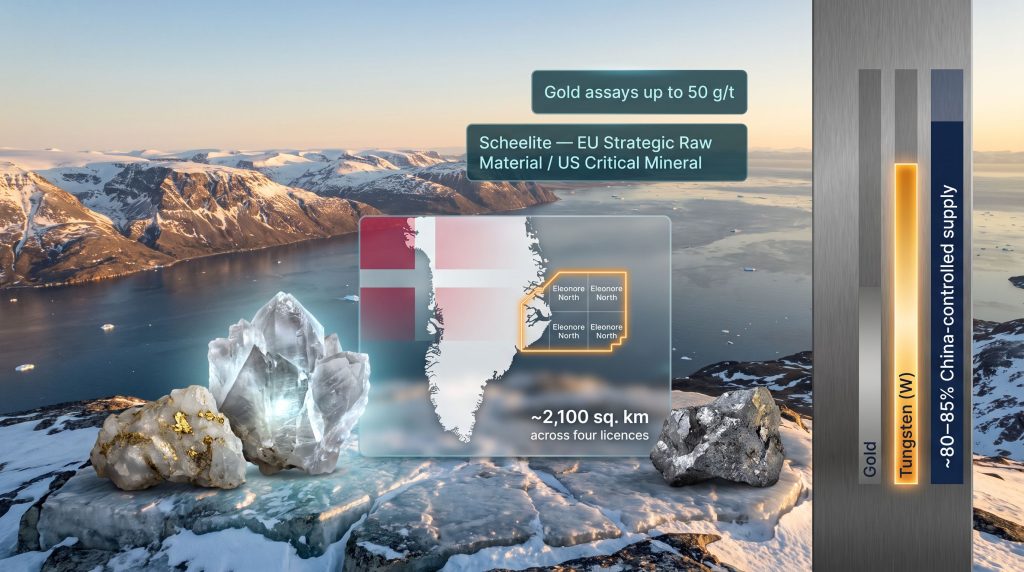
The recent granting of two new exploration licences covering approximately 1,600 sq. km transforms the Eleonore North project into a substantially larger and more diversified exploration platform. The combined portfolio now spans roughly 2,100 sq. km across four licences, all held at 100% by GreenX Metals (ASX: GRX).
| Parameter | Detail |
|---|---|
| Total Licence Area (post-expansion) | ~2,100 sq. km across four licences |
| New Licences Granted | ~1,600 sq. km |
| Existing Licence Area | ~1,221 sq. km (Ymer Island and Strindbergland Peninsula) |
| Primary Commodities | Gold, Tungsten (Scheelite), Antimony |
| Jurisdiction | East Greenland |
| Ownership | 100% GreenX Metals (ASX: GRX) |
| Market Capitalisation | ~$273.9 million (at time of announcement) |
The new licences are positioned approximately 100 km south of the existing tenements, extending the project's reach along a structurally coherent geological corridor. Critically, the Caledonian intrusions within the new licence areas have never been evaluated against the RIRGS exploration model, which means GreenX holds a genuine first-mover position over terrain that is geologically prospective by analogy with the Noa Prospect to the north.
The Noa Prospect: Scale That Demands Attention
Within the original licence area, the Noa Prospect represents the primary gold-antimony target. Anomalous gold in quartz veining has been traced over a strike length of up to 15 kilometres, indicating a large-scale mineralised corridor rather than an isolated vein occurrence. Gold assays of up to 50 g/t have been recorded at surface, representing high-grade expressions that, within the RIRGS framework, likely reflect focused fluid channels within a larger disseminated system.
The 15 km strike dimension is worth contextualising. For comparison, many of the world's significant RIRGS deposits, including examples from the Tombstone gold belt in Alaska and the Yukon's Dublin Gulch, are characterised by gold mineralisation extending over multi-kilometre corridors. The surface scale of the Noa system is therefore not inconsistent with a deposit of meaningful size, though this remains an exploration thesis requiring systematic drilling to test.
What Historical Data Actually Tells Us
Decades of Anomalism, Zero Modern Follow-Up
The history of exploration activity across the Eleonore North corridor is a study in institutional discontinuity. Reconnaissance work began in 1975, when Nordmine, a company that at its peak held an exclusive mineral licence spanning 100,000 sq. km across East Greenland, collected gold-mineralised boulders and vein material from what is now covered by the new licence areas.
Stream sediment sampling followed in 1979 and 1980, establishing gold and scheelite anomalism across the broader region. Heavy mineral concentrate analysis in 1983 confirmed the co-occurrence of gold, scheelite, and associated pathfinder elements within the licence boundaries. Geologists who visited the same year formally recommended detailed follow-up exploration for both gold and scheelite.
That recommendation was never acted upon. Nordmine was liquidated in 1992, and the documented anomalism sat in the public record for more than three decades without generating a modern exploration response. This is not an unusual outcome in Arctic exploration, where logistical costs, permafrost conditions, and the absence of infrastructure historically suppressed exploration activity relative to more accessible regions.
The Margeries Deposits: Historical Estimates Requiring Verification
Within the existing licence area, the North and South Margeries deposits contain historical resource estimates that, while not JORC 2012 compliant, provide indicative context for the tungsten and antimony endowment of the system.
| Deposit | Estimated Tonnage | Grade | Commodity |
|---|---|---|---|
| North Margeries | 83,000 tonnes | 4.6% antimony | Antimony (Sb) |
| South Margeries | 58,100 tonnes | 3.2% tungsten | Tungsten (W) |
| North Margeries (W) | 32,000 tonnes | 1.0% tungsten | Tungsten (W) |
Important disclaimer: These figures represent historical estimates cited in GreenX company materials. They have not been verified under JORC 2012 or NI 43-101 standards and should be treated as indicative of mineralisation potential rather than confirmed mineral resources. Investors should not make investment decisions based solely on historical estimates of this nature.
Prior to the 2026 field season, GreenX re-logged and re-assayed archived drill core from both deposits, applying modern geochemical and mineralogical techniques to legacy material. Historical airborne hyperspectral survey data covering the Margeries area was also reprocessed, generating new alteration and structural targets that were subsequently visited during the 2026 summer field program.
Tungsten: The Strategic Commodity Dimension Most Investors Underweight
Why Tungsten's Supply Geography Creates Structural Opportunity
Gold tends to dominate the narrative when explorers announce high-grade surface results, and understandably so. However, the tungsten dimension of the Eleonore North story carries strategic weight that arguably deserves equal analytical attention. The strategic role of tungsten in modern defence and industrial supply chains makes this project particularly timely.
Global tungsten mine production is heavily concentrated in China, which accounts for approximately 80 to 85 percent of world supply. This level of geographic concentration exceeds even that of cobalt in the Democratic Republic of Congo, a supply chain vulnerability that received sustained investor and policy attention throughout the battery metals cycle. Tungsten has attracted less retail investor attention, partly because its demand profile sits within defence and industrial manufacturing rather than consumer-facing applications.
| Attribute | Gold | Tungsten |
|---|---|---|
| Primary Demand Driver | Monetary/investment, jewellery | Defence, industrial manufacturing |
| Supply Concentration | Geographically diverse | ~80-85% China-controlled |
| Strategic Designation | Store of value | EU Strategic Raw Material / US Critical Mineral |
| Exploration Indicator at Eleonore North | Assays up to 50 g/t, 15 km vein corridor | Scheelite in stream sediments, Margeries deposits |
| Western Supply Gap | Moderate | Severe |
Tungsten's primary applications include high-strength alloys, cutting tools, and armour-piercing ammunition. These are end uses where no commercially viable substitutes currently exist. Both the European Union's Critical Raw Materials Act and the United States critical minerals list have formally identified tungsten as a priority supply chain concern, reflecting genuine geopolitical urgency rather than policy posturing.
The Scheelite Indicator: A Two-for-One Exploration Signal
A nuance that separates more technically sophisticated investors from generalists is the dual role of scheelite at Eleonore North. Because scheelite is both a direct tungsten ore mineral and a well-established pathfinder for RIRGS-style gold deposits, its detection in stream sediment sampling across the licence areas simultaneously advances two separate commodity narratives. This interpretive richness is rarely communicated in headline form, but it materially strengthens the geological case for the project's overall potential.
In addition, the antimony supply risks associated with China's dominant market position are directly relevant here, given antimony's presence within the Noa system's geochemical signature. Moreover, antimony in defence applications has become a growing concern for Western governments seeking to reduce reliance on single-source suppliers.
The 2026 Field Program: Methodology and Expected Outcomes
Two Parallel Workstreams Running Concurrently
The 2026 field program at Eleonore North is structured around two distinct but complementary objectives. The first involves reconnaissance geological mapping and geochemical sampling across the Caledonian intrusions within the newly granted licences, with the specific aim of testing whether the RIRGS model extends southward from the Noa Prospect along the same geological corridor. The second focuses on follow-up work at the Margeries deposits, incorporating targets generated through the reprocessing of historical drill core and airborne hyperspectral data.
Running both workstreams concurrently in a single Arctic field season reflects a capital-disciplined approach to exploration that is particularly well-suited to remote operating environments where mobilisation costs are significant. Key activities completed during the program include:
- Re-logging and re-assaying of archived drill core from North and South Margeries using modern analytical frameworks.
- Reprocessing of historical airborne hyperspectral survey data to identify previously unrecognised alteration and structural targets.
- Reconnaissance geochemical sampling and geological mapping across Caledonian intrusions within the new licence areas.
- Field-testing of targets generated from the reprocessed hyperspectral dataset.
Fieldwork for the 2026 summer season is now complete. First assay results and geological interpretations are expected to be released within Q3 2026. Given the logistical complexity of Arctic field programs, this timeline represents an efficient turnaround from field activity to investor-facing results.
The next major ASX story will hit our subscribers first
Portfolio Expansion and Competitive Positioning
What Four Licences Across 2,100 sq. km Actually Means Strategically
The transition from a focused single-project explorer to a four-licence critical minerals platform covering approximately 2,100 sq. km carries strategic implications beyond simple acreage accumulation. Holding contiguous or proximal licences over a single geological system creates a form of optionality that is difficult to replicate once a jurisdiction attracts broader exploration interest.
Individual prospects within the portfolio can be advanced independently toward resource definition, or the unified project can be positioned for joint venture or strategic partnership discussions at a scale that smaller, fragmented licence holdings cannot match. This structural flexibility is a meaningful attribute in a jurisdiction where major mining companies and government-backed entities are increasingly active in preliminary discussions about supply chain investment.
It is also worth noting that Greenland's mineral licensing framework requires demonstrated exploration activity to maintain tenure. The 2026 field program therefore fulfils both a strategic imperative and a regulatory obligation simultaneously, which investors should factor into their assessment of exploration spend allocation. For broader context on the region's growing significance, a comprehensive Greenland critical minerals guide offers useful background on the evolving political and regulatory environment shaping exploration activity across the island.
Furthermore, as detailed assessments from the United States Geological Survey continue to highlight supply concentration risks for tungsten and antimony, projects offering genuine Western-hemisphere alternatives are attracting increasing institutional scrutiny.
Disclaimer: This article is intended for informational purposes only and does not constitute financial advice. All investment decisions should be made in consultation with a qualified financial adviser. Historical mineral estimates cited in this article have not been verified under JORC 2012 standards. Exploration results discussed represent early-stage geological work and do not guarantee the discovery of an economic mineral deposit. Past exploration results are not necessarily indicative of future outcomes.
For ongoing coverage of ASX materials and mining sector developments, including further reporting on Greenland critical mineral exploration activity, visit The Market Online.
Ready to Position Yourself Ahead of the Next Major Critical Minerals Discovery?
Discovery Alert's proprietary Discovery IQ model delivers real-time alerts on significant ASX mineral discoveries — including emerging critical minerals plays across gold, tungsten, and antimony — instantly translating complex geological data into actionable investment insights for both new and experienced investors. Explore historic discoveries and the substantial returns they've generated, then begin your 14-day free trial at Discovery Alert to secure your market-leading edge before the next major announcement.