August 3, 2026
The Hidden Intelligence Problem Costing Mining Companies Billions
Every tonne of ore mined begins its journey as a prediction. Long before a blast is fired or a conveyor belt turns, geologists, engineers, and planners are making high-stakes decisions based on partial information drawn from a subsurface world they can only sample in fragments. The uncomfortable truth at the heart of modern mining is this: the industry generates more geological data than at any point in its history, yet the mining data gap and orebody decisions remain critically misaligned.
This is the mining data gap — and its consequences ripple outward from the drill core to the processing plant, from the resource estimate to the balance sheet. Closing this gap is not simply a technical challenge. It is a fundamental question of decision architecture, and the industry's ability to answer it will shape both financial performance and sustainability outcomes for decades ahead.
When big ASX news breaks, our subscribers know first
Why Data Volume Is Not the Same as Decision Quality
Modern mining operations capture extraordinary volumes of geological information. Drill programs generate thousands of metres of core. Geochemical assays produce dense grids of elemental data. Structural logging, geophysical surveys, and remote sensing layer additional intelligence onto the growing pile. Yet data abundance does not automatically translate into better orebody decisions.
The structural problem is straightforward but deeply consequential: information generated at one stage of a mine's life is frequently siloed from decision-makers operating at a different stage. A metallurgist optimising flotation performance may never have access to the fine-grained mineralogical variability data collected during early-stage exploration. A mine planner scheduling ore parcels for the mill may be working from a block model that cannot reflect the liberation characteristics governing recovery rates.
This disconnection between data generation and value chain action is not born from negligence. It reflects the structural reality of how mining projects are organised, financed, and operated across time. The challenge is fundamentally one of integration, not volume.
How Sparse Sampling Creates Systemic Uncertainty Across the Orebody Knowledge Chain
The Fundamental Limitation of Drillhole Coverage
No matter how sophisticated the analytical technology applied to a core sample, the most irreducible challenge in orebody characterisation is that only a tiny fraction of any deposit is ever directly observed. A typical exploration drill program may sample a fraction of a percent of the total orebody volume. Everything between the holes is interpolated — inferred from statistical models, variograms, and geological judgement.
Drill spacing is the single most consequential variable governing confidence in orebody geometry and grade continuity. When holes are spaced too widely relative to the scale of geological variability within the deposit, the resulting model cannot reliably resolve structural boundaries, fault offsets, or grade transitions. The technical term for this failure is insufficient continuity resolution, and its downstream effects compound across the entire resource estimation and mine planning process. Interpreting drill results correctly is, therefore, a foundational skill that directly determines how confidently decisions can be made.
When drill spacing fails to resolve geological structure and orebody geometry, the resulting data gap directly weakens continuity resolution — making economic forecasts and development decisions unreliable before a single tonne is mined.
From Inferred Resource to Bankable Study: The Data Threshold Problem
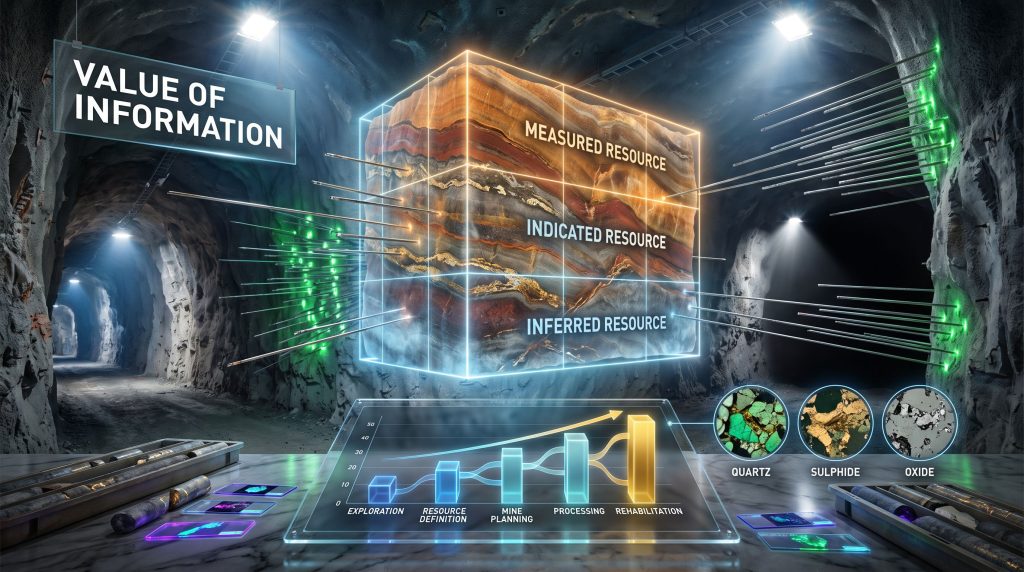
The mining industry's resource classification system provides a useful proxy for understanding how data confidence maps to decision-making risk. Under the JORC Code and equivalent international frameworks, resources are classified according to the level of geological knowledge and confidence supporting the estimate.
| Resource Classification | Typical Data Confidence | Suitability for Major Economic Decisions |
|---|---|---|
| Inferred Resource | Low — high interpolation dependency | Generally insufficient for project financing |
| Indicated Resource | Moderate — improved drill density | Suitable for prefeasibility studies |
| Measured Resource | High — dense, validated data | Supports feasibility and mine design |
The practical implication is stark. A project with a large proportion of its tonnage sitting in the Inferred category carries substantially higher technical risk than headline figures might suggest to a non-specialist observer. Grade and tonnage estimates built on sparse sampling accumulate interpolation error at every step — errors that tend to crystallise as negative reconciliations when actual mining performance is compared against pre-mine predictions.
Research consistently shows that grade reconciliation failures — where mined ore grades fall materially short of resource model predictions — represent one of the most persistent sources of value destruction in the mining industry. The root cause, in the majority of cases, traces back to insufficient data density during the resource definition phase. Sound drill results interpretation at this stage is, consequently, essential to avoiding costly downstream miscalculations.
What Does Geometallurgy Reveal About the Hidden Cost of Disconnected Data?
Geometallurgy as the Bridge Between Geology and Processing Performance
Geometallurgy is the discipline that explicitly links orebody characteristics to processing plant performance. Rather than treating geology and metallurgy as sequential, discrete activities, geometallurgy treats the orebody as a variable input whose physical and chemical properties directly govern throughput, recovery, reagent consumption, and tailings characteristics.
This matters because ore is not homogeneous. A single deposit may contain multiple ore types with dramatically different hardness, mineral associations, grain size distributions, and liberation behaviour. An ore block that looks attractive based on assay grade alone may prove difficult and expensive to process if its mineralogical context is poorly understood.
The Value Chain Cascade: How an Upstream Data Gap Becomes a Downstream Operational Loss
The propagation of data gaps through the mining value chain follows a consistent and costly pattern:
- Exploration and drilling phase: Incomplete spatial resolution of mineralogy and grade distribution creates the foundational uncertainty that all subsequent models inherit
- Resource estimation phase: Block model uncertainty is amplified by interpolation across data gaps, and geological complexity is often simplified to make models tractable
- Mine planning phase: Scheduling and sequencing decisions are made on uncertain ore characterisation, increasing the risk of unexpected blend variations reaching the plant
- Processing phase: Throughput, recovery rates, and reagent consumption are affected by ore variability that the plant was not designed or calibrated to handle
- Sustainability reporting phase: Environmental outcomes, tailings mineralogy, and closure liability estimates become harder to predict and manage with confidence
The critical insight here is that each stage inherits the uncertainty of the stage before it. Data gaps do not stay contained within exploration — they propagate, amplify, and ultimately manifest as operational variance and financial risk.
Why Mineral Composition, Grain Size, and Liberation Data Are Critical
Three mineralogical parameters are particularly decisive for downstream processing performance. Mineral composition determines which recovery pathways are technically viable and what reagent chemistries are appropriate. Grain size governs the grind target required to achieve adequate liberation of the valuable mineral from the host rock. Liberation — the degree to which the target mineral is physically separated from gangue at a given particle size — is the direct determinant of recoverable value.
When these parameters are unknown or poorly characterised across the spatial extent of the orebody, plant operators are effectively flying blind. Optimisation becomes reactive rather than predictive, and value is lost through suboptimal grind settings, poor reagent selection, and insufficient blending control.
How Advanced Mineral Characterisation Technology Is Redefining Orebody Data Quality
What Integrated Mineral Analysis Platforms Deliver
Technologies such as the TESCAN Integrated Mineral Analyser (TIMA) represent a significant advancement in the speed and resolution of automated mineralogical analysis. These platforms combine scanning electron microscopy with energy-dispersive X-ray spectroscopy to simultaneously measure mineral identification, modal abundance, grain size distribution, and mineral liberation — across thousands of particles in a single automated run.
The output is a richly detailed mineralogical fingerprint of an ore sample, far beyond what conventional optical microscopy or bulk geochemical assay can provide. When applied systematically across a drill core archive, these platforms have the potential to dramatically improve the spatial resolution of mineralogical knowledge across an orebody. Furthermore, 3D geological modelling of these datasets enables decision-makers to visualise variability in three dimensions, substantially improving planning confidence.
The Gap Between Instrument Capability and Operational Deployment
A rarely discussed tension in the industry is that the full analytical capability of these instruments is rarely exploited in operational settings. Production pressures, turnaround time requirements, and budget constraints mean that mineral analysis in an operational context is typically focused on answering a narrow set of immediate questions rather than building a comprehensive, longitudinally integrated mineralogical model of the deposit.
In operational settings, mineral characterisation systems are typically deployed to answer immediate production questions, leaving deeper analytical potential underutilised. Research environments offer the rare opportunity to interrogate these datasets more thoroughly and feed refined methodologies back into industry practice.
University research environments, by contrast, can apply these instruments with a longer time horizon and a broader analytical mandate. The University of Queensland's Sustainable Minerals Institute recently acquired a TIMA through its Natural Resources Innovation and Characterisation Hub (NRICH), creating exactly this kind of research-grade analytical capacity. Work being conducted through the W.H. Bryan Mining and Geology Research Centre (BRC) is exploring how data collection workflows, measurement procedures, and analytical methods can be refined and then translated back into practical industry frameworks. According to next-generation orebody knowledge research, this integrated approach to mineralogical data is rapidly becoming a competitive necessity rather than an optional enhancement.
Why Geological Data Integration Across the Mining Value Chain Is So Difficult
The Data Silo Problem
The mining industry's data integration challenge is structural in nature. Different phases of a mine's life are managed by different teams, using different software systems, with different data standards and different commercial incentives. The result is a landscape of silos where valuable information is consistently trapped within the organisational unit that generated it.
| Value Chain Stage | Data Generated | Common Integration Barrier |
|---|---|---|
| Exploration | Drill core, assay, structural logs | Inconsistent data standards and formats |
| Resource definition | Block models, variogram analysis | Limited feedback loops to processing teams |
| Mine planning | Scheduling models, geotechnical data | Siloed planning software environments |
| Processing | Metallurgical testwork, recovery data | Rarely reconciled against geological models |
| Rehabilitation | Tailings characterisation, closure data | Disconnected from upstream ore knowledge |
Data Provenance and Audit Trail Integrity
A frequently overlooked dimension of data quality is provenance — the ability to trace any figure in a resource model back to its original measurement, understanding exactly how it was collected, processed, and transformed on its journey into the model. Without a robust audit trail, it becomes impossible to reliably assess the confidence level attached to any given estimate or to identify where systematic errors may have been introduced.
This matters acutely at the point of major capital allocation decisions. A feasibility study that cannot demonstrate the full provenance chain for its resource inputs carries a hidden risk premium that is not always visible to external reviewers or investors.
The Stakeholder Alignment Problem
Long-life mining assets create a peculiar governance challenge for data management. The teams that generate geological data during exploration are rarely the same teams that rely on it during mine operations, sometimes decades later. Commercial arrangements change, software platforms are replaced, and institutional memory erodes. Establishing clear ownership and stewardship responsibilities for geological data across the full mine lifecycle remains one of the industry's most underappreciated governance problems.
The next major ASX story will hit our subscribers first
What Frameworks Are Emerging to Connect Data Quality Directly to Decision Quality?
Orebody Knowledge and Orebody Learning as Operational Frameworks
The concept of orebody knowledge has gained traction in academic and industry circles as a framework for thinking systematically about what is known about a deposit, at what confidence level, and how that knowledge should be translated into operational decisions. Related to this is the concept of orebody learning — the iterative process by which geological understanding is updated as new information becomes available through mining, and how that updated understanding feeds back into planning and scheduling. Orebody learning as a practice is increasingly recognised as a dynamic feedback mechanism rather than a static analytical exercise.
Both frameworks challenge the traditional linear model of mining, in which geology feeds into engineering in a largely one-directional flow. Instead, they propose a continuous feedback architecture in which operational data continuously enriches the geological model, and the geological model continuously informs operational decisions.
The Value of Information Framework
One of the most practically powerful analytical tools available to mine planners is the Value of Information (VOI) methodology. VOI analysis enables a mining team to explicitly quantify what better data is worth, by modelling the economic improvement in decision quality that additional data would deliver, relative to the cost of collecting it. In addition, understanding cut-off grade economics is an integral component of this analysis, as cut-off grade assumptions directly influence what proportion of the orebody is classified as economically recoverable.
The Value of Information methodology enables mining teams to explicitly calculate how much additional geological data collection is worth — by modelling the decision improvement that new data would deliver relative to its collection cost. This reframes data investment as a quantifiable risk management tool rather than a discretionary budget line.
Step-by-Step: Applying a Data-to-Decision Quality Framework
- Audit existing data coverage — identify spatial gaps, inconsistencies, and missing parameters across the orebody model
- Classify decision sensitivity — determine which planning decisions carry the greatest exposure to data uncertainty
- Quantify the value of additional information — model the economic impact of reducing key uncertainties using VOI methodology
- Prioritise targeted data collection — design infill drilling, sampling, or testwork programs to address the highest-value gaps
- Integrate across disciplines — ensure geological, geotechnical, metallurgical, and environmental datasets are connected within a unified model
- Establish feedback loops — reconcile production and processing outcomes against pre-mine predictions to continuously improve the orebody model over time
How Does the Industry-Academia Partnership Model Accelerate Solutions?
Why Complex, Long-Life Orebodies Benefit Most From Deeper Research Engagement
Geologically complex, long-life mining operations present a category of analytical challenge that operational timelines alone cannot adequately address. The pace of production decision-making is inherently short-cycle, while the questions that most affect long-term value require the kind of sustained, methodical investigation that only a research environment can sustain.
The fellowship model emerging within institutions like the University of Queensland's Sustainable Minerals Institute provides a structural mechanism for bridging this gap. By embedding researchers with cross-disciplinary backgrounds spanning operations, consulting, and academia, these fellowships create intellectual space for longer-horizon problem-solving that is insulated from the immediate pressures of production targets.
Industry-backed research fellowships are designed not to replicate operational analysis, but to create the intellectual space for longer-horizon problem-solving — producing frameworks, tools, and methodologies that can be deployed across multiple operations and asset types.
Connecting Geological Research to Sustainability Objectives
An underappreciated dimension of the mining data gap and orebody decisions is its relationship to environmental and sustainability performance. Tailings management, acid mine drainage risk, and closure liability are all functions of the mineralogical composition of processed ore and waste rock. Better mineralogical characterisation upstream translates directly into more reliable environmental modelling downstream.
Research programs that explicitly ask how geological characteristics influence outcomes beyond the processing plant — connecting orebody knowledge to water quality, tailings stability, and rehabilitation effectiveness — represent a genuinely new frontier in the discipline.
What Are the Practical Outcomes Mining Companies Can Expect From Closing the Data Gap?
The business case for investing in better orebody intelligence is increasingly quantifiable. Across the value chain, the consequences of closing the mining data gap manifest in measurable operational and financial improvements. Moreover, definitive feasibility studies that are underpinned by high-confidence orebody data are substantially more likely to deliver outcomes aligned with pre-development forecasts.
| Outcome Category | Benefit of Closing the Data Gap |
|---|---|
| Resource estimation accuracy | Reduced grade and tonnage forecast error |
| Mine scheduling | More reliable production sequencing |
| Processing performance | Improved recovery rates and reagent efficiency |
| Tailings and waste management | Better characterisation of mineralogical risk |
| Sustainability reporting | Stronger evidence base for environmental commitments |
| Capital allocation | Reduced risk of misaligned development investment |
Frequently Asked Questions: Mining Data Gaps and Orebody Decision-Making
What is a mining data gap and how does it affect orebody decisions?
A mining data gap refers to the spatial, temporal, or disciplinary incompleteness of geological and metallurgical information available to decision-makers at any point in a mine's life. It affects orebody decisions by increasing the uncertainty attached to resource estimates, mine plans, and processing strategies — ultimately increasing financial and operational risk.
Why can't mining companies simply collect more data to solve the problem?
Additional data collection has a cost, and not all data gaps carry equal decision-making weight. The challenge is not simply collecting more data but identifying which data gaps matter most for specific decisions, and then targeting collection effort accordingly. The Value of Information framework exists precisely to make these prioritisation decisions analytically rigorous rather than intuitive.
What is geometallurgy and why is it central to closing the data gap?
Geometallurgy is the practice of characterising the physical and chemical properties of ore in a way that is directly linked to processing plant performance. It is central to the data gap problem because it provides the conceptual and methodological bridge between geological knowledge and operational outcomes — translating orebody variability into predictions about throughput, recovery, and environmental impact.
How does drill spacing influence the reliability of a resource estimate?
Drill spacing determines the scale of geological variability that can be resolved within a resource model. When spacing is too wide relative to the natural variability of the deposit, interpolation errors accumulate, confidence in grade and tonnage estimates decreases, and the model may misrepresent the continuity of ore zones. Tighter spacing improves confidence but increases drilling cost — the optimum is determined by deposit geometry, commodity value, and the sensitivity of key decisions to estimate uncertainty.
What is the difference between an Inferred Resource and a Measured Resource in terms of decision-making risk?
An Inferred Resource carries the lowest confidence level and should not be used as the primary basis for project financing or final feasibility studies. A Measured Resource, supported by dense and validated sampling, provides sufficient confidence for mine design and capital commitment. The gap between these classifications represents a spectrum of decision-making risk that investors and operators must explicitly account for.
How does the Value of Information framework help prioritise data collection investment?
VOI analysis models the economic improvement in decision quality that would result from reducing specific uncertainties, then compares that improvement against the cost of obtaining the additional data. This allows mine planners to rank data collection investments by their expected return, transforming geological data programs from discretionary expenditures into quantified risk management tools.
Can better geological data integration improve sustainability outcomes?
Yes, in several concrete ways. More detailed mineralogical characterisation improves the prediction of acid-generating potential in tailings, supports more accurate closure liability estimation, and enables better management of process water chemistry. Research explicitly exploring how geological characteristics connect to sustainability objectives represents an important and relatively underexplored area within the broader orebody knowledge field.
From Data-Rich to Decision-Ready: The Next Frontier in Orebody Intelligence
Why the Data Challenge Is Fundamentally a Decision Architecture Problem
The mining industry's relationship with geological data is at an inflection point. The volume of information being generated is growing rapidly, driven by automation, remote sensing, and advances in analytical instrumentation. However, the organisational, methodological, and technological frameworks for converting that information into better decisions have not kept pace.
The most important insight emerging from both academic research and industry practice is that the mining data gap and orebody decisions challenge is not primarily a measurement problem — it is a decision architecture problem. Solving it requires not just better instruments or denser drill grids, but fundamentally rethinking how information flows across organisational boundaries, how uncertainty is quantified and communicated, and how feedback from production reconciliation loops back into the geological models that guide future decisions.
Key Takeaways for Geologists, Mine Planners, and Operational Leaders
- Data quality is only as valuable as the decision-making processes it informs. Integration across disciplines is not optional — it is the mechanism through which data becomes intelligence.
- Resource classification is a proxy for decision-making confidence. The proportion of a project's tonnage in Inferred versus Measured categories is a direct indicator of investment risk.
- Geometallurgy is not a specialist niche — it is the connective tissue between geological knowledge and operational performance, and its systematic application should be a standard component of mine planning.
- The Value of Information framework should be a standard tool in the mine planner's analytical toolkit, applied at each major decision gate to justify and optimise data collection investment.
- Sustainability outcomes are downstream consequences of upstream data quality. Better mineralogical characterisation is not only a production optimisation tool — it is an environmental risk management imperative.
Further Exploration: Readers interested in the academic research underpinning geological data integration and geometallurgical frameworks can explore the work being conducted at the University of Queensland's Sustainable Minerals Institute, including the W.H. Bryan Mining and Geology Research Centre, at smi.uq.edu.au.
Disclaimer: This article is intended for informational and educational purposes only. It does not constitute financial, investment, or professional mining advice. Forecasts, frameworks, and analytical perspectives discussed represent general industry knowledge and research directions, and should not be relied upon as the basis for specific investment or operational decisions without independent professional assessment.
Want to Identify Significant ASX Mineral Discoveries Before the Broader Market Does?
Discovery Alert's proprietary Discovery IQ model scans ASX announcements in real time, instantly converting complex geological and commodity data across more than 30 minerals into clear, actionable insights — so subscribers can act on major discoveries the moment they are announced. Begin your 14-day free trial at Discovery Alert today, or explore how historic mineral discoveries have delivered exceptional market returns to understand the full magnitude of what early positioning can mean.