August 22, 2026
The Materials Science Bottleneck That Could Slow the Clean Energy Transition
Every major technological revolution eventually runs into a materials problem. The transistor needed pure silicon. Solar cells needed refined crystalline structures. The lithium-ion battery needed a stable intercalation cathode. Today, as the world pushes deeper into grid-scale energy storage, the next materials wall is already visible: AI for discovering porous oxide materials for next-generation energy storage is emerging as a critical response to electrode chemistry challenges that have remained stubbornly difficult to solve using conventional laboratory methods.
The fundamental physics is compelling. Ions carrying two or three charges per particle, such as magnesium, calcium, aluminum, and zinc, offer theoretically higher energy density per charge carrier compared to the single-charge lithium ion. However, their larger ionic radii create severe diffusion bottlenecks inside conventional cathode frameworks, slowing ion transport to the point where practical performance deteriorates sharply. The electrode material must physically accommodate these larger ions while maintaining structural integrity across thousands of charge-discharge cycles, a constraint that rules out most known oxide compositions.
Traditional materials discovery proceeds by synthesising candidate compounds one at a time, characterising their electrochemical properties, and iterating based on experimental results. At that pace, exploring the vast combinatorial space of transition metal oxides would take decades. Researchers at the New Jersey Institute of Technology (NJIT) and Rensselaer Polytechnic Institute (RPI) have proposed a fundamentally different approach, compressing a years-long search into a computational screening campaign that identified five previously unreported candidate structures.
When big ASX news breaks, our subscribers know first
Why Porous Oxide Frameworks Are the Key to Multivalent-Ion Batteries
Open-Tunnel Architectures and Ion Diffusion
Not all oxide materials are structurally equivalent. Dense, close-packed oxide frameworks may offer excellent electronic conductivity but present near-impassable barriers to larger multivalent ions. Porous oxide materials, by contrast, contain nanoscale channel architectures, often described as open-tunnel frameworks, that create physical pathways for ion diffusion through the electrode bulk.
Well-studied examples within the broader research community include niobium tungsten oxide and molybdenum vanadium oxide, both of which feature interconnected tunnel geometries that allow faster ion transport than conventional layered cathode materials. These structural templates have informed the design criteria used in the NJIT-RPI computational search.
The Multivalent Advantage: Abundance, Cost, and Chemistry
The strategic appeal of moving beyond lithium extends well beyond laboratory curiosity. Furthermore, understanding the evolving battery metals landscape helps contextualise why these alternative chemistries are attracting serious research investment. Consider the comparative supply profile of the target ions:
| Ion Carrier | Charge | Relative Abundance vs. Lithium | Key Challenge |
|---|---|---|---|
| Magnesium (Mg²⁺) | 2+ | Significantly more abundant | Strong electrostatic binding in host lattice |
| Calcium (Ca²⁺) | 2+ | Highly abundant | Large ionic radius limits diffusion rate |
| Aluminum (Al³⁺) | 3+ | Earth's most abundant metal | Trivalent charge causes framework strain |
| Zinc (Zn²⁺) | 2+ | Widely available | Dendrite formation risk in certain electrolytes |
Each of these elements is available at lower cost and with greater geographic distribution than lithium, which remains concentrated in politically sensitive supply chains spanning Australia, Chile, and the Democratic Republic of Congo. Successfully developing electrode materials for even one of these multivalent chemistries would meaningfully reduce critical minerals and energy security risks for battery manufacturers globally.
How the AI Discovery Framework Works: A Technical Breakdown
Two AI Systems, One Materials Pipeline
The NJIT-RPI framework rests on a dual-architecture design that pairs complementary AI capabilities. A single machine learning model is insufficient for materials discovery at this scale because the problem has two distinct dimensions: generating physically plausible crystal structures, and reasoning about their chemical feasibility.
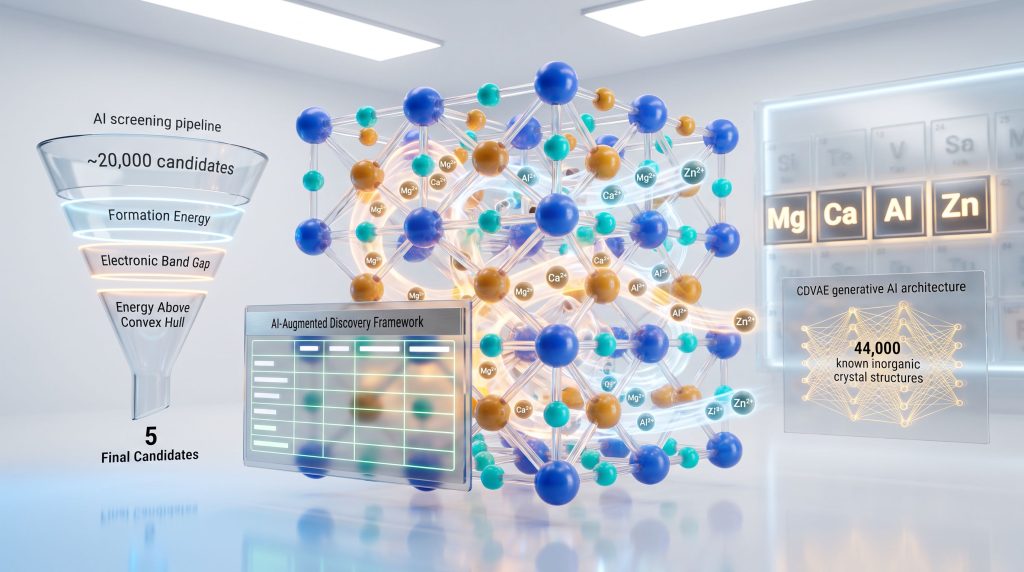
The first component is a Crystal Diffusion Variational Autoencoder (CDVAE), a generative model trained to learn the statistical patterns embedded in known inorganic crystal structures and then sample novel geometries that satisfy physical and chemical constraints. The second is a fine-tuned Large Language Model (LLM) that contributes chemical reasoning to complement the structural generation process. Together, the two systems were trained on more than 44,000 known inorganic crystal structures sourced from the Materials Project database, one of the most comprehensive open-access repositories of computed materials properties in existence.
The Screening Funnel: From 20,000 Candidates to Five
The pipeline generated approximately 20,000 candidate transition metal oxide structures, a quantity that would require generations of laboratory researchers to evaluate experimentally. Computational filtering reduced this field through three sequential criteria:
- Formation energy — thermodynamic feasibility of the compound under standard conditions
- Electronic band gap — ensuring appropriate electrochemical activity for battery electrode function
- Energy above the convex hull — measuring proximity to thermodynamic stability relative to competing phases
This three-stage funnel progressively narrowed the field from roughly 20,000 structures to 55 shortlisted compositions, and ultimately to 5 final candidates featuring open-tunnel frameworks specifically designed to host magnesium, calcium, aluminum, or zinc ions.
Methodology Note: Structural relaxation using M3GNet, a machine learning interatomic potential, allowed the research team to process far more candidate geometries than density functional theory (DFT) alone would permit. This substantially reduced computational cost while maintaining predictive accuracy at the pre-screening stage.
DFT Validation and Phonon Analysis
Once the five candidates were identified, density functional theory — the gold standard for computational materials validation — confirmed that all five exhibited lower formation energies than analogous entries in the Materials Project database. DFT calculates the quantum mechanical electronic structure of a material from first principles, providing high-confidence predictions of stability and bonding geometry.
Phonon dispersion analysis added a second validation layer by assessing dynamic stability. A material may appear thermodynamically stable under static DFT calculations but prove unstable when atomic vibrations are considered. The phonon dispersion results for the five candidates showed no unstable vibrational modes across the entire Brillouin zone, the mathematical space used to describe vibrational behaviour in periodic crystal structures.
The Five Candidates and the Metastability Question
What Makes These Structures Genuinely Novel
All five shortlisted compositions share open-tunnel framework geometries engineered to accommodate multivalent ions across the target group: magnesium, calcium, aluminum, and zinc. Critically, none of these compositions appeared in existing materials databases prior to this study, establishing the genuine novelty of the computational discovery rather than merely re-identifying known compounds.
Ca₄In₂O₂ and the Thermodynamic Metastability Debate
One candidate, Ca₄In₂O₂, merits specific attention because it illustrates an important and often misunderstood concept in computational materials science. This structure showed an energy above the convex hull of 0.36 eV/atom, placing it in the metastable category rather than the fully stable region.
Critical Distinction: Thermodynamic metastability does not equal unsynthesisability. Many commercially important battery materials, including certain cathode phases used in current lithium-ion cells, exist in metastable states that are kinetically accessible under controlled synthesis conditions. The relevant question is not whether a material is the most thermodynamically stable phase, but whether it can be produced and maintained under practical conditions.
The phonon dispersion results for Ca₄In₂O₂ found no unstable vibrational modes across its Brillouin zone, indicating dynamic stability despite thermodynamic metastability. This distinction matters because dynamic instability would cause a crystal structure to spontaneously distort or decompose, while thermodynamic metastability simply means a lower-energy competing phase exists. The research team proposed that non-equilibrium processing conditions could provide a viable synthesis route for this and potentially other metastable candidates in the set.
Retrieval-Augmented Generation: Bridging Computation and the Laboratory
Planning Synthesis Routes for Materials That Have Never Been Made
Identifying a computationally promising material is only part of the challenge. Experimentalists need actionable synthesis guidance: what temperature, what atmospheric conditions, what precursor materials, and what safety protocols apply to a compound with no experimental precedent.
The NJIT-RPI team addressed this by developing a Retrieval-Augmented Generation (RAG) system that searches the existing scientific literature for synthesis protocols used with structurally or chemically analogous compounds, then adapts those conditions as candidate routes for novel compositions. RAG systems differ from standard language model generation because they ground their outputs in retrieved factual information rather than relying solely on parametric knowledge encoded during training.
The K₂Cu₄F₁₀ Worked Example
Applied to the related compound K₂Cu₄F₁₀, the RAG system proposed a solid-state reaction synthesis route and identified nine feasible elemental substitutions that could expand the viable compositional space around the target structure. Solid-state synthesis involves mixing and heating precursor powders to drive diffusion-controlled reactions, a well-established route for producing complex oxide and fluoride phases.
The nine proposed substitutions reflect both isovalent strategies — replacing an element with another of the same oxidation state to tune structural parameters without altering charge balance — and potentially aliovalent approaches that modify the electronic structure more substantially. This AI-generated substitution map gives experimentalists a ranked priority list for follow-up synthesis attempts rather than requiring them to explore substitutions systematically from scratch.
It is essential to note that none of the proposed synthesis routes have been experimentally validated. The authors explicitly frame this component as a computational planning tool, not a confirmed laboratory protocol.
AI-Augmented Discovery vs. Traditional Battery Materials R&D
The scale of the methodological shift becomes clear in direct comparison:
| Dimension | Traditional Laboratory Approach | AI-Augmented Discovery Framework |
|---|---|---|
| Candidate generation | Manual hypothesis-driven synthesis | Generative model produces ~20,000 structures |
| Screening speed | Months to years per candidate | Computational filtering in days to weeks |
| Stability assessment | Experimental characterisation | DFT + M3GNet relaxation + phonon analysis |
| Synthesis guidance | Expert intuition and literature review | RAG system querying scientific literature |
| Discovery scope | Limited by researcher bandwidth | Explores previously uncharted compositional space |
| Validation status | Experimental confirmation | Computational only, lab validation pending |
The contrast is not intended to diminish the role of experimental research. Every computational candidate ultimately requires physical synthesis and electrochemical testing before its practical utility can be assessed. What the AI framework provides is a dramatically more efficient pre-screening mechanism that allows experimental resources to be concentrated on the most promising compositional targets.
The next major ASX story will hit our subscribers first
Supply Chain Implications and the Critical Minerals Dimension
Reducing Lithium Dependency at Scale
The strategic importance of non-lithium battery chemistries extends beyond laboratory interest into critical minerals policy. In addition, the broader picture of critical minerals demand underscores why developing viable alternative electrode chemistries has become a priority for governments and manufacturers alike. Lithium supply remains geographically concentrated, and cobalt, used in many high-energy lithium-ion cathodes, faces even more severe supply chain vulnerabilities.
Aluminum deserves particular attention here: it is the most abundant metal in Earth's crust, with established global refining infrastructure already in place. An aluminum-ion battery with practical performance characteristics would face essentially no raw material supply constraint at any conceivable deployment scale.
Zinc also presents an interesting case. Unlike lithium, zinc has well-developed recycling infrastructure from its decades of use in alkaline batteries and galvanising applications. Consequently, this existing end-of-life pathway could accelerate the circular economy credentials of zinc-ion battery systems, a point reinforced by recent advances in battery recycling breakthrough research emerging from Asia.
Current Limitations and What Comes Next
The Experimental Validation Gap
The NJIT-RPI study is explicit about where the current work stands: none of the five AI-generated candidates have been physically synthesised or electrochemically tested. The study represents a computational discovery framework, not a validated battery material ready for prototype development. Several key milestones must be achieved before any candidate can be assessed for practical relevance:
- Physical synthesis of each candidate structure under controlled laboratory conditions
- Structural characterisation confirming the predicted open-tunnel geometry
- Electrochemical testing measuring ion insertion capacity, voltage profile, and cycle stability
- Rate capability assessment evaluating ion diffusion performance under realistic charge-discharge conditions
- Long-term cycling studies to assess structural durability
Known Constraints of the Generative AI Approach
The framework also carries inherent limitations worth understanding:
- The generative model's output is bounded by the diversity of its 44,000-structure training set, meaning genuinely exotic compositions outside that chemical space may be underrepresented
- Computationally stable structures are not guaranteed to be practically synthesisable under standard laboratory conditions
- Human expert judgement remains essential for interpreting and prioritising AI-generated outputs, particularly for metastable candidates
- Scaling DFT validation from 55 to thousands of candidates would impose significant computational cost
Funding for related earlier work in the same research programme at NJIT came from a National Science Foundation award supporting niobium tungsten oxide anode research, indicating the institutional continuity of this research direction.
Frequently Asked Questions: AI and Porous Oxide Materials for Energy Storage
What is a Crystal Diffusion Variational Autoencoder (CDVAE)?
A generative AI model designed to produce novel crystal structures by learning statistical patterns from known inorganic compounds, then sampling new geometries that satisfy physical and chemical constraints.
Why are porous oxide materials important for multivalent batteries?
Their open-tunnel channel architectures provide the physical space required for larger multivalent ions to diffuse through the electrode, addressing the core ion transport limitation that has constrained multivalent battery development.
What does energy above the convex hull mean in materials science?
It quantifies how far a material's thermodynamic energy sits above the most stable competing phases at the same composition. A value of zero indicates full thermodynamic stability; positive values such as 0.36 eV/atom indicate metastability, though the material may still be synthesisable under controlled conditions.
How does Retrieval-Augmented Generation assist with synthesis planning?
The RAG system queries scientific literature to identify synthesis protocols used for structurally or chemically similar compounds, then adapts those conditions as candidate routes for novel compositions with no experimental precedent.
When will these AI-discovered materials be tested in real batteries?
No experimental timeline has been announced. The current work represents the computational discovery phase; laboratory synthesis, electrochemical characterisation, and prototype testing represent subsequent research stages requiring separate resourcing and experimental programmes.
The Broader Horizon: AI as a Systematic Materials Discovery Platform
The NJIT-RPI framework is best understood not as a one-time discovery event but as a proof-of-concept for a systematic approach to navigating the vast unexplored space of inorganic crystal chemistry. The same architectural logic — generative structure creation paired with computational stability screening and RAG-assisted synthesis planning — could in principle be extended to other electrode material classes, electrolyte design problems, and solid-state ionic conductor discovery.
Furthermore, developments such as direct lithium extraction technology demonstrate how computational and engineering innovations are converging across the energy storage sector to accelerate the broader transition timeline.
Within the energy storage research community, the convergence of generative AI, high-performance computing, and advanced experimental characterisation is beginning to compress the materials development cycle in ways that were not feasible even five years ago. Battery manufacturers and materials companies investing in computational discovery capabilities are building a structural research advantage that may become commercially significant over a five to fifteen year horizon.
The five porous oxide candidates identified in this study may or may not prove experimentally viable. That uncertainty is inherent to the computational discovery phase. What the research demonstrates with greater confidence is that AI for discovering porous oxide materials for next-generation energy storage has matured to the point where it can generate genuinely novel, computationally validated candidates at a scale and speed that traditional approaches cannot match. The path from those five structures to a working battery electrode remains long, but the ability to identify credible starting points in a fraction of the time previously required represents a meaningful advance in the race to build the next generation of energy storage technology.
Source Note: The primary research underpinning this article, titled Generative AI for Discovering Porous Oxide Materials for Next-Generation Energy Storage, was published in Cell Reports Physical Science and is accessible through the NJIT Digital Commons repository. The study provides full methodological detail on the CDVAE architecture, DFT validation protocols, M3GNet relaxation procedures, and the RAG-based synthesis planning system described here.
Want To Stay Ahead of the Next Major Materials or Mining Discovery on the ASX?
Discovery Alert's proprietary Discovery IQ model scans ASX announcements in real time, instantly identifying significant mineral discoveries and turning complex data into actionable investment insights — explore historic discovery returns to understand what early positioning can mean, and begin your 14-day free trial at Discovery Alert to secure your market-leading edge.