August 4, 2026
The Geological Opportunity That Western Markets Have Been Ignoring
For decades, the exploration industry has concentrated its capital in well-trodden corridors: the Abitibi Greenstone Belt, the Pilbara, the Nevada Basin and Range. Meanwhile, one of the planet's most geologically endowed and politically stable frontier regions has sat largely untouched. East Greenland's Caledonian orogenic belt carries documented mineral anomalism stretching back to the 1980s, yet systematic, model-driven exploration has been conspicuously absent. That structural gap in the global exploration record is now beginning to close, and the GreenX Greenland gold and critical minerals portfolio sits at the centre of that shift.
When big ASX news breaks, our subscribers know first
Understanding Why East Greenland Has Been So Underexplored
Arctic Logistics and the Historical Exploration Window
East Greenland imposes genuine operational constraints. Short Arctic summers, sea ice variability, and the absence of permanent infrastructure have historically made sustained fieldwork expensive and logistically complex. These barriers have less to do with geological prospectivity and more to do with cost structures that smaller exploration companies could not absorb during periods of subdued commodity prices.
What has changed is the convergence of multiple forces simultaneously: gold trading above $4,000/oz as of mid-2026, tungsten and antimony formally designated as Critical Raw Materials by both the European Union and the United States, and a broader Western policy consensus that supply chain diversification away from Chinese-controlled mineral production is a strategic priority rather than an aspiration. Furthermore, the critical minerals demand surge driven by the global energy transition has made frontier jurisdictions like Greenland far more commercially compelling.
The Caledonian Belt: A Geological System Built for RIRGS
The Caledonian orogenic belt in East Greenland formed through a series of continental collisions during the Palaeozoic era, emplacing a suite of granitic intrusions into Precambrian basement rocks. These intrusions are the key geological feature underpinning exploration interest at Eleonore North. Specifically, they are the type of reduced, low-oxygen granitic bodies that form the host environment for Reduced Intrusion-Related Gold Systems, more commonly referred to in exploration circles as RIRGS.
RIRGS are a distinct class of gold deposit that differ fundamentally from orogenic shear-hosted gold or epithermal vein systems. Rather than being controlled by regional fault networks or volcanic hydrothermal activity, RIRGS mineralisation is genetically linked to the chemistry and thermal evolution of the granitic intrusion itself. The diagnostic mineralogical fingerprint includes gold in association with tungsten (typically as scheelite), bismuth, and molybdenum. This polymetallic signature is critically important because it means a single deposit type can yield multiple commodities with strategic relevance.
The fact that documented gold and scheelite anomalism has existed in the public geological record since the 1980s without triggering systematic RIRGS-model exploration represents one of the more significant structural gaps in modern Arctic exploration history.
GreenX's Greenland Portfolio: Scale, Structure, and Strategic Logic
Four Licences, 2,100 km², and a Suite of Untested Intrusions
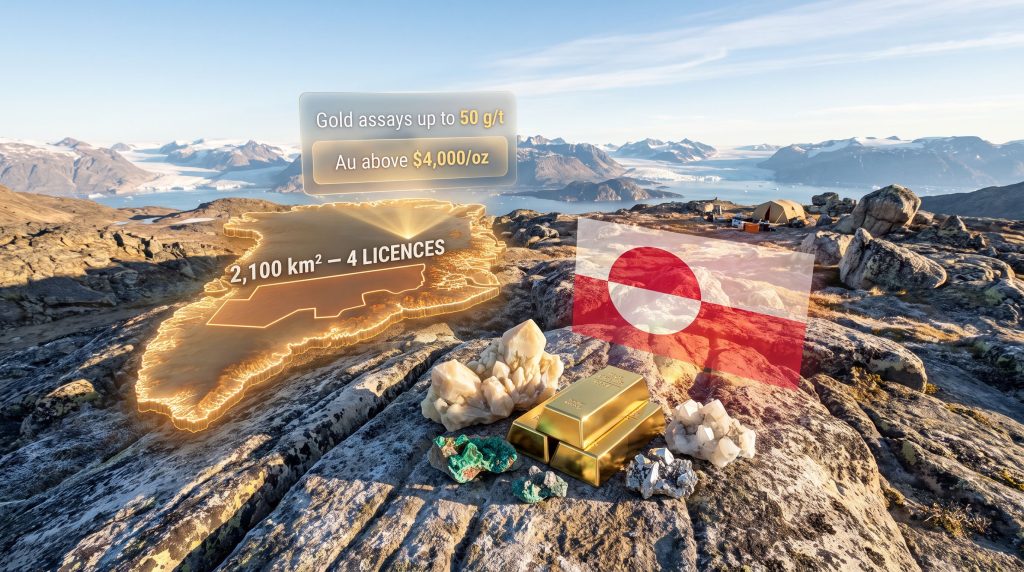
GreenX Metals, listed on the ASX, LSX, and Frankfurt Stock Exchange, has assembled what is now a substantial exploration landholding across East Greenland following the grant of two new exploration licences adding approximately 1,600 km² of additional tenure to its existing position. The total portfolio now covers approximately 2,100 km² across four licences, all within the Eleonore North project area. You can learn more about the company's broader strategic direction on the GreenX Metals official website.
The newly acquired ground sits approximately 100 km to the south of the existing licences, which is a meaningful consideration for exploration planning. Rather than simply extending a known corridor, the expansion opens access to a separate cluster of Caledonian intrusions that have never been evaluated through the lens of RIRGS geology.
| Licence Component | Approximate Area | Location Reference | Exploration Status |
|---|---|---|---|
| Existing Eleonore North licences | ~500 km² | Northern cluster, East Greenland | Active fieldwork underway |
| Two newly granted licences | ~1,600 km² | ~100 km south of existing tenure | Newly acquired, initial assessment phase |
| Total portfolio | ~2,100 km² | East Greenland | Four licences combined |
Historical Grades and What They Signal at This Stage
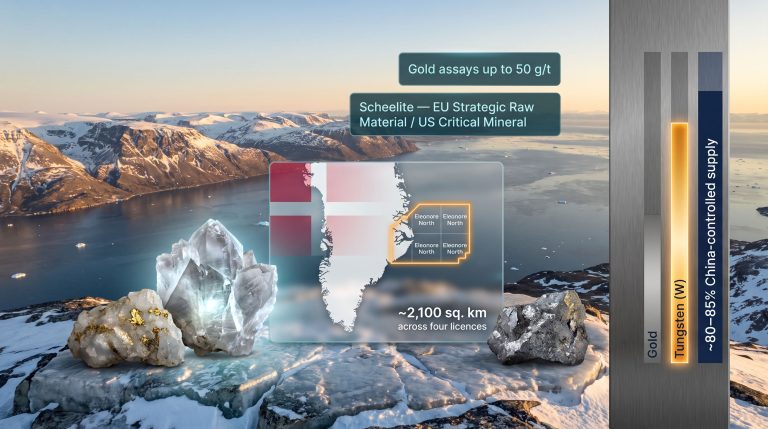
The newly acquired licence areas carry a meaningful historical data foundation. Gold assays of up to 50 g/t have been previously reported across these blocks, alongside extensive scheelite mineralisation confirmed through stream sediment sampling programmes. It is essential to contextualise these figures appropriately: historical stream sediment data and reconnaissance rock chip assays represent first-pass anomalism, not resource estimates. They indicate where mineralising systems have operated, not necessarily where economic concentrations exist at depth.
That said, reconnaissance-level gold grades of 50 g/t are not trivial. In analogous RIRGS terranes globally, including systems like Fort Knox in Alaska and Dublin Gulch in Canada's Yukon Territory, early reconnaissance anomalism of this character preceded significant discovery. The critical test now is whether systematic geological mapping and targeted sampling can confirm the RIRGS model is active across the newly expanded tenure. For further context on the broader Greenland critical minerals race, geopolitical dynamics are playing an increasingly important role in accelerating exploration investment.
Arctic Rift Copper: Diversification Within the Greenland Strategy
Beyond the Eleonore North gold and critical minerals focus, GreenX also holds a 51% joint venture interest in the Arctic Rift Copper Project in Greenland as of December 2024, with an earn-in pathway available to increase ownership to as much as 80%. Copper's role in electrification infrastructure, EV motor windings, and grid build-out gives this asset a different but complementary strategic rationale. Together, the two Greenland assets expose the company to a broad critical mineral commodity suite within a single, coherent jurisdictional strategy.
The RIRGS Model: What Investors and Geologists Need to Know
How RIRGS Deposits Form and Why the Model Matters
The RIRGS concept was systematically developed as an exploration framework in the 1990s and 2000s, partly through academic work on gold systems in Alaska and Canada's western Cordillera. Reduced intrusion-related systems form when auriferous fluids exsolve from crystallising granitic magmas under chemically reduced (low oxygen fugacity) conditions. These fluids migrate outward from the intrusion through surrounding rock packages, depositing gold and associated metals as temperature and pressure gradients change.
Key characteristics that exploration geologists use to identify RIRGS environments include:
- Reduced granitic host rocks lacking magnetite and containing ilmenite as the primary iron oxide phase
- Gold-tungsten-bismuth-molybdenum mineral associations in mineralised zones
- Sheeted vein arrays and stockwork mineralisation styles rather than single fault-controlled veins
- Scheelite (calcium tungstate) as a visible and mappable proxy mineral for tungsten-gold systems
- Moderate depth of formation, typically between 5 and 10 kilometres, implying structural preservation in erosion-resistant terrains
East Greenland's preservation of Caledonian intrusive complexes beneath relatively limited post-orogenic erosion makes it structurally analogous to proven RIRGS terranes. The key uncertainty is whether the intrusions present at Eleonore North are of the correct chemical character (sufficiently reduced) and whether the structural architecture has focused mineralising fluids into concentrated target zones.
Scheelite as a Critical Co-Product: The Tungsten Supply Chain Context
Scheelite mineralisation at Eleonore North carries significance well beyond its role as a gold pathfinder mineral. Understanding tungsten's strategic importance is essential here: China controls an estimated 80% or more of global tungsten production and holds dominant positions across refining and downstream processing as well. Both the EU and U.S. have formally classified tungsten as a Critical Raw Material.
Tungsten's industrial applications span defence (kinetic energy penetrators and armour-piercing munitions), cutting tool manufacturing, electronics, and emerging high-temperature applications. Unlike many critical minerals where substitution options exist, tungsten's unique physical properties — specifically its extraordinarily high melting point of 3,422°C — make it extremely difficult to replace in many applications.
The combination of near-zero Western primary tungsten production and no viable material substitute in critical defence applications creates a strategic supply vulnerability that Western governments are increasingly motivated to address through exploration investment in aligned jurisdictions.
Commodity-by-Commodity Strategic Value Assessment
What Each Target Mineral Means for the Portfolio Thesis
| Commodity | Critical Material Status | Primary Demand Driver | China Supply Concentration | Strategic Urgency |
|---|---|---|---|---|
| Gold | Strategic reserve asset | Central banks, electronics, safe haven | Low (diversified) | Moderate |
| Tungsten | EU and U.S. Critical Raw Material | Defence, cutting tools, electronics | Very High (80%+) | Very High |
| Antimony | EU and U.S. Critical Raw Material | Flame retardants, batteries, defence | Very High (estimated 70%+) | Very High |
| Copper | Energy transition critical mineral | EV motors, grid infrastructure, renewables | Moderate | High |
Antimony deserves particular attention because it receives less public discussion than tungsten despite carrying an equally severe supply concentration risk. Understanding antimony's vital industrial role helps contextualise why its co-occurrence with gold in certain geological systems means that RIRGS environments can carry antimony as an additional value driver. It is used in lead-acid battery alloys, flame retardant formulations, and increasingly in next-generation battery chemistries.
Greenland's Jurisdictional Profile: Why Sovereignty Matters to Investors
Rule of Law, Autonomous Governance, and the Licensing Framework
Greenland operates as an autonomous territory within the Kingdom of Denmark. While it manages its own internal affairs through the Naalakkersuismu government, it benefits from Danish constitutional protections and operates under a rule-of-law framework comparable to Western European standards. The Mineral Licence and Safety Authority (MLSA) functions as the primary regulatory body for mining and exploration activities.
This jurisdictional structure is genuinely differentiated from many frontier exploration environments. Compare it with analogous geological terranes in parts of Central Asia or West Africa, where sovereign risk, regulatory unpredictability, and enforcement uncertainty impose meaningful discount rates on exploration assets. Greenland's strategic mineral importance is consequently gaining significant attention from institutional investors seeking stable frontier exposure. Greenland carries none of those structural risks common to higher-risk jurisdictions.
For ESG-focused institutional investors, Greenland's governance framework also meets environmental regulatory standards consistent with EU norms, given its relationship with Denmark. This matters increasingly as institutional capital allocators apply more rigorous jurisdiction screening to resource investment decisions.
The next major ASX story will hit our subscribers first
Exploration Risk Assessment: An Objective Framework
Where the Uncertainty Lies at This Stage of the Programme
It is important that investors approach early-stage exploration with a calibrated understanding of what is known, what is inferred, and what remains speculative. The following risk matrix reflects the current status of GreenX's Greenland programme honestly.
| Risk Category | Current Assessment | Key Uncertainty |
|---|---|---|
| RIRGS model validity at Eleonore North | Unconfirmed; requires systematic testing | Whether intrusions are sufficiently reduced in chemistry |
| Historical data reliability | Reconnaissance-level; directionally useful | Sampling methodology and analytical standards from 1980s data |
| Geological scale of mineralisation | Unknown at depth | Drill testing required to assess vertical and lateral extent |
| Jurisdictional and regulatory risk | Low | Stable Danish-framework governance |
| Arctic logistics and access | Moderate challenge | Seasonal exploration windows; remote site logistics |
| Critical mineral co-product potential | High strategic relevance if confirmed | Subject to mineralisation confirmation |
This article contains forward-looking statements and exploration projections. Investors should conduct independent due diligence and consider the highly speculative nature of early-stage mineral exploration. Past exploration results do not guarantee future discovery outcomes.
2026 Field Season: What the Programme Is Testing
The Scientific Question Being Put to the Ground
GreenX has field teams actively conducting work across the expanded Eleonore North tenure during the 2026 exploration season. The programme encompasses geological mapping across newly acquired licence areas, systematic rock chip sampling of exposed intrusive contacts and mineralised zones, and stream sediment follow-up sampling designed to vector towards bedrock sources of gold and scheelite anomalism. Detailed information on the Eleonore North project scope is available on the official project page.
The fundamental scientific hypothesis being tested is whether the suite of Caledonian intrusions within the expanded licence package are genetically and chemically analogous to the reduced granitic systems that host economic RIRGS gold-tungsten deposits in Alaska and Canada. This is the first time these specific intrusions have been evaluated against that model, which represents a genuine knowledge gap in the exploration record of the region.
Key milestones to monitor through 2026 and into 2027 include:
- Release of rock chip and stream sediment assay results from systematic sampling of newly acquired licence areas
- Geological mapping outputs identifying priority intrusive targets for further investigation
- Determination of drill-ready target status based on fieldwork data integration
- Any structural or geochemical evidence confirming reduced oxidation state of sampled intrusions
- Potential identification of near-surface scheelite zones amenable to further resource-stage work
Scenario Pathways: Where the Programme Could Go From Here
Three Development Trajectories for Investors to Consider
Bull case: Systematic 2026 fieldwork confirms RIRGS-compatible geochemical signatures across multiple Caledonian intrusions. Rock chip sampling returns high-grade gold-tungsten-scheelite results at several target zones. Drill-ready targets are defined by end of the field season, enabling a drilling programme to commence in 2027. Discovery of a structurally significant gold-tungsten system attracts strategic investor interest from European or American critical mineral supply chain participants.
Base case: Fieldwork narrows the target inventory from the broad tenure to one or two high-priority intrusive complexes. Geochemical data confirms RIRGS-favourable characteristics at selected targets but requires further work before drilling can be justified. A phased drilling programme is consequently planned for 2027 subject to funding and regulatory approvals.
Bear case: Geochemical and geological mapping data fails to confirm reduced intrusion chemistry across the sampled licence areas. Gold and scheelite anomalism proves to be dispersed and structurally unorganised, reducing the probability of economic concentration at depth. Portfolio reassessment and strategic review of Greenland tenure prioritisation is therefore required.
Each of these pathways is plausible at this stage. The binary nature of early-stage exploration means that near-term field results carry disproportionate weight in determining project trajectory and market valuation. Coverage of the GreenX Greenland gold and critical minerals portfolio has been reported in detail by Kalkine Media, providing additional context for investors tracking this programme.
Frequently Asked Questions
What is the GreenX Greenland gold and critical minerals portfolio?
The GreenX Greenland gold and critical minerals portfolio comprises four exploration licences covering approximately 2,100 km² in East Greenland, held under the Eleonore North project. The portfolio targets gold, tungsten, antimony, and copper using a RIRGS geological exploration model applied to Caledonian intrusive complexes.
What makes the RIRGS model appropriate for East Greenland?
Caledonian granitic intrusions in East Greenland share structural and compositional characteristics with known RIRGS host environments in Alaska and Canada's Yukon. The co-occurrence of gold assays up to 50 g/t and scheelite mineralisation from historical reconnaissance work aligns with the diagnostic geochemical signatures of RIRGS systems.
Why is tungsten considered a critical mineral?
Tungsten is classified as a Critical Raw Material by both the EU and the United States due to its concentration of production in China, which controls an estimated 80% or more of global supply, combined with its irreplaceable role in defence applications, cutting tools, and high-temperature industrial processes. Its exceptionally high melting point of 3,422°C makes substitution technically impractical in most strategic applications.
Does GreenX hold any other Greenland assets?
Yes. In addition to Eleonore North, GreenX holds a 51% interest in the Arctic Rift Copper Project in Greenland through a joint venture, with an earn-in option available to increase that ownership to up to 80%.
What are the main risks facing the Eleonore North programme?
The principal risks include the unproven status of the RIRGS model at Eleonore North (no drilling has yet confirmed the geological hypothesis), the reconnaissance-level quality of historical data, seasonal Arctic logistics constraints, and the funding requirements associated with transitioning from fieldwork to a systematic drilling programme.
For broader context on global critical mineral supply chain dynamics and Greenland's evolving role in Arctic resource development, readers may consult reporting available at Mining Weekly, which covers the global mining sector including frontier exploration jurisdictions.
Want to Know When the Next Major Mineral Discovery Hits the ASX?
Discovery Alert's proprietary Discovery IQ model scans ASX announcements in real time, instantly alerting subscribers to significant mineral discoveries across gold, tungsten, copper, and other critical commodities — turning complex geological data into actionable investment insights before the broader market catches on. Explore historic discovery returns on Discovery Alert's dedicated discoveries page and begin your 14-day free trial today to position yourself ahead of the next major find.