August 5, 2026
When Rock Becomes the Enemy: Understanding Deep Underground Seismic Risk in Modern Copper Mining
Deep underground mining has always involved a fundamental tension between the pursuit of ore and the behaviour of the surrounding rock mass. As mines extend further below surface, the physics of that relationship change dramatically. Rock that behaves predictably at shallow depths can exhibit sudden, violent responses to excavation at depth, releasing stored strain energy in ways that challenge even the most sophisticated geomechanical models. This is the technical frontier where Codelco halts El Teniente expansion project development, and it is precisely this frontier that has forced a pause on one of its most strategically significant projects.
The decision by Codelco to halt all development and construction activities at the Andes Norte expansion of its El Teniente division is not simply a news event. It is a window into the geological, operational, and safety complexities that define the future of copper mining globally.
When big ASX news breaks, our subscribers know first
El Teniente and the Andes Norte Expansion: Context and Strategic Weight
El Teniente, located in the Andes mountains of central Chile, holds the distinction of being the largest underground copper mine in the world by both scale and historical output. The mine has been in continuous operation for over a century and represents a cornerstone of Codelco's production portfolio, which in turn underpins a significant portion of Chile's sovereign revenue and export earnings.
Chile's copper supply gap is a matter of serious concern, particularly given that Chile controls approximately 23% of global identified copper reserves, according to the US Geological Survey. Consequently, Codelco's ability to execute on its expansion pipeline carries national economic weight as much as corporate significance.
The Andes Norte project was designed to extend El Teniente's productive life by accessing deeper ore bodies through block cave mining techniques. Block caving is a large-scale, low-cost underground mining method that relies on gravity to fragment and draw down ore after undercutting the base of a mineralised column. It is particularly well-suited to massive low-grade porphyry copper deposits like El Teniente, but it introduces complex geomechanical stresses as extraction voids expand progressively underground.
Andes Norte sits within Codelco's broader structural renewal program, a multi-billion dollar portfolio of projects designed to sustain and grow the company's production base over the next several decades. Other major projects within this portfolio include Rajo Inca at Salvador and the New Mine Level at El Teniente itself. The program has faced repeated cost escalations and timeline delays, and the Andes Norte suspension adds a new layer of pressure to an already strained capital allocation framework.
What Triggered the Codelco Halts El Teniente Expansion Decision
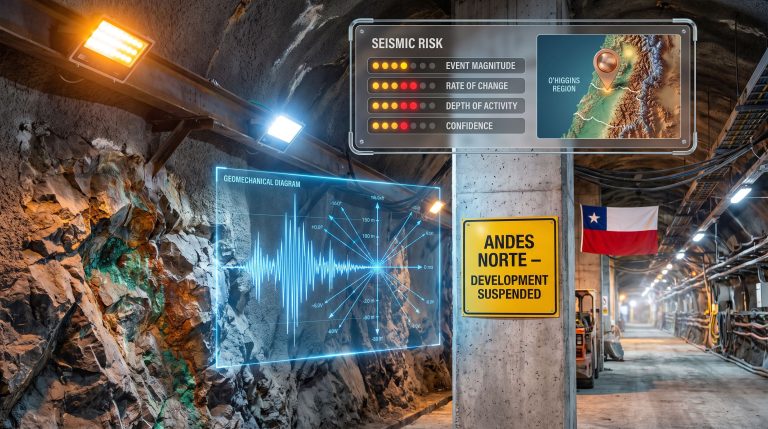
The suspension did not arise from a single acute event but from the findings of an extended technical review process spanning approximately six months. Geomechanical monitoring at depth identified a seismic phenomenon that differs categorically from the types of seismic activity El Teniente has historically encountered and managed. Codelco classified the halt as a preventive safety measure rather than a reactive response to damage or injury.
This distinction is important. Preventive suspensions based on monitoring data signal a maturation in mining safety culture, one where instrumentation networks and geomechanical modelling are given sufficient authority to stop billions of dollars of development work before a catastrophic event occurs.
Rock Bursts: The Physics of Stored Energy Release
To understand what Codelco's geomechanical teams identified, it helps to understand the mechanics of rock bursts. A rock burst is a sudden, violent failure of rock under high stress conditions in an underground mine environment. When excavation removes the confining pressure that previously stabilised a high-stress zone, stored strain energy can be released instantaneously, projecting fragmented rock into excavated openings with extraordinary force.
Several conditions combine to create elevated rock burst risk in deep block cave operations:
- Depth below surface: Stress increases with depth at approximately 0.027 MPa per metre in average crustal conditions, though tectonic settings can amplify this significantly
- Rock mass stiffness: Competent, brittle rock stores more elastic strain energy than ductile rock and releases it more violently upon failure
- Geological discontinuities: Faults, dykes, and contact zones create stress concentrations and potential slip surfaces
- Excavation geometry: Large cave footprints and undercut dimensions alter stress trajectories across wide areas
- Rate of extraction: Rapid caving advance can mobilise stress changes faster than the rock mass can adjust through gradual deformation
El Teniente's geology is characterised by a large porphyry copper system with extensive hydrothermal alteration and multiple intrusive phases. The mine sits within a zone of active tectonics, and the interaction between mining-induced stress changes and the natural tectonic stress field at depth creates a geomechanical environment of exceptional complexity.
The July 2025 Fatal Incident and Its Legacy on Safety Protocols
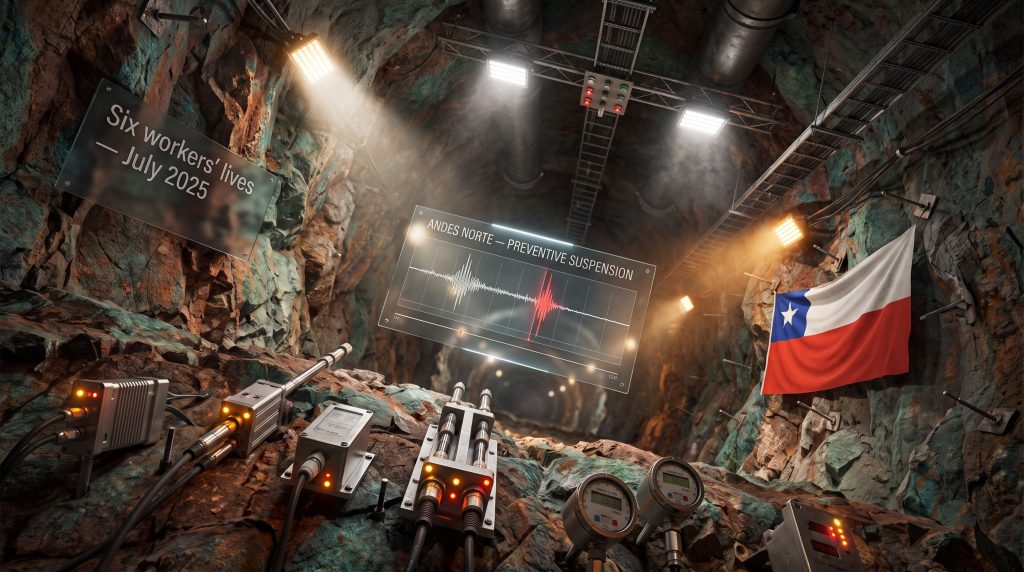
The backdrop to the Andes Norte suspension cannot be fully understood without reference to a fatal rock burst event at El Teniente in July 2025 that claimed the lives of six workers. That tragedy elevated geomechanical scrutiny across the entire operation, prompting a comprehensive review of monitoring protocols, excavation designs, and risk thresholds.
While Codelco has indicated the Andes Norte suspension is based on newly identified seismic data specific to that development front, the institutional response to the July 2025 event clearly shaped the precautionary framework within which subsequent risk assessments were conducted. The mine's safety culture was already under intense internal and regulatory scrutiny when the anomalous seismic patterns were detected at Andes Norte.
Mining safety experts broadly recognise that fatal incidents in underground operations tend to catalyse more conservative risk thresholds across entire operations, not just at the specific locations where incidents occur. The decision to halt Andes Norte reflects this broader recalibration.
Geomechanical Risk Management: How the Industry Approaches Deep Underground Seismic Hazards
The tools available to geomechanical engineers have improved substantially over the past two decades, but the fundamental challenge of predicting rock mass behaviour at depth under changing stress conditions remains formidable. The following table summarises the primary risk management approaches deployed at major deep underground operations:
| Risk Management Approach | Core Function | Application in Deep Block Cave Mining |
|---|---|---|
| Microseismic monitoring networks | Detect and locate seismic events in real time | Maps stress migration patterns as caving progresses |
| Numerical stress modelling | Simulates rock mass response to excavation | Predicts stress concentrations and failure zones |
| Extensometer arrays | Measures rock displacement at specific points | Identifies zones of abnormal deformation |
| In-situ stress testing | Quantifies actual stress magnitudes and orientations | Calibrates numerical models to site conditions |
| Preventive suspension protocols | Halts work in elevated-risk zones | Applied at Andes Norte following anomaly identification |
| Independent geotechnical review | External expert verification of risk assessments | Ensures objectivity in high-stakes decisions |
Enhancing Instrumentation: What Codelco's Next Steps Likely Involve
Codelco has indicated its intention to strengthen instrumentation and monitoring systems at Andes Norte before any restart determination is made. In practice, this typically involves several parallel workstreams:
- Densifying the microseismic sensor network to improve spatial resolution of event locations and source mechanisms
- Installing additional displacement monitoring including extensometers, multi-point borehole extensometers, and convergence monitoring stations
- Running back-analysis of detected seismic events to characterise the specific failure mechanisms involved
- Updating numerical models with revised rock mass parameters calibrated to observed behaviour
- Engaging independent geotechnical review panels to scrutinise findings and provide external validation before any work recommences
- Assessing design modifications that could redistribute stress away from high-risk zones, potentially involving changes to excavation sequencing or undercut geometry
No confirmed restart timeline has been communicated, which is consistent with the nature of geomechanical investigations of this complexity. Resolution could take months to years depending on what the enhanced monitoring reveals.
Production Implications: Separating Current Output from Future Capacity
A critical distinction for anyone assessing the commercial significance of this decision is the separation between Codelco's current copper production at El Teniente and the future production capacity that Andes Norte was intended to deliver. The suspension does not affect active production sectors of the mine, which continue to operate under their own geomechanical management frameworks.
| Timeframe | Impact Category | Assessment |
|---|---|---|
| Immediate (0 to 6 months) | Current copper output from El Teniente | Minimal – existing production unaffected |
| Medium-term (6 to 24 months) | Andes Norte development timeline | Significant delay – no restart date confirmed |
| Long-term (2+ years) | Future production growth capacity | Dependent on geotechnical resolution and design response |
The longer-term picture is more concerning from a supply perspective. Copper demand is projected to increase substantially through the 2030s, driven by electric vehicle battery systems, grid-scale energy storage, wind and solar generation infrastructure, and data centre buildout. The International Energy Agency has estimated that copper demand could nearly double by 2040 under accelerated energy transition scenarios, while new mine supply development continues to face significant lead time and technical challenges.
If the Andes Norte suspension extends beyond 24 months, it could materially compress Codelco's production growth trajectory at precisely the point when global demand is expected to accelerate most sharply. Furthermore, the Chile copper outlook for longer-term supply growth depends heavily on the successful resolution of exactly these kinds of technical challenges.
Global Benchmarks: How Other Deep Underground Copper Mines Handle Seismic Risk
El Teniente is not unique in facing elevated seismic hazards at depth. Several of the world's major underground copper and base metal operations contend with comparable or greater challenges:
- Chuquicamata Underground (Chile): Codelco's transition of Chuquicamata from open pit to underground block cave operation involves its own set of high-stress geomechanical challenges, though the geological environment differs from El Teniente's hydrothermal porphyry system
- Kidd Creek (Canada): One of the deepest base metal mines in the world at over 3,000 metres, with decades of experience managing rockburst conditions using yielding support systems and intensive seismic monitoring
- South African deep gold mines: Operations in the Witwatersrand Basin have produced extensive research on rockburst mechanics and mitigation, including the development of energy-absorbing support elements now used globally
- Olympic Dam (Australia): While at shallower depths, the scale of the proposed underground expansion highlights how geomechanical complexity scales with excavation size even in lower-stress environments
Emerging Technologies Reshaping Underground Seismic Hazard Assessment
The frontier of underground seismic risk management is increasingly intersecting with advanced data analytics and machine learning. Indeed, underground copper mining technology is evolving rapidly to address precisely these kinds of challenges. Several developments are reshaping how mines anticipate and respond to seismic hazards:
- Waveform-based source mechanism analysis allows engineers to distinguish between different failure types, including shear slip on pre-existing structures versus new fracture propagation through intact rock
- Machine learning classification of microseismic events is improving the signal-to-noise ratio of monitoring systems, filtering out blast-related signals and mechanical noise to isolate genuine stress-driven events
- Digital twin modelling of underground excavations enables continuous updating of stress state predictions as mining progresses, integrating real sensor data with numerical model outputs
- Probabilistic hazard assessment frameworks, borrowed from earthquake engineering, are being adapted for underground mining environments to quantify risk levels and define intervention thresholds more rigorously
These technologies do not eliminate geomechanical risk, but they give operators better tools to detect when conditions are departing from expected behaviour, which is precisely the capability that enabled Codelco to identify the anomalous seismic phenomenon at Andes Norte before it produced catastrophic consequences.
The next major ASX story will hit our subscribers first
The Broader Stakes: Codelco's Financial Position and Chile's Copper Future
Codelco has faced significant financial pressure over recent years, with its structural renewal program consuming substantial capital while production volumes have at times disappointed expectations. The state-owned enterprise carries considerable debt, and any prolonged suspension of a major development project compounds the tension between capital expenditure commitments and revenue generation capacity.
The Codelco production strategy has broader implications beyond corporate balance sheets. For the Chilean government, which receives dividends and royalties from Codelco's operations, project delays translate directly into reduced fiscal headroom at a time when the country is navigating complex decisions about mining taxation and environmental regulation.
The safety-driven decision to halt Andes Norte represents exactly the kind of governance trade-off that defines responsible state enterprise management: prioritising worker safety and long-term operational integrity over short-term production and financial targets. How Codelco navigates the technical resolution of the Andes Norte seismic challenge will be closely watched as a signal of the organisation's geomechanical capabilities and institutional resilience.
Frequently Asked Questions: Codelco Halts El Teniente Expansion Project
What has Codelco specifically halted at El Teniente?
All development and construction activities at the Andes Norte expansion project have been suspended. Existing production operations across other sectors of the El Teniente mine continue normally and are not affected by the decision.
What caused the Andes Norte suspension?
Technical analysis conducted over approximately six months identified a seismic phenomenon at depth that represents a different category of risk from the geomechanical conditions El Teniente has historically managed. Codelco characterised the halt as a preventive safety measure based on monitoring data rather than a response to an acute incident.
Is this connected to the July 2025 fatal incident at El Teniente?
A fatal rock burst event at El Teniente in July 2025 killed six workers and substantially elevated geomechanical scrutiny across the operation. While the Andes Norte suspension is grounded in newly identified seismic data at that specific development front, the broader safety review environment following the July 2025 tragedy has informed the precautionary decision-making framework.
When will Andes Norte construction resume?
No confirmed restart date has been provided. Codelco has indicated it will enhance instrumentation and monitoring systems and complete further technical analysis before determining when and under what conditions work can safely recommence. However, mining-technology.com reports that the scope of geomechanical investigation suggests this process may extend considerably.
Does this affect copper prices or global supply?
Current copper production from El Teniente is not materially affected. However, a prolonged suspension could compress Codelco's future production growth capacity at a time when global copper demand is rising. The market implications grow more significant the longer the development delay extends.
What is a rock burst and why is it dangerous underground?
A rock burst is the sudden, violent release of stored strain energy in underground rock, typically triggered when excavation reduces the confining pressure stabilising a high-stress zone. In deep block cave environments, the combination of elevated in-situ stress, brittle rock, and large excavation voids significantly amplifies the probability and severity of such events.
Key Takeaways for the Mining Industry
-
Preventive suspensions based on monitoring data represent a meaningful evolution in underground mining safety culture, moving the industry toward intervention before catastrophe rather than in response to it
-
Deep block cave geomechanics remain one of the most technically demanding challenges in modern mining, with risk profiles that can change significantly as excavations extend further below surface
-
The July 2025 fatal incident at El Teniente has had lasting institutional consequences for how Codelco assesses and responds to geomechanical risk signals across its operations
-
Copper supply chain resilience depends on the industry's ability to resolve deep underground geomechanical challenges without compromising worker safety or long-term production capacity
-
Advanced monitoring technologies including microseismic networks, digital twin modelling, and machine learning classification are becoming essential infrastructure for managing seismic hazard in next-generation underground copper mines
-
Codelco's technical and financial navigation of the Andes Norte suspension will serve as a reference point for how state-owned mining enterprises balance safety obligations, capital constraints, and production commitments under increasingly complex geomechanical conditions
Want to Stay Ahead of Major ASX Mineral Discoveries Before the Broader Market?
Discovery Alert's proprietary Discovery IQ model delivers real-time alerts on significant ASX mineral discoveries — turning complex geological and commodity data into actionable investment insights for both short-term traders and long-term investors. Explore how historic discoveries have generated substantial returns on Discovery Alert's dedicated discoveries page, and begin your 14-day free trial today to position yourself ahead of the market.