
July 27, 2026
Manufacturing Overcapacity Drives Unprecedented Cost Compression
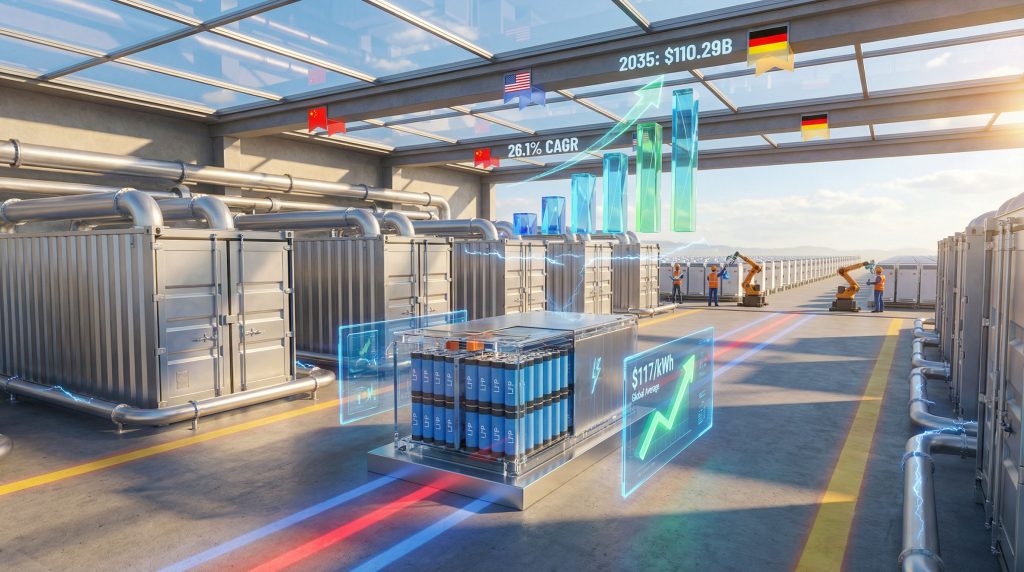
The battery energy storage landscape witnessed remarkable transformation throughout 2025, with costs keep falling boosting BESS deployment across all market segments. Turnkey BESS systems achieved pricing of $117 per kilowatt-hour, representing a dramatic 70% reduction from 2022 levels and a 31% year-on-year decline from 2024 pricing structures.
This cost compression stems primarily from Chinese manufacturing overcapacity creating sustained downward pressure on global pricing mechanisms. Chinese manufacturers achieved remarkable cost efficiency, delivering systems at $63/kWh compared to European pricing of $120/kWh, establishing a significant competitive moat that influences global market dynamics.
The scale of this transformation becomes evident when considering that 2025 capital expenditures could construct battery systems three times larger in megawatt-hour capacity compared to equivalent investments made in 2022. This fundamental shift in cost-performance ratios enables previously uneconomical applications to achieve positive investment returns without subsidy support.
Key Manufacturing Dynamics:
- Chinese production capacity substantially exceeds current global demand
- Factory-assembled modular systems reduce installation complexity by 40-60%
- Lithium carbonate price normalisation following 2022-2023 volatility
- Integrated supply chain advantages reducing component procurement costs by 15-25%
When big ASX news breaks, our subscribers know first
Technology Maturation Reaches Critical Commercial Thresholds
Lithium iron phosphate (LFP) battery chemistry has achieved technological maturity, with cost optimisation opportunities becoming increasingly marginal. Industry analysis indicates that LFP systems have reached their cost reduction plateau, with future improvements dependent on manufacturing scale rather than fundamental technological breakthroughs.
However, three distinct technological pathways are emerging that could sustain long-term cost decline trajectories alongside energy transition materials development. Furthermore, these innovations complement lithium industry innovations currently transforming the sector.
Sodium-Ion Technology Commercialisation
Sodium-ion battery systems have transitioned from laboratory development to early commercial deployment, with operational projects functioning across Switzerland, China, and the United States. This technology offers particular advantages for stationary storage applications where energy density requirements are less stringent than automotive applications.
Advanced Anode Material Evolution
Manufacturing processes are shifting from silicon oxide-based anodes toward silicon-carbon solutions, which demonstrate improved performance characteristics in grid-scale applications. Graphite-silicon blends are emerging as intermediate solutions that balance cost and performance considerations for large-scale deployments.
All-Solid-State Battery Development
Although deployment timelines remain distant, industry development efforts are coalescing around sulfide-based architectures as the most viable pathway for mainstream commercialisation. These systems could offer significant safety and performance advantages for utility-scale installations.
Global Deployment Acceleration Exceeds All Projections
Battery energy storage deployments achieved unprecedented scale throughout 2025, with 104 GW of new capacity additions representing 257 GWh of energy storage. This brought cumulative global capacity to 267 GW and 610 GWh, surpassing the 100 GW annual installation milestone for the first time in industry history.
Remarkably, 40% of all cumulative BESS capacity was installed during 2025 alone, demonstrating the exponential growth trajectory characterising this market segment. This deployment pattern reflects the convergence of technological readiness, economic viability, and policy support mechanisms across multiple geographic markets.
Regional Deployment Leadership Analysis:
| Region | 2025 Capacity Additions | Market Share | Growth Driver |
|---|---|---|---|
| China | 65+ GW | 62% | Manufacturing integration |
| United States | 12 GW | 12% | Policy support mechanisms |
| Australia | 3.2 GW | 3% | Grid stability requirements |
| Saudi Arabia | 2.8 GW | 2.7% | Vision 2030 initiatives |
| Canada | 1.9 GW | 1.8% | Renewable integration |
China maintains overwhelming market dominance, leveraging integrated manufacturing capabilities and domestic demand to achieve cost leadership positions. In addition, the United States demonstrates steady growth supported by federal policy initiatives, while Australia's rapid adoption reflects urgent grid stability requirements as renewable penetration increases.
Commercial Sector Applications Drive Market Expansion
The commercial energy storage segment has emerged as a primary growth driver, with costs keep falling boosting BESS adoption across previously uneconomical applications. Peak demand charge management systems now generate positive returns in most developed markets, creating substantial deployment opportunities for distributed storage systems.
Electric vehicle charging infrastructure represents a particularly compelling application, where battery storage systems enable load balancing and demand charge optimisation. Consequently, data centres are transitioning from diesel generator backup systems toward battery-based solutions, driven by reliability improvements and environmental considerations.
Commercial Application Economic Thresholds:
- Peak shaving applications: ROI achieved at $150/kWh system costs
- EV charging demand management: Positive returns at current pricing levels
- Data centre backup power: 5-7 year payback periods versus diesel systems
- Grid services revenue stacking: $200-400/kW annual revenue potential
The convergence of declining costs and expanding revenue opportunities creates multiple pathways for commercial energy storage investment returns, supporting accelerated market penetration across diverse applications. Furthermore, battery metals investment opportunities continue expanding across this growing sector.
Long-Term Service Agreements Transform Project Economics
Battery manufacturers have extended Long-Term Service Agreements (LTSAs) from traditional 20-year terms to 25-year agreements, providing enhanced project financing certainty. These warranties guarantee 60-70% state-of-health maintenance over the contract duration, assuming standard cycling patterns.
Major manufacturers including CATL, Fluence, BYD, Tesla, and others now offer these extended warranty terms, fundamentally altering project risk profiles and enabling longer-term financing structures. This warranty evolution reflects manufacturer confidence in battery durability and supports utility-scale project development by reducing technology risk premiums.
LTSA Impact on Project Financing:
- Debt financing terms extended from 15 to 20+ years
- Interest rate premiums reduced by 50-100 basis points
- Insurance costs decreased by 20-30% due to manufacturer guarantees
- Project IRR improvements of 100-200 basis points
Moreover, innovations in battery recycling breakthrough technologies are extending system lifecycle value propositions.
"Battery storage systems have achieved economic viability thresholds where energy arbitrage, peak shaving, and grid services generate positive returns without subsidies in most developed markets, fundamentally altering infrastructure investment calculations."
Grid Connection Challenges Create Development Bottlenecks
Despite favourable technology and cost trends, grid interconnection processes have emerged as significant project development constraints. Germany exemplifies these challenges, with extended interconnection queues creating substantial project delays and additional development costs.
Grid upgrade requirements typically add 15-30% to total project costs, while permitting processes extend development timelines by 12-24 months in mature markets. These infrastructure bottlenecks represent the primary constraint on BESS deployment acceleration rather than technology or economic factors.
Grid Integration Challenges by Region:
- Germany: Extended interconnection queues, 18-month average delays
- United States: Regional transmission planning complexity
- Australia: Network service provider coordination requirements
- United Kingdom: Distribution network upgrade costs
Policy frameworks are evolving to address these constraints, with regulatory authorities updating grid codes to accommodate high-penetration storage scenarios and streamlining interconnection procedures.
The next major ASX story will hit our subscribers first
Long-Duration Storage Opportunities Emerge Beyond Lithium-Ion
While lithium-ion systems dominate current deployments, long-duration energy storage (LDES) technologies targeting 8+ hour discharge durations are gaining traction. Currently, only 0.5 GW of LDES projects operate outside China, with most pipeline projects still utilising lithium-ion technology rather than alternative storage mechanisms.
Policy support remains critically important for LDES project development, as energy arbitrage revenues alone cannot support project economics for extended duration systems. Revenue stacking opportunities combining energy arbitrage with grid services provide the most viable pathway for LDES commercialisation.
Alternative Storage Technology Readiness:
- Flow batteries: Commercial deployment for 8+ hour applications
- Compressed air energy storage: Targeting 10-24 hour discharge requirements
- Thermal storage: Industrial heat applications creating new demand segments
- Hydrogen production: Seasonal storage integration pathways
Investment Opportunities Across the Value Chain
The dramatic cost reductions create differentiated investment opportunities across the battery energy storage value chain. Manufacturing capacity investments require $2-5 billion capital commitments with 7-10 year payback periods but offer substantial returns for organisations achieving scale economies.
System integration and project development present more accessible entry points with $10-500 million capital requirements and shorter payback periods. These segments benefit from expanding market demand without requiring massive manufacturing infrastructure investments.
Investment Risk-Return Analysis:
| Investment Category | Capital Requirements | Payback Period | Risk Profile |
|---|---|---|---|
| Cell Manufacturing | $2-5 billion | 7-10 years | High technology, market risk |
| System Integration | $50-200 million | 3-5 years | Medium operational risk |
| Project Development | $10-100 million | 2-4 years | Low-medium regulatory risk |
| Component Supply | $25-150 million | 4-6 years | Medium supply chain risk |
Early-stage technologies such as sodium-ion batteries and second-life battery applications present higher-risk, higher-return opportunities for investors willing to accept technology development uncertainties. Additionally, lithium refinery developments create upstream value chain opportunities.
Regional Market Dynamics Shape Competitive Landscapes
Asia-Pacific markets maintain manufacturing leadership positions, with China's integrated ecosystem supporting continued cost advantages. India's utility-scale procurement programmes are achieving record-low storage tariffs, while Australia's grid stability requirements drive rapid capacity additions despite higher system costs.
North American markets demonstrate strong policy support through federal initiatives, with state-level clean energy mandates creating procurement pipeline certainty. The projected 27.12% compound annual growth rate reflects aggressive renewable integration targets and grid modernisation requirements.
European markets face higher system costs but benefit from stable regulatory frameworks and established project financing mechanisms. The $120/kWh regional pricing reflects higher labour costs and more stringent safety requirements compared to Asian manufacturing centres.
Technology Integration Drives System Performance Improvements
Modular containerised systems have reduced site preparation and installation complexity by 30-50%, accelerating project deployment timelines and reducing overall system costs. These factory-assembled solutions minimise on-site construction requirements and improve system reliability through standardised manufacturing processes.
Advanced battery management systems enable more sophisticated grid services participation, allowing storage systems to provide multiple revenue streams simultaneously. Frequency regulation, voltage support, and energy arbitrage services can be combined to optimise system revenue generation.
System Integration Advantages:
- Reduced installation time from 6-9 months to 3-4 months
- Standardised safety systems and fire suppression equipment
- Integrated power conversion and grid interconnection equipment
- Remote monitoring and predictive maintenance capabilities
According to recent analysis from Battery Energy Storage Systems, pricing continues to decline sharply across all market segments. Furthermore, industry research indicates that global BESS demand jumped 51% in 2025 as installations topped 300 GWh.
Market Transformation Implications for Energy Infrastructure
The convergence of falling costs, technological maturity, and expanding applications creates a fundamental shift in global energy infrastructure investment patterns. Organisations positioned to capitalise on manufacturing scale advantages, system integration expertise, and grid-scale project development capabilities will capture disproportionate value as storage deployment accelerates.
Costs keep falling boosting BESS deployment across utility-scale, commercial, and residential segments, with projected market growth from $10.42 billion in 2025 to $110.29 billion by 2035. This represents a 26.61% annual growth rate as applications become economically viable without subsidy support.
The dramatic cost reductions fundamentally alter energy system economics, enabling higher renewable energy penetration, improved grid reliability, and new business models based on energy storage arbitrage. However, investment strategies focusing on technology integration, project development expertise, and strategic market positioning will generate superior returns as this transformation accelerates through the remainder of the decade.
Consequently, costs keep falling boosting BESS adoption creates unprecedented opportunities for organisations capable of leveraging these technological and economic shifts effectively. The convergence of favourable market conditions, policy support, and technological readiness establishes a foundation for sustained sector growth throughout the next decade.
Searching for Battery Energy Storage Investment Opportunities?
Discovery Alert's proprietary Discovery IQ model delivers real-time alerts on significant mining discoveries that supply critical materials for the rapidly expanding battery energy storage sector, helping investors identify actionable opportunities before they hit the mainstream market. With BESS costs plummeting and demand soaring, explore how major mineral discoveries have historically generated substantial returns and begin your 30-day free trial today to position yourself ahead of this transformative market shift.