
July 27, 2026
When Geopolitical Pause Meets Earnings Season: How Markets Navigate Dual-Catalyst Weeks
Few market environments test investor conviction more thoroughly than a week where geopolitical risk and high-stakes corporate earnings arrive simultaneously. The natural instinct is to treat these as separate variables, but experienced market participants understand they interact in complex, often amplifying ways. When a Middle East diplomatic pause coincides with the most closely watched earnings reports of the calendar year, the resulting cross-currents can produce sharp moves in either direction with very little warning.
This is precisely the environment Australian and global investors face heading into Week 31 of 2026. Trump delays Iran escalation and US tech earnings ahead is the phrase dominating trading desks right now. However, the actual market dynamics beneath that headline are considerably more nuanced and deserve careful unpacking. Understanding how tariffs and market impact feed into this dual-catalyst environment adds another layer of complexity for investors to consider.
When big ASX news breaks, our subscribers know first
The Anatomy of a Diplomatic Pause: Why Tactical Delay Is Not De-Escalation
Markets have a persistent tendency to interpret any pause in geopolitical tension as a meaningful step toward resolution. This is a well-documented behavioural bias, and one that has repeatedly burned investors who mistake a tactical deferral for genuine strategic retreat.
The current situation involving Iran follows a pattern that has appeared multiple times across the past two decades of U.S.-Iran relations. What traders are pricing is not peace, but rather a temporary reduction in the probability of near-term military action. The option of escalation has not been removed from the table — it has simply been deferred. That distinction carries real financial consequences.
Gulf state intermediaries, particularly Saudi Arabia, Qatar, and the UAE, play a structurally underappreciated role in shaping these timelines. These nations operate with their own strategic imperatives around oil pricing, regional stability, and bilateral relationships with Washington. When these states apply coordinated pressure toward a diplomatic window, the result is often a conditional pause rather than a foundational shift in U.S. policy. Furthermore, markets that price in the latter when only the former has occurred tend to face rapid repricing when negotiations stall or break down.
Oil Price as the Primary Transmission Mechanism
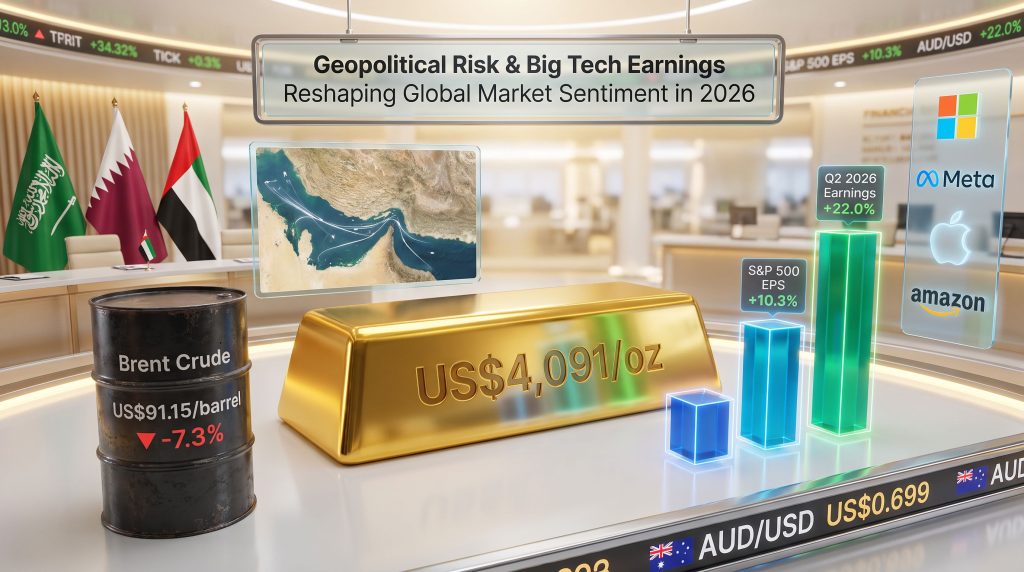
The most direct financial expression of this geopolitical shift has been visible in crude oil markets. Brent Crude declined -7.3% to US$91.15 per barrel, a move that reflects a partial unwinding of the war risk premium that had been embedded in energy prices during peak tension periods.
The structural geography here matters enormously. The Strait of Hormuz handles approximately 20% of global oil supply in transit volume, making it one of the most consequential maritime chokepoints on the planet. Any credible threat to that corridor produces an almost instantaneous response in crude futures, and conversely, any diplomatic signal that reduces that threat allows some of that premium to exit the price.
Historical U.S.-Iran confrontations have consistently produced an asymmetric price dynamic: crude spikes fast on escalation signals but recovers more slowly as diplomatic processes unfold. The oil price shock dynamic is well understood by energy executives, and the current -7.3% decline reflects a partial unwind, not a full normalisation. This matters for ASX energy sector investors, who must distinguish between a temporary relief rally and a durable change in the underlying supply risk equation.
| Scenario | Crude Oil Impact | ASX Energy Sector | Global Risk Appetite |
|---|---|---|---|
| Full military escalation | Sharp spike (+15-25%) | Short-term boost, long-term uncertainty | Risk-off, defensive rotation |
| Prolonged negotiation stalemate | Moderate premium (+5-10%) | Elevated but volatile | Mixed, sector-dependent |
| Verified diplomatic deal | Price normalisation | Pullback in energy premiums | Risk-on, growth assets favoured |
| Current: tactical pause | Partial relief (-7.3% recent) | Cautious optimism | Tentative risk-on |
A single breakdown in Iran negotiations would rapidly reinstate the oil price war premium that the current pause has partially unwound. Traders should treat Strait of Hormuz shipping traffic and maritime insurance premium movements as real-time conflict probability indicators rather than waiting for official statements.
What the Earnings Cycle Reveals About Corporate America's Structural Resilience
While geopolitical dynamics dominate the risk-off conversation, the earnings backdrop entering Week 31 presents a genuinely compelling picture of corporate health. The S&P 500 is tracking a fourth consecutive quarter of double-digit profit growth, with year-over-year EPS growth projected at approximately 10.3% for the most recent reporting period.
More striking is the FactSet projection pointing to Q2 2026 S&P 500 earnings growth of approximately 22.0%. If confirmed, this would represent back-to-back quarters above the 20% EPS growth threshold — a historically rare achievement that signals not just cyclical recovery but structural margin expansion across large-cap U.S. corporations.
The Four Reports That Will Define Equity Market Direction
Within this earnings cycle, four mega-cap technology companies carry disproportionate weight:
-
Microsoft remains the purest proxy for enterprise AI adoption, with Azure cloud revenue growth being the central metric against which market expectations will be measured. Any significant beat or miss on Azure trajectory relative to consensus will drive outsized sector-wide reactions.
-
Meta Platforms has transformed its financial narrative over the past 18 months from a company battling advertising headwinds to one aggressively monetising AI-integrated products. Advertising revenue recovery and AI product revenue streams are the variables to track.
-
Apple, currently the world's most valuable publicly listed company, carries unique index-level significance. Any guidance revision, whether driven by iPhone demand, services revenue, or geographic exposure to China trade dynamics, produces outsized movements across benchmarks.
-
Amazon presents a dual-engine earnings story, with AWS cloud segment performance and retail margin recovery both needing to demonstrate momentum. AWS growth rate trajectory is particularly closely watched as a barometer for enterprise cloud spending health.
Three Structural Forces Behind Tech Earnings Elevation
Three interconnected dynamics are sustaining elevated technology sector profitability in 2026:
-
Artificial intelligence monetisation has crossed a critical inflection point. Enterprise AI deployment is no longer primarily an R&D cost centre; it is generating measurable, reportable revenue across cloud, software, and advertising platforms.
-
Hyperscaler capital expenditure cycles are translating into multi-year revenue visibility. The massive data centre buildout programs undertaken by Microsoft, Amazon, and Alphabet are now beginning to produce contractually committed revenue streams that provide unusual earnings predictability.
-
Digital advertising market recovery has been more durable than many analysts projected following the 2022-2023 correction. Platform advertising markets have rebounded on the back of improved targeting capabilities and AI-driven ad optimisation tools.
Large-cap technology platforms have increasingly become proxy indicators for broader economic health. When AI, cloud, and digital advertising revenues converge positively, the resulting earnings beats tend to produce disproportionate index-level movements, particularly in growth-weighted benchmarks like the Nasdaq.
How the ASX Is Positioned Entering This Global Catalyst Window
Australian equity markets are heading into Monday's open with an approximately 80-point projected gain, representing roughly a +0.9% move that reflects composite optimism from the geopolitical pause and pre-earnings sentiment on Wall Street. ASX market performance heading into this week suggests investors are cautiously positioned for upside, though conviction remains tentative.
The currency dimension adds complexity. The Australian dollar is trading at US$0.699, sitting fractionally below the psychologically significant US$0.70 threshold. This level is not incidental; it represents the boundary at which AUD strength begins to exert meaningful headwinds on ASX-listed exporters, particularly iron ore and LNG producers whose revenues are USD-denominated.
Wall Street's mixed Friday close, with the Dow Jones finishing +0.5% higher while the Nasdaq composite declined -0.6%, is itself an informative signal. This divergence pattern is characteristic of sector rotation rather than broad-based conviction, with investors cycling out of high-multiple technology names ahead of earnings uncertainty and into more defensively positioned industrials and financial stocks.
The Domestic Policy Overlay: RBA and Fed in Simultaneous Focus
Australian investors this week face an unusual concentration of policy-sensitive events:
-
The U.S. Federal Reserve rate decision lands Wednesday (U.S. time), with any shift in forward guidance language — particularly around the "higher for longer" framing — carrying direct implications for RBA positioning.
-
Australian CPI data is also due Wednesday, and the domestic inflation print is now a critical input for August RBA meeting probability calculations. Markets are increasingly treating August as a live meeting, meaning any CPI surprise in either direction could materially reprice rate-sensitive sectors including property, utilities, and financials.
-
RBA Governor Michele Bullock is scheduled to address a public fundraiser event this week. Historically, central bank communication in non-standard forum settings often contains the most unscripted and therefore most market-relevant signals about policy intent.
ASX Resource Reporting Calendar: Week 31
| Company | ASX Code | Reporting Window | Sector Focus |
|---|---|---|---|
| Rio Tinto | RIO | Wednesday (early) | Diversified mining |
| Stanmore Resources | SMR | Monday | Metallurgical coal |
| IGO Limited | IGO | Tuesday | Lithium/nickel |
| Iluka Resources | ILU | Tuesday | Mineral sands/rare earths |
| Whitehaven Coal | WHC | Tuesday | Thermal/met coal |
| Mineral Resources | MIN | Later in week | Lithium/iron ore |
| Woodside Energy | WDS | Later in week | LNG/oil |
| Fortescue | FMG | Later in week | Iron ore/green energy |
| Liontown Resources | LTR | Later in week | Lithium |
| Pilbara Minerals | PLS | Later in week | Lithium |
Notable Corporate Developments Beyond Reporting Season
Three ASX-listed companies have made strategic announcements that deserve attention independent of the broader earnings cycle:
Lynas Rare Earths (ASX: LYC) has formalised a $29 million processing partnership with South Korea's LS Eco Energy, advancing its capacity to process rare earth materials outside China. This agreement is strategically significant given the intensifying global competition to establish resilient rare earth supply chains that reduce dependence on Chinese processing infrastructure.
Vulcan Energy (ASX: VUL) has commenced civil construction at a 30-megawatt geothermal power plant supporting its Lionheart lithium project in Germany. This milestone is notable because it represents one of the few integrated green lithium production models globally, combining direct lithium extraction from geothermal brine with renewable power generation from the same geological source.
Talga Group (ASX: TLG) has executed an offtake agreement with Japan's Hanwa, reinforcing a pattern of Japanese industrial capital actively securing battery-grade graphite supply chains. Japan's automakers and battery manufacturers have been among the most systematic in locking in long-term critical mineral supply agreements.
Commodity Signals Investors Should Monitor Through Week 31
| Commodity | Price | Direction | Key Driver |
|---|---|---|---|
| Brent Crude | US$91.15/barrel | Down -7.3% | Iran diplomatic pause reducing war premium |
| Iron Ore | US$98.10/tonne (Singapore) | Flat | Stable Chinese demand outlook |
| Gold | US$4,091/ounce | Elevated | Persistent macro uncertainty and safe-haven demand |
| U.S. Natural Gas | US$2.80/gigajoule | Down | Seasonal demand softness |
| AUD/USD | US$0.699 | Near key level | Fed/RBA rate differential expectations |
What Gold Above US$4,000 Is Actually Telling Markets
Gold's sustained elevation above US$4,091 per ounce despite partial geopolitical relief carries a specific diagnostic meaning that investors should not overlook. When crude oil falls sharply on reduced conflict probability but gold remains elevated, the market is communicating that institutional investors have not fully accepted the diplomatic signal as credible or durable.
This divergence between falling crude and elevated gold is a classic partial de-escalation signature. In addition, central bank gold demand continues to provide a structural floor beneath prices, even as energy markets respond to near-term geopolitical signals. Energy traders are pricing a reduced probability of near-term military action, while gold holders maintain tail risk hedges because the underlying structural tension has not been resolved.
Iron ore's flat trajectory into Week 31 reflects a China iron ore demand environment that is neither accelerating nor deteriorating. For ASX-listed iron ore producers, this is broadly a neutral signal, suggesting stable revenue conditions but limited near-term upside catalysts from the demand side.
Frequently Asked Questions: Navigating This Week's Market Complexity
Why does a U.S.-Iran diplomatic pause have such an immediate effect on Australian markets?
The transmission channels are multiple. Crude oil price movements directly affect ASX energy sector valuations. Changes in global risk appetite flow into commodity pricing that affects Australian resource exports. Currency effects from USD strength or weakness relative to the AUD create additional sector-level impacts across both exporters and importers.
What would a U.S. Federal Reserve hawkish surprise mean for the ASX this week?
Any Fed language suggesting rates remain elevated for longer than currently priced would likely strengthen the USD against the AUD, pressuring import-sensitive sectors while providing some relief to export-oriented resource companies. More broadly, a hawkish surprise would compress valuation multiples on growth-oriented ASX technology and healthcare names.
Is the current gold price above US$4,000 sustainable?
Sustaining gold above US$4,000 requires the continuation of at least two of three conditions: persistent geopolitical uncertainty, ongoing central bank accumulation programs, and real yields that remain below levels that make gold carry costs prohibitive. All three currently apply, but each is subject to rapid change depending on Fed guidance and the Iran situation's resolution trajectory.
The next major ASX story will hit our subscribers first
Strategic Framework: Operating in a Dual-Catalyst Environment
Markets very rarely encounter simultaneous geopolitical and earnings catalysts of equivalent magnitude within a single trading week. The interaction effects between these two forces can amplify volatility substantially in either direction, and investors who treat them as independent variables risk being caught off-guard by their convergence dynamics.
The constructive scenario — where Iran negotiations continue without breakdown and tech earnings deliver beats across Microsoft, Meta, Apple, and Amazon — would represent a powerful validation of the soft landing plus AI growth narrative. Consequently, in that environment, risk assets broadly benefit, the AUD likely firms toward and through US$0.70, and ASX growth sectors would participate meaningfully. Live market updates suggest sentiment remains cautiously optimistic as investors await confirmation from both fronts.
The adverse scenario — involving an earnings miss from any of the four mega-cap reporters combined with a breakdown in Iran negotiations — could produce a rapid and severe risk-off rotation. In that environment, defensive assets including gold, utilities, and consumer staples would likely outperform, while growth-oriented materials, technology, and energy names face disproportionate selling pressure.
The week ahead functions as a genuine stress test for the prevailing market narrative. Moreover, this is a week where the phrase Trump delays Iran escalation and US tech earnings ahead captures only the surface of what is at stake. Investors with clear scenario frameworks, pre-defined response thresholds, and diversified sector positioning across both commodity-sensitive and technology-linked ASX stocks will be best positioned to navigate the volatility that simultaneous geopolitical and earnings catalysts typically generate.
This article is intended for informational purposes only and does not constitute financial advice. All forward-looking statements, price projections, and scenario analyses involve inherent uncertainty. Readers should conduct independent research and consult a licensed financial adviser before making any investment decisions.
Want to Stay Ahead of the Next Major ASX Mineral Discovery?
While macro forces like geopolitical pauses and earnings seasons dominate headlines, Discovery Alert's proprietary Discovery IQ model continuously scans ASX announcements in real time, instantly identifying significant mineral discoveries across more than 30 commodities — visit the Discovery Alert discoveries page to see how historic finds have generated extraordinary returns, and start your 14-day free trial to ensure you're positioned before the broader market moves.