
July 26, 2026
The Hidden Cost of Getting Mine Closure Wrong
Across the global mining industry, a quiet but profound shift is underway. For generations, the question asked at the start of any new mining project was straightforward: how do we get the ore out efficiently? Today, a second question carries equal weight in boardrooms, permitting offices, and community consultations: what does this land become after we leave?
The answer to that second question is increasingly shaping whether projects get built at all. Nature-based solutions in mining have moved from a niche environmental concept to a central pillar of mine lifecycle planning, and the operators who understand this shift earliest are gaining measurable competitive advantages over those who treat restoration as an afterthought.
When big ASX news breaks, our subscribers know first
Why Restoration Can No Longer Be an Afterthought
The global pipeline for critical mineral development is expanding rapidly. Copper, lithium, cobalt, nickel, and rare earth elements underpin semiconductors, batteries, renewable energy infrastructure, and medical technology systems. The scale of extraction required to meet projected demand over the coming decades means that more land will be disturbed, more water systems will be affected, and more communities will be asked to host mining operations than at any point in recent history.
This context makes mine closure planning not just an environmental obligation, but a strategic differentiator. Investors, regulators, and host communities now evaluate operators on the credibility and ambition of their post-mining land use commitments, not just their resource grades or production forecasts. Furthermore, understanding mine reclamation importance is becoming essential for any operator seeking long-term project approval.
"Mining companies are, in effect, temporary tenants of the landscape. The tenure may span decades, but the ecological and social legacy of how that land is left behind defines the industry's licence to operate well into the future."
Companies integrating nature-based solutions from the pre-feasibility stage are finding that robust, ecologically grounded closure strategies deliver tangible advantages across permitting timelines, community relationships, and access to ESG-sensitive capital.
What Nature-Based Solutions Actually Mean in a Mining Context
Beyond the Buzzword: A Practical Framework
Nature-based solutions in mining refer to the deliberate use of ecological processes, natural systems, and biological mechanisms to address operational, environmental, and closure challenges at mine sites. Rather than relying exclusively on engineered infrastructure, this approach harnesses the inherent functionality of ecosystems — including forests, wetlands, grasslands, riparian corridors, and soil biology — to deliver outcomes that are more durable and less maintenance-intensive over time.
The distinction from conventional engineering is meaningful:
| Feature | Traditional Engineering | Nature-Based Solutions |
|---|---|---|
| Primary mechanism | Structural and mechanical | Ecological and biological |
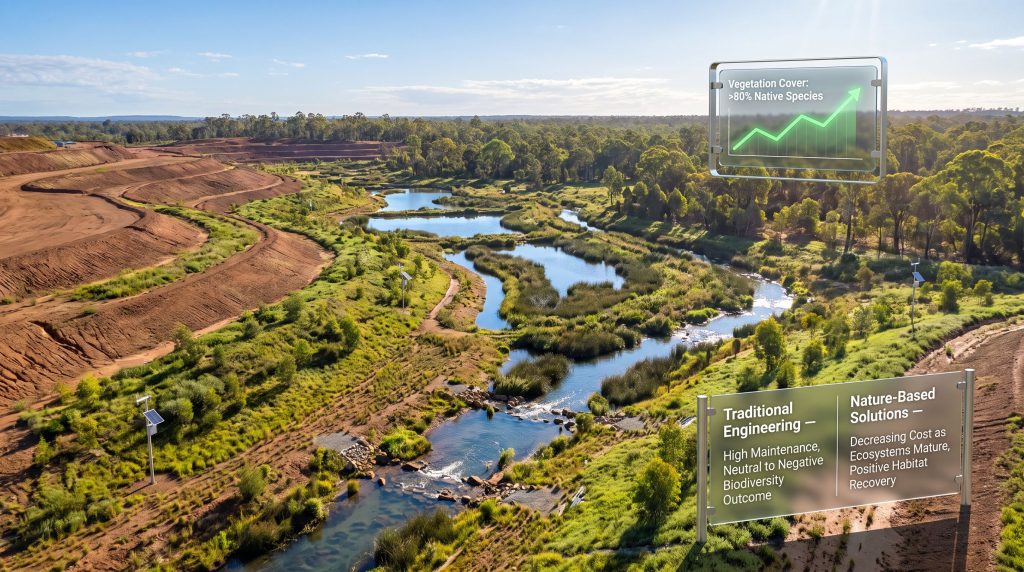
| Maintenance intensity | High and ongoing | Decreases as ecosystems mature |
| Biodiversity outcome | Neutral to negative | Positive, supports habitat recovery |
| Cost trajectory | Stable to increasing | Decreasing as natural systems establish |
| Regulatory alignment | Compliance-focused | Exceeds compliance, creates ESG value |
| Community perception | Remediation | Restoration and legacy |
Nature-based solutions are not a replacement for engineering. They are most effective when combined with it, using precise geotechnical and environmental design to create the conditions under which natural systems can recover and self-sustain.
Where NbS Integrate Across the Mine Lifecycle
One of the most important and least understood aspects of this approach is that it cannot be retrofitted at closure. Effective nature-based design must be embedded from the very first planning stages. In addition, a thorough definitive feasibility study should incorporate NbS objectives well before construction begins:
- Exploration and design: Hydrological alignment, ecological baseline surveys, buffer zone planning, and landform geometry designed with closure in mind from the outset
- Active operations: Progressive rehabilitation as mining advances, phytoremediation of disturbed zones, and constructed wetlands for water treatment
- Closure and post-closure: Full ecosystem reconstruction, wildlife corridor design, and long-term monitoring using digital sensor networks
Five Categories of NbS Being Applied in Mining Today
1. Ecological Land Reclamation and Landform Restoration
Reshaping disturbed landforms — including open pits, waste dumps, and tailings storage facilities — to mimic natural topography and drainage behaviour is one of the most impactful applications of NbS in mine closure. Rather than relying on hard engineering alone to stabilise slopes, leading practice involves designing successional vegetation systems that progressively build soil organic matter, canopy cover, and ecological function over time.
The Holden Mine remediation in north-central Washington State, located within the Okanogan-Wenatchee National Forest, illustrates what large-scale integrated reclamation looks like in practice. The site, which operated as one of the United States' largest copper mines between 1937 and 1957, produced more than 90,000 tonnes of copper during its operational life. After mining ceased, the land was largely abandoned, and residual waste began leaching into a nearby creek, threatening aquatic life and surrounding ecosystems.
The remediation program, led by Stantec on behalf of Rio Tinto (which inherited the clean-up obligation through a series of business acquisitions), confronted an extraordinary scope of work:
- Approximately 100 kilometres of underground tunnel network requiring management
- 300,000 cubic metres of waste rock requiring removal
- 8.5 million tonnes of mill tailings covering 50 hectares of US National Forest land
- Tailings deposited directly against the creek at near-vertical slope angles
The remediation involved regrading approximately 8 million tonnes of tailings, stabilising the surface with topsoil and woody vegetation to establish a successional forest. Around 275 linear metres of creek were realigned and restored to improve aquatic habitat. A barrier wall and groundwater treatment system were installed at the toe of slope to minimise discharge of impacted groundwater into the surrounding watershed.
The results exceeded projections. Water quality improved and aquatic species returned to the creek faster than the restoration timeline had anticipated — a testament to the power of integrating engineered controls with ecologically grounded design. Stantec's nature-based solutions framework for mining outlines how this integrated thinking can be applied across diverse site conditions.
2. Constructed Wetlands and Passive Water Treatment
Wetland ecosystems — including peat, biochar, and vegetated filter systems — can intercept and treat contaminated mine water at a fraction of the long-term cost of active chemical treatment plants. Constructed wetlands deliver a dual function: water quality improvement and habitat creation for aquatic and semi-aquatic species. As passive systems mature, their treatment efficiency tends to improve while operational costs decrease.
3. Phytoremediation and Bioremediation
Using plants, fungi, algae, and soil microorganisms to immobilise or extract heavy metals and other contaminants from disturbed soil and groundwater is particularly effective where diffuse contamination makes excavation impractical. Emerging applications include mycoremediation — the use of fungal mycelial networks to intercept and neutralise acid mine drainage — an area that remains less widely understood but is attracting growing research attention.
4. Stream and Riparian Corridor Restoration
The Four Mile Creek restoration in Colorado demonstrates the practical application of NbS to mine-affected water systems. Waste rock left from historical mining operations had elevated arsenic concentrations in the creek to levels exceeding drinking water standards. The remediation program involved testing waste rock to characterise metal content, physically removing contaminated material from the channel, and capping residual material with an evapo-transpiration cover to reduce leaching into groundwater.
Native riparian vegetation was established along the creek corridor. The outcome was unambiguous: arsenic levels fell below detection limits, and stream ecology improved measurably.
This case reflects a broader regulatory evolution. Historically, stream protection at mine sites defaulted to hard armouring with large rocks and metal wire revetments — approaches that prevented erosion but suppressed ecological function. Updated regulatory frameworks in several jurisdictions now permit limited, managed erosion, allowing streams to self-organise toward natural equilibrium through processes including:
- Reconstruction of natural channel geometry and meander patterns
- Re-establishment of riffle-pool sequences and floodplain connectivity
- Installation of fish passage features where aquatic fauna movement was previously blocked
- Root system stabilisation through riparian vegetation rather than rock armouring
5. Habitat Connectivity and Biodiversity Recovery
At Pikeview Quarry in Colorado — a former limestone mine foundational to the construction of Colorado Springs since the early 1900s — the restoration program addressed both ecological and community objectives. Approximately 2.6 million cubic metres of material, primarily sourced from within the mine itself, was used to stabilise and reshape the disturbed mountainside across a 130-acre footprint.
More than 31,000 native shrubs and trees were planted to create habitat suitable for bighorn sheep, deer, bears, bobcats, foxes, rabbits, and a range of bird species. By mid-2024, wildlife had already returned to the restored landscape, ahead of expectations. The site is simultaneously being developed into a recreational area featuring mountain biking trails and community open space, demonstrating how PMLU planning can serve multiple objectives.
Measuring Ecological Recovery: What Success Actually Looks Like
Physical stabilisation is the starting point, not the finish line. True ecological restoration requires re-establishing the functional relationships between soils, plants, invertebrates, vertebrates, and water systems that characterise a healthy landscape.
| Recovery Metric | Indicator of Success |
|---|---|
| Vegetation cover | Greater than 80% native species cover within five years |
| Soil organic carbon | Trending toward reference ecosystem levels |
| Invertebrate diversity | Comparable to undisturbed reference sites |
| Wildlife utilisation | Target species confirmed using the site |
| Water quality | Meets or exceeds pre-mining baseline conditions |
Key components of genuine habitat restoration include:
- Soil biology reconstruction: Reintroducing microbial communities, mycorrhizal networks, and organic matter to support plant establishment
- Locally sourced native vegetation: Using seeds and nursery stock drawn from the surrounding landscape, rather than generic commercial revegetation mixes, significantly accelerates ecosystem function recovery
- Invasive species suppression: Active management of pioneer weed species that rapidly colonise disturbed ground before native plants can establish
- Wildlife corridor design: Creating connected habitat patches that allow species to move through the landscape without crossing hostile terrain
- Staged fauna reintroduction: Returning disrupted species to the site once habitat suitability assessments confirm appropriate conditions
Digital Monitoring: The Technology Layer That Makes NbS Accountable
How Smart Sensor Networks Are Redefining Closure Performance
Nature-based solutions deliver their strongest outcomes when paired with continuous, data-driven monitoring that enables rapid adaptive management. The Holden Mine closure has become a reference case for this integration. The site operates an extensive network of active sensors and telemetry systems enabling near-real-time analytics across water quality, geotechnical stability, and ecological recovery metrics.
A key innovation at Holden is the implementation of an automated Trigger Action Response Plan (TARP) system, where sensor data crossing pre-defined thresholds activates pre-programmed response protocols without requiring manual intervention. This architecture allows conditions to be managed dynamically rather than reactively.
Partly as a result of these monitoring capabilities, Holden Mine has become one of the first North American mine closure projects to achieve conformance with the Global Industry Standard on Tailings Management (GISTM) — an internationally recognised benchmark for tailings facility safety and environmental performance.
Core digital monitoring capabilities being deployed in leading closure programs include:
- Real-time water quality sensors measuring pH, conductivity, dissolved metals, and flow rates continuously
- Geotechnical monitoring arrays including settlement sensors, inclinometers, and piezometers tracking slope and tailings stability
- Satellite and drone-based remote sensing tracking revegetation progress across large footprints
- Automated TARPs enabling near-real-time intervention before deteriorating conditions escalate
The next major ASX story will hit our subscribers first
Post-Mining Land Use Planning: Defining the End Before the Beginning
Why PMLU Must Be Set at the Feasibility Stage
Post-mining land use planning is the process of defining, agreeing upon, and systematically working toward a specific land use outcome for a mine site after extraction ceases. It is emphatically not a closure-phase activity. Regulators in most major mining jurisdictions require a credible PMLU commitment as a condition of project approval, and financial assurance calculations are typically based on the cost of achieving the agreed outcome.
Common PMLU categories and their alignment with nature-based approaches:
| PMLU Type | Typical Applications | NbS Alignment |
|---|---|---|
| Native ecosystem restoration | Remote, ecologically sensitive sites | High |
| Productive agricultural land | Pastoral regions, flat terrain | Moderate |
| Recreational open space | Peri-urban and community-adjacent sites | High |
| Forestry or carbon plantings | Temperate and tropical regions | High |
| Industrial or infrastructure reuse | Urban-fringe and brownfield sites | Low to moderate |
Increasingly, Traditional Owner and host community expectations are centred not on what a mine will produce but on what the land will become. This cultural and social dimension of PMLU is becoming a primary factor in social licence negotiations and must be treated as a technical input to closure design, not an afterthought. Considering natural capital in mining is, consequently, becoming a fundamental part of how responsible operators structure their planning frameworks.
The Financial and ESG Case: Why NbS Make Business Sense
The Value Proposition Beyond Regulatory Compliance
The business case for nature-based solutions in mining extends well beyond avoiding regulatory penalties. A mature, self-sustaining ecosystem requires significantly less ongoing intervention than engineered infrastructure, meaning that long-term total cost of ownership is typically lower for NbS-based closure plans even when upfront capital costs are comparable. However, the sector's broader mining sustainability transformation is reshaping expectations across every phase of the project lifecycle.
Direct financial benefits include:
- Reduced long-term maintenance expenditure as ecosystems self-sustain
- Potential qualification for carbon credit schemes and biodiversity offset payments through habitat restoration programs
- Reduced liability exposure from demonstrated proactive and high-quality restoration programs
- Stream restoration programs may qualify for environmental incentive funding in some jurisdictions
Strategic and ESG benefits include:
- Strengthened social licence, with communities more likely to support future projects from operators with credible restoration track records
- Improved attractiveness to ESG-focused institutional capital, which increasingly screens for mine closure credibility
- Stronger regulatory relationships built on demonstrated performance rather than minimum compliance
- Talent attraction benefits, as environmental leadership is an increasing factor for skilled professionals evaluating employers in the sector
"Operators that demonstrate attention, funding, and genuine commitment to ecological reclamation are building a form of reputational capital that has measurable effects on their ability to permit, finance, and execute future projects."
Effective mining waste management is, furthermore, a foundational component of any credible NbS strategy, directly influencing closure costs, community trust, and long-term environmental outcomes. The ICMM's work on nature-positive outcomes for the mining sector provides a compelling framework for understanding how these financial and ecological imperatives converge.
A Strategic Framework: Embedding NbS Across the Full Mine Lifecycle
From First Concept to Final Handover
Stage 1: Pre-Feasibility and Feasibility
- Conduct comprehensive ecological baseline surveys to characterise the reference ecosystem the site must ultimately return to
- Define PMLU in direct consultation with regulators, host communities, and Traditional Owners
- Align pit geometry, waste placement, and water management design with closure objectives from day one
Stage 2: Detailed Design and Permitting
- Develop integrated closure plans specifying NbS interventions at each mine component
- Design waste landforms and tailings facilities with progressive rehabilitation sequencing embedded
- Establish financial assurance mechanisms calibrated to NbS-based closure costs
Stage 3: Active Operations
- Implement progressive rehabilitation as mining advances rather than deferring all restoration to closure
- Establish on-site nurseries and seed banks to build a reliable supply of locally provenant plant material
- Deploy monitoring infrastructure early to accumulate baseline datasets against which closure performance can be assessed
Stage 4: Closure and Post-Closure
- Execute the full PMLU transition including final landform shaping, ecosystem reconstruction, and community handover
- Maintain adaptive management programs until regulatory sign-off on closure completion is achieved
- Document and publish outcomes to support future project approvals and advance industry knowledge
Frequently Asked Questions
What is the difference between mine reclamation and mine restoration?
Mine reclamation refers to physically stabilising disturbed land and preventing ongoing environmental harm. Mine restoration goes further, aiming to re-establish functional ecosystems with native biodiversity, natural hydrology, and ecological processes comparable to pre-disturbance conditions.
Are nature-based solutions more expensive than traditional engineering?
Initial capital costs can be comparable to or slightly higher than conventional engineering in some applications. However, long-term total cost of ownership is typically lower, as maturing ecosystems require less ongoing maintenance and passive treatment systems eliminate recurring chemical input costs.
Can NbS be applied to legacy mine sites rather than just new projects?
Yes. NbS are being applied to legacy contaminated sites as well as new project planning. Legacy applications often require more intensive initial intervention to create the conditions under which natural recovery processes can take hold.
What role does community engagement play in PMLU planning?
Community input is fundamental. Host communities, Traditional Owners, and local governments frequently have specific and deeply held aspirations for post-mining land use — whether ecological, agricultural, recreational, or cultural — and integrating these perspectives from the earliest planning stages is essential to achieving durable, credible closure outcomes.
What is the Global Industry Standard on Tailings Management?
GISTM is an internationally recognised standard developed to improve the safety and environmental performance of tailings storage facilities worldwide. Conformance is increasingly expected by institutional investors and regulators and requires robust monitoring systems, emergency response planning, and sustained community engagement programs.
Closing the Loop Between Extraction and Ecological Stewardship
The mining sector's long-term social licence ultimately depends on its ability to demonstrate that resource extraction and ecological responsibility are not mutually exclusive. Nature-based solutions in mining offer the industry a technically credible, financially sound, and community-aligned pathway to meeting that challenge.
The projects that will define the industry's reputation over the coming decades are not those that extract the most tonnes. They are those that leave the land in a condition that future generations — whether local communities, wildlife, or regulators — can point to as evidence that responsible mining is possible.
That ambition starts not at closure, but at the very first line drawn on a feasibility study.
Want to Stay Ahead of the Next Major ASX Mineral Discovery?
Discovery Alert's proprietary Discovery IQ model delivers real-time alerts the moment significant mineral discoveries are announced on the ASX, transforming complex data across more than 30 commodities into clear, actionable insights for investors at every level — start your 14-day free trial today and see why historic discoveries have generated extraordinary returns.