July 26, 2026
The Hidden Economics of Diesel Dependency in African Mining
Across sub-Saharan Africa, the economics of large-scale mining are quietly distorted by a single, unglamorous variable: diesel. In landlocked mining provinces far removed from coastal refineries and international fuel terminals, the cost of moving diesel to where it is needed compounds at every step of the logistics chain. For operations extracting coal, copper, or platinum from the interior of the continent, fuel is not merely an input cost — it is a structural vulnerability that shapes everything from profit margins to geopolitical risk exposure.
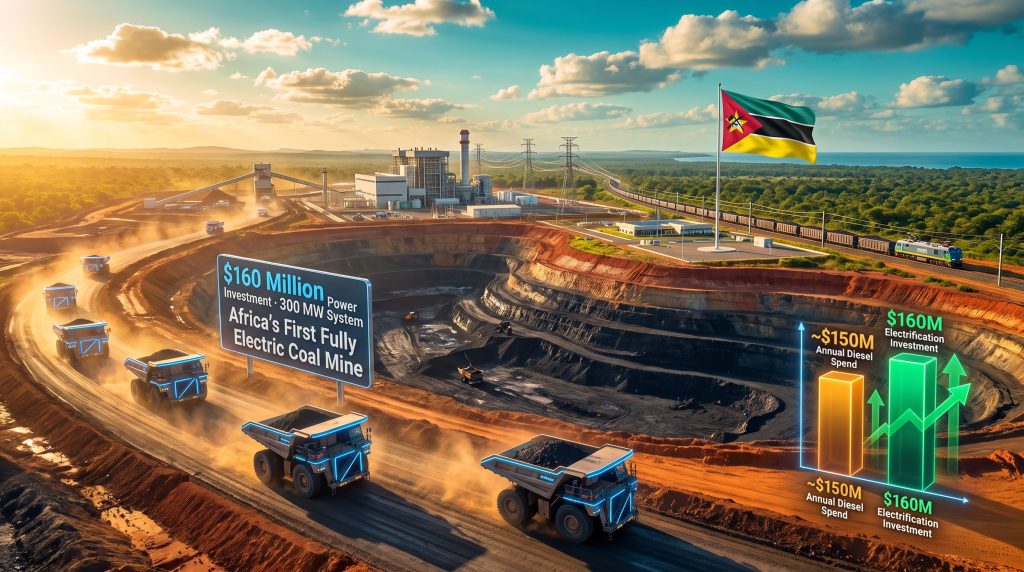
This is the operational reality that makes the Moatize coal project in Tete Province, Mozambique, so analytically interesting. The decision by Vulcan, the mining company owned by Naveen Jindal's Jindal Group, to commit $160 million to the electrification of what is being described as Africa's first fully electric coal mine is not, at its core, an environmental story. It is a story about capital efficiency, sovereign risk, and the compounding arithmetic of fuel import dependency in frontier mining economies.
When big ASX news breaks, our subscribers know first
Why Diesel Is a Structural Liability in Mozambique's Tete Province
Mozambique does not operate domestic diesel refining capacity. Every litre consumed across the country's mining sector arrives as an imported commodity, priced at international benchmarks and subject to logistics costs that multiply across the 912-kilometre Nacala Logistics Corridor connecting landlocked Tete Province to Indian Ocean export terminals at Nacala Port.
For the Moatize operation alone, this translates to roughly $150 million spent annually on diesel imports — a figure that represents a meaningful share of the total operational budget for even a large-scale producer. The structural problem is not just the headline cost. It is the volatility exposure. When global oil prices move, remote African mining operations absorb those shocks without the buffer of domestic refining alternatives or strategic reserves.
"Mining operations in fuel-import-dependent economies face a structural double burden: paying international commodity prices for diesel while absorbing logistics costs across remote transport corridors. Electrification fundamentally restructures this cost equation by replacing a variable, import-dependent input with a fixed, domestically generated one."
The broader context of mining electrification trends across the globe reinforces why this shift is gaining momentum. The Tete Province sits atop one of sub-Saharan Africa's most significant coking coal deposits. The Moatize concession spans 250 square kilometres and has produced in excess of 35 million metric tonnes of coal annually over the past three years. The scale of this output makes the fuel cost burden proportionally severe — and the economic logic of electrification proportionally compelling.
What the $160 Million Electrification System Actually Builds
The Moatize electrification programme centres on a 300-megawatt power plant that will serve multiple operational functions simultaneously. Understanding the power allocation architecture is essential to grasping why this project is qualitatively different from previous African mining electrification initiatives.
| Power Allocation Segment | Estimated Capacity |
|---|---|
| Mining equipment operations | ~90 megawatts |
| Coal processing facilities | ~30 megawatts |
| Rail corridor electrification | ~100 megawatts |
| Surplus for Mozambique national grid | Remaining capacity |
Vulcan's CEO Mukesh Kumar confirmed the breakdown of this allocation publicly, stating that approximately 90 megawatts would power mining operations directly, 30 megawatts would be dedicated to processing infrastructure, and around 100 megawatts would go toward electrifying the rail corridor. The residual capacity is earmarked for supply to Mozambique's national electricity grid.
The rail electrification component deserves particular attention. The Nacala Logistics Corridor is the arterial export route for Moatize coal, and diesel-powered locomotives along this corridor represent a significant and often underappreciated operational cost. Electrifying rail at this scale is not a cosmetic adjustment — it materially changes the cost structure of every tonne moved from pit to port.
What Defines a "Fully Electric" Mine at the Operational Level
The term "fully electric mine" is used with varying precision across the industry, and the distinction matters for evaluating the Moatize project's actual significance. There are three broad categories of mining electrification:
- Partial or auxiliary electrification — solar panels powering site facilities, electric drill rigs operating alongside diesel haul trucks.
- Hybrid or trolley-assist systems — diesel-electric trucks that draw power from overhead lines on specific haul road segments while retaining diesel capability elsewhere.
- Full operational electrification — all heavy equipment, processing, and transport systems running on electricity generated or procured on-site, eliminating diesel dependency across the operational footprint.
The Moatize project's third mining section has achieved the third category, with a fully electric heavy equipment fleet replacing diesel-powered haul trucks and machinery. The broader $160 million investment extends this electrification principle across the entire 300-megawatt system, encompassing mining, processing, and rail. This integrated scope distinguishes it from earlier African initiatives that incorporated electric components without achieving system-wide electrification.
Several South African, Zambian, and Ghanaian operations have incorporated battery-electric vehicle drills and solar-powered auxiliary systems in recent years. None have replicated the operational integration scale being attempted at Moatize. The key differentiator is the on-site power generation model: by building its own power plant rather than relying on an external grid, Vulcan sidesteps the grid-access barrier that has consistently stalled full electrification in remote African mining provinces. Furthermore, the growing adoption of renewable energy in mining globally demonstrates that this approach is both commercially viable and increasingly necessary.
The Green Cement Byproduct Stream
One aspect of the Moatize electrification model that receives insufficient attention is the circular economy component embedded within the thermal power plant design. Ash generated by the power plant is being repurposed for green cement production at the site. This byproduct utilisation strategy converts what would otherwise be a waste disposal liability into a secondary revenue stream while simultaneously reducing the environmental footprint of the power generation process.
In the context of regional infrastructure demand across Tete Province and Mozambique more broadly, a local cement supply capability carries genuine downstream value. Construction materials sourced from mine byproducts reduce input costs for adjacent infrastructure projects and create supply chain linkages that extend the project's economic impact beyond the concession boundary.
The Financial Arithmetic: Payback Period and Capital Efficiency
The investment case for the Moatize electrification programme rests on a relatively straightforward calculation, though the precise payback timeline depends on operational ramp-up velocity and the proportion of diesel expenditure that electrification actually displaces.
The core inputs are:
- Total electrification investment: $160 million (approximately €140.6 million)
- Current annual diesel expenditure: approximately $150 million
- Implied payback period at full displacement: slightly above one year
Even under conservative assumptions — where electrification displaces 70 to 80 percent of diesel costs rather than the full amount, and accounting for ongoing power plant operating costs — the payback horizon remains well within the range that most institutional mining investors would consider compelling for an infrastructure upgrade of this scale.
"If the Moatize electrification model is replicated across Mozambique's other Tete Province operations, the cumulative diesel displacement could potentially exceed $500 million annually across the basin — fundamentally altering the economics of coal extraction in the region and potentially attracting further international capital into mine modernisation programmes."
This is not a speculative environmental commitment. It is a capital reallocation from a variable operating cost (diesel) into a fixed infrastructure asset (power plant), structured to generate returns within a single operational cycle. The decarbonisation economics underpinning this approach are increasingly difficult to ignore across the broader mining sector.
Environmental and Community Outcomes: The Local Impact Profile
Mozambique's Minister of Mineral Resources and Energy, Estevão Pale, has publicly framed the Moatize electrification as both an economic and environmental intervention. His stated position emphasises that replacing fuel-powered equipment with electric systems will materially reduce diesel consumption and lower the environmental costs associated with mining operations — a framing that reflects the government's dual interest in productivity improvement and community welfare.
Because Mozambique lacks domestic refining capacity, Pale noted that every efficiency gain achieved through electrification reduces the country's exposure to imported fuel costs — a consideration that applies at the national economic level, not merely at the individual mine level.
The community-level impacts projected for settlements adjacent to the Moatize concession centre on two primary improvements:
- Air quality: Replacing diesel-powered haul trucks and locomotives eliminates diesel particulate emissions and coal dust generated by diesel haulage activity across the concession.
- Noise reduction: Electric equipment operates at substantially lower noise levels than diesel machinery, reducing chronic noise pollution for surrounding communities.
It is important to contextualise these outcomes within the broader environmental profile of the project. Mine-level electrification addresses scope 1 emissions — those generated directly by operational activities. It does not alter the scope 3 emissions profile associated with the combustion of the coal produced, which occurs at the point of end-use by steel mills and power stations internationally. The project's sustainability credentials are therefore context-dependent and should be evaluated against a local impact benchmark rather than a whole-of-lifecycle carbon framework.
How Moatize Compares to the Global Electrification Frontier
| Metric | Moatize (Mozambique) | Typical Diesel Mine | Leading Global Electric Mine |
|---|---|---|---|
| Power system capacity | 300 MW | Grid/diesel dependent | 50–200 MW (varies) |
| Fleet type | Full electric (section 3) | Diesel haul trucks | BEV or trolley-assist |
| Annual diesel spend pre-conversion | ~$150 million | Variable | Near zero (post-conversion) |
| Grid contribution | Yes (surplus) | No | Rare |
| Byproduct utilisation | Green cement (ash) | Typically none | Varies |
The global mining energy transition has accelerated considerably since 2020, driven by battery technology cost reductions, ESG investor pressure, and operational efficiency imperatives. Projects in Canada, Sweden, and Australia have pioneered underground battery-electric vehicle fleets and trolley-assist systems on surface operations. What distinguishes the Moatize approach, however, is the integrated power generation model — rather than drawing from existing grid infrastructure, the project creates its own energy ecosystem capable of serving mining, processing, rail, and national grid needs simultaneously.
This self-sufficiency dimension is particularly significant in the African mining context, where grid reliability and transmission infrastructure in remote provinces cannot be taken for granted. Building the power plant alongside the electrification programme eliminates dependency on external energy supply and insulates operations from the kind of load-shedding events that have periodically disrupted mining output across southern Africa. For additional context on mobile crushing and electric equipment adoption across the continent, International Mining's coverage of Africa's first fully electric Sandvik mobile crushing plant offers a useful parallel perspective.
The next major ASX story will hit our subscribers first
India's Expanding Resource Footprint in Southeastern Africa
The Moatize electrification programme is not an isolated investment decision. It sits within a deliberate strategic trajectory that began with the Jindal Group's earlier establishment of operations at the Chirodzi coal mine in Tete Province and accelerated with the April 2022 acquisition of the Moatize project from Brazilian mining giant Vale for more than $270 million.
That acquisition transferred control of not only the mine but also the Nacala Logistics Corridor — the 912-kilometre rail and port infrastructure connecting Tete to the Indian Ocean. Acquiring both the resource asset and the export infrastructure in a single transaction is strategically sophisticated, as it eliminates the logistics dependency that has historically constrained independent operators in landlocked African mining provinces.
The broader pattern here reflects a shift in the geopolitics of African resource investment. As some Western mining majors face increasing ESG scrutiny over coal and fossil fuel exposure, and as Chinese operators navigate reputational and regulatory headwinds in certain African jurisdictions, Indian industrial conglomerates have moved into the space with capital, operational experience, and long-term commodity demand rationale driven by India's ongoing steel sector growth. In addition, the global race to secure critical materials — including the lithium supply strategy driving investment decisions in South America — illustrates just how competitive resource-sector geopolitics have become.
Is Electrifying a Coal Mine a Contradiction?
This is the question that ESG analysts and sustainability-focused investors will inevitably raise, and it deserves a direct answer. The tension between mine-level decarbonisation and the continued production of a fossil fuel commodity is genuine, not rhetorical. Mining operators are increasingly separating operational emissions narratives from product emissions narratives — a practice that is commercially rational but analytically incomplete.
For investors applying ESG frameworks, the relevant question is whether electric coal mine infrastructure qualifies as green capital expenditure under their particular methodology. The answer will vary by framework: some will treat operational emissions reduction as qualifying progress, while others will apply a whole-of-lifecycle assessment that captures downstream combustion impacts.
What is less debatable is the local economic and environmental value of the electrification programme for Mozambique and for Tete Province communities specifically. The displacement of $150 million in annual diesel imports reduces the country's external account exposure, the community-level air quality benefits are measurable, and the national grid contribution addresses a genuine electricity access gap in a country where energy poverty remains a material development constraint. Furthermore, the Copperbelt Katanga Mining report on this investment provides additional detail on how the Jindal Group's commitment is reshaping industrial energy expectations across the region.
Frequently Asked Questions: Africa's First Fully Electric Coal Mine
What is Africa's first fully electric coal mine?
The Moatize coal operation in Tete Province, Mozambique, operated by Vulcan and owned by the Jindal Group, is being identified as Africa's first fully electric coal mine. Its third mining section has achieved fully electric fleet status, and the broader $160 million investment will extend electrification across a 300-megawatt power system covering mining, processing, and rail operations.
Who owns the Moatize mine and what is their total investment commitment?
Vulcan, a mining company owned by the Jindal Group led by Naveen Jindal, acquired the Moatize operation from Vale in April 2022 for more than $270 million. The current electrification investment totals $160 million, approximately €140.6 million.
How much does the mine currently spend on diesel, and will electrification eliminate that cost?
Current annual diesel expenditure at Moatize is approximately $150 million. Full electrification is designed to eliminate the majority of this cost. The precise savings curve will depend on operational ramp-up timelines and the degree of diesel displacement achieved across all operational segments.
Will the mine's power plant supply electricity to Mozambique's national grid?
Yes. The 300-megawatt system is designed to generate capacity beyond the mine's operational requirements, with surplus electricity directed to Mozambique's national grid — establishing a dual-purpose energy infrastructure model with both commercial and national development value.
Does electrifying a coal mine make it environmentally sustainable?
Mine-level electrification reduces direct operational emissions (scope 1), coal dust, and diesel particulate pollution in and around the concession. It does not address the downstream carbon impact of coal combustion by end users (scope 3). The project's sustainability claim is therefore strongest when evaluated against a local environmental impact benchmark.
Is the "Africa's first fully electric mine" designation officially verified?
The designation originates from company communications and has been confirmed by Mozambique's government and reported by regional media. Some earlier African mining projects have incorporated individual electric components, but none have previously achieved system-wide electrification at the operational scale and integration depth of the Moatize programme.
Key Takeaways for Mining Investors and Industry Observers
- The $160 million Moatize electrification investment represents one of the largest single mine electrification commitments in African mining history
- Energy self-sufficiency, driven by the need to eliminate $150 million in annual diesel imports, is the primary economic driver of the project
- The 300-megawatt power system's dual function — serving mine operations and contributing to Mozambique's national grid — establishes a new template for industrial energy infrastructure in resource-constrained African economies
- India's expanding presence in southeastern African resource extraction, through acquisitions like the $270 million Moatize purchase, reflects a deliberate geopolitical and commercial strategy that is reshaping competitive dynamics in the region
- The Moatize model's success or failure will serve as a benchmark for whether full mine electrification is commercially viable in frontier African mining jurisdictions — with replication potential across the Tete Basin and beyond
Readers seeking broader context on African mining investment and industrial energy transition can explore related reporting from Business Insider Africa at africa.businessinsider.com, which covers markets, infrastructure, and industrial development across the continent.
Want to Stay Ahead of the Next Major Mining Discovery?
Discovery Alert's proprietary Discovery IQ model scans ASX announcements in real time, instantly identifying significant mineral discoveries across more than 30 commodities — from coal and copper to critical minerals driving the global energy transition — and delivering actionable insights directly to subscribers. Explore how historic discoveries have generated exceptional returns and begin your 14-day free trial today to position yourself ahead of the broader market.