
May 14, 2026
Understanding the Strategic Importance of Maritime Energy Corridors
Energy security in the modern era hinges on a complex network of maritime chokepoints that channel the world's hydrocarbon supplies across vast oceanic distances. These narrow waterways represent far more than geographical features—they function as critical arteries in the global energy circulatory system, where shipping disruptions in Strait of Hormuz can trigger cascading effects across international markets and economic stability.
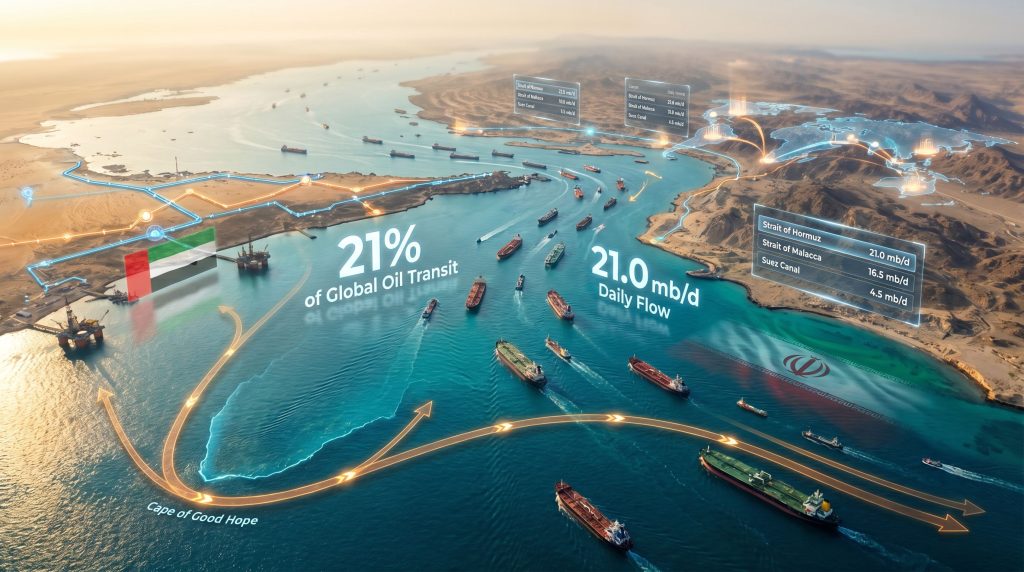
The Strait of Hormuz exemplifies this vulnerability as a 21-mile-wide passage controlling approximately 21% of global petroleum liquids transit. This concentration of energy flow through such a narrow corridor creates what energy analysts describe as systemic risk amplification, where localized disruptions can generate disproportionate global consequences.
The Architecture of Global Energy Vulnerability
Maritime energy transport operates through several critical chokepoints, each presenting unique risk profiles and alternative routing possibilities. The strategic significance extends beyond simple volume calculations to encompass regional supply dependencies and infrastructure limitations.
Key Maritime Energy Chokepoints:
- Strait of Hormuz: 21.0 million barrels daily (21% of global trade)
- Strait of Malacca: 16.0 million barrels daily (16% of global trade)
- Suez Canal: 5.5 million barrels daily (6% of global trade)
- Bab el-Mandab: 6.2 million barrels daily (6% of global trade)
The concentration of energy flows through these passages creates what researchers term "chokepoint interdependence," where the closure of one route can overwhelm alternative pathways and amplify supply constraints beyond the immediate disruption zone. Furthermore, these vulnerabilities intersect with broader geopolitical tensions, as evidenced by the complex relationship between US-China trade war impact and energy security considerations.
When big ASX news breaks, our subscribers know first
What Triggers Shipping Disruptions in the Strait of Hormuz?
Maritime disruptions emerge through complex interactions of geopolitical tensions, economic warfare strategies, and regional security dynamics. Understanding these trigger mechanisms becomes essential for assessing risk probability and developing contingency frameworks.
Recent disruptions in April 2026, as documented by the International Energy Agency, demonstrate how shipping disruptions in Strait of Hormuz can rapidly reshape global energy markets. The IEA's emergency response protocols were activated following what analysts describe as a multifaceted escalation involving regional naval activities and diplomatic tensions.
Primary Escalation Pathways
Naval Enforcement Operations:
- Unilateral vessel inspection regimes
- Selective transit restrictions based on flag state or cargo origin
- Economic blockade implementations targeting specific trade relationships
Retaliatory Maritime Actions:
- Defensive waterway closures in response to external pressure
- Mining or physical obstruction of shipping channels
- Proxy operations involving non-state maritime actors
Regional Conflict Spillover Effects:
- Military operations extending into international waters
- Cross-border tensions affecting neutral commercial shipping
- Insurance market withdrawal creating de facto shipping embargos
The 2026 disruptions illustrate how these escalation pathways can converge, creating compound effects that exceed the sum of individual trigger events. Energy security analysts emphasise that modern shipping disruptions in Strait of Hormuz often reflect broader geopolitical realignments rather than isolated maritime incidents, particularly in the context of OPEC oil production impact decisions.
How Do Shipping Route Disruptions Cascade Through Energy Markets?
When shipping disruptions in Strait of Hormuz occur, the immediate market response involves rapid price discovery mechanisms that transmit uncertainty across interconnected financial and physical markets. The April 2026 events triggered what the IEA characterised as ripple effects through global oil markets, prompting the agency's largest-ever emergency oil stock release.
Immediate Market Response Mechanisms
Price Discovery and Volatility Amplification:
- Futures markets incorporate supply risk premiums within hours of disruption announcements
- Spot market pricing diverges from contract pricing as physical delivery constraints emerge
- Volatility indices experience exponential increases as market participants hedge exposure
Supply Chain Recalibration:
- Vessel operators activate emergency routing protocols
- Insurance premiums increase dramatically for affected shipping routes
- Charter rates surge due to extended voyage requirements and reduced effective fleet capacity
Cascading Impact Timeline
| Timeframe | Primary Effects | Secondary Effects | Tertiary Effects |
|---|---|---|---|
| 0-7 Days | Immediate price spikes, Emergency route diversions | Insurance rate increases, Charter premium surges | Consumer fuel price adjustments |
| 1-4 Weeks | Strategic inventory drawdowns, Fleet capacity constraints | Alternative supply activation, Regional shortage development | Industrial production curtailments |
| 1-3 Months | Strategic reserve releases, Demand destruction emergence | Investment flow redirection, Long-term contract renegotiation | Macroeconomic policy adjustments |
The compounding nature of these effects explains why shipping disruptions in Strait of Hormuz generate market impacts that persist long after initial trigger events resolve. Each phase of the cascade creates new vulnerabilities and dependencies that amplify subsequent disruptions, particularly when considering broader factors like oil price trade war dynamics.
Secondary Economic Transmission
Beyond immediate energy price effects, disruptions trigger broader economic adjustments:
- Industrial Input Cost Escalation: Manufacturing sectors dependent on petroleum-based feedstocks experience immediate cost pressures
- Transportation Sector Stress: Aviation and maritime industries face dual pressures from higher fuel costs and reduced supply reliability
- Regional Economic Asymmetries: Countries with limited strategic reserves or alternative supply access experience disproportionate impacts
However, these challenges must be understood within the broader context of US oil production decline, which compounds supply security concerns.
What Are the Alternative Routing Strategies During Disruptions?
When maritime emergencies necessitate emergency logistics reconfiguration, several alternative routing strategies become critical for maintaining global energy flows. These alternatives, however, impose significant economic and operational constraints that effectively reduce global shipping capacity.
Emergency Maritime Route Activation
Cape of Good Hope Diversions:
- Vessel journey times increase by 15-20 days compared to normal Suez Canal routing
- Effective shipping capacity reduces by approximately 40% due to extended voyage cycles
- Additional fuel consumption increases per-barrel transport costs by $2-4
Pipeline Bypass Utilisation:
- East-West Pipeline (Saudi Arabia): 5 million barrels per day capacity
- Petroline System: 4.5 million barrels per day capacity
- UAE pipeline networks: 1.8 million barrels per day total capacity
These pipeline systems provide crucial alternatives during disruptions, though their combined capacity represents only a fraction of normal maritime transit volumes. Pipeline operations also face maintenance constraints and political considerations that can limit emergency utilisation.
Regional Storage Hub Activation
Strategic Commercial Inventory Release:
- Singapore commercial storage facilities: 45-50 million barrel capacity
- Rotterdam and Amsterdam storage complexes: 35-40 million barrel capacity
- Fujairah strategic reserves: 15-20 million barrel capacity
Emergency Stock Coordination:
- International Energy Agency member coordination protocols
- Regional strategic petroleum reserve activation
- Commercial inventory release incentive programs
The effectiveness of these alternative strategies depends heavily on preparation and international coordination. Disruptions that occur during maintenance periods or amid other regional tensions can overwhelm alternative infrastructure capacity, as highlighted by the Hormuz crisis analysis.
How Do Regional Powers Respond to Maritime Energy Disruptions?
Regional and international responses involve coordinated diplomatic, economic, and strategic resource deployment designed to minimise market disruption and maintain energy security.
Strategic Reserve Deployment Protocols
National Strategic Petroleum Reserve Capacities:
- United States Strategic Petroleum Reserve: 714 million barrel capacity
- China strategic reserves: 500+ million barrel estimated capacity
- Japan strategic petroleum stocks: 324 million barrel capacity
- European Union coordinated reserves: 180+ million barrel capacity
The April 2026 disruptions prompted what the IEA described as unprecedented coordination among member nations for emergency stock releases. This represented the largest coordinated release in IEA history, demonstrating the severity of supply constraints.
International Energy Agency Response Framework
Emergency Coordination Mechanisms:
- Coordinated strategic stock release protocols among 31 member countries
- Demand restraint measure implementation across industrial sectors
- Alternative supply source activation through producer nation coordination
Market Stabilisation Interventions:
- Consumer price protection measures through targeted subsidies
- Industrial energy allocation systems prioritising essential sectors
- International monetary coordination to address currency market volatility
The IEA's response to 2026 disruptions included comprehensive analysis through senior oil market analysts who provided detailed assessment of market impacts and recommended policy responses to protect consumers from price volatility. Furthermore, these responses must consider broader energy security and transition objectives.
Multilateral Security Coordination
Naval Escort Operations:
- Coalition maritime security missions for commercial vessel protection
- International maritime law enforcement coordination
- Regional naval cooperation agreements activation
Economic Counter-Measure Implementation:
- Coordinated sanctions regimes targeting disruptive actors
- Trade facilitation measures for alternative energy suppliers
- Financial system stability measures addressing commodity market volatility
According to the Atlantic Council's analysis, these coordinated responses are essential for maintaining global economic stability during prolonged disruptions.
What Are the Long-Term Strategic Implications?
Recurring disruptions drive fundamental structural changes in energy infrastructure investment, supply chain design, and strategic planning frameworks. These disruptions serve as catalysts for accelerated energy security initiatives and alternative energy development.
Energy Infrastructure Resilience Planning
Diversification Investment Imperatives:
- Accelerated pipeline construction projects connecting alternative supply sources
- Regional refining capacity expansion to reduce dependence on specific crude types
- Strategic storage facility development in geographically diverse locations
Supply Chain Restructuring Priorities:
- Multi-source supply agreement implementation across major consuming regions
- Inventory strategy modifications emphasising security over cost optimisation
- Geographic risk assessment integration into procurement decision frameworks
Capital Allocation Shifts During Disruption Cycles
| Investment Category | Pre-Disruption Allocation | Crisis Allocation | Post-Crisis Stabilisation |
|---|---|---|---|
| Traditional Energy Infrastructure | 65% | 45% | 55% |
| Alternative Route Development | 15% | 35% | 25% |
| Renewable Energy Acceleration | 20% | 20% | 20% |
Disruptions consistently trigger capital reallocation toward infrastructure projects that reduce chokepoint dependency. However, this reallocation often proves temporary, with investment patterns reverting toward cost-optimal configurations once immediate crisis pressure subsides.
Technology Development Acceleration
Alternative Energy Infrastructure:
- Renewable energy project acceleration in strategic regions
- Battery storage system deployment for grid stability during supply disruptions
- Hydrogen economy development as long-term fossil fuel alternative
Maritime Technology Innovation:
- Autonomous vessel development for high-risk transit zones
- Advanced logistics optimisation systems for emergency routing
- Real-time supply chain monitoring and prediction systems
The recurring nature of disruptions creates sustained innovation incentives, driving technological solutions that enhance energy security resilience beyond traditional infrastructure approaches.
The next major ASX story will hit our subscribers first
How Can Businesses and Investors Prepare for Future Disruptions?
Preparing for future maritime emergencies requires comprehensive risk management frameworks that address both immediate operational challenges and long-term strategic positioning. Successful preparation involves scenario-based planning and diversified risk mitigation strategies.
Operational Resilience Strategy Development
Supply Chain Diversification:
- Multi-source procurement agreements spanning different geographic regions
- Flexible logistics contract negotiation allowing rapid route switching
- Strategic inventory positioning in geographically distributed facilities
Real-Time Risk Monitoring Systems:
- Maritime route tracking and early warning systems
- Geopolitical risk assessment integration with operational planning
- Alternative supplier activation protocols with pre-negotiated capacity agreements
Financial Risk Management Frameworks
Energy Price Volatility Hedging:
- Commodity derivatives strategies protecting against supply disruption price spikes
- Currency exposure management for international energy purchases
- Supply disruption insurance products covering additional logistics costs
Investment Portfolio Adjustments:
- Energy security infrastructure allocation within investment portfolios
- Geographic diversification requirements for energy-intensive operations
- Alternative energy transition timeline acceleration to reduce fossil fuel dependency
Scenario-Based Planning Models
Best-Case Scenario Planning:
- Rapid diplomatic resolution with minimal long-term market impact
- Temporary price volatility followed by market normalisation
- Limited infrastructure investment requirements for resilience
Base-Case Scenario Preparation:
- Extended but limited disruption lasting 2-6 months
- Significant supply chain reconfiguration requirements
- Moderate long-term infrastructure investment needs
Worst-Case Scenario Readiness:
- Prolonged closure with regional military conflict
- Fundamental global energy trade pattern restructuring
- Massive infrastructure investment requirements and energy transition acceleration
"Critical Investment Insight: Organisations demonstrating robust contingency planning and diversified supply chain management consistently outperform industry benchmarks during shipping disruptions, indicating that proactive risk management creates sustainable competitive advantages."
Strategic Investment Considerations
Energy Security Infrastructure Allocation:
- Pipeline project investments connecting alternative supply sources
- Strategic storage facility development in secure geographic locations
- Renewable energy project acceleration with battery storage integration
Supply Chain Resilience Technology:
- Advanced logistics optimisation platforms for emergency routing
- Predictive analytics systems for early disruption warning
- Automated inventory management systems optimising security versus cost trade-offs
Companies that integrate disruption planning into core business strategy demonstrate superior resilience and maintain operational continuity during crisis periods, creating long-term value for stakeholders and competitive market positioning.
Navigating Energy Security in an Interconnected World
Shipping disruptions in Strait of Hormuz illuminate fundamental vulnerabilities in globalised energy systems while demonstrating the interconnected nature of modern economic security. The April 2026 disruptions, prompting the IEA's largest-ever emergency oil stock release, underscore how localised maritime events can trigger worldwide economic adjustments requiring coordinated international responses.
Success in managing these challenges demands comprehensive scenario planning that integrates geopolitical risk assessment with operational flexibility and infrastructure resilience. Organisations investing in diversified supply strategies and maintaining strategic flexibility position themselves advantageously for managing future uncertainty in global energy markets.
The evolving nature of energy geopolitics requires continuous adaptation of risk management frameworks, emphasising supply chain diversification and alternative energy development as essential components of long-term economic stability. These events serve as recurring reminders of the urgent need for energy security infrastructure that reduces dependence on vulnerable maritime chokepoints.
Effective preparation for future disruptions involves balancing immediate operational requirements with long-term strategic investments in alternative energy sources and resilient infrastructure systems. This balanced approach enables organisations to maintain competitiveness during crisis periods while contributing to broader energy security objectives that benefit entire regional economies.
Disclaimer: This analysis contains forward-looking statements and scenario projections that involve inherent uncertainties. Energy market disruptions involve complex geopolitical and economic factors that may develop differently than projected. Readers should conduct independent research and consider multiple analytical frameworks when making investment or operational decisions related to energy security planning.
Looking for Investment Opportunities in Energy Security Infrastructure?
Discovery Alert's proprietary Discovery IQ model delivers real-time alerts on significant ASX mineral discoveries, including energy transition and critical minerals opportunities that benefit from heightened energy security concerns. Begin your 14-day free trial today to position yourself ahead of market movements triggered by global energy disruptions.