June 22, 2026
Maritime enforcement strategies are reshaping global energy markets through sophisticated quarantine mechanisms that extend far beyond traditional financial sanctions. These operations represent a fundamental shift in how nations project power over resource-dependent economies, leveraging technological capabilities and legal frameworks to control commodity flows at their source. The Venezuela oil quarantine has emerged as a prime example of this evolving approach to economic pressure.
The evolution from asset freezes to physical vessel interdiction creates unprecedented pressure points in international energy trade, particularly affecting nations whose economies depend heavily on hydrocarbon exports. This transformation in sanctions methodology demonstrates how modern enforcement combines satellite surveillance, maritime law, and coordinated international response to achieve strategic objectives.
Understanding the Strategic Framework Behind Economic Sanctions
What Makes Oil Quarantine Different from Traditional Sanctions?
Traditional sanctions typically focus on financial system isolation, freezing assets and restricting banking relationships. The Venezuela oil quarantine strategy operates through direct physical intervention, creating immediate operational disruption rather than gradual economic pressure. This approach leverages maritime law enforcement capabilities to intercept vessels carrying sanctioned cargo, fundamentally altering the risk calculus for petroleum trade.
Vessel interdiction operates under the International Emergency Economic Powers Act (IEEPA) and admiralty law frameworks, requiring court-ordered seizures for assets under U.S. jurisdiction. The legal foundation extends through flag state regulations, territorial water authority, and international cooperation agreements that enable enforcement across multiple jurisdictions.
The operational mechanics involve:
- Real-time vessel tracking through Automatic Identification Systems (AIS) and satellite monitoring
- Coordinated enforcement between Coast Guard, Navy, and allied maritime forces
- Asset forfeiture procedures under 18 U.S.C. § 2461 for civil violations
- International cooperation protocols through IMO frameworks and bilateral agreements
Compared to Iran and Russia sanctions models, the Venezuela approach emphasises immediate physical control rather than long-term financial isolation. Iran sanctions focused primarily on banking sector exclusion and technology transfer restrictions, while Russia measures targeted energy infrastructure financing and equipment access.
How Does Vessel Seizure Technology Work in Practice?
Satellite tracking systems form the technological backbone of maritime enforcement operations. Synthetic Aperture Radar (SAR) provides all-weather monitoring capability, while AIS transponders broadcast vessel position, course, and speed data at regular intervals. However, sanctioned operators frequently disable AIS transmissions, requiring enhanced surveillance through commercial satellite partnerships and military reconnaissance assets.
Coast Guard coordination operates under Title 14 of the U.S. Code, establishing clear authority for maritime law enforcement. The service maintains approximately 25-30 cutters in the Caribbean region with interdiction capability, supported by aviation assets and intelligence-sharing agreements with regional partners.
Enforcement procedures require specific jurisdictional elements:
- Flag state authority for vessels registered under U.S. maritime law
- Territorial water jurisdiction within 12 nautical miles of coastlines
- Economic zone controls extending 200 nautical miles from baseline
- Cargo origin restrictions for U.S.-sourced petroleum products or equipment
International cooperation occurs through the International Maritime Organization (IMO) framework, enabling coordinated response among participating nations. Letters of Marque legal provisions, though rarely invoked in modern practice, provide additional authority for asset seizure under specific circumstances.
When big ASX news breaks, our subscribers know first
Why Venezuela's Heavy Crude Creates Unique Market Dynamics
What Makes Venezuelan Oil Strategically Important?
Venezuela holds the world's largest proven oil reserves at approximately 304 billion barrels, with heavy and extra-heavy crude comprising the majority of these resources. The Orinoco Belt contains vast deposits of crude with API gravity ratings of 8-12°, classifying it as extra-heavy compared to light crude above 34° API.
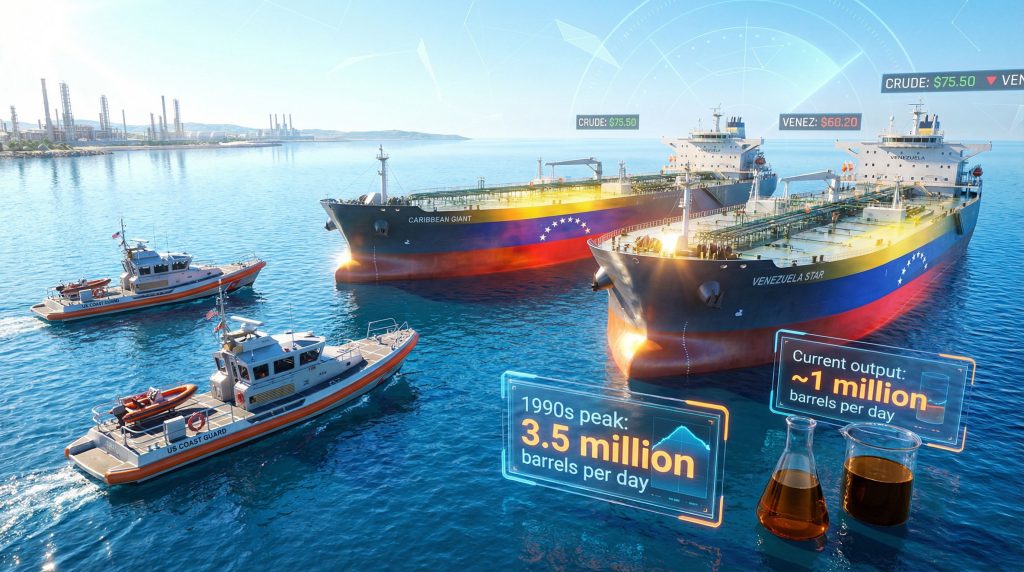
Historical production demonstrates the scale of potential recovery. Venezuela achieved peak output of approximately 3.1 million barrels per day in 1997, according to U.S. Energy Information Administration data. Current production has declined to approximately 760,000 barrels per day as of 2024, representing a dramatic decrease from historical capacity.
The technical characteristics that make Venezuelan crude strategically significant include:
- Sulfur content of 3-4% by weight, requiring specialised hydrotreating equipment
- Viscosity of 500-1,200 centipoise at 100°F versus 2-10 centipoise for light crude
- Processing complexity demanding delayed coking or hydrocracking units
- Global scarcity of heavy crude supplies from politically stable regions
Secretary of State Marco Rubio noted the global shortage of heavy crude as a key market factor, emphasising that Gulf Coast refineries represent optimal processing infrastructure for Venezuelan petroleum. This technical compatibility creates natural economic incentives for Western investment in Venezuelan production recovery.
Price differentials between heavy and light crude typically range from $5-15 per barrel, reflecting processing complexity and infrastructure requirements. However, supply constraints for heavy crude have periodically narrowed these spreads, particularly during periods of Canadian oil sands production limitations or Mexican heavy crude export restrictions.
How Do Refinery Economics Drive Investment Interest?
The U.S. Gulf Coast maintains approximately 8.5-9 million barrels per day of refining capacity, with an estimated 50-55% capable of processing heavy crude through specialised equipment configurations. This infrastructure advantage positions American refiners to capture significant value from Venezuelan crude processing.
| Heavy Crude Processing Capacity by Region | Capacity (MMbbl/d) | Specialised Units |
|---|---|---|
| US Gulf Coast | 4.5-5.0 | 15-18 delayed coking units |
| Asia-Pacific | 2.8-3.2 | Limited heavy crude optimisation |
| Europe | 1.5-2.0 | Moderate processing capability |
Processing economics favour facilities with existing coking infrastructure. Heavy Venezuelan crude produces approximately 65-70% light products versus 80-85% from light crude feedstock at equivalent thermal severity. However, the capital intensity for upgrading standard refineries requires $500-800 million per 100,000 barrels per day of heavy crude processing capacity.
Yield economics create compelling investment opportunities despite higher processing costs. Delayed coking and hydrocracking units convert heavy residual fractions into valuable gasoline, diesel, and petrochemical feedstocks. Furthermore, refineries with existing heavy crude capability can capture margin advantages when light-heavy crude price spreads widen.
Rubio emphasised that non-Russian and non-Chinese companies would show dramatic interest in Venezuelan investments, citing Western technological advantages in heavy crude processing. The exclusion of Chinese and Russian firms from potential joint ventures creates preferential access for American and European energy companies.
Strategic Leverage Mechanisms in Energy Diplomacy
What Conditions Must Venezuela Meet to Lift Restrictions?
The United States has established specific requirements for sanctions relief that extend beyond simple political transitions. These conditions create measurable benchmarks for policy effectiveness while maintaining leverage over Venezuelan decision-making processes related to the Venezuela oil quarantine.
Core requirements include:
- Severing ties with Iran, Hezbollah, and Cuba – eliminating military cooperation and intelligence sharing
- Dismantling drug trafficking networks – disrupting cocaine transshipment operations
- Preventing adversary benefit – ensuring oil revenues don't support Russian or Chinese strategic objectives
- Establishing transparent systems – creating verifiable revenue distribution mechanisms
The assessment framework emphasises actions over rhetoric, focusing on measurable policy changes rather than diplomatic statements or public commitments.
Enforcement mechanisms operate through asset forfeiture procedures under 18 U.S.C. § 2461, enabling civil seizure of vessels and petroleum cargoes. Court-ordered interdiction provides legal foundation for maritime enforcement, creating immediate financial consequences for sanctions violations.
The quarantine strategy maintains pressure through revenue denial rather than infrastructure destruction. By controlling petroleum exports, the United States can rapidly adjust economic pressure based on Venezuelan compliance with specified conditions, creating incentive structures for cooperative behaviour. This approach aligns with broader OPEC market influence considerations in regional energy dynamics.
How Does Oil Revenue Control Influence Political Transitions?
Venezuela's government historically derived 95%+ of export revenues from petroleum sales, creating extreme dependency on hydrocarbon income for government operations. Without oil revenue access, the state lacks capital for subsidies, patronage networks, and essential services that maintain political control.
The current oil industry operates as a revenue extraction mechanism that benefits political elites rather than the broader population. This concentration of petroleum income creates vulnerability to external pressure through quarantine operations that directly impact government financing.
Resource dependency creates specific leverage points:
- Subsidy system collapse when petroleum export revenues decline
- Patronage network disruption affecting political coalition stability
- Infrastructure maintenance failures reducing long-term production capacity
- Import capacity limitations constraining consumer goods availability
The assessment methodology focuses on observable actions rather than public statements, requiring concrete policy changes before sanctions relief consideration. This approach establishes clear performance metrics while maintaining flexibility for graduated response to Venezuelan cooperation levels.
Democratic transition requirements remain deliberately unspecified regarding timeline and specific electoral mechanisms, providing negotiation flexibility while maintaining pressure for fundamental political reforms. This strategic ambiguity complements broader oil trade dynamics affecting regional stability.
Production Recovery Scenarios and Market Implications
What Would Full Venezuelan Oil Recovery Look Like?
Historical production analysis reveals the scale of potential Venezuelan petroleum recovery. Peak output during the 1990s reached 3.1-3.5 million barrels per day, representing practical maximum capacity under Petróleos de Venezuela SA (PDVSA) operations before infrastructure deterioration.
Current production of approximately 760,000 barrels per day indicates a recovery potential of 1.5-2.5 million barrels per day with significant Western investment and technological modernisation. Conservative industry estimates suggest 2.0-2.5 million barrels per day as achievable with substantial capital expenditure over a 5-7 year timeline.
Recovery scenarios based on investment levels:
- Rapid recovery (18 months): 1.2-1.5 MMbbl/d requiring $3-5 billion investment
- Moderate recovery (3-5 years): 1.8-2.2 MMbbl/d requiring $8-12 billion investment
- Full recovery (7-10 years): 2.5-3.0 MMbbl/d requiring $15-20 billion investment
Infrastructure deterioration in the Orinoco Belt represents the primary constraint on production recovery. Extra-heavy crude extraction requires steam injection and diluent (light hydrocarbons) for flow assurance, with current diluent production severely constrained by equipment failures and maintenance backlogs.
Presidential statements indicate U.S. oil companies would invest billions to rebuild Venezuelan petroleum infrastructure, suggesting government support for private sector participation in recovery efforts. This policy backing creates favourable conditions for major integrated oil companies to evaluate Venezuelan opportunities, particularly given recent US oil production decline trends affecting domestic supply.
How Would Western Investment Transform Operations?
Western investment could fundamentally transform Venezuelan petroleum operations through technology transfer, capital injection, and operational expertise. Industry estimates suggest $15-20 billion in total investment over 5-7 years for production recovery to 2.5 million barrels per day.
Investment requirements by category:
| Infrastructure Type | Investment Range | Timeline |
|---|---|---|
| Production facilities | $4-6 billion | 3-5 years |
| Transportation/pipeline | $3-5 billion | 2-4 years |
| Processing infrastructure | $2-3 billion | 2-3 years |
| Orinoco Belt optimisation | $4-6 billion | 5-7 years |
Modern subsurface optimisation technologies could improve recovery rates by 10-15% versus current Venezuelan operations. Enhanced oil recovery techniques, digital monitoring systems, and automated production controls represent significant upgrades to existing infrastructure.
Joint venture structures would likely follow production-sharing agreement models rather than traditional concessions, providing Venezuelan state participation while enabling Western technological leadership. Risk premiums for Venezuelan operations would initially command 3-5% above comparable Latin American projects due to political and operational uncertainties.
Debt restructuring represents a critical prerequisite for large-scale investment. Venezuelan external debt approximates $40-50 billion as of 2024, requiring formal restructuring agreements before major international oil companies commit substantial capital to recovery projects.
The exclusion of Russian and Chinese companies from participation creates preferential access for Western firms, potentially improving project economics through reduced competition for acreage and infrastructure access. This dynamic coincides with broader OPEC production impact assessments affecting global market balance.
Regional Geopolitical Ramifications
What Are the Broader Caribbean Security Implications?
The Venezuela oil quarantine strategy extends beyond petroleum enforcement to encompass broader Caribbean security architecture. Drug trafficking interdiction capabilities deployed for sanctions enforcement create dual-use assets that enhance regional narcotics control operations.
Cocaine transshipment from South America through Caribbean routes represents approximately 90% of North American cocaine supply, according to DEA assessments. Maritime patrol assets stationed for oil quarantine operations can simultaneously disrupt drug trafficking networks, creating synergistic security benefits.
U.S. forces deployed in the region maintain capability for stopping sanctioned vessels while paralysing revenue generation mechanisms for illicit networks. This dual-mission approach optimises resource allocation while addressing multiple security priorities through integrated operations.
Regional cooperation frameworks benefit from enhanced U.S. maritime presence:
- Intelligence sharing with Caribbean partner nations
- Joint interdiction operations targeting multiple threat streams
- Capacity building for regional coast guard forces
- Economic stability support through reduced criminal activity
Migration patterns could shift significantly based on Venezuelan economic recovery. Improved petroleum revenues and political stability would likely reduce outward migration pressure, benefiting neighbouring countries currently hosting Venezuelan refugees.
How Does This Strategy Affect US-Latin America Relations?
The Venezuela intervention establishes important precedents for U.S. engagement across Latin America. Maritime quarantine mechanisms demonstrate American capability to project power through economic pressure rather than direct military intervention, potentially influencing regional sovereignty perceptions.
Diplomatic implications extend beyond Venezuela to broader hemispheric relationships. Regional partners must balance cooperation with U.S. enforcement efforts against concerns about intervention precedents in their own territorial waters or economic zones.
Economic partnership restructuring opportunities emerge through Venezuelan market reopening. Energy sector investment, infrastructure development, and trade relationship normalisation could create positive spillover effects for regional economic integration.
Democratic transition support mechanisms tested in Venezuela may inform future U.S. approaches to authoritarian governments across Latin America. Success or failure in Venezuelan political transformation will influence policy frameworks for similar situations.
Investment and Market Response Scenarios
What Opportunities Exist for Energy Companies?
Venezuelan market reopening creates substantial opportunities for Western energy companies, particularly those with existing heavy crude processing capabilities. Integrated oil companies with Gulf Coast refining assets possess competitive advantages for Venezuelan crude utilisation.
Western vs. Non-Western Investment Competition:
| Company Type | Advantages | Constraints |
|---|---|---|
| US/European Majors | Technology, capital, Gulf Coast integration | Political risk, debt overhang |
| Chinese State Companies | Excluded from participation | Sanctions restrictions |
| Russian Energy Firms | Excluded from participation | Sanctions restrictions |
| Independent Producers | Lower capital requirements | Limited processing integration |
Joint venture structuring possibilities include production-sharing agreements, technical service contracts, and concession arrangements. Each structure offers different risk-return profiles based on capital commitment levels and operational control requirements.
Risk assessment frameworks must incorporate political transition uncertainties, infrastructure rehabilitation costs, and debt restructuring timelines. Venezuelan projects would command risk premiums reflecting these uncertainties, potentially affecting investment economics for smaller operators.
Major integrated companies with existing Latin American operations and heavy crude expertise represent the most likely initial investors. These firms possess technical capabilities, capital resources, and risk management experience necessary for Venezuelan market entry. Additionally, emerging uranium market trends may influence broader energy investment portfolios.
How Might Oil Prices React to Venezuelan Recovery?
Venezuelan production recovery could add 0.5-2.5 million barrels per day to global supply depending on investment levels and recovery timelines. Market absorption capacity and OPEC+ response mechanisms would significantly influence price impacts.
Supply Addition Scenarios:
- Gradual increase (6-12 months): 0.5-0.8 MMbbl/d addition with minimal price disruption
- Moderate recovery (2-3 years): 1.2-1.8 MMbbl/d requiring market rebalancing
- Rapid expansion (5+ years): 2.0-2.5 MMbbl/d potentially pressuring prices
Heavy crude market dynamics differ from light crude pricing due to processing complexity and infrastructure requirements. Venezuelan production recovery would primarily impact heavy crude pricing rather than benchmark light crude markers.
OPEC+ response considerations include production allocation adjustments to accommodate Venezuelan supply increases. Saudi Arabia and other swing producers might reduce output to maintain price stability, limiting overall market impact from Venezuelan recovery.
Market absorption capacity depends heavily on refinery utilisation rates and heavy crude demand growth. Asian refining expansion and U.S. Gulf Coast capacity utilisation would influence pricing dynamics for Venezuelan crude grades.
The next major ASX story will hit our subscribers first
Long-term Strategic Outcomes
What Success Metrics Define Policy Effectiveness?
Policy effectiveness measurement requires concrete benchmarks beyond political rhetoric or diplomatic statements. Observable actions across multiple dimensions provide assessment criteria for sanctions relief and relationship normalisation.
Democratic institution establishment benchmarks:
- Electoral system transparency with international monitoring
- Judicial independence from executive control
- Press freedom restoration and media pluralism
- Civil society participation in governance processes
Economic benefit distribution metrics include poverty reduction rates, healthcare access improvement, and infrastructure development indicators. Revenue transparency mechanisms must demonstrate petroleum income reaches Venezuelan citizens rather than political elites.
Regional security improvement indicators encompass drug interdiction success rates, migration pattern stabilisation, and cooperative law enforcement relationships. These metrics provide measurable evidence of policy success beyond oil production statistics.
U.S. strategic interest advancement includes Caribbean security enhancement, democratic norm strengthening, and economic partnership expansion. Long-term success requires sustainable Venezuelan political and economic stability rather than short-term compliance.
How Could This Model Apply to Other Sanctioned Nations?
The Venezuelan quarantine model offers potential applications for other resource-dependent economies under sanctions pressure. Maritime enforcement capabilities and revenue control mechanisms could influence policy approaches toward Iran, Russia, and North Korea.
Iran nuclear programme parallels include revenue denial through petroleum export restrictions and international cooperation requirements for sanctions enforcement. However, Iran's more diversified economy and regional allies create different strategic dynamics than Venezuela's Caribbean isolation.
Russia energy sector lessons demonstrate the complexity of sanctioning major petroleum producers with significant global market share. Venezuelan recovery could inform approaches to post-conflict Russian energy sector reconstruction and international reintegration.
Cuba embargo evolution provides historical context for long-term sanctions relationships and transition mechanisms. Venezuelan policy success or failure will influence approaches to Cuban economic engagement and political transition support.
The effectiveness of economic pressure through resource control depends heavily on target nation characteristics: economic dependency levels, alternative partnership options, and domestic political dynamics. Each case requires customised approaches rather than standardised sanctions frameworks. The Venezuela oil quarantine represents a targeted application of these principles adapted to specific regional conditions.
This analysis is based on current policy statements and market conditions as of January 2026. Actual outcomes depend on Venezuelan political developments, international cooperation levels, and global energy market dynamics that may differ from current projections. Investment decisions should incorporate comprehensive risk assessment and professional financial advice.
Want to Position Yourself for the Next Major Energy Discovery?
Discovery Alert instantly alerts investors to significant ASX mineral discoveries using its proprietary Discovery IQ model, turning complex mineral data into actionable insights. Understand why major mineral discoveries can lead to substantial market returns by exploring Discovery Alert's dedicated discoveries page, showcasing historic examples of exceptional outcomes, and begin your 30-day free trial today to position yourself ahead of the market.