June 22, 2026
The Hidden Carbon Cost Embedded in Every Tonne of Iron Ore Shipped Across the Pacific
Before a single tonne of iron ore reaches a blast furnace in China, Japan, or South Korea, it has already accumulated a significant carbon liability simply by existing on a ship. The vessels responsible for moving bulk commodities across oceanic trade routes are, by cumulative fuel burn, among the most emissions-intensive transport assets on the planet. A single large bulk carrier burning heavy fuel oil on the Pilbara-to-Asia corridor can consume hundreds of tonnes of fuel per day, generating thousands of tonnes of CO₂ over the course of a round trip.
For companies whose entire business model depends on repeating that voyage hundreds of times annually, the decarbonisation of marine transport is not a distant policy consideration. It is an operational reality with an accelerating compliance deadline attached to it.
That is the context in which Fortescue's (ASX: FMG) commitment to Fortescue ammonia-capable vessels needs to be understood. Not as a marketing exercise, but as a structurally motivated response to one of the most technically complex emissions challenges in global heavy industry.
When big ASX news breaks, our subscribers know first
Why Bulk Iron Ore Shipping Sits at the Intersection of Scale and Emissions Intensity
The iron ore trade between Western Australia and Northeast Asia is one of the highest-frequency, highest-volume commodity shipping corridors in the world. Newcastlemax and Capesize vessels operate on this route in near-continuous rotation, and the cumulative fuel consumption across an entire fleet over a calendar year runs into millions of tonnes of marine fuel.
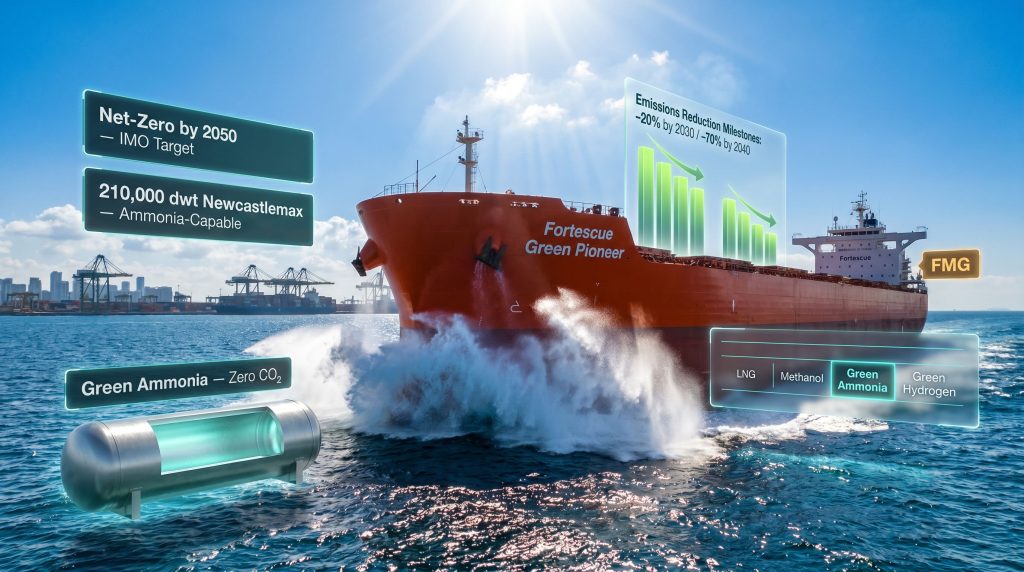
The International Maritime Organisation's revised 2023 greenhouse gas strategy sets out legally binding reduction milestones that make this fuel consumption problem urgent rather than theoretical:
- A minimum 20% reduction in greenhouse gas emissions from international shipping by 2030, measured against 2008 baseline levels
- A further reduction of at least 70% by 2040
- Net-zero emissions from international shipping by or around 2050
For a company like Fortescue, which ships hundreds of millions of tonnes of iron ore annually, these targets translate directly into fleet technology decisions that need to be made now, not in 2040. Vessel construction lead times, retrofit scheduling windows, and bunkering infrastructure development all operate on timelines of five to fifteen years. Decisions deferred become options foreclosed.
Understanding Why Ammonia Emerged as Fortescue's Fuel of Choice
The alternative marine fuel landscape is crowded with contenders, each carrying distinct trade-offs across emissions profile, energy density, infrastructure maturity, and cost. Understanding why Fortescue converged on ammonia as its primary decarbonisation pathway requires examining how the leading alternatives compare.
| Marine Fuel Alternative | Carbon Content | Energy Density (MJ/kg) | Commercial Maturity (2026) |
|---|---|---|---|
| LNG | High (fossil origin) | ~50 | Fully commercial |
| Methanol | Low to moderate | ~20 | Early commercial |
| Green Hydrogen | Zero | ~120 | Pre-commercial |
| Green Ammonia | Zero | ~18.6 | Demonstrator / early commercial |
| Biofuels | Variable | ~37 | Niche commercial |
Ammonia's defining characteristic is structural: the molecule NH₃ contains no carbon atoms. Combustion therefore produces no CO₂ as a direct byproduct. When the ammonia is itself produced using renewable electricity to power an electrolysis process, the full lifecycle emissions can approach near-zero, making it one of the very few marine fuels theoretically capable of satisfying the IMO's 2050 net-zero mandate without relying on carbon offsets. Furthermore, this connects directly to broader efforts in green iron production, where decarbonising the entire supply chain — from mine to steelmill — is increasingly the central strategic objective.
LNG, by contrast, reduces CO₂ emissions by approximately 20 to 25% compared to heavy fuel oil but delivers no pathway to the deep decarbonisation the IMO targets require. Companies that have committed heavily to LNG as a transitional fuel may find themselves needing to transition again within the same asset lifecycle, a prospect that concentrates capital risk rather than reducing it.
Fortescue's decision to bypass LNG as a bridge fuel and move directly toward ammonia-capable vessels represents a higher-risk, higher-conviction strategic position, one that bets on the technology maturing before the regulatory and competitive penalties for inaction become prohibitive.
The Technical Architecture of Ammonia-Capable Propulsion at Sea
Pure ammonia combustion presents genuine engineering challenges. Ammonia has a narrow flammability range, a high auto-ignition temperature, and combustion characteristics that differ substantially from conventional marine diesel. The solution Fortescue has adopted, in common with engine manufacturers developing the technology, is a dual-fuel configuration that uses ammonia as the primary energy carrier while a small quantity of diesel or pilot fuel initiates and stabilises the combustion cycle.
This approach is technically significant for several reasons:
- It eliminates the need to solve pure ammonia ignition at commercial scale before deployment
- It preserves operational redundancy, as vessels can revert to conventional fuel operation if required
- It allows ammonia percentage in the fuel blend to be progressively increased as engine technology and crew competency develop
- It reduces the capital risk of early adoption by avoiding an all-or-nothing technology commitment
The dual-fuel approach does, however, introduce one important byproduct challenge. Ammonia combustion generates elevated levels of nitrogen oxides (NOx), a regulated air pollutant under IMO Tier III standards. Managing this requires Selective Catalytic Reduction (SCR) after-treatment systems to bring NOx output within compliance thresholds, adding engineering complexity and cost to the propulsion package.
A related technical concern is ammonia slip, where trace quantities of uncombusted ammonia pass through the combustion cycle and exit via exhaust. Beyond the direct air quality implications, ammonia slip can contribute indirectly to nitrous oxide (N₂O) formation, itself a potent greenhouse gas. Engine manufacturers including MAN Energy Solutions and Wärtsilä are actively developing low-slip combustion solutions specifically for the ammonia fuel context, with commercial-scale availability expected to align with the industry's 2030 retrofit timelines.
The Green Pioneer: What the World's First Commercial Ammonia Vessel Demonstrator Proved
The Fortescue Green Pioneer occupies a unique position in maritime history as the world's first dual-fuel ammonia-powered vessel to conduct operational demonstrations at commercial scale across multiple international ports. Two of the vessel's four engines were converted to dual-fuel ammonia-diesel capability, preserving the redundancy necessary for safe blue-water operation while demonstrating the technology under real-world conditions.
The strategic choice of demonstration ports carries as much significance as the technology itself. The Green Pioneer completed ammonia bunkering and operational demonstrations at Singapore, Southampton, Boston, and New York. Each of these locations represents a major global maritime hub:
- Singapore is the world's largest bunkering port by volume, and its inclusion signals ammonia's potential to penetrate the global marine fuel supply chain at scale
- Southampton provides access to European regulatory frameworks and Lloyd's Register classification infrastructure
- Boston and New York engage the United States Coast Guard and American Bureau of Shipping regulatory ecosystem, broadening the evidentiary base for ammonia fuel acceptance
This multi-jurisdictional demonstration approach is not incidental. Classification societies, flag states, and port authorities each operate under different regulatory frameworks, and building an evidence base across all of them simultaneously accelerates the development of the unified international standards that commercial-scale ammonia shipping will require.
How an Ammonia Dual-Fuel Vessel Operates: A Step-by-Step Breakdown
- Ammonia bunkering at port — Liquid ammonia is transferred to the vessel via specialist equipment under stringent safety protocols, stored in either cryogenic or pressurised onboard tanks depending on the vessel's storage system design
- Engine and fuel system preparation — Dual-fuel engine management systems are calibrated to the target ammonia-diesel blend ratio for the voyage profile
- Combustion initiation — Diesel pilot injection creates the ignition conditions required, after which ammonia provides the dominant energy contribution across the combustion cycle
- Emissions monitoring underway — Onboard systems track NOx, CO₂, SOx, and ammonia slip in real time, generating the compliance data required for IMO Carbon Intensity Indicator (CII) rating assessments
- Port arrival and data submission — Accumulated emissions records are submitted to classification society auditors and used to inform ongoing regulatory framework development
From Demonstrator to Commercial Scale: The CMB.TECH Charter and Fleet Expansion
The demonstrator phase of Fortescue's ammonia vessel programme has produced a technically validated proof of concept. The next challenge is translating that proof of concept into commercial-scale deployment across vessels large enough to carry meaningful iron ore cargo volumes.
Fortescue's agreement with CMB.TECH, the clean marine technology division of Compagnie Maritime Belge, addresses this directly. The charter agreement covers the deployment of a 210,000 deadweight tonne Newcastlemax ore carrier configured as a dual-fuel ammonia-capable newbuild, with delivery expected by the end of 2026.
CMB.TECH is among the most technically advanced commercial operators currently developing ammonia-fuelled bulk carriers, making the partnership a capability combination rather than a simple charter arrangement. Fortescue brings the operational demand signal and the decarbonisation strategic commitment; CMB.TECH brings the vessel engineering expertise and newbuild delivery pipeline.
Fortescue's Ammonia Vessel Milestone Timeline
| Period | Key Development |
|---|---|
| Pre-2024 | Green Pioneer converted to dual-fuel ammonia-diesel configuration |
| 2024–2025 | Operational demonstrations at Singapore, Southampton, Boston, and New York |
| 2026 (expected delivery) | 210,000 dwt Newcastlemax ammonia-capable ore carrier via CMB.TECH/Bocimar |
| By 2030 | Fleet-wide retrofit of Fortescue-owned vessels with ammonia-capable engines |
| Post-2030 | Ammonia propulsion specified as standard for all future Fortescue newbuilds |
The choice of the Newcastlemax vessel class for the first commercial deployment is deliberate and technically significant. At approximately 200,000 to 210,000 dwt, these are the largest bulk carriers capable of transiting Newcastle Harbour in Australia and are purpose-optimised for the Pilbara-to-Asia iron ore corridor. Demonstrating ammonia propulsion at this scale, rather than on a smaller vessel, provides the maritime industry with a commercially representative data set that smaller demonstrators cannot replicate.
The next major ASX story will hit our subscribers first
Competitive Positioning: How Fortescue's Strategy Compares Across Major Bulk Shippers
Fortescue's ammonia-first approach stands in contrast to the strategies adopted by other major bulk commodity operators, most of whom have chosen LNG as a transitional fuel while monitoring alternative fuel development from a safer technological distance. In addition, the broader context of the China steel and iron ore market adds further urgency to these decisions, as the region's demand trajectory heavily influences how quickly decarbonisation solutions must be scaled.
| Company | Primary Fuel Strategy | Fleet Status (2026) |
|---|---|---|
| Fortescue (ASX: FMG) | Green ammonia, direct pathway | Demonstrator operational; Newcastlemax delivery 2026; fleet retrofit by 2030 |
| BHP (ASX: BHP) | LNG transitional, green methanol long-term | LNG vessels in service; methanol trials underway |
| Rio Tinto (ASX: RIO) | Wind-assisted propulsion, LNG | Rotor sail trials active; LNG newbuilds ordered |
| Vale (Brazil) | LNG and biofuels | Large LNG-capable Valemax fleet operational |
The contrast is instructive. BHP and Rio Tinto's LNG commitments reduce near-term emissions but do not solve the 2050 challenge. Their strategies effectively purchase time while technology matures. Fortescue's ammonia commitment accepts greater near-term technology risk in exchange for a theoretically more direct path to the deep decarbonisation outcome that global shipping regulations will eventually require.
Whether that bet proves prescient or premature depends substantially on factors outside any single company's control, including green ammonia production costs, bunkering infrastructure development, and the pace of regulatory standardisation.
The Infrastructure Gap: Why Port Readiness is the Critical Bottleneck
Vessel technology is only half of the ammonia shipping equation. A dual-fuel ammonia vessel without access to ammonia bunkering at its ports of call is operationally constrained regardless of its engineering sophistication.
Unlike LNG, which has benefited from a decade of deliberate global bunkering network investment, ammonia marine bunkering infrastructure remains in its infancy as of 2026. The number of ports globally that have conducted ship-to-ship or terminal-to-ship ammonia fuel transfers for marine propulsion purposes can be counted on one hand.
Port authorities face a specific set of requirements before ammonia bunkering can be offered commercially:
- Development and approval of Material Safety Data Sheet (MSDS) protocols specific to ammonia fuel transfer operations
- Certification of bunkering equipment and transfer hoses rated for ammonia service conditions
- Training and certification of port personnel in ammonia emergency response procedures
- Establishment of exclusion zone protocols and evacuation procedures given ammonia's acute toxicity
Ammonia is acutely toxic to humans at concentrations of approximately 300 parts per million and above, creating a safety profile meaningfully different from LNG or methanol. This is not an insurmountable challenge, given that ammonia has been handled industrially at scale for over a century in fertiliser production and refrigeration applications, but it requires purpose-built protocols that the maritime industry is still developing.
Regulatory Complexity: The Patchwork of Standards Ammonia Shipping Must Navigate
The IMO's International Code of Safety for Ships Using Gases or Other Low-Flashpoint Fuels (IGF Code) is the primary regulatory framework governing alternative marine fuel vessels, and it is being progressively amended to incorporate ammonia. Operational data generated by the Green Pioneer's demonstration programme is actively informing this amendment process, giving Fortescue an unusual degree of influence over the regulatory standards that will govern its own future fleet.
Classification societies have each published interim guidelines for ammonia-fuelled vessels:
- Lloyd's Register has issued interim rules for ammonia-fuelled ships covering fuel system design, safety systems, and risk assessment requirements
- DNV has published its ammonia-fuelled vessel class notation framework, including requirements for NOx after-treatment and ammonia detection systems
- Bureau Veritas has similarly issued interim guidance covering structural and systems requirements for ammonia fuel storage and distribution aboard vessels
A unified international standard remains under development, creating a compliance complexity challenge for vessels operating across multiple flag state jurisdictions simultaneously. This regulatory fragmentation is itself a market inefficiency that early movers like Fortescue are positioned to help resolve by generating the operational data that standard-setters require.
Green Ammonia Supply: The Upstream Dependency That Determines Everything
The environmental case for ammonia-fuelled shipping rests entirely on one foundational assumption: that the ammonia being consumed was produced using renewable energy. Green ammonia, produced via electrolysis powered by wind or solar electricity, delivers a near-zero lifecycle emissions profile. Grey ammonia, produced via steam methane reforming of natural gas, offers no meaningful climate benefit compared to conventional marine fuel.
This upstream dependency is the most important and least discussed aspect of the ammonia shipping transition. A vessel technically capable of burning ammonia but supplied with grey ammonia at port is not contributing to decarbonisation in any meaningful sense. The emissions reduction is occurring on paper, not in the atmosphere.
Fortescue's broader corporate strategy includes large-scale green hydrogen and green ammonia production through its energy business division, creating a potential vertical integration pathway from renewable electricity generation through to vessel bunkering. Innovations in hydrogen iron ore reduction are closely related, as both pathways depend on scaling green hydrogen infrastructure to commercially viable cost levels. Furthermore, Australia's green metals leadership position provides a structural advantage in developing green ammonia supply chains at the scale maritime shipping would require.
The strategic coherence of Fortescue's position is notable: if the company can successfully develop domestic green ammonia production at competitive cost, it simultaneously solves its own fleet's fuel supply challenge and potentially creates an export commodity in green ammonia that serves other shipping operators globally.
This demand-anchor dynamic extends beyond Fortescue's own balance sheet. By committing to Fortescue ammonia-capable vessels at commercial scale before industry consensus has formed, the company is generating the demand signal that justifies infrastructure investment by:
- Electrolyser manufacturers scaling production capacity and reducing unit costs
- Port operators making the business case for ammonia bunkering facility capital expenditure
- Shipyards developing standardised ammonia-capable vessel designs for the broader bulk carrier market
- Insurance markets developing actuarial frameworks for ammonia-fuelled vessel coverage
Frequently Asked Questions About Fortescue Ammonia-Capable Vessels
What exactly are Fortescue ammonia-capable vessels?
Fortescue ammonia-capable vessels are bulk carriers fitted with dual-fuel engine systems capable of burning a blend of ammonia and diesel for propulsion, rather than relying solely on conventional heavy fuel oil. The Green Pioneer is the operational demonstrator, while a 210,000 dwt Newcastlemax vessel represents the first commercial-scale deployment under the CMB.TECH charter arrangement.
Why is ammonia considered zero-carbon as a marine fuel?
Ammonia (NH₃) contains no carbon atoms in its molecular structure, so its combustion produces no CO₂. When produced using renewable electricity, the full supply chain lifecycle emissions approach near-zero, satisfying the IMO's long-term net-zero shipping target without requiring carbon offset mechanisms.
What are the biggest risks to Fortescue's ammonia shipping strategy?
The primary risk factors include the pace of green ammonia production cost reduction, the development of commercial-scale bunkering infrastructure at major ports, the finalisation of unified international regulatory standards for ammonia-fuelled vessels, and the resolution of NOx and ammonia slip technical challenges at the engine level. Each of these represents a genuine uncertainty rather than a solved problem.
When is the new Newcastlemax ammonia vessel expected to enter service?
The 210,000 dwt Newcastlemax ammonia-capable ore carrier developed with CMB.TECH (Bocimar) is expected to be delivered by the end of 2026, representing the transition from demonstrator phase to initial commercial-scale operation.
How does Fortescue's approach differ from BHP and Rio Tinto?
Fortescue has committed directly to ammonia as its primary decarbonisation pathway, bypassing LNG as a transitional fuel. BHP and Rio Tinto have both invested in LNG-capable vessels, which reduce emissions by approximately 20 to 25% compared to heavy fuel oil but do not deliver the deep decarbonisation required to meet 2050 IMO targets without additional interventions. Consequently, the China iron ore outlook may increasingly favour suppliers who can demonstrate credible green shipping credentials as regulatory pressure intensifies.
Key Considerations for Evaluating the Long-Term Significance of This Programme
Several dimensions of Fortescue's ammonia vessel programme deserve consideration from an industry and investment perspective:
- Technology timing risk: Committing to ammonia propulsion before unified international standards are finalised creates compliance uncertainty as regulations evolve around an already-deployed fleet
- Supply chain dependency: The decarbonisation outcome is contingent on green ammonia supply being available at commercial scale and competitive cost at ports on the Pilbara-to-Asia trade route
- Regulatory influence: Fortescue's early mover position gives the company disproportionate influence over the international regulatory frameworks being developed, a strategic asset not reflected on any balance sheet
- Market-making potential: If Fortescue's programme successfully validates ammonia shipping at commercial scale, the template becomes available to the entire bulk commodity shipping sector, potentially accelerating adoption in ways that extend Fortescue's first-mover advantage into a market-shaping role
This article contains forward-looking analysis and references to industry projections, technology timelines, and regulatory frameworks. Readers should be aware that outcomes in emerging technology sectors are subject to material uncertainty and should not interpret this content as financial advice. Independent assessment of investment decisions is recommended.
Want to Stay Ahead of the Next Major ASX Mineral Discovery?
Discovery Alert's proprietary Discovery IQ model delivers real-time alerts on significant ASX mineral discoveries, turning complex mineral data into actionable insights for investors across all experience levels — start your 14-day free trial today and explore the historic returns major discoveries have generated to understand why early positioning matters.