June 21, 2026
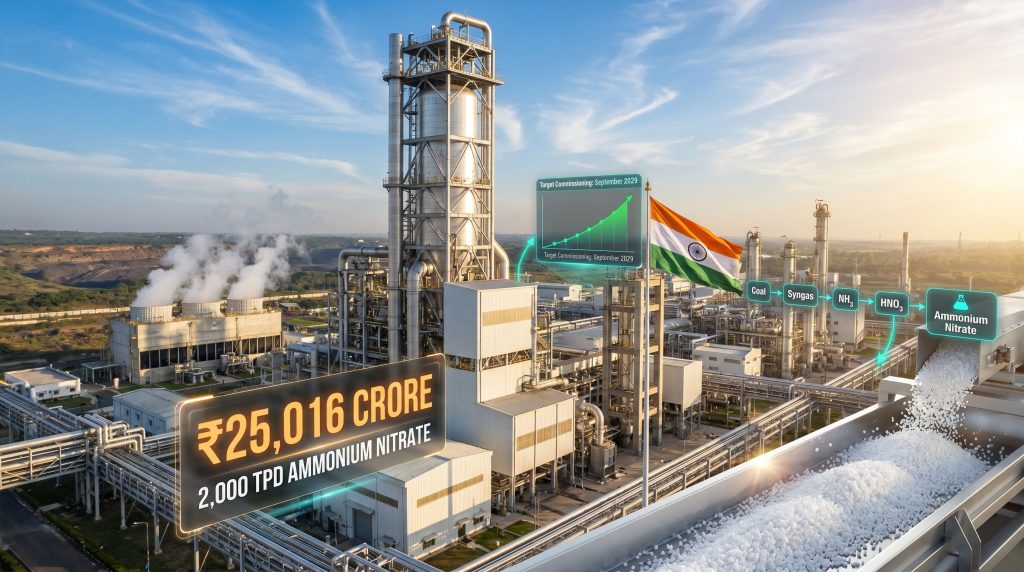
India's Coal-to-Chemicals Ambition: Understanding the Industrial Logic Behind a ₹25,016 Crore Bet
The global chemicals industry has long treated feedstock geography as destiny. Nations with abundant natural gas became ammonia powerhouses. Nations with coal found themselves at a structural disadvantage in fertiliser and explosives manufacturing, forced to import intermediates their geology could theoretically supply. India presents a uniquely compelling case study in how industrial policy can attempt to rewrite that logic entirely.
With proven coal reserves ranking among the world's largest, yet persistent dependence on imported ammonium nitrate and ammonia-derived chemicals, India has faced an uncomfortable paradox for decades. The coal to ammonium nitrate project in Odisha, developed by Bharat Coal Gasification & Chemicals Limited (BCGCL), is the most ambitious attempt yet to resolve that contradiction at commercial scale.
When big ASX news breaks, our subscribers know first
Why Ammonium Nitrate Dependency Is a Strategic Vulnerability
To understand why this project matters, it helps to examine what ammonium nitrate actually does inside an economy. Most consumers associate the compound with fertilisers or, occasionally, catastrophic industrial accidents. However, in the context of India's development trajectory, ammonium nitrate is better understood as a foundational infrastructure material.
Every major tunnelling project, open-cut mine, quarrying operation, and large-scale demolition activity relies on ANFO, which stands for ammonium nitrate fuel oil. ANFO is the standard bulk explosive medium across global mining and civil engineering, and ammonium nitrate functions as its primary oxidiser. Without it, India's coal extraction operations, road construction programmes, and hydroelectric dam excavations would face serious cost and supply constraints.
The demand picture across India's economy breaks down across three interconnected channels:
- Mining and quarrying: Ammonium nitrate is the oxidising agent in ANFO explosives used to fragment rock across coal, iron ore, limestone, and other extractive operations
- Civil infrastructure: Large-scale tunnelling, highway cutting, and demolition projects throughout the National Infrastructure Pipeline depend on ammonium nitrate-based blasting agents
- Fertiliser and agriculture: The ammonia produced as an intermediate in ammonium nitrate synthesis can be directed toward urea and nitrogen fertiliser manufacturing, directly supporting crop productivity
India currently imports meaningful volumes of ammonium nitrate to bridge the gap between domestic production capacity and actual industrial demand. That import dependency creates exposure to global price cycles, shipping disruptions, and the geopolitical dynamics of major producing nations, particularly those in Eastern Europe and the Middle East where natural gas-based ammonia production is concentrated.
Furthermore, India LNG import costs add another layer of vulnerability, given that natural gas-based ammonia production competes directly with coal gasification pathways for investment capital and policy priority. The compound nature of this risk becomes clearer when you consider that India's infrastructure investment pipeline is expanding at precisely the moment global chemical supply chains remain fragile from the disruptions of recent years.
Project Architecture: Structure, Scale, and Site Selection
The BCGCL facility represents a deliberate alignment of India's two largest public sector industrial entities. Coal India Limited, the world's largest coal-producing company by volume, holds 51 per cent equity in the joint venture, while Bharat Heavy Electricals Limited (BHEL) holds the remaining 49 per cent. This structure is not incidental; it pairs feedstock control with technology ownership in a single integrated entity.
| Parameter | Detail |
|---|---|
| Developer | Bharat Coal Gasification & Chemicals Limited (BCGCL) |
| Equity Structure | Coal India Limited 51%, BHEL 49% |
| Project Location | Lakhanpur, Jharsuguda District, Odisha |
| Site Area | Approximately 350 acres |
| Total Capital Investment | ₹25,016 crore |
| Target Commissioning | September 2029 |
| Annual Ammonium Nitrate Output | ~0.66 MTPA (6.6 lakh tonnes) |
| Daily Production Capacity | 2,000 tonnes per day |
The site selection at Lakhanpur in Jharsuguda district reflects careful supply chain logic. Jharsuguda sits within one of India's most coal-intensive industrial corridors, home to the Ib Valley coalfields operated by Mahanadi Coalfields Limited (MCL), itself a Coal India subsidiary. Locating the gasification complex adjacent to the feedstock source eliminates long-distance coal transport costs and reduces logistical complexity for what will be a continuous, high-throughput industrial process.
MCL's contribution to the project extends beyond land. The subsidiary is committing 0.79 million tonnes per year (MTY) of washed coal and 1.19 MTY of washery reject material from its Ib Valley washery annually. The inclusion of washery rejects is a particularly noteworthy design choice. Coal washery rejects are a low-calorific, high-ash fraction that most conventional power stations and industrial users actively avoid. Converting this material into a productive gasification feedstock effectively monetises a waste stream, improving MCL's overall coal utilisation economics.
How Does This Compare to Previous Indian Industrial Projects?
Definitive feasibility studies for comparable coal-to-chemicals initiatives in India have historically struggled with feedstock matching — the challenge of aligning indigenous coal quality with the technical requirements of available gasification technologies. The BCGCL project addresses this directly through BHEL's indigenously developed PFBG process, which is specifically engineered for India's higher-ash domestic coal profile.
The PFBG Technology Pathway: How Coal Becomes a High-Value Chemical
The technological heart of the BCGCL project is Pressurised Fluidised Bed Gasification (PFBG), a process developed indigenously by BHEL. This distinction matters enormously for India's broader industrial ambitions, and it is worth understanding why PFBG was selected over alternative gasification technologies.
Most commercial-scale gasification facilities globally deploy entrained-flow gasifiers, which require finely pulverised, low-ash, relatively high-grade coal to function efficiently. India's domestic coal, sourced primarily from Gondwana-age deposits in Jharkhand, Odisha, and Chhattisgarh, is characterised by higher ash content and lower calorific values than premium international metallurgical or thermal coal grades. Entrained-flow technology would either require expensive coal beneficiation or the import of higher-grade feedstocks, undermining the entire import-substitution rationale.
PFBG technology operates differently. In a pressurised fluidised bed reactor, coal particles are suspended in an upward-moving stream of steam and oxygen under elevated pressure. The fluidised state promotes intimate contact between the coal and gasifying agents, enabling efficient carbon conversion even with high-ash, lower-rank coal. This tolerance for lower-quality feedstock is precisely what makes PFBG suited to India's coal resource profile.
The step-by-step conversion sequence proceeds as follows:
- Coal feed preparation: Washed coal and washery rejects from MCL's Ib Valley operations are sized and prepared for gasifier feed
- Pressurised fluidised bed gasification: Coal is reacted with steam and oxygen inside the PFBG reactor under elevated temperature and pressure, producing raw syngas — a hydrogen and carbon monoxide-rich mixture
- Syngas cleaning and conditioning: The raw syngas undergoes multi-stage purification to remove hydrogen sulphide, carbonyl sulphide, particulates, and carbon dioxide, yielding a clean hydrogen-rich gas stream
- Ammonia synthesis: Purified hydrogen is combined with nitrogen derived from an on-site air separation unit, then passed over an iron-based catalyst under high pressure in the Haber-Bosch process to yield anhydrous ammonia
- Nitric acid production: A portion of the ammonia is catalytically oxidised in air, producing nitric acid through the Ostwald process
- Ammonium nitrate formation: Ammonia and nitric acid are neutralised in a controlled reactor to produce ammonium nitrate solution, which is subsequently concentrated and converted into prills or granules for transport and use
What distinguishes this pathway from conventional natural gas-based ammonia plants is not merely the feedstock but the degree of indigenous technology control. BHEL's PFBG avoids royalty payments to foreign gasification licensors, a recurring cost burden in many large Indian petrochemical and fertiliser projects.
Comparing Feedstock Routes: Coal Gasification Versus Natural Gas Reforming
A question that analysts and policymakers inevitably raise about coal-to-chemicals projects concerns their carbon economics relative to natural gas-based alternatives. The comparison deserves honest treatment.
| Dimension | Coal Gasification Route (BCGCL) | Natural Gas Steam Reforming |
|---|---|---|
| Primary Feedstock | Domestic coal and washery rejects | Natural gas (often imported LNG) |
| Technology Ownership | Indigenous PFBG (BHEL-developed) | Typically licensed from foreign technology providers |
| Feedstock Price Risk | Lower, linked to domestic coal pricing | Higher, correlated to global LNG market volatility |
| Carbon Intensity | Higher per unit of ammonia produced | Lower under equivalent boundary conditions |
| Feedstock Availability | Abundant domestically | Constrained domestically; import-dependent |
| Strategic Fit for India | High, leverages coal surplus and avoids gas imports | Moderate, gas supply and pricing remain structural constraints |
The carbon intensity argument in favour of natural gas reforming is real but context-dependent. India's domestic gas production has historically been insufficient to supply both the power sector and a large-scale ammonia manufacturing base simultaneously. The country imports liquefied natural gas at spot or term prices that are subject to significant volatility, as demonstrated by the 2021–2022 global gas price shock that disrupted fertiliser production across multiple Asian economies.
Coal gasification carries a higher carbon footprint per tonne of ammonia produced under current operating conditions. However, this calculation shifts materially if carbon capture and storage provisions are integrated in future project phases. The BCGCL facility's design as a replicable national template suggests carbon management provisions may be considered in subsequent iterations of the model.
The National Coal Gasification Mission: Situating BCGCL Within a Larger Policy Ambition
The BCGCL project does not exist in isolation. It is formally positioned within India's National Coal Gasification Mission, which carries a target of gasifying 100 million tonnes of coal annually by 2030. That aggregate target, if achieved, would represent a structural transformation in how India uses its coal resources, shifting a meaningful fraction from direct combustion toward chemical feedstock applications.
The logic driving this mission reflects several converging pressures. India's coal market reforms are, furthermore, reshaping how feedstock is priced and allocated, adding a further layer of commercial opportunity for integrated coal-to-chemicals ventures like BCGCL:
- Energy transition complexity: Coal cannot be phased out rapidly given its role in India's baseload power, but diversifying its application toward chemicals creates higher economic value per tonne
- Chemical import substitution: Ammonia, methanol, and ammonium nitrate are all achievable through coal gasification, reducing the foreign exchange cost of chemical imports
- Technology commercialisation: Developing commercially proven indigenous gasification technology creates exportable industrial know-how for other coal-dependent developing economies
- Agricultural security: Ammonia intermediates from gasification can supply domestic fertiliser manufacturing, reducing vulnerability in food production supply chains
The BCGCL project's explicit designation as a model for future coal-to-chemicals projects signals that its engineering, regulatory, and financing structure is intended to be replicated elsewhere in India's coal belt. Jharsuguda is, in this framing, a proof-of-concept rather than a one-off initiative. These energy security challenges underscore why India is pursuing sovereign solutions at scale rather than remaining dependent on international chemical markets.
The next major ASX story will hit our subscribers first
Approvals, Financial Commitments, and EPC Awards
From a project execution standpoint, BCGCL has achieved meaningful de-risking before the first tonne of concrete is poured. Major statutory and environmental clearances are reported to be in place, and the financial and contractual framework is substantially established.
| Approval or Commitment | Detail |
|---|---|
| State-Level Clearance | Single Window Clearance from Odisha's High-Level Clearance Authority (HLCA) |
| Ministry of Coal Financial Incentive | ₹1,350 crore committed |
| EPC Package 1 (Coal-to-AN facility) | Awarded to Larsen & Toubro, valued at up to ₹5,000 crore |
| EPC Package 2 (Ammonia Synthesis) | Awarded to Larsen & Toubro, valued at up to ₹2,500 crore |
| Environmental Approvals | All major statutory clearances reported as secured |
The award of both primary EPC packages to Larsen & Toubro consolidates execution accountability and reduces interface risk between the gasification and synthesis sections of the plant. L&T's contract to build the coal-to-ammonium nitrate plant in Odisha has attracted considerable industry attention, given the project's scale and technical novelty. L&T's experience across large-scale process plant construction in India makes it a logical selection for a project of this technical complexity and capital scale.
The ₹1,350 crore Ministry of Coal incentive reflects the project's alignment with national energy policy objectives, though investors and analysts should note this represents a contribution toward the total ₹25,016 crore project cost rather than a dominant funding source. The balance is expected to be funded through the joint venture's own capital structure and project financing arrangements.
What Does the EPC Structure Mean for Project Risk?
Consolidating both primary EPC packages under a single contractor reduces the coordination complexity that typically arises at the interface between gasification and chemical synthesis units. In addition, single-contractor accountability provides clearer recourse mechanisms if commissioning milestones are missed, an important consideration for a project of this pioneering technical scope.
Regional Economic Implications for Jharsuguda and Odisha
Jharsuguda district has historically functioned as a resource extraction node within Odisha's industrial economy, with coal mining and aluminium smelting representing its dominant activities. The BCGCL facility introduces a downstream chemicals manufacturing dimension that could meaningfully diversify the district's economic base.
The anticipated economic contributions extend across multiple layers:
- Direct employment in plant operations, safety management, instrumentation, and process control, requiring skilled chemical and mechanical engineers alongside trained technicians
- Ancillary industry formation including chemical logistics, packaging, equipment maintenance, and industrial services businesses that typically cluster around major process plant operations
- Skill development demand creating pull for specialised training in coal gasification, ammonia handling, and industrial safety that could benefit regional technical institutions
- Infrastructure improvement driven by the utility, road access, and power supply upgrades required to support a facility of this investment scale
For Odisha as a state, the project adds ammonium nitrate manufacturing to an industrial portfolio that has historically centred on metals, power generation, and raw material extraction. The High-Level Clearance Authority's Single Window Clearance process reflects Odisha's established approach to facilitating large capital investments. Broader resource export challenges facing commodity-dependent economies globally, furthermore, highlight why downstream processing investments of this nature carry increasing strategic significance for resource-rich states.
What This Project Reveals About India's Industrial Strategy
Stepping back from the project specifics, the coal to ammonium nitrate project in Odisha illuminates several broader dynamics in how India is approaching industrial self-reliance in the mid-2020s.
First, the deliberate choice to deploy indigenous rather than licensed technology signals a policy preference for building sovereign industrial capability even at the cost of some initial technical risk. BHEL's PFBG technology has not previously been deployed at this scale for chemical production, making the Odisha facility a genuinely pioneering commercial demonstration.
Second, the integration of a waste stream (washery rejects) as productive feedstock represents a resource efficiency logic that extends beyond simple import substitution. By converting low-value coal fractions into high-value chemicals, the project improves the economics of MCL's existing washery operations while reducing the environmental liability associated with reject accumulation.
Third, the explicit linkage between ammonia production and fertiliser manufacturing positions the coal to ammonium nitrate project in Odisha at the intersection of India's industrial and agricultural policy objectives. Consequently, India's domestic manufacturing push through coal gasification connects energy security goals to food security outcomes within a single capital investment, making this one of the more strategically integrated industrial initiatives of the current decade.
Disclaimer: This article is intended for informational purposes only and does not constitute financial or investment advice. Forecasts, timelines, and projected outputs are based on official project announcements and publicly available information. Actual outcomes may differ materially from projections due to construction risk, technology performance, regulatory changes, or market conditions. Readers should conduct their own due diligence before forming investment or commercial conclusions.
Want to Stay Ahead of Major Resource and Commodity Discoveries on the ASX?
Discovery Alert's proprietary Discovery IQ model delivers real-time alerts on significant ASX mineral discoveries — cutting through complex data across more than 30 commodities to surface actionable opportunities the moment they are announced. Explore historic discoveries and their extraordinary returns, then begin your 14-day free trial at Discovery Alert to position yourself ahead of the broader market.