June 20, 2026
When the Ocean Teaches the Mine: Engineering Lessons from the Deep
The most consequential productivity leaps in industrial history have rarely come from within the industries that needed them most. Aviation borrowed materials science from military research. Oil and gas transformed its efficiency through satellite telemetry developed for space programs. Agriculture was revolutionised by chemistry intended for warfare. The pattern is consistent: when an industry hits a ceiling, the breakthrough usually arrives from somewhere unexpected.
Mining is now living through exactly this moment. The surge in critical minerals demand for powering electric vehicles, wind turbines, and grid-scale battery storage means deposits are increasingly found in geologically complex, physically remote, and operationally hazardous environments. The equipment that served the industry for decades was not designed for these conditions. MintMech offshore innovations transforming mining represent one of the most compelling responses to this challenge.
When big ASX news breaks, our subscribers know first
The Engineering Gap That Critical Minerals Have Exposed
The surge in demand for lithium, tin, copper, cobalt, and rare earth elements has done more than reshape commodity markets. It has exposed a structural weakness in how mining equipment is designed. Legacy drilling rigs, rod-handling systems, and control architectures were built for accessible, relatively stable environments where manual intervention was always an option.
As the frontier of mineral extraction moves into coastal zones, nearshore marine environments, and geologically challenging terrain, those assumptions no longer hold. Furthermore, mining automation trends increasingly point to a need for engineering solutions borrowed from sectors that have already solved these exact problems.
The offshore energy sector spent the better part of four decades confronting an almost identical set of problems. Operating in the North Sea, or anchoring a drilling vessel in open water, requires engineering solutions that assume:
- Personnel cannot always reach the point of hazard safely
- Equipment must function reliably across extreme temperature and corrosion cycles
- Precision operations must proceed even when the platform itself is moving
- System failures carry catastrophic financial and safety consequences
These are precisely the conditions that increasingly define advanced mineral exploration and extraction. The structural equivalence between offshore engineering challenges and emerging mining challenges is not superficial. It is deep enough to justify a systematic transfer of technology, methodology, and design philosophy from one sector to the other.
MintMech Offshore Innovations: A Cross-Sector Engineering Model
MintMech is a UK-based engineering and equipment company whose technical identity is built on offshore wind, marine construction, subsea operations, and offshore geotechnical drilling. What distinguishes the company is not a single product but a methodology: the deliberate identification of engineering problems in mining that are structurally identical to problems already solved in offshore environments.
This approach can be described as a structural equivalence framework. It maps offshore engineering disciplines onto mining challenges where the underlying physics, risk profile, and operational constraints are functionally the same, even if the surface-level context looks different. The four primary technology transfers that define MintMech offshore innovations transforming mining are:
| Offshore Engineering Capability | Mining Application | Core Benefit |
|---|---|---|
| Heave compensation systems | Drill string stabilisation in dynamic environments | Improved core recovery and data quality |
| Automated pipe and deck handling | Rod and casing handling in deep drilling programs | Reduced manual handling incidents |
| Interlocked control architecture | Safety sequencing in high-consequence mining operations | Engineered risk elimination rather than operator reliance |
| Modular offshore structural assembly | Remote and nearshore mining plant deployment | Reduced logistical complexity at challenging sites |
Each of these technology transfers addresses a specific point of failure in conventional mining operations. In addition, each has a proven track record in offshore environments where failure tolerance is essentially zero.
The AMEC Facility: Infrastructure Built for Integration
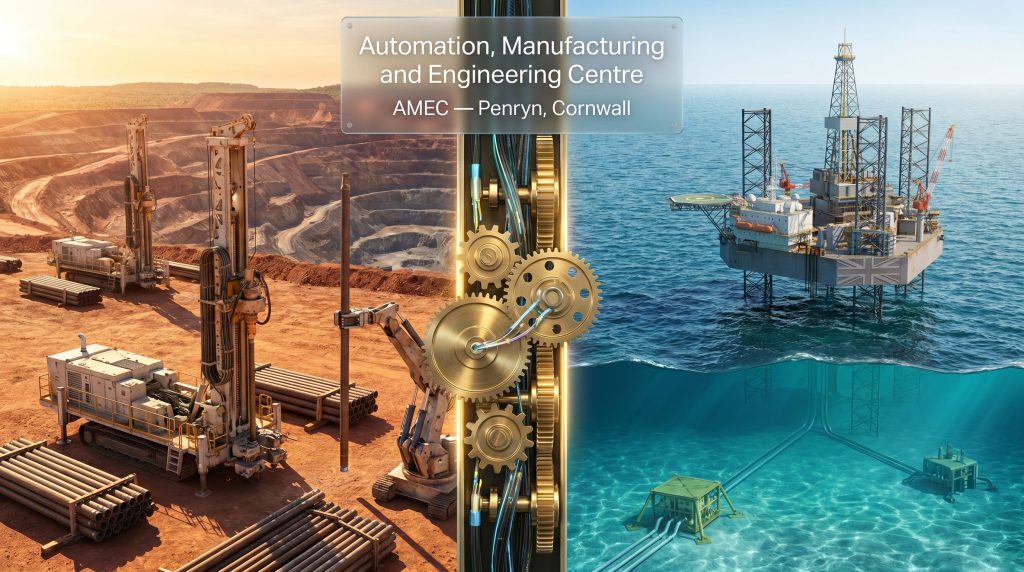
A critical enabler of MintMech's cross-sector model is the physical infrastructure it has built to support it. The company's Automation, Manufacturing and Engineering Centre (AMEC) in Penryn, Cornwall, is not simply a larger workshop. It is an integrated development environment specifically designed to compress the gap between engineering concept and field-ready system.
The facility brings together four functions that are typically separated across different organisations and timelines in conventional equipment development:
- Engineering design office for rapid concept-to-specification iteration
- Workshop fabrication for in-house manufacturing quality control
- External yard for full-scale assembly and staging
- Factory acceptance testing (FAT) for pre-deployment validation under controlled conditions
In most traditional equipment procurement cycles, the handoff between these stages introduces delays, communication failures, and quality risks. A design team specifies a system, a separate fabricator builds it, and a third party tests it, often after it has already been mobilised to site.
MintMech's integrated model mirrors the project execution philosophy used in offshore wind and subsea construction. Consequently, the cost of discovering a system failure offshore, or mid-campaign, makes pre-deployment validation non-negotiable.
The offshore sector did not develop rigorous factory acceptance testing because it was convenient. It developed it because sending a system offshore without comprehensive pre-deployment validation is an extraordinarily expensive way to find out it does not work. That same discipline is now being applied to mining equipment development.
Cornwall as a Strategic Node: History, Geology, and Forward Momentum
The choice of Penryn, Cornwall as the location for the AMEC facility is more than a matter of real estate availability. Cornwall occupies a genuinely unusual position in the UK's industrial geography. It has one of the longest histories of metal mining in the world, with tin and copper extraction dating back thousands of years.
The region's geology, driven by the emplacement of the Cornubian Batholith — a large granite intrusion associated with hydrothermal mineralisation — makes it one of the most metal-endowed areas in Western Europe. Moreover, advances in 3D geological modelling are helping operators better understand these complex subsurface environments.
Why South Crofty Matters
The South Crofty tin mine, located near Redruth, is one of the most visible symbols of Cornwall's mineral renaissance. With historical production records stretching back centuries and a resource base that includes cassiterite-bearing lodes at depth, South Crofty represents the kind of technically complex, heritage-rich project that modern engineering solutions must be able to serve.
Tin is classified as a critical mineral by both the UK and the European Union, reflecting its importance in electronics, soldering, and emerging low-carbon applications. Beyond tin, Cornwall's prospectivity extends to lithium, with the county's geothermal brines increasingly recognised as a potential source of battery-grade lithium carbonate.
This positions the region at the intersection of two major supply chain priorities: hard-rock and brine-hosted critical minerals in a politically stable, infrastructure-rich Western jurisdiction. For MintMech, this geography is not incidental. It places the company in close proximity to both the offshore engineering talent pool and the emerging client base created by Cornwall's mineral project pipeline.
Heave Compensation: A Technical Deep Dive
How Does Active Heave Compensation Work?
Of all the offshore technologies being transferred to mining contexts, active heave compensation (AHC) is perhaps the most technically specialised. In offshore drilling operations conducted from vessels, the drill string extends from the vessel down to the seabed. Wave action causes the vessel to move vertically, sometimes by several metres in rough sea states.
Without compensation, this motion is transmitted through the drill string to the drill bit, causing:
- Erratic weight-on-bit, reducing penetration rate and bit life
- Mechanical shock loading on drill rods and connections
- Core disturbance, which degrades sample quality for geotechnical and geological analysis
- Elevated risk of rod string failure in extreme sea states
Active heave compensation systems use real-time motion sensors, hydraulic or electromechanical actuators, and control algorithms to maintain a constant relationship between the drill bit and the seabed, regardless of vessel motion. The result is that the drill string effectively does not know the vessel is moving.
MintMech has engineered retrofittable versions of these systems, a design decision with significant commercial implications. Purpose-built vessels with integrated AHC are expensive capital assets accessible only to well-funded operators. However, retrofittable systems allow existing vessels and assets to be upgraded at a fraction of the cost, broadening the range of operators who can conduct high-quality drilling in dynamic marine environments.
This matters acutely for offshore geotechnical campaigns supporting mineral project development, where core recovery rates directly influence the quality of resource estimates, which in turn drive investment decisions.
The next major ASX story will hit our subscribers first
Automated Rod Handling: Removing People from the Line of Hazard
Manual rod and pipe handling is statistically one of the most hazardous activities in both offshore drilling and mining. It combines heavy, unwieldy loads, repetitive motion under time pressure, proximity to rotating and reciprocating machinery, and often difficult working conditions. Incident data from both sectors consistently identifies manual handling as a leading cause of serious injury.
Automated rod handling systems, developed originally for offshore drill floors where the consequences of dropped pipe or a struck worker can be catastrophic, apply the same design logic to mining drill rigs. The key engineering principles include:
- Removal of personnel from the immediate handling zone during pipe-running operations
- Consistent, repeatable grip and connection sequencing that does not vary with operator fatigue or experience
- Integration with the rig's control system to prevent incompatible simultaneous operations
- Remote monitoring capability allowing supervisory oversight without physical presence at the hazard point
Offshore drilling operations that have implemented automated pipe handling have documented reductions in manual handling incidents while simultaneously achieving higher pipe connection rates per shift. Both outcomes transfer directly to mining drill programmes, where safety performance and meterage are both key operational metrics.
Interlocked Control Systems: Engineering Safety Rather Than Assuming It
One of the less visible but arguably most important technology transfers from offshore to mining is the design philosophy underlying control system architecture. In offshore operations, interlocked controls are standard practice. These are systems where a machine physically or electronically cannot execute a commanded action unless a defined set of preconditions is confirmed to be met.
This is fundamentally different from systems that rely on operator awareness and judgment to prevent unsafe sequences. The distinction matters because human factors research consistently shows that experienced operators in familiar environments are highly prone to automation complacency and normalisation of deviation — two cognitive patterns that contribute to serious incidents even in well-managed operations.
Applying interlocked control architecture to mining equipment means that safety-critical sequences cannot be bypassed, even under time pressure or by experienced operators. This represents a philosophical shift from designing equipment that skilled people can operate safely to designing equipment that makes unsafe operation mechanically or electronically impossible.
What This Means for the Investable Mining Universe
The implications of MintMech offshore innovations transforming mining extend well beyond any single project or company. By making it technically and economically feasible to operate in environments previously considered too challenging or hazardous for conventional equipment, this class of engineering effectively expands the range of mineral deposits that can be brought into production.
Projects that were classified as technically stranded — not for lack of mineralisation but for lack of appropriate engineering solutions — become viable when the right capabilities are available. This is a meaningful consideration for critical mineral supply chain planning, particularly as Western governments and industrial consumers work to diversify away from single-source geographies.
Furthermore, advances in AI mining efficiency are converging with offshore-derived engineering to create a new generation of integrated, intelligent mining systems. The broader trend is clear: automation in mining is transitioning from a premium feature to a baseline engineering requirement. In addition, renewable mining solutions are being integrated alongside these engineering advances, creating genuinely holistic approaches to next-generation mineral extraction.
As the operational frontier of mineral extraction moves into more demanding environments, companies with offshore engineering pedigrees and integrated development infrastructure will be increasingly well positioned to serve the next generation of technically complex mining projects.
Disclaimer: This article is intended for informational and educational purposes only. It does not constitute financial or investment advice. References to companies, projects, or technologies are for illustrative purposes. Readers should conduct their own due diligence before making any investment or commercial decisions.
Ready to Capitalise on the Next Major Mineral Discovery?
Discovery Alert's proprietary Discovery IQ model instantly translates complex ASX mineral announcements across 30+ commodities into clear, actionable insights — giving investors a real-time edge in an increasingly technical market. Explore historic discoveries and their returns, then begin your 14-day free trial at Discovery Alert to position yourself ahead of the market.