June 10, 2026
The Structural Case for Precious Metals When Every Other Asset Looks Expensive
There are moments in financial history when the crowd's confidence in conventional assets reaches a point of near-universal agreement. Technology stocks can only go up. Real estate always appreciates. Bonds provide safety. These assumptions tend to harden at precisely the wrong time, just before multi-year reversals that few investors are positioned to survive. The current macro environment shares uncomfortable parallels with those historical inflection points.
For investors exploring the Mark Faber gold and silver buying opportunity thesis, the entry point is not a single price target or a technical chart pattern. It is a macro-structural argument about what happens to hard assets when the financial architecture supporting paper wealth begins to fracture under the weight of its own complexity. Understanding strategic gold investment within this context requires looking beyond short-term price noise.
When big ASX news breaks, our subscribers know first
Why the Global Financial Architecture Is Under Unprecedented Stress
The $40 Trillion Debt Problem and Its Downstream Consequences
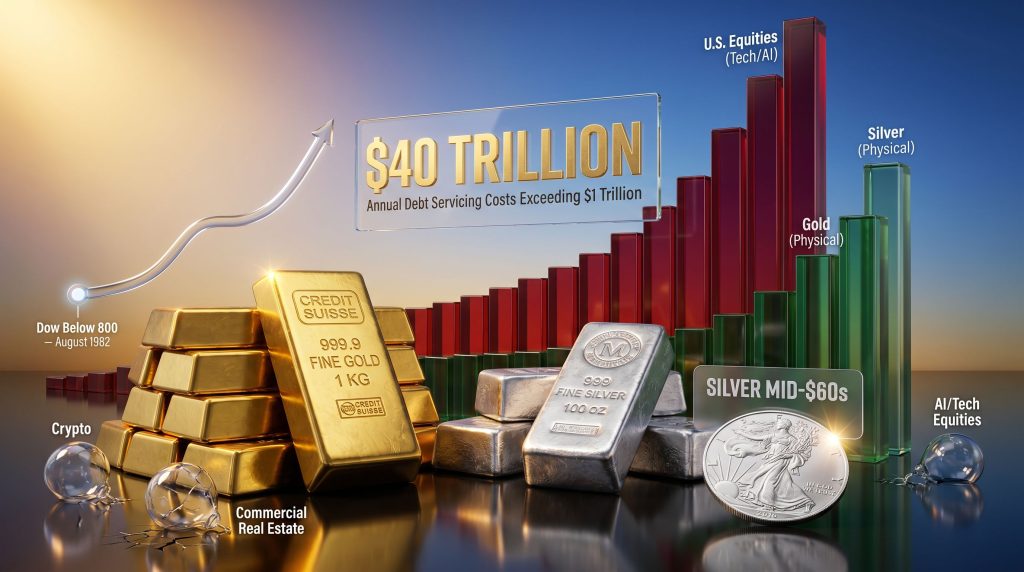
U.S. federal debt is approaching $40 trillion, with annual debt servicing costs already exceeding $1 trillion per year. These are not abstract numbers. When a government allocates more than a trillion dollars annually just to service existing obligations, its capacity to respond to future shocks through conventional fiscal tools shrinks dramatically.
The comparison to 2007-2008 is instructive but incomplete. During that crisis, debt levels were already elevated by historical standards, but they were materially lower than today's baseline. Furthermore, when the 2007 economy began to weaken, bond markets rallied. Investors fled to U.S. Treasuries as a safe haven, providing a natural shock absorber. That dynamic is far less reliable today.
Bond markets are now deeply concerned about the structural sustainability of deficit spending, and the traditional flight-to-safety mechanism that softened the 2008 blow may not function the same way in a future crisis. The political dimension compounds the economic one. Neither major party in the U.S. can credibly campaign on austerity, and the only way to satisfy contradictory voter preferences politically is through monetary accommodation that gradually debases purchasing power.
How Multiple Asset Bubbles Tighten Liquidity Without Triggering a Visible Crisis
One of the less-discussed dynamics in the current environment is how simultaneous overvaluation across multiple asset classes creates a kind of slow liquidity drain rather than a sudden, headline-generating collapse.
When cryptocurrencies decline sharply, capital is destroyed or immobilised. When commercial real estate suffers from vacancy and refinancing stress, that capital is locked up for years. When residential property buyers who purchased condos to flip them find themselves unable to sell at a profit, their capital becomes frozen in place. None of these events individually triggers a financial crisis. Together, however, they quietly reduce the systemic liquidity available to support other asset classes.
Table: How Asset Class Deflation Compresses Systemic Liquidity
| Asset Class | Primary Deflation Mechanism | Liquidity Effect | Time Horizon |
|---|---|---|---|
| Cryptocurrencies | Price collapse, margin calls | Immediate capital destruction | Days to weeks |
| Commercial Real Estate | Vacancy rates, refinancing stress | Long-duration capital lock-up | Years |
| Residential Property | Unsellable inventory, negative equity | Gradual immobilisation | Months to years |
| Equities | Valuation compression, earnings misses | Margin pressure, forced selling | Weeks to months |
| Bonds | Rising yields, price decline | Collateral value erosion | Ongoing |
This table illustrates why the current correction in gold and silver should not be read as a signal that the hard-asset thesis has broken down. It reflects the same liquidity tightening affecting all asset classes, not a fundamental change in the structural case for precious metals.
Understanding the Correction: What Silver's Drop From $120 Actually Tells Us
Reading the Pullback With an Investor's Eye
Silver reached approximately $120 USD before entering a sustained correction phase. At current levels in the mid-$60 range, that represents a drawdown of roughly 44% from peak valuations. Gold and platinum experienced parallel corrections over the same period, which is significant. When an entire asset category corrects simultaneously, the cause is almost certainly macro and liquidity-driven rather than specific to any single metal's supply-demand fundamentals.
Experienced macro investors distinguish between two types of corrections: those that invalidate an investment thesis and those that represent the thesis becoming temporarily unpopular. The macro structural case for precious metals, rooted in debt monetisation, inflationary fiscal policy, and currency debasement, has not changed. What has changed is the short-term positioning of speculative capital as liquidity tightens across the broader market.
For investors without existing precious metals exposure, current price levels may represent a more favourable accumulation entry point than peak valuations. The correction reflects systemic liquidity pressure, not a breakdown in the hard-asset investment thesis.
How Experienced Investors Read Precious Metals Market Signals
One analytical approach worth understanding involves paying close attention to the behaviour of gold mining equities relative to spot gold prices. Mining stocks tend to lead the physical metals in both directions, acting as an early warning system for sector-wide weakness or strength. Consequently, when gold equities begin underperforming spot gold for an extended period, it often signals broader sector deterioration before it appears in the headline price of the metal itself.
A related insight involves the distinction between opening and closing prices. Opening prices in financial markets tend to reflect emotional, reactive positioning based on overnight news. Closing prices, by contrast, represent more considered market judgements. Traders and analysts who develop the ability to distinguish between emotionally-driven intraday moves and closing price trends develop a significant informational edge over time. According to Marc Faber's market analysis, this discipline of reading market signals correctly is central to navigating precious metals cycles profitably.
Step-by-Step: Reading Precious Metals Market Signals
- Track gold mining equity performance relative to spot gold price trends over several weeks
- Use closing prices rather than intraday moves as the primary indicator of directional conviction
- Assess whether sector weakness is specific to precious metals or part of a broader risk-off liquidity tightening event
- Differentiate between speculative short-term selling and structural long-term repositioning by institutional investors
- Build positions incrementally across multiple entry points rather than committing full capital at a single price level
- Monitor relative performance across gold, silver, and platinum simultaneously as a cross-validation tool
The Long-Term Bull Case: What Actually Drives Gold and Silver Higher
Currency Debasement as the Structural Floor for Hard Asset Demand
The investment case for gold and silver does not depend on a single catalyst. It rests on a multi-decade structural argument about the direction of real purchasing power in fiat currency systems. The gold-stock market relationship further reinforces why hard assets become increasingly attractive as equity valuations reach unsustainable extremes.
Western governments face a paradox with no politically palatable resolution. Reducing debt requires either higher taxes, which destroys electoral prospects, or spending cuts, which alienate core constituencies. The path of least resistance, historically and currently, is monetary expansion: allowing inflation to gradually erode the real value of outstanding debt. This is sometimes described as financial repression.
Gold and silver, by contrast, cannot be printed, cannot be debased by policy decision, and carry no counterparty risk. These properties make them structurally relevant in any environment where monetary accommodation remains the dominant policy tool.
Why Precious Metals May Outperform Even If They Fall
This is one of the most counterintuitive but analytically important points in the current precious metals debate. The Mark Faber gold and silver buying opportunity thesis does not require these assets to appreciate in absolute terms. It requires only that they decline less than the alternatives.
Consider U.S. technology and AI-related equities currently trading at 30 to 40 times earnings, with valuations that embed assumptions of perpetual earnings growth. If those growth assumptions prove incorrect even partially, the valuation compression from those multiples could be severe. Gold and silver could fall 10 or 15 percent from current levels and still represent superior capital preservation compared to assets experiencing 40 to 60 percent multiple compression.
The investment case for precious metals does not require them to rise. In a broad asset deflation environment, relative preservation of purchasing power is the primary objective, and hard assets with no counterparty risk are structurally positioned to deliver it.
The Inflation-War-Tariff Triangle
Three macro forces are converging to create a persistent inflationary floor that undermines the real value of cash and bonds simultaneously. Trade tariffs raise input costs across supply chains, and those costs are passed through to consumers in the short term regardless of any domestic production gains that may eventually emerge. Military and defence spending is inherently inflationary because it consumes productive resources without creating consumer goods or capital formation.
This environment is structurally different from the disinflationary cycles of the 1990s and 2000s that conditioned a generation of investors to expect low inflation as the default. Investors operating with those outdated assumptions may systematically underestimate the long-term case for inflation hedges. Furthermore, Faber's broader warnings about war and currency decay suggest this inflationary triangle could persist well beyond a single economic cycle.
Asset Class Comparison: Where to Position in a Late-Cycle Macro Environment
Table: Risk and Reward Assessment Across Major Asset Classes
| Asset Class | Current Sentiment | Valuation Risk | Hard-Asset Hedge Potential | Long-Term Outlook |
|---|---|---|---|---|
| U.S. Equities (Tech/AI) | Extremely Bullish | Very High (30-40x P/E) | None | Cautious multi-year |
| Residential Real Estate | Moderately Bullish | High | Partial | Neutral to negative |
| Long-Duration Bonds | Cautious | Elevated | None | Uncertain |
| Cash / Money Market | Unpopular | Low | None | Tactical positive |
| Physical Gold | Neutral/Recovering | Moderate | High | Long-term bullish |
| Physical Silver | Bearish/Correcting | Low-Moderate | High | Long-term bullish |
| Platinum | Largely Overlooked | Low | High | Long-term bullish |
The Contrarian Case for Holding Elevated Cash Positions
In an environment where the majority of asset classes are priced for optimism, cash and short-duration money market instruments offer something that is frequently undervalued: optionality. The ability to deploy capital when dislocations create genuine value is one of the most powerful tools available to a patient investor.
Cash is currently among the least popular asset classes with retail investors conditioned by four decades of equity appreciation to treat it as a drag on performance. The contrarian logic suggests that the least-loved asset in any cycle often delivers the best forward returns when consensus positioning eventually reverses. Holding an unusually high proportion of assets in cash and money market funds is not pessimism; it is strategic positioning for a future that may look very different from the recent past.
Physical Ownership Versus Paper Exposure
When comparing physical gold vs ETFs, futures contracts and leveraged ETFs introduce counterparty risk, margin call vulnerability, and roll costs that systematically erode long-term returns. Physical gold and silver eliminate these structural disadvantages. The trade-off is the cost of storage and insurance, which is relatively modest compared to the risk-adjusted benefits of eliminating counterparty exposure entirely.
Is the U.S. Stock Market Entering a Multi-Year Bear Phase?
Historical Precedent and the Duration Problem
The current U.S. equity bull market traces its origins to August 1982, when the Dow Jones Industrial Average briefly traded below 800 points. From that foundation, the multi-decade bull market has produced gains that are essentially without historical parallel in both magnitude and duration.
Multi-decade bull markets do not end in three-month corrections. They require extended bear phases to reset valuations, reduce speculative excess, and restore the earnings yields that justify long-term investment. Historical analysis suggests that a bear market following a 40-plus year bull cycle could persist anywhere from 4 to 20 years, depending on the severity of the preceding overvaluation and the policy responses deployed.
The Changed Role of the Bond Market
In 2007, the classic 60/40 portfolio provided meaningful protection because bonds rallied as equities fell. That relationship is now structurally compromised. With bond markets facing simultaneous pressure from elevated issuance, inflation uncertainty, and fiscal credibility concerns, the traditional safety valve that softened previous downturns may be far less effective in a future stress scenario.
This structural shift materially elevates the relative importance of genuinely non-correlated assets, which is precisely where gold, silver, and platinum fit within a portfolio construction framework. In addition, the gold-silver ratio analysis offers further insight into relative value positioning across the precious metals complex during periods of structural market stress.
The next major ASX story will hit our subscribers first
A Practical Framework for New Investors Navigating an Overvalued Market
Building a Resilient Portfolio in an Overpriced Environment
- Establish a cash buffer by holding a higher-than-conventional proportion in money market funds or short-duration instruments to preserve optionality
- Initiate a staged precious metals position beginning with physical gold and silver, sized conservatively and added to incrementally during weakness
- Resist momentum chasing in assets priced at 30 to 40 times earnings with embedded perpetual growth assumptions
- Adopt a multi-year time horizon and understand that the macro thesis for hard assets plays out over cycles, not quarters
- Monitor cross-asset liquidity signals including simultaneous deterioration across cryptocurrencies, commercial real estate, equities, and bonds as an early warning of systemic stress
- Diversify within the precious metals complex across gold, silver, and platinum to capture differentiated exposure within the hard-asset category
Investors who accumulated gold and silver at prices below current levels and held through multiple corrections have historically been rewarded. Entry precision matters far less than the willingness to hold through volatility with a macro thesis intact.
Monetary System Reform: What Comes After a Systemic Crisis?
Scenario Analysis: Post-Crisis Monetary System Possibilities
| Scenario | Relative Probability | Gold and Silver Impact | Key Precondition |
|---|---|---|---|
| New Fiat System (USD-based) | High | Moderate positive | Political consensus |
| Multi-Currency Reserve System | Moderate | Positive | Geopolitical realignment |
| Partial Gold-Backed System | Low | Strongly positive | Fiscal crisis severity |
| Central Bank Digital Currencies | Moderate-High | Neutral to negative | Infrastructure readiness |
| Commodity-Backed Basket | Low-Moderate | Positive | International agreement |
A gold-backed monetary system would constrain government spending by tying currency issuance to a finite physical asset. This constraint is precisely why Western governments and central banks resist the idea. The Bretton Woods system, which operated from 1944 to 1971, demonstrated both the stabilising effects of gold-backed monetary arrangements and their political fragility when governments face spending pressures that exceed their gold reserves.
Frequently Asked Questions: Mark Faber Gold and Silver Buying Opportunity
Is now a good time to buy gold and silver?
Macro analysts with a long-term hard-asset orientation argue that the current correction from recent highs represents a more favourable accumulation window than peak valuations. However, further downside remains possible, making staged entry strategies preferable to lump-sum deployment at any single price level.
How much of a portfolio should be allocated to precious metals?
There is no universal formula. The principle of holding an unusually high proportion of assets in hard assets and cash is most relevant in environments characterised by overvalued equities, record debt levels, and persistent monetary uncertainty. Individual allocation depends on time horizon, risk tolerance, and existing portfolio composition.
What is the difference between physical gold and gold mining stocks?
Physical gold eliminates counterparty risk entirely and is unaffected by company-specific operational or management risks. Gold mining equities offer leverage to the gold price but introduce equity market correlation, management execution risk, and cost inflation sensitivity. For instance, during periods of broad market stress, undervalued mining stocks frequently decline more sharply than the physical metals themselves before recovering.
Could gold and silver fall further from current levels?
Yes. Short-term price movements cannot be predicted with certainty by any analyst. The macro case for the Mark Faber gold and silver buying opportunity is a long-term structural argument. Consequently, investors should size positions with the financial flexibility to add during further weakness rather than treating any current level as a guaranteed floor.
Why does inflation benefit gold and silver?
Gold and silver produce no yield and carry no counterparty obligation. Their value is intrinsic rather than contractual. When inflation erodes the purchasing power of paper currencies over time, assets that cannot be printed or policy-debased tend to maintain or increase their real value across full economic cycles.
Key Takeaways: Precious Metals in 2025 and the Road Ahead
- The global macro environment, defined by record debt levels, inflationary fiscal policy, liquidity tightening across multiple asset classes, and overvalued financial markets, provides a structural long-term tailwind for gold, silver, and platinum
- Silver's correction from approximately $120 to the mid-$60s reflects systemic liquidity pressure and sector-wide repositioning rather than a fundamental breakdown in the hard-asset thesis
- Physical ownership is structurally superior to paper exposure through futures or leveraged ETFs for long-term wealth preservation objectives
- A multi-year bear market in U.S. equities, if it materialises from the current elevated baseline, could validate the relative outperformance case for precious metals even without significant absolute price appreciation in the metals themselves
- The bond market's reduced capacity to act as a safe-haven buffer, compared to its role in 2007-2008, elevates the strategic importance of genuinely non-correlated hard assets in portfolio construction
- Patience, staged accumulation, elevated cash positioning, and a long-term time horizon are the defining characteristics of a successful precious metals strategy in the current environment
This article is intended for informational and educational purposes only and does not constitute financial advice. All investments involve risk, including the possible loss of principal. Past performance of any asset class is not indicative of future results. Readers should conduct their own due diligence and consult a qualified financial adviser before making any investment decisions. Forecasts, scenario analyses, and price projections mentioned in this article are speculative in nature and should not be relied upon as predictions of future market outcomes.
Want To Know When The Next Major Mineral Discovery Hits The ASX?
Discovery Alert's proprietary Discovery IQ model delivers real-time alerts on significant ASX mineral discoveries, instantly cutting through market noise to surface actionable opportunities — explore the historic returns major discoveries have generated to understand the potential, then begin your 14-day free trial and position yourself ahead of the broader market.