June 10, 2026
The Hidden Economics Behind Western Nations' Rush to Rebuild Domestic Metals Processing
The global metals processing landscape is undergoing a structural transformation that few investors fully appreciate. While attention has focused on mining exploration and lithium battery chemistry, the bottleneck in critical mineral supply chains is increasingly found not underground, but inside smelters. Trafigura funding for Australian smelters has brought this issue into sharp relief, as processing capacity, long treated as a commodity service industry, is being reframed as sovereign infrastructure. Understanding why governments are now writing large cheques to keep ageing furnaces alive requires looking at the deeper forces reshaping global supply chain architecture.
When big ASX news breaks, our subscribers know first
What Is Nyrstar Australia, and Why Does It Sit at the Centre of This Debate?
Nyrstar Australia operates as a subsidiary within the Trafigura corporate structure, one of the world's largest commodity trading and logistics groups. While Trafigura's name is most commonly associated with oil and metals trading, its ownership of Nyrstar's Australian processing assets places it directly inside the geopolitical contest over critical minerals and energy security.
The two facilities drawing the most attention are located at Port Pirie in South Australia and Hobart in Tasmania. These are not new installations. Both represent decades-old industrial infrastructure that was originally built around base metals economics, primarily zinc and lead processing. What has changed is not the physical assets themselves, but the strategic value of what those assets could potentially produce.
Port Pirie and Hobart: Base Metal Roots, Critical Mineral Futures
Port Pirie has historically operated as one of the world's largest lead smelting complexes. Its multi-metal recovery capabilities, which already capture silver, gold, copper, and other by-products from complex ore feeds, make it technically suited for expansion into antimony and bismuth recovery. Hobart's zinc works, meanwhile, have been evaluated for their potential to extract germanium and indium, two metals that occur in trace concentrations within zinc-bearing ores and are currently recovered at commercial scale in very few locations outside China.
These four metals — antimony, bismuth, germanium, and indium — each carry formal critical mineral classifications across multiple Western jurisdictions, including Australia, the United States, the European Union, and Japan. Their shared characteristic is a combination of narrow geographic supply concentration, high technical substitution difficulty, and essential roles in defence electronics, semiconductors, and clean energy infrastructure.
Breaking Down the Trafigura Funding for Australian Smelters: A$240 Million and What It Covers
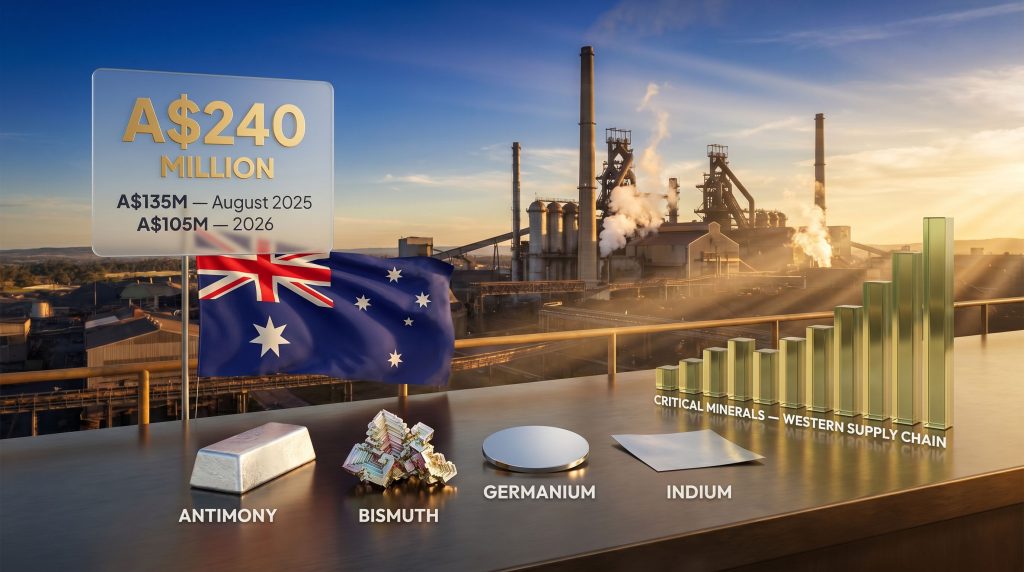
The total public funding commitment behind Nyrstar Australia's smelting operations now stands at A$240 million, structured across two tranches delivered over roughly eighteen months. According to Reuters, the initial tranche was pledged as an urgent rescue package to prevent imminent closure of both facilities.
| Funding Tranche | Amount (AUD) | Approximate USD Value | Timing |
|---|---|---|---|
| Initial Commitment | A$135 million | ~$87.4 million | August 2024 |
| Additional Commitment | A$105 million | ~$73.7 million | 2026 |
| Total Combined | A$240 million | ~$161 million | 2024-2026 |
This capital is described as transitionary support, a term that carries specific meaning in the context of industrial policy. Transitionary support does not imply permanent subsidisation. Instead, it is designed to preserve operational continuity while feasibility studies determine whether full modernisation is technically and commercially viable. In effect, the government is paying to keep the option alive rather than committing to the full transformation cost upfront.
Critically, this public funding is being deployed alongside continued capital commitment from Trafigura as the shareholder. The combination of public and private investment signals that at least some commercial logic underpins the decision, though the full economics of modernisation remain under active study.
What Transitionary Support Actually Means in Practice
For investors and analysts unfamiliar with industrial policy mechanisms, transitionary support can be misread as a straightforward grant or subsidy. The practical reality is more nuanced:
- It covers operational costs during the study period, preventing closure before the investment case is fully assessed
- It does not pre-commit governments to funding the full rebuild, which is expected to require substantially more capital
- It creates a window within which offtake discussions, feasibility engineering, and financing structures can be developed
- It carries implicit conditionality, meaning continued support will depend on study outcomes demonstrating a credible long-term path
Whether the funding takes the form of grants, concessional loans, or a hybrid structure has not been publicly specified in full detail, and the distinction matters considerably for long-term taxpayer exposure.
The Four Critical Minerals at the Core of the Investment Thesis
Antimony: From Flame Retardants to Grid-Scale Energy Storage
Antimony has quietly become one of the most strategically significant metals in Western defence and energy policy. Its primary industrial applications have historically included flame retardants and lead-acid battery hardening agents, but its profile shifted sharply with growing interest in antimony-based flow batteries for grid-scale energy storage. The recent antimony price surge has further highlighted Western vulnerability to supply disruptions from dominant producers.
China produces roughly half of global antimony supply and an even larger share of refined output. Export restrictions introduced by Chinese authorities in recent periods have accelerated Western efforts to identify alternative sources. Nyrstar's shipment of its first antimony from Port Pirie represents a tangible, if early, step toward establishing a non-Chinese processing node for this material.
Germanium and Indium: The Semiconductor Metals That Most People Have Never Heard Of
Germanium and indium occupy unusual positions in the critical minerals universe. Neither is mined as a primary product. Both are recovered exclusively as by-products — germanium primarily from zinc smelting and indium similarly from zinc and lead processing streams. This by-product nature creates a peculiar supply dynamic: output cannot simply be scaled up by drilling more holes. Production volume is constrained by the volume of host metal being processed.
China controls an estimated 80% or more of global germanium refining capacity and a dominant share of indium production. Germanium is essential for fibre optic cables, infrared optics used in military systems, and certain solar cell architectures. Indium, most commonly found in indium tin oxide, is the transparent conducting layer in virtually every flat panel display and touchscreen manufactured globally. The strategic exposure created by this concentration is significant.
Bismuth: The Overlooked Element With a Growing Industrial Role
Bismuth tends to receive less media attention than the other three metals in this group, but its industrial significance is growing. The impact of bismuth export controls from China has furthermore underscored how dependent Western industry has become on a single source for this material. As a lead-free substitute in a range of applications from plumbing solder to pharmaceutical compounds and metallurgical additives, bismuth demand has been rising steadily. Its recovery at Port Pirie would represent a complementary revenue stream alongside antimony production, improving the economics of the broader modernisation case.
The Structural Cost Problem Threatening Smelter Viability
The case for public investment in Australian smelters cannot be fully understood without examining the underlying economics that created the crisis in the first place. Australian metals processing operations face a layered set of structural disadvantages that go beyond simple operating cost comparisons.
The Treatment Charge Collapse
Treatment charges — the fees paid by mining companies to smelters for processing ore concentrates into refined metal — have been under sustained downward pressure for several years. These charges are effectively the revenue model for independent smelting operations. When treatment charges fall, smelter margins compress, and facilities with higher operating cost bases are the first to become uneconomic. Australian smelters, operating in a high-energy-cost and high-labour-cost environment, sit at a structural disadvantage relative to Asian competitors, particularly in China and South Korea, that benefit from lower input costs and larger scale.
Energy and Labour Cost Differentials
Australia's industrial electricity prices are among the highest in the developed world for energy-intensive manufacturing. Smelting operations are inherently power-intensive, and energy often represents the single largest variable cost component. Combined with labour costs that reflect Australia's broader wage environment, the total operating cost profile of Australian smelters creates a competitiveness gap that has widened over time rather than narrowed.
BMO analysts have described Australian smelters as operating within a dual-pressure environment, characterised by structurally elevated running costs on one side and deteriorating processing fee revenue on the other. Under these conditions, the economics of continued independent operation without some form of public support become extremely difficult to sustain.
However, as reported by the AFR, Trafigura has already slashed the book value of its Australian smelting assets by $363 million, a stark acknowledgement of just how challenging the underlying commercial environment has become.
Long-Term Viability: Two Scenarios Investors Should Understand
The fundamental question surrounding Trafigura funding for Australian smelters is not whether the current funding keeps the lights on in the near term. It clearly does. The more consequential question is what the feasibility studies will reveal about the economics of full modernisation.
Scenario A: Feasibility Studies Support Commercial Modernisation
If engineering and financial analysis confirms that Port Pirie and Hobart can produce critical minerals at commercially viable cost structures, the path to long-term sustainability involves:
- Securing long-term offtake agreements with Western industrial buyers or allied government procurement programmes
- Attracting additional private sector co-investment from technology companies or defence supply chain participants
- Accessing further public funding on a project-financing basis rather than as transitionary support
- Building a revenue base that reduces ongoing dependence on government capital injections
Scenario B: Modernisation Costs Exceed Commercial Justification
If studies conclude that the capital required to fully modernise both facilities cannot be justified against realistic revenue projections, governments face a politically uncomfortable set of choices:
- Continued subsidisation at a scale that may be difficult to defend to taxpayers
- Selective investment in only one facility where economics are more favourable
- A managed operational wind-down with significant consequences for regional employment in South Australia and Tasmania
- Acceptance that domestic processing capacity in these specific metals cannot be commercially rebuilt within current market parameters
The gap between the A$240 million committed to date and the capital that would likely be required for full modernisation of both facilities is substantial. Industry estimates for comparable smelter rebuilds in other jurisdictions suggest total capital requirements could run into the billions of dollars, not hundreds of millions.
The next major ASX story will hit our subscribers first
How Australia's Approach Compares to Global Critical Minerals Policy
Australia is not alone in recognising that processing capacity represents a strategic vulnerability. The response frameworks adopted by other major Western economies provide useful context for evaluating the scale and ambition of the Australian effort. In addition, the critical raw materials facility framework being developed in Europe illustrates how allied nations are pursuing comparable solutions to the same supply chain vulnerabilities.
| Region | Policy Mechanism | Key Target Metals | Funding Scale |
|---|---|---|---|
| Australia | Transitionary grants and feasibility support | Antimony, Germanium, Indium, Bismuth | A$240 million committed |
| United States | IRA tax credits and DOE loan guarantees | Lithium, Rare Earths, Nickel, Cobalt | Multiple billions USD |
| European Union | Critical Raw Materials Act strategic frameworks | Broad critical minerals list | Multi-billion EUR commitments |
| Japan | JOGMEC strategic stockpiling and processing partnerships | Indium, Germanium, Rare Earths | Substantial ongoing investment |
What distinguishes Australia's position is the specific combination of existing processing infrastructure, proximity to allied markets in the Asia-Pacific, and a domestic mining sector capable of supplying complex polymetallic concentrates that carry the trace critical mineral content relevant to these smelters. The challenge is converting that geographic and geological advantage into an economically sustainable processing industry.
What Nyrstar's First Antimony Shipment Actually Signals
The fact that Nyrstar has already shipped its first antimony from Port Pirie is a detail worth unpacking carefully. In project development terms, moving from feasibility assessment to first physical output is a meaningful transition. It demonstrates that the technical pathway for antimony recovery at the facility is real and not merely theoretical.
However, first shipment and commercial-scale production are separated by a significant distance in capital, engineering, and market development terms. The processing challenges associated with scaling up from proof-of-concept to consistent commercial output are considerable. What the first shipment establishes is proof of concept — validation that the metallurgical chemistry works at some scale. What it does not yet establish is whether that production can be sustained and expanded at a cost structure that makes economic sense without ongoing public subsidy.
For potential Western buyers of Australian-produced antimony, germanium, or indium, the more important signals will be consistent volume delivery, quality certification, and price competitiveness relative to alternative sources. These benchmarks are still being established.
Frequently Asked Questions: Trafigura Funding for Australian Smelters
What is Trafigura's role in Nyrstar Australia's operations?
Trafigura is the parent company of Nyrstar, making it the ultimate private sector owner of both the Port Pirie and Hobart smelting facilities. Alongside government funding, Trafigura continues to deploy its own capital into the operations, maintaining a commercial stake in the outcome of the modernisation studies.
Why did the Australian government provide A$105 million in additional funding in 2026?
The additional funding was provided to ensure both smelting facilities remain operational through 2026 while modernisation feasibility studies are completed. Without this support, the structural economics of both facilities would make continued operation difficult to justify on purely commercial grounds in the near term.
What critical minerals are being assessed at Port Pirie and Hobart?
Port Pirie in South Australia is being evaluated for antimony and bismuth production, while the Hobart zinc works in Tasmania is the subject of feasibility work targeting germanium and indium recovery.
What happens if feasibility studies do not support full modernisation?
If the studies conclude that modernisation cannot be justified economically, governments would face difficult decisions about whether to continue subsidising operations, pursue a selective investment approach, or manage an eventual wind-down. No public commitment to indefinite support has been made.
Is the funding a grant or a loan?
The specific financial structure of the total A$240 million commitment has not been publicly disclosed in complete detail. The distinction between grants, concessional loans, and hybrid arrangements has material implications for long-term taxpayer exposure and Trafigura's own capital obligations.
Key Takeaways for Investors and Industry Observers
- The combined A$240 million in public funding for Nyrstar Australia reflects a deliberate shift in how Australian industrial policy treats metals processing, moving from purely commercial activity toward strategic infrastructure classification
- Four metals sit at the centre of the investment rationale: antimony, bismuth, germanium, and indium, each characterised by heavy Chinese supply concentration and growing Western demand in defence, electronics, and clean energy
- The current funding is explicitly transitionary, designed to preserve operational continuity while feasibility determines whether full modernisation is economically viable
- Full modernisation capital requirements are expected to substantially exceed current commitments, meaning additional funding rounds and private sector co-investment will be essential if both facilities are to achieve long-term sustainability
- The first antimony shipment from Port Pirie is a positive technical proof point, but the distance between first shipment and commercial-scale independent operations remains considerable
- Australia's structural advantages in geology and proximity to allied markets are real, but converting those advantages into a viable domestic processing industry will require sustained capital commitment well beyond the current funding envelope
This article is intended for informational purposes only and does not constitute financial or investment advice. Forward-looking statements, scenario projections, and feasibility outcomes referenced herein involve inherent uncertainty. Readers should conduct their own due diligence before making any investment or commercial decisions related to the companies, assets, or markets discussed.
For ongoing coverage of global metals markets, smelting economics, and critical mineral policy developments, Kitco News provides continuous reporting across these topics.
Want to Track the Next Major ASX Critical Minerals Discovery Before the Market Does?
Discovery Alert's proprietary Discovery IQ model scans ASX announcements in real time, delivering instant alerts on significant mineral discoveries — including critical metals like antimony, germanium, and indium — so subscribers can act on actionable opportunities ahead of the broader market. Explore historic discoveries and their returns to understand the potential scale of these opportunities, then begin your 14-day free trial at Discovery Alert to position yourself at the forefront of the next major find.