June 10, 2026
Why Infrastructure Ownership Has Become the Defining Edge in Arctic Oil Development
Across the history of frontier oil development, the companies that ultimately capture the most value are rarely those that simply hold the largest acreage positions. They are the ones that control the infrastructure through which oil must travel to reach markets. Nowhere is this dynamic more consequential than on Alaska's North Slope, where APA acquires North Slope infrastructure in Alaska to fundamentally reshape its competitive position across nearly half a million gross acres.
The distance between a discovered barrel and a sold one on the North Slope is measured not just in miles, but in the cost of access to pipelines, processing facilities, and logistics systems that can take years and hundreds of millions of dollars to build from scratch. Shifting Alaska drilling policy has added further urgency to securing infrastructure control before the competitive landscape tightens further.
The Economic Logic of Vertical Integration in Remote Arctic Operations
In most oil-producing regions, an upstream company can drill a successful well and route its production through third-party gathering and processing infrastructure at negotiated tariff rates. The economics are predictable, if not always favourable. In remote Arctic environments, however, this model breaks down in significant ways.
The North Slope of Alaska presents logistical challenges that fundamentally alter the cost structure of oil development. There are no road networks connecting production areas to markets. Winter access windows govern when drilling equipment can move across the tundra, and processing facilities capable of handling cold, waxy, or high-pour-point crude require specific engineering.
Perhaps most critically, every barrel produced must eventually reach the Trans-Alaska Pipeline System (TAPS), the 800-mile system that carries North Slope oil south to the marine terminal at Valdez. For operators without owned pipeline connections to TAPS, this dependency creates a cost layer that can render otherwise viable projects uneconomic.
It also creates a scheduling vulnerability: when third-party infrastructure operators have competing priorities, access constraints can delay development programmes and compress returns. Owning the connection to TAPS is not merely an operational convenience — it is a prerequisite for cost-competitive development in the eastern North Slope corridor.
When big ASX news breaks, our subscribers know first
Breaking Down the Savant Alaska Transaction
Assets, Acreage, and Strategic Capacity
The Savant Alaska acquisition delivers a package of assets that collectively address each of the infrastructure bottlenecks outlined above. Understanding the individual components reveals why the deal is structured the way it is and what it enables operationally.
| Asset | Key Metric | Strategic Significance |
|---|---|---|
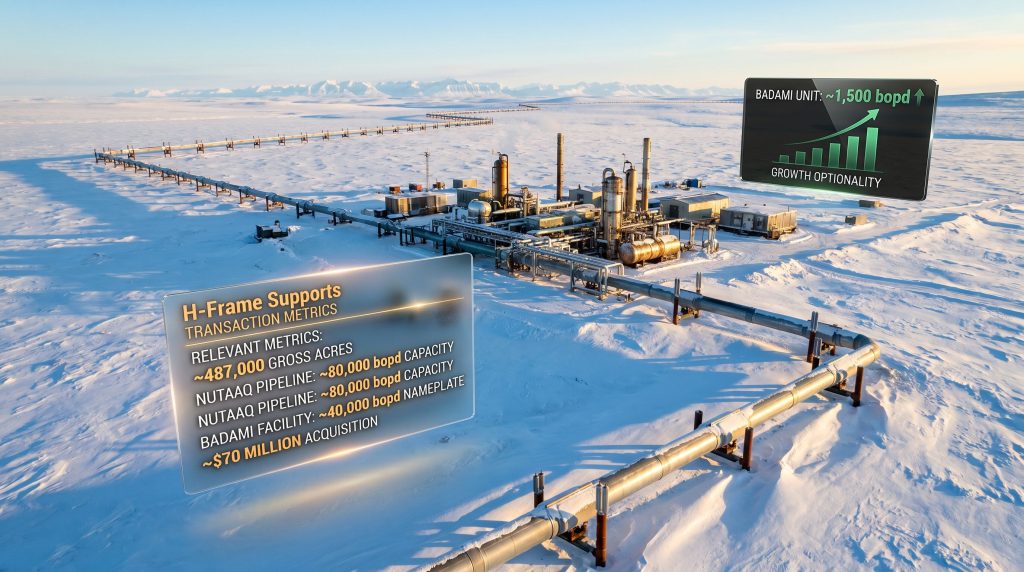
| Badami Production Facility | ~40,000 bopd nameplate capacity | Central processing hub for eastern North Slope output |
| Nutaaq Pipeline | ~80,000 bopd capacity | Direct connection to TAPS |
| Gross Acreage Added | ~104,000 acres | Expands APA's total Alaska position to ~487,000 gross acres |
| Badami Unit Current Production | ~1,500 bopd | Baseline output with identified upside potential |
| Upfront Transaction Value | ~$70 million | Plus contingent payments linked to future development milestones |
The nameplate capacity of the Badami production facility at approximately 40,000 bopd deserves particular attention when viewed alongside current production of roughly 1,500 bopd. That gap between installed capacity and actual throughput represents a significant volume of latent processing capability that APA can deploy without requiring additional capital expenditure on surface infrastructure.
For an operator planning multiple wells across an appraisal programme, this available headroom dramatically reduces the incremental cost of production growth. Furthermore, the broader commodity price impacts on project economics make this kind of cost certainty especially valuable in the current market environment.
The Nutaaq Pipeline: A Direct Line to TAPS
The Nutaaq Pipeline functions as the critical link connecting eastern North Slope production to the broader TAPS system. With an 80,000 bopd transport capacity, it represents a substantial volume commitment to the region's development potential.
In practical terms, this pipeline means that production from the Badami unit, any new exploration discoveries, and future appraisal wells targeting prospects like the Sockeye complex can all be moved to market through infrastructure APA now owns, rather than infrastructure it must negotiate access to.
The distinction between common-carrier pipelines and privately operated systems matters greatly in frontier development. Common-carrier systems provide open access to shippers at regulated tariff rates, but they also create uncertainty around timing, capacity allocation, and long-term cost trajectories. Private infrastructure owned by the operator, however, provides certainty on all three fronts — and that certainty directly affects investment decision-making for future wells.
Grey Owl and Badami Unit Interests
Beyond the infrastructure, the transaction includes interests in both the Badami unit and the Grey Owl unit. The Badami unit's current output of approximately 1,500 bopd reflects a production base that carries identified undeveloped resource potential within the unit boundary. The Grey Owl unit interests represent an additional evaluation opportunity, with the full scope of their resource potential to be assessed as APA assumes operatorship and conducts detailed technical review.
How the Acquisition Transforms APA's Alaska Position
From Exploration Acreage Holder to Integrated Operator
Prior to this transaction, APA held a 50% working interest in a significant eastern North Slope exploration block on Alaska state lands. That position carried real prospective value, but it was fundamentally constrained by the absence of owned infrastructure. Commercialising any discovery would have required either negotiating access to third-party facilities or committing to the construction of new infrastructure — both of which introduce cost and timing variables that erode project returns.
The Savant acquisition eliminates that constraint entirely. APA's Alaska portfolio now encompasses approximately 487,000 gross acres with a fully integrated set of owned assets:
- Owned production processing capability at Badami (~40,000 bopd capacity)
- Owned pipeline transportation to TAPS via the Nutaaq system (~80,000 bopd)
- Owned accommodations, logistics facilities, and field support systems ready for winter operations
- Operatorship of the existing joint venture structure
This combination transforms the risk profile of APA's Alaska programme. What was previously an exploration-weighted position requiring infrastructure partnership is now an operationally self-sufficient platform capable of supporting a multi-well appraisal and development campaign on the company's own terms. The value of such energy infrastructure extensions has been demonstrated repeatedly across frontier basins globally.
Joint Venture Structure: New Operator, Familiar Partners
With the closing of this transaction, APA assumes operatorship of an existing joint venture that includes Lagniappe Alaska, an Armstrong company, and Oil Search (Alaska), a subsidiary of Santos. This structure carries meaningful implications for how the development programme will be executed.
As operator, APA holds the decision-making authority over drilling sequences, capital allocation within the programme, and operational priorities. The JV partners retain their participating interests and share in both costs and production, but the operator's role gives APA the ability to set the pace and focus of the development agenda.
"The transition to operator status within an existing JV is not simply administrative. It fundamentally shifts the locus of strategic decision-making to APA, giving the company direct control over how its drilling budget is deployed and in what sequence prospects are tested."
The 2026-2027 Winter Drilling Programme: Reading APA's Development Thesis
Dual-Well Strategy: Balancing Risk and Appraisal
APA has confirmed plans to drill two wells during the 2026-2027 winter season, each serving a distinct strategic objective. The structure of this dual-well programme provides insight into how the company is thinking about risk management and resource conversion within its Alaska portfolio.
The two-well programme is designed around complementary objectives:
- Exploration well: Targeting a new play concept within the eastern North Slope acreage. This well carries higher geological risk but also offers the potential to open an entirely new resource fairway adjacent to owned infrastructure.
- Appraisal well: Focused on the Sockeye complex, a previously identified discovery. This well is designed to better define the scale of the accumulation and evaluate whether existing Badami facility infrastructure can support its commercial development.
The pairing of one exploration-risk well with one appraisal-focused well reflects a disciplined capital allocation philosophy. By committing to one higher-risk, higher-reward exploration test alongside a de-risking programme on a known discovery, APA maximises the information value of its winter season budget.
The Sockeye Complex: A Potentially Material Resource
The Sockeye complex appraisal well carries particular significance within APA's broader Alaska strategy. The complex represents a discovered accumulation, meaning the geological concept has already been validated. What remains to be determined is the scale of the resource and, critically, whether the existing Badami facility can serve as the processing and transportation hub for its future development.
If appraisal drilling confirms a resource of sufficient scale, the economics of Sockeye development are substantially improved by the infrastructure APA now owns. Rather than requiring a standalone processing facility and a new pipeline connection, Sockeye production could potentially flow through the Badami facility and Nutaaq Pipeline to TAPS. This infrastructure optionality is precisely the kind of value-enhancing flexibility that mine-to-port logistics thinking encourages in resource development more broadly.
Why Winter Governs the North Slope Operational Calendar
The emphasis on the 2026-2027 winter season reflects a fundamental characteristic of North Slope oil development. Much of the eastern North Slope landscape sits on permafrost and wetland terrain that is not accessible to heavy drilling equipment during summer months.
Alaska Department of Natural Resources seasonal access regulations and the practical physics of tundra travel mean that drilling operations typically occur during winter when frozen ground can support the weight of rigs, equipment convoys, and supply logistics. APA's acquisition of accommodations, logistics facilities, and field support systems as part of the Savant deal means the company does not need to establish operational presence from scratch for the upcoming season.
Financial Structure and Deal Economics
Deconstructing the $70 Million Acquisition
The transaction combines an upfront payment of approximately $70 million with contingent consideration tied to future development activity. This two-part structure is common in upstream oil and gas transactions where the buyer and seller hold different views on the value of undeveloped resources.
The fixed component compensates the seller for the infrastructure and current production value that can be assessed with reasonable certainty today. The contingent component aligns seller and buyer incentives around the successful conversion of undeveloped resources into producing assets. If APA's appraisal and development programme delivers more modest results, in addition, the company's total consideration remains closer to the upfront figure, preserving financial flexibility.
Infrastructure Premium Versus Current Production Value
At roughly $70 million upfront for a facility capable of processing 40,000 bopd and current production of approximately 1,500 bopd, the arithmetic of this transaction is instructive. The deal price is clearly not being justified by current cash flow from existing production alone.
It reflects the strategic premium that APA is paying for operational control, capacity optionality, and infrastructure access that eliminates third-party dependencies across a 487,000-acre portfolio. This is infrastructure-led M&A logic: the value is in what the assets enable, not what they currently produce.
Alaska's North Slope in Context: Broader Industry Dynamics
TAPS Throughput and the Economics of System Utilisation
The Trans-Alaska Pipeline System has operated well below its peak throughput of approximately 2.1 million bopd since the 1980s. Current throughput has declined significantly from those historical highs, creating both a challenge and an opportunity for North Slope operators. Lower system volumes increase the per-barrel cost of TAPS transportation for all shippers, as fixed operating costs are spread across fewer barrels.
New North Slope production projects, including those that APA may bring online through its Sockeye appraisal and exploration programme, contribute to TAPS throughput sustainability. Furthermore, the shifting geopolitical landscape for energy resources adds another dimension of strategic importance to North Slope development activity.
The Evolving Operator Ecosystem on the Eastern North Slope
The Savant acquisition reshapes the balance of operator influence in the eastern North Slope JV structure in ways that extend beyond APA itself. Santos, through its Oil Search Alaska subsidiary, now partners with an APA-led operation. Armstrong Energy, through Lagniappe Alaska, maintains its participating interest in an acreage position that has just gained a more resourced and infrastructure-equipped operator.
These changes in the JV dynamic matter for understanding how the eastern North Slope development story is likely to unfold. With APA in the operator seat, backed by owned infrastructure and a confirmed two-well winter programme, the pace of activity in this part of Alaska is set to accelerate considerably.
The next major ASX story will hit our subscribers first
Frequently Asked Questions
What is APA Corporation's total Alaska acreage after the Savant acquisition?
Following closing, APA's eastern North Slope position will encompass approximately 487,000 gross acres, incorporating the newly added ~104,000 gross acres from the Savant transaction.
What is the Nutaaq Pipeline and how does it connect to TAPS?
The Nutaaq Pipeline is an 80,000-bopd capacity system that transports crude oil from the eastern North Slope production area directly to the Trans-Alaska Pipeline System, which carries North Slope oil to the marine export terminal at Valdez.
What is the current production rate at the Badami unit?
The Badami unit currently produces approximately 1,500 barrels of oil per day, with additional undeveloped resource potential identified within the unit boundary.
When is the transaction expected to close?
The deal is expected to close by end of 2026, subject to regulatory approvals and standard closing conditions.
What is the Sockeye complex?
The Sockeye complex is a discovered resource accumulation within APA's eastern North Slope acreage. The planned appraisal well is designed to better define the size of the discovery and evaluate whether existing Badami infrastructure can support future commercialisation.
How does owning infrastructure reduce development costs in Alaska?
Infrastructure ownership eliminates third-party pipeline tariffs and processing fees, reduces logistical lead times, and provides scheduling flexibility for drilling programmes. In high-cost Arctic environments, these savings compress per-barrel finding and development costs and lower the capital threshold at which individual projects reach commercial sanction.
Key Takeaways
The strategic logic behind this transaction extends well beyond the acquisition of a modestly producing oil unit. Several interconnected themes emerge:
- Infrastructure control is the decisive variable in frontier basin development. APA acquires North Slope infrastructure in Alaska as a means of transforming from exploration acreage holder to integrated operator — a qualitative shift in competitive positioning.
- The $70 million transaction price reflects optionality value, not just current production. The significant gap between Badami's 40,000 bopd capacity and its 1,500 bopd current output represents deployable infrastructure acquired without paying a corresponding production premium.
- The dual-well winter programme signals disciplined capital allocation. Pairing an exploration test with a Sockeye appraisal well balances risk against the need to generate resource definition data within the seasonal drilling window.
- Operatorship changes the development equation. With APA now directing the JV alongside Santos and Armstrong affiliates, the company controls the pace, sequencing, and capital focus of a programme across nearly half a million gross acres.
- Contingent payment structures protect near-term capital efficiency while preserving seller participation in exploration upside — an arrangement that reflects realistic uncertainty about undeveloped resource scale.
Disclaimer: This article is for informational purposes only and does not constitute financial or investment advice. Statements regarding future development timelines, resource potential, and production outcomes involve forward-looking elements subject to material uncertainties, geological risks, regulatory considerations, and operational variables. Readers should conduct independent research and consult qualified financial advisers before making investment decisions.
Want to Stay Ahead of Significant Resource Discoveries Before the Broader Market Reacts?
Discovery Alert's proprietary Discovery IQ model delivers real-time alerts on significant ASX mineral discoveries, instantly translating complex geological and market data into actionable investment insights — explore historic examples of major discovery returns to understand the scale of opportunity, then begin your 14-day free trial at Discovery Alert to position yourself ahead of the market.