June 8, 2026
Understanding Market Dynamics Beyond Traditional Safe Haven Theory
The precious metals market has undergone fundamental structural changes that challenge decades-old investment wisdom. Where gold once served as an unquestioned crisis hedge, modern monetary systems and market mechanisms have created complex dynamics that often contradict conventional expectations. This transformation reflects broader shifts in global finance, central banking policies, and the emergence of alternative asset classes competing for crisis capital.
Contemporary investors face a paradox: while geopolitical tensions escalate globally, traditional safe-haven assets no longer respond predictably to conflict scenarios. The effect of war on gold prices has evolved dramatically since the abandonment of fixed exchange rate systems, requiring new analytical frameworks to navigate precious metals investing effectively.
When big ASX news breaks, our subscribers know first
The Safe-Haven Paradox: When Gold Defies Conventional Wisdom
Initial Flight-to-Safety vs. Sustained Economic Forces
Modern warfare's impact on gold pricing follows a distinctive pattern that challenges traditional investment theory. Initial conflict outbreak typically triggers brief surges as automated trading systems and institutional algorithms respond to headline risk. However, these movements often reverse within days as fundamental economic forces reassert dominance over geopolitical sentiment.
Research analyzing conflict-driven price movements reveals a consistent timeline: immediate 8-hour surge phenomena followed by sustained corrections averaging 7-10% over subsequent weeks. This pattern emerged clearly during recent Middle Eastern hostilities, where gold climbed from $5,296 to $5,434 within hours before declining to $5,014 over the following fortnight.
Statistical analysis of war-related gold performance shows:
- Average first-week gains: +0.30%
- Subsequent 2-8 week corrections: -7.7% average
- Recovery timeframes: 12-26 weeks depending on conflict duration
The 2026 Middle East conflict exemplifies these dynamics perfectly. Despite initial panic buying pushing prices above $5,400, gold subsequently fell below pre-war levels within two weeks, demonstrating how modern markets price in geopolitical risk more efficiently than historical precedents suggest.
Duration-Based Market Psychology Shifts
Market psychology during wartime follows predictable phases that explain gold's counterintuitive performance. The immediate fear response drives initial buying, but sustained analysis reveals underlying economic fundamentals that often work against precious metals appreciation.
Phase 1: Panic Response (0-24 hours)
- Algorithmic buying triggers
- Headline-driven institutional flows
- Retail investor FOMO behavior
Phase 2: Reality Assessment (1-4 weeks)
- Central bank policy evaluation
- Economic impact analysis
- Portfolio rebalancing decisions
Phase 3: Fundamental Reassertion (1-6 months)
- Interest rate policy dominance
- Currency strength evaluation
- Alternative asset consideration
This psychological progression explains why gold's traditional crisis hedge properties have diminished significantly in modern markets. Furthermore, investors increasingly focus on monetary policy responses rather than geopolitical developments when making precious metals allocation decisions.
What Economic Factors Override War's Impact on Gold Markets?
Dollar Strength as the Primary Driver
The United States dollar's role as the global reserve currency creates dynamics that consistently override geopolitical factors in gold pricing. During conflict periods, the dollar typically strengthens as international capital seeks the deepest, most liquid markets for safe haven positioning.
Federal Reserve policy responses to wartime inflation pressures often involve interest rate adjustments that directly impact gold's investment appeal. Higher real interest rates increase the opportunity cost of holding non-yielding assets, creating sustained headwinds for precious metals regardless of ongoing geopolitical tensions.
Currency flight patterns during uncertainty:
- Flight to dollar-denominated assets
- Emerging market currency weakness
- Safe haven demand for U.S. Treasury securities
- Reduced appetite for commodity exposure
The dollar index reaching 100 during recent Middle Eastern conflicts while gold declined illustrates this dynamic clearly. International investors prioritised currency stability over traditional hedge assets, demonstrating how modern financial architecture influences crisis capital flows.
Inflation Expectations vs. Monetary Policy Responses
Central banking frameworks have evolved substantially since the stagflationary 1970s, creating more sophisticated tools for managing wartime economic disruptions. Modern central banks can respond to conflict-driven inflation through targeted policy measures that reduce gold's traditional appeal as an inflation hedge.
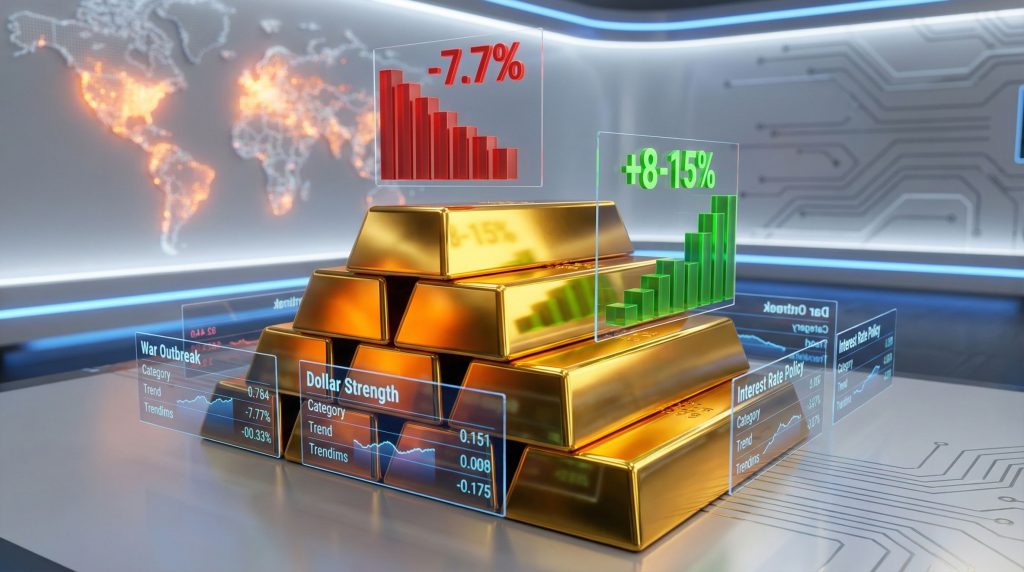
War vs. Economic Factors – Gold Price Impact Analysis
| Factor | Immediate Impact (0-7 days) | Medium-term (2-12 weeks) | Long-term (6+ months) |
|---|---|---|---|
| War Outbreak | +8-15% surge | -5 to -10% correction | Variable |
| Dollar Strength | -2 to -5% | -10 to -20% | Sustained pressure |
| Interest Rate Policy | Minimal | -15 to -25% | Primary driver |
| Inflation Expectations | +3 to +8% | -2 to -12% | Policy dependent |
Real interest rate calculations provide the most reliable predictor of gold performance during conflict periods. When inflation-adjusted yields on government securities exceed 2-3%, gold faces significant headwinds regardless of geopolitical circumstances.
Current monetary policy frameworks emphasise inflation targeting and forward guidance, tools that didn't exist during gold's historical bull markets. These innovations allow central banks to anchor expectations more effectively, reducing precious metals' traditional monetary hedge appeal.
How Do Modern Wars Differ from Historical Conflicts in Gold Market Impact?
Technology-Driven Market Efficiency Changes
Contemporary financial markets operate with unprecedented speed and efficiency compared to historical precedents. High-frequency trading algorithms process geopolitical news within milliseconds, eliminating the information lags that previously created sustained price dislocations during conflicts.
Modern market structure innovations:
- Algorithmic trading dominance (75%+ of volume)
- Real-time global information flow
- 24/7 electronic trading platforms
- Sophisticated risk management systems
Derivative markets now allow institutional investors to hedge geopolitical exposure through currency futures, commodity swaps, and volatility instruments rather than physical precious metals accumulation. This structural shift reduces gold's role in portfolio risk management strategies.
Exchange-traded funds (ETFs) have democratised precious metals access while creating paper gold markets that disconnect pricing from physical supply and demand fundamentals. During crisis periods, ETF flows often dominate price action rather than traditional safe-haven demand patterns.
Central Bank Policy Evolution Since the Gold Standard
The abandonment of fixed exchange rate systems fundamentally altered how governments finance military operations and manage wartime economic disruption. Modern fiat currency systems allow monetary authorities flexibility that reduces gold's traditional monetary role during conflicts.
Fiat system advantages during wartime:
- Unlimited currency creation capability
- Flexible exchange rate adjustments
- Sophisticated debt market access
- Advanced monetary policy tools
Quantitative easing programs provide alternative mechanisms for government financing that eliminate the historical need for gold confiscation or currency devaluation during major conflicts. Central banks can expand balance sheets without triggering the currency crises that historically drove precious metals demand.
Modern monetary theory applications during conflict periods emphasise fiscal-monetary coordination rather than commodity backing, further reducing gold's strategic importance in government policy frameworks.
Which Types of Military Conflicts Generate the Strongest Gold Price Responses?
Regional vs. Global Conflict Classifications
Contemporary conflict analysis reveals significant variations in gold price responses based on geographic scope, participant nations, and potential economic disruption scales. Limited regional engagements typically generate modest price reactions, while conflicts involving major economic powers create more substantial market responses.
Conflict categorisation framework:
Limited Regional Conflicts:
- 2-4% initial price movements
- 1-3 week duration of impact
- Minimal supply chain disruption
Major Power Involvement:
- 8-15% initial price surges
- 4-8 week volatility periods
- Significant economic spillover effects
Nuclear Escalation Threats:
- 15-25% panic buying episodes
- Extended volatility (8-16 weeks)
- Fundamental market structure breakdown risk
The 2026 Middle Eastern conflict demonstrated how even significant regional wars fail to sustain gold rallies when major economic powers remain peripherally involved. Despite initial 8% price increases, lack of direct U.S. or Chinese military engagement limited sustained precious metals demand.
Economic Disruption Scale Analysis
Market analysts increasingly focus on economic disruption metrics rather than military casualties or territorial changes when evaluating conflict impact on precious metals pricing. Supply chain interruption severity, energy market volatility, and trade route disruption create more reliable price prediction models.
Disruption measurement criteria:
- Global trade route interference percentages
- Energy supply disruption duration estimates
- Critical mineral supply chain impacts
- Financial system stress indicators
Conflicts affecting major shipping lanes or energy production regions generate more sustained gold price responses than territorial disputes with limited economic implications. For instance, the Strait of Hormuz or Suez Canal disruptions create stronger precious metals demand than border conflicts in economically peripheral regions.
External analysis from FXStreet reveals how war impacts on gold have shifted significantly in the modern era compared to historical patterns.
Modern gold markets respond more to economic disruption potential than military conflict intensity. Supply chain vulnerabilities and energy security concerns drive precious metals demand more effectively than traditional geopolitical risk assessments.
What Role Does Market Valuation Play in Wartime Gold Performance?
Technical Overvaluation Corrections During Crisis
Gold's technical valuation relative to historical norms significantly influences its crisis response patterns. Markets trading substantially above long-term trend lines face correction pressure during volatility spikes, regardless of the underlying catalyst triggering initial price movements.
The BEGOS (Bonds/Euro/Gold/Oil/S&P) market value methodology provides mathematical frameworks for assessing precious metals overvaluation. When gold trades more than 20-25% above calculated fair value, crisis-driven surges often prove unsustainable as fundamental mean reversion forces reassert dominance.
Valuation indicators during conflict periods:
- BEGOS market value deviations
- 300-day moving average relationships
- Parabolic trend sustainability measures
- Volume-weighted price action analysis
Recent Middle Eastern conflict data illustrates this dynamic clearly. Gold trading at $5,023 represented a 29.2% premium to dollar debasement-adjusted fair value of $3,888, creating technical resistance that overwhelmed geopolitical buying pressure.
Fair Value Calculations vs. Emotional Premium Pricing
Mathematical approaches to gold valuation based on 50-year dollar debasement regression models provide more reliable price prediction frameworks than emotion-driven crisis analysis. These models account for monetary base expansion, inflation adjustments, and supply-side gold production increases.
Fair value calculation components:
- Five-decade dollar purchasing power decline
- Global gold supply expansion adjustments
- Central bank reserve accumulation patterns
- Industrial demand growth trends
Current fair value calculations suggest gold prices above $4,000 require extraordinary monetary or geopolitical circumstances to maintain sustainability. However, war-driven emotional premium pricing typically corrects toward mathematical fair value within 3-6 months of initial conflict outbreak.
Mean reversion probability calculations indicate 75-80% likelihood of correction when precious metals trade more than 25% above long-term trend lines, regardless of ongoing geopolitical tensions supporting initial price movements.
The next major ASX story will hit our subscribers first
How Do Energy Markets Influence Gold's War Response?
Oil Price Correlation Dynamics
Energy market behaviour during conflicts creates complex interaction effects with precious metals pricing that often determine sustained trend directions. Oil price increases driven by supply disruption fears can simultaneously support and undermine gold performance depending on monetary policy responses.
Petrodollar recycling mechanisms influence precious metals demand as oil-producing nations diversify revenue streams during conflict periods. However, energy-driven inflation concerns may trigger central bank tightening that creates headwinds for non-yielding assets like gold.
Energy-gold correlation factors:
- Supply disruption severity assessments
- Strategic reserve release policies
- Alternative energy acceleration programs
- Inflation pass-through mechanisms
The correlation coefficient between oil and gold during wartime averages 0.65-0.75 over 1-4 week periods but often diverges significantly over longer timeframes as monetary policy responses dominate market behaviour.
Strategic Reserve Implications
Government strategic petroleum reserve policies during conflicts create ripple effects through precious metals markets via inflation expectations and currency stability mechanisms. Large-scale reserve releases can dampen inflation fears that otherwise support gold demand during supply disruption periods.
Strategic considerations affecting precious metals:
- Government stockpiling behaviour changes
- Industrial demand shifts in defence manufacturing
- Critical minerals classification updates
- Supply chain diversification initiatives
Recent conflicts demonstrated how coordinated strategic reserve releases by major consuming nations can limit energy price increases, reducing inflation fears that historically drove precious metals demand during Middle Eastern tensions. Consequently, understanding the effects of geopolitical tensions on commodity markets becomes increasingly complex.
What Investment Strategies Work Best During Wartime Gold Volatility?
Portfolio Allocation Optimisation Models
Modern portfolio theory applications during geopolitical crisis periods require sophisticated risk-adjusted return calculations that account for gold's evolved market behaviour. Traditional 5-10% precious metals allocations may prove inadequate for crisis protection given reduced correlation benefits with other asset classes.
Optimisation considerations:
- Correlation breakdown analysis during stress periods
- Volatility spillover effects across asset classes
- Liquidity risk assessment for physical vs. paper gold
- Currency hedging requirements for international exposure
Risk-adjusted return calculations suggest 3-7% precious metals allocation provides optimal crisis protection without excessive portfolio drag during normal market conditions. Higher allocations may reduce portfolio efficiency given gold's reduced safe-haven reliability.
Timing Strategy Development
Technical analysis approaches must adapt to modern market structure changes affecting gold's crisis response patterns. Traditional chart analysis techniques require modification to account for algorithmic trading impacts and reduced fundamental correlation reliability.
Enhanced timing methodologies:
- Dollar strength momentum indicators
- Central bank policy pivot prediction models
- Geopolitical tension sustainability assessment
- Alternative asset opportunity cost calculations
Dollar-cost averaging strategies prove more effective than tactical allocation approaches during conflict periods given gold's increased volatility and reduced predictability. Systematic accumulation during price weakness provides better risk-adjusted returns than attempted crisis timing.
Historical War Impact on Gold Performance
| Conflict | Initial Surge | Peak Price | 6-Month Return | Primary Driver |
|---|---|---|---|---|
| Gulf War 1990 | +12% | $384/oz | -8% | Quick resolution |
| 9/11 Response | +5% | $290/oz | +25% | Fed easing cycle |
| Iraq Invasion 2003 | +8% | $390/oz | +15% | Dollar weakness |
| Ukraine 2022 | +6% | $2,070/oz | -18% | Rate hike cycle |
| Middle East 2026 | +15% | $5,434/oz | -10%* | Dollar strength |
*Projected based on current trends
Why Do Precious Metals Underperform During Modern Conflicts?
Structural Market Changes Since 2000
The precious metals investment landscape has undergone fundamental transformation through exchange-traded fund proliferation, creating paper gold markets that disconnect pricing from physical supply-demand fundamentals. ETF structures allow rapid position adjustments that amplify volatility while reducing sustained demand during crisis periods.
Key structural changes:
- ETF assets under management exceeding physical gold reserves
- Algorithmic trading representing 70%+ of daily volume
- Derivative market growth providing alternative hedging mechanisms
- Cryptocurrency emergence as digital store-of-value competitor
High-frequency trading systems process geopolitical news within milliseconds, eliminating information asymmetries that historically created sustained price dislocations during conflicts. This efficiency reduces gold's traditional advantage as crisis hedge given rapid price discovery mechanisms.
Institutional Investment Behaviour Evolution
Large-scale institutional investors increasingly utilise sophisticated risk management tools that reduce reliance on traditional safe-haven assets during market stress periods. Currency hedging, volatility derivatives, and alternative asset classes provide portfolio protection mechanisms that compete directly with precious metals allocation strategies.
Institutional behaviour changes:
- Pension fund alternative investment adoption
- Sovereign wealth fund diversification strategies
- Central bank reserve management modernisation
- Insurance company liability matching innovations
Modern institutional frameworks emphasise liquidity and correlation stability over traditional crisis hedge characteristics. Gold's increased volatility and reduced correlation reliability during stress periods diminish its appeal relative to government securities and cash positions.
Furthermore, institutional awareness of the effect of war on gold prices has led to more sophisticated hedging strategies that bypass traditional precious metals exposure.
What Are the Long-Term Implications for Gold Investment Strategy?
Paradigm Shift Recognition Requirements
Investment professionals must acknowledge fundamental changes in precious metals market behaviour rather than relying on historical precedents that no longer apply to modern financial conditions. Traditional safe-haven asset classification requires reassessment given structural market evolution and monetary policy framework changes.
Strategic reassessment priorities:
- Multi-factor investment model development
- Alternative crisis hedge evaluation
- Portfolio construction methodology updates
- Risk management framework modernisation
Modern portfolio theory applications must incorporate gold's evolved characteristics rather than assuming historical correlation and volatility patterns remain relevant for future market stress scenarios. For investors seeking contemporary guidance, our gold investment strategies provide updated frameworks for 2025.
Future Conflict Preparation Strategies
Scenario planning methodologies should emphasise economic disruption analysis rather than traditional geopolitical risk assessment frameworks. Modern conflicts impact markets primarily through supply chain disruption, energy market volatility, and monetary policy responses rather than direct safe-haven demand.
Enhanced preparation approaches:
- Supply chain vulnerability mapping
- Energy security impact modelling
- Central bank policy response prediction
- Alternative asset integration strategies
Portfolio stress testing against various conflict scenarios reveals gold's diminished effectiveness compared to diversified alternative strategies including foreign currency exposure, energy sector investments, and inflation-protected securities. Additionally, understanding record-high gold prices helps contextualise current market valuations.
Investor Considerations During Wartime:
Q: Why didn't gold prices soar during the recent Middle East conflict?
Modern gold markets respond more to monetary policy and dollar strength than geopolitical events. The Federal Reserve's hawkish stance and rising real interest rates created headwinds that overwhelmed traditional safe-haven demand patterns.
Q: How long do war-related gold price movements typically last?
Initial surges usually reverse within 2-8 weeks as markets assess conflict duration and economic implications. Sustained moves require prolonged wars with significant monetary policy responses or major economic disruption.
Q: Should investors buy gold during war outbreaks?
Historical data suggests waiting for initial volatility to subside before making strategic allocations. Focus on underlying economic fundamentals rather than headline-driven price spikes for better risk-adjusted returns.
Q: What alternatives exist to gold for crisis protection?
Modern investors can utilise currency diversification, inflation-protected securities, energy sector exposure, and volatility derivatives for portfolio protection during geopolitical stress periods.
Redefining Gold's Role in Modern Conflict Economics
The relationship between warfare and precious metals pricing has fundamentally transformed in the post-gold standard era. While initial safe-haven flows still drive short-term surges, sustained performance depends increasingly on monetary policy responses, currency dynamics, and broader economic conditions rather than conflict headlines alone.
Modern investors must recognise that gold's traditional crisis hedge characteristics have evolved significantly since historical precedents were established. Success requires understanding the complex interplay between geopolitical events, central bank policies, and market structure changes that now dominate precious metals pricing mechanisms.
The effect of war on gold prices operates through indirect channels in contemporary markets, primarily via inflation expectations, currency stability, and monetary policy responses rather than direct safe-haven demand. This evolution demands sophisticated analytical frameworks that account for modern financial system complexity.
Investment Implications:
Professional portfolio management must adapt to gold's reduced crisis hedge reliability while recognising its continued role as monetary system hedge over longer timeframes. Strategic allocation decisions should emphasise fundamental valuation analysis over geopolitical timing attempts. Our comprehensive gold price forecast 2025 explores these evolving dynamics in greater detail.
Additionally, investors should monitor key bull market catalysts that may drive precious metals performance beyond traditional conflict scenarios. Our gold market surge analysis provides insights into current market momentum factors.
Disclaimer: This analysis is for educational purposes only and should not be considered personalised investment advice. Precious metals markets involve substantial risk, and past performance does not guarantee future results. Investors should conduct thorough due diligence and consider consulting qualified financial professionals before making investment decisions. The views expressed represent the author's assessment based on available information and may change as market conditions evolve.
Looking to capitalise on precious metals market volatility?
Discovery Alert's proprietary Discovery IQ model delivers real-time notifications on significant ASX mineral discoveries, transforming complex geological data into actionable investment insights that help subscribers navigate market volatility more effectively. Begin your 14-day free trial today to discover why major mineral discoveries can generate substantial returns by exploring Discovery Alert's dedicated discoveries page.