June 3, 2026
Understanding Market Structure Evolution in Base Metals Trading
The London Metal Exchange operates within a complex ecosystem where institutional capital flows intersect with retail speculation, creating amplified volatility patterns that extend far beyond traditional supply-demand fundamentals. This speculative metals trading London Metal Exchange environment has transformed how modern derivatives markets function as sophisticated mechanisms where price discovery occurs through multiple participant categories, each operating under different risk tolerance thresholds and information processing capabilities.
Professional money managers increasingly view base metals futures as portfolio diversification instruments, particularly during periods of currency debasement concerns and inflationary pressure. Furthermore, the institutional rotation into hard assets reflects broader allocation strategies where copper and aluminum serve as proxies for global economic growth expectations, while smaller markets like tin attract momentum-based trading approaches seeking to capitalise on concentrated supply risks.
Capital Flow Dynamics and Institutional Positioning
The fourth quarter of 2025 witnessed unprecedented institutional engagement with 777,016 contracts in average daily volume, surpassing the previous 735,604 contract record from the second quarter of 2014. This represents more than a statistical milestone – it demonstrates restored confidence following the 2022 crisis that threatened the exchange's credibility among professional investors.
LME futures open interest expanded 15% year-over-year by late 2025, reaching levels not observed since early 2021. This metric indicates sustained directional positioning rather than merely increased hedging activity, suggesting that institutions maintained conviction in their metals exposure despite elevated volatility conditions.
Fund positioning data reveals that renewed institutional interest accelerated from September 2025 onward, with capital flows targeting the entire metals complex rather than concentrating in specific contracts. This broad-based approach suggests systematic allocation decisions rather than opportunistic positioning around individual supply disruptions, reflecting the broader industry evolution trends shaping market participation.
When big ASX news breaks, our subscribers know first
Policy-Driven Trading Opportunities and Regional Price Dislocations
Geopolitical factors function as primary catalysts for speculative activity when they create measurable pricing inefficiencies between regional markets. Additionally, trade policy announcements generate what market participants term "policy risk premiums" – additional volatility compensation demanded for maintaining directional positions during regulatory uncertainty periods.
Import Tariff Impact Mechanisms
The Trump administration's trade policy initiatives created substantial opportunities for speculative metals trading London Metal Exchange participants throughout 2025. However, the tariffs impact markets in complex ways that extend beyond immediate price adjustments. Aluminum import tariffs reached 50% effective June 2025, while copper faced ongoing investigation initiated in February 2025 with a decision timeline extending to June 2026.
| Metal | Policy Action | Market Response | Volume Impact |
|---|---|---|---|
| Aluminum | 50% tariff implemented | Regional pricing dislocations | CME premium contracts +47% US, +72% EU |
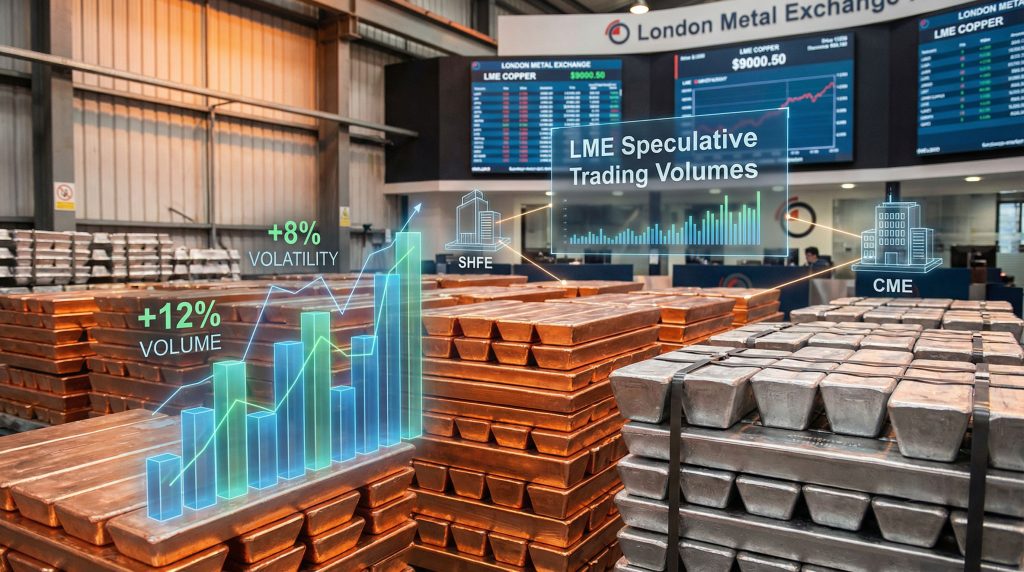
| Copper | Investigation launched | Extended uncertainty period | LME volumes +12% year-over-year |
| Steel | Policy consideration | Anticipatory positioning | Derivative contract migration |
These policy developments generated measurable arbitrage opportunities as physical metal flows adjusted to new cost structures. Consequently, LME copper trading intensified following the February investigation announcement and maintained elevated activity throughout 2025. In contrast, CME flagship copper contracts experienced 33% volume contraction as traders avoided unprecedented New York copper prices volatility and London-to-Chicago arbitrage uncertainty.
Supply Chain Realignment Effects
Physical metal flows respond slowly to policy signals due to logistical constraints, creating temporal windows where price dislocations persist and attract speculative positioning. The US-China trade war effects continue to influence these dynamics through complex supply chain adjustments.
The phenomenon of "tariff avoidance" – where importers accelerate shipments to avoid future duty assessments – generates demand volatility that manifests in both physical and financial markets. CME aluminum premium contracts demonstrated this dynamic clearly, with Midwest US contracts gaining 47% and European contracts increasing 72% year-over-year in 2025.
Retail Market Democratisation and Accessibility Innovations
Exchange operators have fundamentally altered market structure through product innovations designed to capture retail participation previously concentrated in precious metals markets. These structural changes enable smaller investors to establish meaningful positions in industrial metals without requiring substantial capital commitments.
Micro-Contract Growth Patterns
The CME's micro copper contract, representing 2,500 pounds (one-tenth the standard contract size), registered 20% year-over-year volume growth in 2025, reaching approximately 4 million metric tons in annual trading volume. This sustained expansion indicates that retail investors are successfully transitioning from precious metals into industrial commodity trading.
Event options – binary-style derivatives offering simplified payoff structures – experienced explosive growth with 31,000 lots traded in December 2025 alone, exceeding the entire 2024 calendar year volume. This concentration suggests pronounced seasonal patterns in retail speculative activity, likely coinciding with year-end portfolio rebalancing decisions.
Educational Content and Social Media Influence
Retail participation patterns reflect broader educational trends promoting hard asset allocation and inflation protection strategies. For instance, social media platforms and online educational content have expanded retail awareness of industrial metals as portfolio diversification tools, though most retail participants lack the fundamental analysis capabilities possessed by institutional counterparts.
The migration of retail capital from cryptocurrency and equity markets during periods of elevated volatility demonstrates how displaced speculative capital seeks alternative opportunities in commodities markets. Moreover, volatility hedging strategies have become increasingly important as educational content promotes participation accessibility.
Chinese Market Dynamics and Regulatory Response
Shanghai Futures Exchange activity reached extraordinary levels during December 2025, with concentrated volume surges across multiple contracts creating concerns about market integrity and systemic stability. Chinese retail trading culture exhibits distinct behavioural characteristics including pronounced herding behaviour and rapid capital rotation between trending markets.
Volume Surge Analysis
Shanghai metals markets experienced unprecedented activity levels in December 2025:
- Aluminum volumes: Highest monthly level in three years
- Nickel turnover: Highest volume in four years
- Copper contract: Highest activity since November 2015
- Tin trading: Record 9 million tons monthly volume
The tin market surge proved particularly dramatic, with daily trading reaching 739,000 tons – equivalent to approximately two years of global tin consumption in a single trading session. These volumes vastly exceed any rational relationship to physical market fundamentals, indicating predominantly speculative positioning with minimal delivery intentions.
Regulatory Intervention Mechanisms
The China Nonferrous Metals Industry Association issued public warnings against excessive speculation, characterising the price rally as unreasonable and advising against trend-following behaviour. Chinese regulatory authorities historically employ multiple intervention tools including position limits, margin requirement adjustments, and public warnings to moderate speculative excess.
"Chinese authorities regularly intervene when speculative activity threatens market stability, utilising position limits, margin adjustments, and official warnings to moderate excessive trading behaviour."
Shanghai Futures Exchange market microstructure enables higher leverage ratios (sometimes 20:1 or greater) compared to Western margin requirements. Furthermore, this amplifies both upside and downside volatility when coordinated retail positioning unwinds. The T+0 settlement system allows day traders to establish and liquidate positions multiple times daily, creating natural amplification of momentum-driven price movements.
Institutional Risk Management Framework Evolution
Professional traders must distinguish between normal market microstructure volatility (reflecting diverse participant behaviour and information processing) versus spike volatility driven by coordinated retail positioning. However, historical volatility models may systematically underestimate tail risk probability when retail traders operate with high leverage and exhibit herd-like behavioural patterns.
Position Sizing and Volatility Modeling
The relationship between order flow and price impact becomes nonlinear during periods of elevated speculative metals trading London Metal Exchange activity. Models assuming proportional relationships between position size and price impact may significantly underestimate friction costs when retail participants simultaneously liquidate large positions.
Key Risk Management Adaptations:
- Enhanced volatility modeling: Incorporating regime-change detection for retail speculation periods
- Dynamic position sizing: Algorithms that adjust exposure based on speculative participation indicators
- Stop-loss optimisation: Avoiding clustered trigger levels that could amplify liquidation cascades
- Margin requirement monitoring: Tracking exchange-level margin adjustments as early warning signals
Counterparty Risk Assessment
The 2022 LME nickel crisis created lasting institutional awareness regarding clearing mechanism stability and margin adequacy during extreme volatility periods. Consequently, the 2025 recovery in institutional confidence, evidenced by record trading volumes, suggests that post-crisis reforms have been deemed adequate by professional investors, though heightened vigilance remains standard practice.
Intraday volatility intensification throughout 2025 required institutional risk managers to recalibrate their frameworks for copper and tin markets where speculative metals trading London Metal Exchange participation achieved record levels. The unprecedented volatility in metals arbitrage pricing between London and Chicago referenced by market participants indicates that traditional hedging relationships became unreliable during peak speculation periods.
Technological Integration and Market Structure Changes
High-frequency trading algorithms increasingly participate in metals markets, providing liquidity while potentially amplifying volatility during stress periods. Machine learning models now analyse satellite imagery, shipping data, and social sentiment alongside traditional fundamental indicators to generate trading signals.
Alternative Data Integration
Modern speculative strategies incorporate non-traditional information sources including:
- Satellite monitoring: Real-time mine operation activity levels
- Port congestion analytics: Shipping delay and inventory movement tracking
- Social sentiment analysis: WeChat and Twitter discussion volume correlation
- Industrial activity indicators: Power consumption and transportation data
This information asymmetry creates temporary advantages for technologically sophisticated participants while potentially increasing overall market complexity and interconnectedness. In addition, the LME's physical market benefits continue to evolve alongside these technological advances.
Exchange Innovation and Product Development
Ongoing market structure evolution includes exchange consolidation, new contract specifications, and settlement mechanism innovations. Environmental, social, and governance (ESG) considerations may create new categories of metals derivatives linked to sustainable production standards and carbon footprint metrics.
The next major ASX story will hit our subscribers first
Future Market Structure Considerations
The expansion of speculative metals trading London Metal Exchange reflects broader trends toward asset financialisation and retail market democratisation. As emerging markets develop sophisticated financial infrastructure, speculative capital flows may become more geographically distributed, potentially reducing concentration risks while increasing overall volatility through diverse participant behaviour patterns.
Regulatory Environment Evolution
Market participants must maintain compliance frameworks adaptable to evolving oversight mechanisms. Position limits, margin requirements, and market maker obligations continue developing as regulators balance market accessibility with stability concerns. The success of Chinese intervention mechanisms may influence regulatory approaches in Western markets.
Investment Strategy Implications
Institutional investors require balanced exposure to metals speculation against portfolio volatility targets. Structured products and volatility overlays can provide upside participation while limiting downside risk during speculative unwinds. The key lies in understanding both fundamental supply-demand dynamics and behavioural patterns of different participant categories.
Portfolio Construction Framework:
- Fundamental analysis: Traditional supply-demand modelling
- Sentiment monitoring: Retail participation and positioning indicators
- Technical analysis: Momentum and reversal pattern recognition
- Risk overlay: Volatility-based position sizing and hedging strategies
The continued evolution of speculative metals trading London Metal Exchange represents a fundamental shift in how industrial commodities function within global financial markets. Success requires sophisticated understanding of both traditional commodity fundamentals and modern market microstructure dynamics driven by diverse participant behavioural patterns.
Looking to Profit from Base Metals Trading Opportunities?
Discovery Alert's proprietary Discovery IQ model delivers real-time alerts on significant ASX mineral discoveries, including base metals opportunities that could benefit from the speculative trading dynamics explored above. With institutional participation reaching record levels and market volatility creating actionable opportunities, subscribers gain instant access to major mineral discoveries that have historically generated substantial returns for early investors.