
May 16, 2026
Economic diversification pressures across Africa's resource-dependent nations have intensified as global commodity cycles expose the vulnerabilities of single-asset economies. Mining jurisdictions face recurring challenges when flagship operations mature, forcing governments to rapidly develop alternative revenue streams or risk fiscal instability. This structural dynamic has become particularly acute in West Africa, where iron ore price trends and gold price volatility creates unpredictable government income flows.
The imperative for Mauritania gold sector diversification emerges from this broader continental pattern, as the nation confronts declining output from its primary gold asset while simultaneously pursuing expanded mineral exploration across untapped geological provinces. Understanding how this diversification unfolds requires examining the intersection of geological potential, international investment flows, and policy frameworks designed to attract capital into frontier mining territories.
Economic Vulnerabilities Drive Strategic Portfolio Expansion
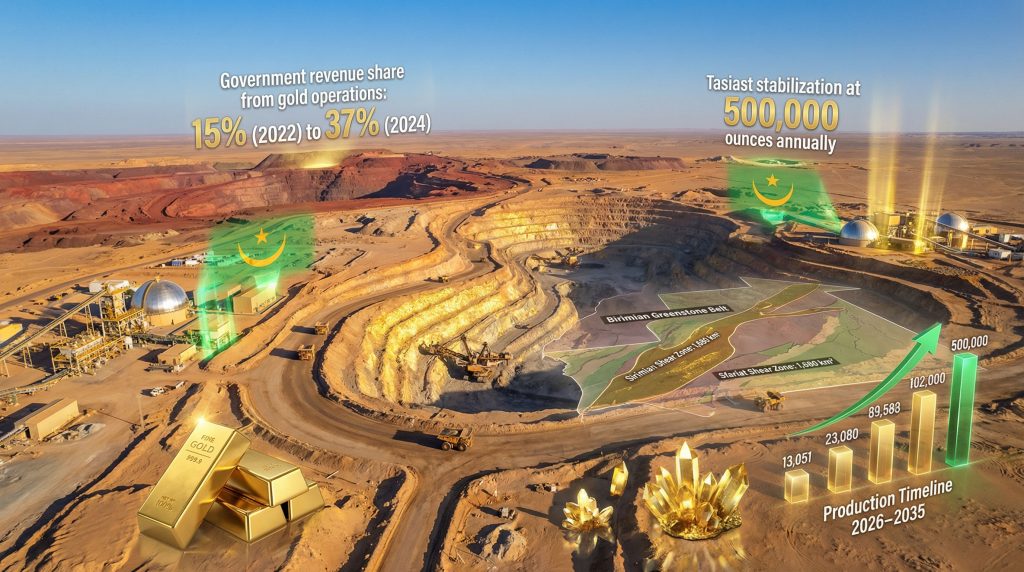
Mauritania's mineral economy faces structural concentration risks that have intensified as its dominant gold operation transitions into lower-grade ore processing. The Tasiast mine's production trajectory illustrates the challenge facing single-asset dependent economies: after reaching 622,394 ounces in 2024, output declined by 23% in 2025 as operations shifted to lower-grade ore bodies. Kinross, the mine's operator, expects production to stabilise around 500,000 ounces annually through 2026, with no recovery above 600,000 ounces anticipated before 2028.
This decline carries immediate fiscal implications, as Mauritania's mining sector diversification becomes increasingly critical. The mine's dominance extends beyond direct revenue generation: it accounted for 77% of national gold production in 2023, creating dangerous single-point-of-failure exposure for government budgets.
Revenue Concentration Creates Policy Urgency
The concentration of mining revenues in two primary assets—SNIM's iron ore operations and Kinross's Tasiast gold mine—exposes Mauritania to synchronised commodity price volatility. When both iron ore and gold market performance experience downturns simultaneously, the government faces compounding fiscal pressures that threaten infrastructure investment and social spending programs.
Historical analysis of mining-dependent African economies reveals that successful diversification requires proactive policy intervention during periods of high commodity prices, rather than reactive measures during downturns. Furthermore, understanding the mineral exploration importance helps explain Mauritania's current competitive bidding processes for exploration licences.
Alternative Revenue Streams Through Exploration Licensing
Recent permit allocations demonstrate government commitment to expanding the mineral production base beyond Tasiast dependency. Montage Gold's acquisition of five exploration permits covering 2,103 square kilometres in northern Mauritania represents the most significant new exploration commitment announced in 2026, with an initial $2 million budget allocated for geological assessment and 15,000 metres of drilling planned for the fourth quarter.
The competitive bidding process that awarded these permits signals a strategic shift toward market-based allocation mechanisms, designed to maximise government revenue capture from licensing fees while ensuring exploration commitments meet technical standards. This approach contrasts with historical discretionary permit awards and reflects broader governance improvements across African mining jurisdictions, as outlined in Mauritania's comprehensive mining overview.
When big ASX news breaks, our subscribers know first
Geological Assessment Reveals Untapped Resource Potential
Northern Mauritania's geological architecture contains structural characteristics associated with major gold deposits across West Africa's Birimian greenstone belt systems. The Sfariat Shear Zone, covering approximately 1,680 square kilometres through four contiguous permits awarded to Montage Gold, represents the most prospective target for orogenic gold system discovery.
Government estimates suggest Mauritania's total gold potential exceeds 25 million ounces (approximately 777+ tonnes), compared to Tasiast's proven and probable reserves of 4.4 million ounces as of December 2025. This implies significant untapped resources that could support multiple large-scale mining operations if exploration programmes successfully advance to feasibility and development stages.
Structural Controls and Metallogenic Targeting
The Zednes region, where Montage Gold secured an 80% interest through partnership with local firm SOCIEX, lies within geological settings considered favourable for orogenic gold deposits. These systems typically form during metamorphic events that concentrate gold along structural conduits such as shear zones and fault systems.
Orogenic gold deposits across West Africa have historically produced some of the continent's most significant gold mines, with deposit sizes ranging from 2-10+ million ounces. Consequently, understanding the mining permitting overview becomes crucial as these projects advance through regulatory stages.
| Geological Zone | Area (km²) | Exploration Status | Key Characteristics |
|---|---|---|---|
| Sfariat Shear Zone | 1,680 | Advanced targeting | Structural controls, shear zone geology |
| Zednes Region | 423 | Partnership agreement | Orogenic gold system potential |
| Additional Zones | 25,000+ | Government estimates | Unexplored regional potential |
Exploration Timeline and Resource Definition
Montage Gold's exploration programme represents the most advanced systematic assessment of northern Mauritanian gold potential since government geological surveys established regional prospectivity. The company's $2 million initial budget will fund geological mapping, geophysical surveys, and soil sampling across both permit areas before focused drilling begins in late 2026.
Industry-standard exploration cycles typically require 2-3 years for initial resource definition, followed by 2 years for feasibility studies and 3 years for mine construction if economic deposits are discovered. This 7-8 year development timeline means that new production from current exploration would not reach commercial scale until the early 2030s, emphasising the importance of immediate exploration investment to maintain long-term production capacity.
International Investment Flows Respond to Policy Signals
The arrival of Canadian-based Montage Gold with committed capital and technical teams signals international recognition of Mauritania gold sector diversification opportunities. The company's willingness to invest $2 million in early-stage exploration, combined with drilling commitments for late 2026, demonstrates confidence in both geological potential and regulatory stability.
Risk-Return Assessment for Foreign Operators
Montage Gold's permit acquisition strategy reflects careful risk management principles common among mid-tier mining companies entering frontier jurisdictions. The Sfariat permits provide 100% ownership with direct government awards, eliminating partnership complexity during early exploration phases. The Zednes partnership with SOCIEX offers local knowledge and relationships while maintaining Montage's exploration control through full funding obligations.
The agreement structure with SOCIEX demonstrates sophisticated risk allocation: Montage funds all exploration activities through the exploitation permit stage, while SOCIEX retains the option to either co-fund mine development or convert its 20% interest into a 1% net smelter royalty. This structure incentivises discovery while providing SOCIEX with optionality at development decision points.
Historical Investment Patterns and Local Integration
Kinross Gold's $3.1 billion in local procurement spending between 2011-2024 establishes a precedent for major supply chain integration in Mauritanian mining operations. This historical spending, averaging approximately $233 million annually, demonstrates the potential for significant economic multiplier effects when large-scale mining operations reach production stages.
The procurement integration model developed at Tasiast provides a template for future mining operations, with established supplier networks, logistics capabilities, and workforce training programmes that can support expanded mineral production across multiple sites. This existing infrastructure reduces development costs and timeline risks for new projects.
Investment Climate Indicators:
Competitive bidding processes ensure transparent permit allocation, while government estimates of 25+ million ounces total potential suggest substantial long-term opportunities. International companies increasingly view Mauritania as an attractive exploration destination within the broader West African mining corridor.
Production Scenarios Depend on Exploration Success Rates
Near-term production forecasting for Mauritania gold sector diversification must account for the natural decline at Tasiast while assessing realistic timelines for new discovery and development. Current national output of 25+ tonnes annually (approximately 804,000 ounces) relies heavily on Tasiast's contribution, with Guelb Moghrein contributing 3.4% as a copper byproduct and artisanal operations providing additional volumes.
Short-Term Outlook Through 2028
Tasiast's stabilisation at approximately 500,000 ounces annually creates a production baseline that new discoveries must supplement to maintain national output levels. The 23% decline in 2025 sales, despite rising global gold prices, illustrates how grade degradation impacts revenue generation even during favourable market conditions. However, the gold price forecast suggests strong market fundamentals may offset some production declines.
Artisanal and small-scale mining contributes meaningful volumes, with 14.7 tonnes produced officially between 2020 and August 2024 through MAADEN Mauritanie's formalisation efforts. This implies annual artisanal production of approximately 2.5-3 tonnes (80,000-96,000 ounces), though significant unofficial production likely occurs outside formal channels.
Medium-Term Development Potential
Successful exploration outcomes could support multiple mining operations by the early 2030s, though development timelines remain highly uncertain. The industry-standard progression from grassroots exploration to commercial production typically spans 7-10 years, with many projects experiencing delays due to technical, financial, or regulatory challenges.
| Development Stage | Typical Duration | Investment Requirement | Success Probability |
|---|---|---|---|
| Advanced Exploration | 2-3 years | $50-100 million | 70-80% completion rate |
| Feasibility Studies | 2 years | $20-50 million | 60-70% proceed to development |
| Construction | 3-4 years | $500+ million | 80-90% completion rate |
| Production Ramp-up | 1-2 years | Ongoing capex | 90%+ achieve nameplate capacity |
Long-Term Strategic Positioning
Government estimates of 25+ million ounces total potential suggest capacity for multiple large-scale operations if exploration programmes successfully identify economic deposits. A diversified production portfolio with 3-4 operating mines would significantly reduce single-asset dependency while creating sustained employment and fiscal revenue streams.
The development cycle timeline means that exploration investment made in 2026-2027 will determine production capacity available in the mid-2030s. This creates policy urgency for continued investment attraction while global capital remains available for frontier exploration projects.
Artisanal Sector Integration Addresses Revenue Leakage
Formalisation of artisanal and small-scale mining represents a critical component of Mauritania gold sector diversification, both for immediate revenue capture and long-term sector development. MAADEN Mauritanie's establishment in 2020 marked government recognition that artisanal production could contribute meaningfully to national output if properly integrated into official channels.
Quantifying Informal Gold Flows
Research by SWISSAID suggests that approximately 30 tonnes of gold may have left Mauritania through unofficial channels between 2016-2022, representing substantial revenue leakage that formalisation efforts could capture. This estimate, based on comparison of official production data with artisanal sector output assessments, highlights the scale of economic activity occurring outside government oversight.
The 14.7 tonnes officially produced through MAADEN Mauritanie between 2020-August 2024 demonstrates progress in capturing artisanal production, though the SWISSAID findings suggest significant volumes continue flowing through informal export channels. Addressing this leakage requires enhanced monitoring systems, improved market linkages, and incentive structures that encourage formal participation.
Technology Integration for Production Monitoring
Digital tracking systems for artisanal gold production could significantly improve revenue capture while providing data for resource planning and environmental monitoring. These systems, successfully implemented in other West African jurisdictions, use mobile technology and blockchain verification to create transparent production records from mine site to export point.
Training programmes for sustainable extraction methods address both production efficiency and environmental impact concerns. Formal sector integration can improve recovery rates while reducing mercury use and other environmentally harmful practices common in informal artisanal operations.
Market Linkage Development
Creating direct market access for formalised artisanal producers eliminates intermediary capture that reduces prices paid to miners while increasing government revenue through formal export channels. This requires establishing buying centres, implementing fair pricing mechanisms, and providing financial services that support artisanal operator cash flow requirements.
The scale of artisanal activity suggests potential for 50,000+ participant formalisation, which could generate substantial employment and income distribution effects in rural areas where large-scale mining operations are not economically viable.
Infrastructure Development Supports Sector Expansion
Mauritania gold sector diversification requires coordinated infrastructure investment to support exploration activities, future mine development, and enhanced production logistics. Current infrastructure networks, developed primarily to serve iron ore and existing gold operations, must expand to accommodate increased mining activity across geographically dispersed locations.
Processing Capacity and Beneficiation Facilities
Limited local processing capacity constrains value-addition opportunities and increases transportation costs for concentrate export. Developing regional processing hubs could support multiple mining operations while creating additional employment and technology transfer opportunities. These facilities would process ore from various sources, achieving economies of scale unavailable to individual operations.
Integration with existing mining infrastructure networks, particularly transportation corridors and power systems developed for iron ore and current gold operations, could reduce development costs for new projects. Strategic infrastructure planning can optimise shared facilities usage while maintaining operational flexibility for different operators.
Transportation and Security Protocols
Expanding exploration and production activities require enhanced transportation networks connecting remote mineral areas with processing facilities and export ports. Road network improvements must balance accessibility requirements with security considerations, particularly for gold transportation through regions with limited government presence.
Security protocols for gold transportation become increasingly complex as production diversifies across multiple sites and operators. In addition, coordinated approaches between government security forces, private operators, and international best practice frameworks can establish effective protection systems while maintaining cost efficiency.
The next major ASX story will hit our subscribers first
Policy Frameworks Enable Sustainable Mining Growth
Regulatory environment evolution reflects government commitment to attracting international investment while ensuring sustainable development outcomes. The competitive bidding processes implemented for recent exploration licence awards represent a shift toward transparent, market-driven allocation mechanisms that maximise government revenue while establishing clear operator obligations.
Environmental Assessment and Community Consultation
Enhanced environmental assessment requirements for new projects reflect international best practice adoption and help ensure long-term sustainability of expanded mining activities. These requirements, while adding complexity to project development, can reduce long-term operational risks and improve community acceptance of mining operations.
Revenue-sharing mechanisms with local communities address historical concerns about mineral extraction benefits flowing primarily to national-level government and international operators. Community development funds, modelled after successful programmes in other African mining jurisdictions, can ensure local populations receive direct benefits from nearby mining activities.
International Cooperation and Technical Assistance
Technical assistance partnerships for geological surveys enhance government capacity to assess mineral potential and supervise exploration activities. These partnerships, often funded through international development programmes, provide access to advanced geological assessment techniques and technology transfer opportunities.
Regional coordination on mining standards facilitates cross-border investment flows and knowledge sharing among West African mineral-producing countries. Harmonised approaches to environmental protection, community consultation, and revenue management can reduce regulatory complexity for companies operating across multiple jurisdictions.
Risk Assessment Reveals Multiple Vulnerability Points
Mauritania gold sector diversification faces technical, market, and operational risks that could significantly impact development outcomes. Understanding these risk factors is essential for realistic planning and investment decision-making as the sector expands beyond Tasiast dependency.
Geological and Technical Risk Factors
Exploration success rates in frontier territories typically range from 5-15% of projects advancing from grassroots exploration to commercial production. This statistic highlights the inherent uncertainty in exploration-based diversification strategies, as most permit areas will not yield economic discoveries despite initial geological promise.
Infrastructure development costs in remote areas can significantly exceed initial estimates, particularly for projects requiring new road construction, power generation, or water supply systems. These cost overruns frequently force project modifications or delays that impact economic viability assessments.
Processing technology requirements for complex ore types may necessitate specialised equipment and expertise not readily available in Mauritania. This creates technology dependency risks and increases operational complexity for companies without extensive African mining experience.
Market and Economic Vulnerability Assessment
Global gold price volatility directly impacts project economics and exploration investment decisions. Price fluctuations of 20-30% annually can transform economically viable projects into marginal prospects, affecting both operator profitability and government revenue projections.
Competition from established African gold producers creates market share challenges for Mauritanian operations, particularly during periods of excess supply or reduced global demand. Established operations in Ghana, Mali, and Burkina Faso have cost advantages and market relationships that new Mauritanian operations must overcome.
Currency fluctuation effects on foreign investment can create additional volatility for international operators, particularly those with dollar-denominated revenue streams and local currency cost structures.
Environmental and Social Risk Management
Water resource management in arid regions presents ongoing operational challenges for mining operations, with potential conflicts between mining water requirements and local community needs. Climate change impacts may exacerbate these challenges through increased drought frequency and intensity.
Community consultation and benefit-sharing requirements, while essential for sustainable operations, can create timeline delays and cost increases if not properly managed from project inception. Lessons learned from other African mining jurisdictions emphasise the importance of early, comprehensive community engagement programmes.
Environmental rehabilitation obligations represent long-term financial commitments that must be factored into project economics and government planning. These obligations, typically secured through bonding or escrow mechanisms, ensure environmental restoration occurs regardless of operational outcomes.
Regional Development Integration Creates Multiplier Effects
Mauritania gold sector diversification aligns with broader economic development goals through employment generation, foreign exchange optimisation, and regional economic integration opportunities. Understanding these connections is essential for maximising development impacts beyond direct mining revenues.
Employment Generation Across Development Phases
Direct mining employment varies significantly across project phases, with exploration creating 50-200 jobs, construction generating 500-2,000 temporary positions, and operations supporting 300-800 permanent roles per major mining operation. These figures multiply across multiple projects, potentially creating thousands of direct mining jobs if diversification succeeds.
Indirect employment in supporting industries typically ranges from 2-4 additional jobs per direct mining position, depending on local procurement requirements and supply chain integration levels. This multiplier effect can generate substantial economic impacts in regions with limited alternative employment opportunities.
Skills development for local workforce creates lasting human capital improvements that benefit broader economic development beyond mining sector activities. Technical training programmes, management development, and entrepreneurship support can establish capabilities that support economic diversification into other industries.
Foreign Exchange Earnings Optimisation
Reduced dependence on iron ore export revenues enhances balance of payments stability by diversifying commodity export portfolios. Multi-metal export streams reduce vulnerability to single-commodity price cycles while providing government budget planning flexibility.
Enhanced foreign exchange earnings from expanded gold production can support import capacity for development projects and consumer goods. This improved import capacity particularly benefits infrastructure development and technology acquisition programmes essential for broader economic modernisation.
Cross-Border Investment and Knowledge Transfer
Cross-border mining investment facilitation with neighbouring countries creates opportunities for shared infrastructure development and technical expertise exchange. Regional approaches to power generation, transportation networks, and processing facilities can achieve economies of scale unavailable to individual country programmes.
Knowledge transfer within the West African mining sector benefits from established networks of technical professionals, equipment suppliers, and financing institutions familiar with regional operating conditions. This knowledge base reduces project development risks and timeline requirements for operators expanding across multiple countries.
Shared infrastructure development with neighbouring countries, particularly transportation corridors connecting to international ports, can reduce project development costs while enhancing regional economic integration. These infrastructure investments generate benefits extending well beyond mining sector activities.
Investment Disclaimer: Mining exploration and development involve substantial risks including geological uncertainty, regulatory changes, and market volatility. Potential investors should conduct thorough due diligence and seek professional advice before making investment decisions. Past performance and geological potential do not guarantee future results or discoveries.
Looking to Capitalise on Africa's Mining Diversification Trends?
Discovery Alert's proprietary Discovery IQ model delivers real-time alerts on significant ASX mineral discoveries, instantly empowering subscribers to identify actionable opportunities ahead of the broader market. Explore historic examples of exceptional returns from major mineral discoveries, then begin your 14-day free trial today to position yourself ahead of the market.