May 14, 2026
Strategic Dependencies and Economic Vulnerabilities in Resource-Based Economies
Resource-dependent nations face an enduring challenge: balancing immediate revenue generation against long-term economic resilience. When single assets drive substantial portions of national output, structural vulnerabilities emerge that can persist for decades. This dynamic becomes particularly pronounced in the gold sector, where ore grade transitions and reserve depletion create predictable yet challenging economic pressures requiring strategic diversification initiatives. Mauritania diversifying gold sector represents a comprehensive approach to addressing these fundamental economic vulnerabilities through systematic exploration expansion and regulatory modernisation.
The global mining landscape demonstrates how countries navigate these transitions through various policy frameworks and investment attraction mechanisms. Furthermore, analysing gold market performance trends provides insight into broader resource optimisation strategies and the complex interplay between geological constraints, fiscal policy, and international capital allocation decisions.
When big ASX news breaks, our subscribers know first
How Is Mauritania Restructuring Its Gold Mining Strategy?
Strategic Pivot from Single-Asset Dependency
Mauritania is implementing a comprehensive restructuring of its gold sector through competitive licensing frameworks designed to attract international exploration capital. The country has moved beyond traditional single-operator models toward a diversified exploration approach targeting multiple geological prospects across northern territories.
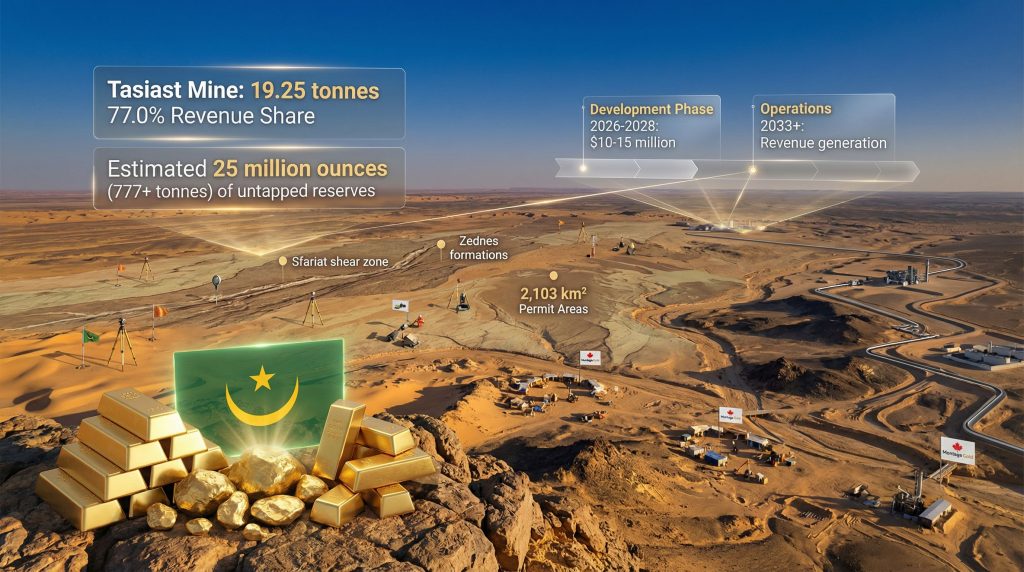
Recent licensing activities demonstrate this strategic shift. Montage Gold secured five exploration permits covering 2,103 square kilometres in northern Mauritania through a competitive bidding process, representing a $2 million initial investment for 2026 exploration activities. This entry model exemplifies Mauritania's hybrid approach combining direct government awards with private capital mobilisation.
The permit structure reflects sophisticated geological targeting analysis rather than generalised acreage allocation. Four permits link to the Sfariat shear zone, while the Zednes permit targets geological formations favourable for orogenic gold deposits within Birimian greenstone belt settings.
Government-Led Exploration Licensing Framework
The licensing mechanism operates through competitive bidding processes that transfer exploration risk to private operators while maintaining government revenue participation. Under current frameworks, exploration companies fund complete early-stage activities until exploitation permits are granted, reducing public sector capital requirements whilst ensuring discovery upside participation.
Montage's exploration programme includes:
• Geological mapping and structural analysis
• Geophysical surveys to identify subsurface targets
• Soil sampling for geochemical surface expressions
• 15,000 metres of drilling planned for Q4 2026
This phased approach represents standard industry practice for orogenic gold exploration in West African geological settings, progressing from surface characterisation through subsurface testing within the exploration permitting framework.
International Investment Attraction Mechanisms
The regulatory framework incorporates flexible partnership structures accommodating both international operators and local stakeholders. The Zednes joint venture structure demonstrates this flexibility, with Montage acquiring an 80% stake while SOCIEX (a Mauritanian firm) retains 20% convertible to a 1% net smelter royalty option.
This conversion mechanism allows local partners to participate without requiring proportional capital commitment during feasibility and construction phases. Consequently, it reduces financial barriers whilst maintaining local stakeholder involvement in successful discoveries.
What Economic Vulnerabilities Drive This Diversification Push?
Tasiast Mine Production Decline Analysis
Mauritania diversifying gold sector responds to structural production challenges at its primary gold asset. The Tasiast mine experienced a 23% production decline in 2025 as operations transitioned to lower-grade ore phases, dropping from 622,394 ounces in 2024 to approximately 500,000 ounces annually.
| Production Metric | 2024 Value | 2025 Value | Change |
|---|---|---|---|
| Annual Output (ounces) | 622,394 | ~500,000 | -23% |
| Total Sales Performance | Baseline | 20% decline | -20% YoY |
| Grade Transition | Higher grade | Lower grade | Structural shift |
This decline represents a structural rather than cyclical adjustment. However, despite record-high gold prices in global markets, Kinross projects production stabilisation around 500,000 ounces with no return above 600,000 ounces before 2028, indicating a multi-year lower-grade phase requiring strategic response.
Revenue Concentration Risk Assessment
The concentration risk extends beyond production metrics to fiscal impact. Tasiast accounts for 77% of Mauritania's gold output and 28.73% of extractive sector payments to government, making it the second-largest fiscal contributor after SNIM's iron ore operations.
Mauritania Gold Production Concentration (2023)
| Production Source | Output Share | Fiscal Contribution |
|---|---|---|
| Tasiast Mine | 77.0% | 28.73% |
| Guelb Moghrein | 3.4% | 4.2% |
| Artisanal/Small-scale | 19.6% | 2.1% |
The 20% sales decline in 2025 despite rising gold prices demonstrates that volume losses cannot be offset by favourable market conditions. In addition, this creates direct fiscal pressure requiring alternative revenue sources to maintain economic stability.
Fiscal Dependency on Single Operator Model
Economic modelling reveals unsustainable dependency patterns when single assets generate disproportionate fiscal contributions. At current production levels, Tasiast's declining trajectory creates compounding vulnerabilities as both absolute revenues and percentage shares diminish simultaneously.
The transition to lower-grade ore typically requires either higher processing volumes to maintain revenue or accepting reduced absolute production. Furthermore, Kinross has chosen the latter approach, projecting consistent output around 80% of peak performance rather than investing in higher-volume processing infrastructure.
Which Exploration Models Are Being Deployed Across Northern Territories?
Geological Targeting of Orogenic Gold Systems
Northern Mauritania's exploration focus centres on favourable geological settings within the West African Craton. The Sfariat shear zone and Zednes formations represent orogenic gold deposit environments similar to successful West African gold provinces, offering structural and geochemical characteristics conducive to significant mineralisation.
Geological targeting priorities include:
• Shear zone-hosted mineralisation within Birimian greenstone belts
• Structural targets with favourable orientation and kinematics
• Geochemical signatures indicating hydrothermal gold transport
• Multiple untested targets within established mineralising systems
This geological approach contrasts with broader regional exploration, focusing capital on proven deposit-style environments rather than speculative greenfield acreage.
Competitive Bidding Process Implementation
The competitive bidding framework ensures market-based valuation of exploration opportunities whilst maintaining government control over strategic resource development. Rather than closed negotiations or administrative allocation, Mauritania employs transparent tender processes attracting multiple international participants.
"The permits were awarded through a competitive bidding process, with additional licences potentially granted to other international companies in coming months, signalling systematic market opening rather than isolated licensing decisions."
This approach generates competitive exploration commitments whilst establishing precedent for ongoing sector development through market mechanisms rather than bilateral negotiations.
Foreign Direct Investment Partnership Structures
Partnership models accommodate varying risk tolerances and capital capacities among international and local participants. The hybrid structure combining direct government awards (Sfariat permits) with negotiated joint ventures (Zednes agreement) demonstrates flexibility in accommodating different investor requirements and local stakeholder participation.
Investment structure characteristics:
• 100% operator funding during exploration phases
• Government revenue participation through royalties and taxes
• Local partner participation without proportional capital requirements
• Conversion options balancing risk and reward allocation
These mechanisms reduce public sector financial exposure whilst ensuring appropriate revenue sharing from successful discoveries.
What Are the Long-Term Resource Optimisation Scenarios?
Multi-Decade Development Timeline Projections
Resource optimisation in gold exploration operates on extended timelines requiring patient capital and strategic planning. From exploration initiation to production commencement typically spans 7-12 years, meaning significant Tasiast diversification likely won't materialise until the early 2030s under optimal scenarios.
Development Phase Timeline:
| Phase | Duration | Capital Requirement | Key Outcomes |
|---|---|---|---|
| Exploration | 2026-2028 | $10-15 million | Resource definition |
| Feasibility | 2028-2030 | $25-40 million | Economic viability |
| Construction | 2030-2033 | $200-500 million | Production capacity |
| Operations | 2033+ | Ongoing | Revenue generation |
This timeline assumes successful exploration outcomes and favourable feasibility results, with actual development potentially extending longer based on discovery characteristics and market conditions.
Artisanal Sector Formalisation Strategies
Shorter-term diversification opportunities exist through artisanal mining formalisation, offering immediate production increases whilst longer-term exploration proceeds. MAADEN Mauritanie, established in 2020, has facilitated 14.7 tonnes of official artisanal production between 2020 and August 2024, representing nearly 20% of national output.
However, significant production remains outside official channels. Research from the African Development Bank indicates approximately 30 tonnes of gold may have exited Mauritania through unofficial channels between 2016-2022, highlighting formalisation potential and revenue capture opportunities through improved monitoring systems.
Infrastructure Investment Requirements
Successful diversification requires coordinated infrastructure development supporting multiple production centres rather than single-asset optimisation. This includes transportation networks, processing facilities, and regulatory systems capable of managing expanded production across diverse geographical areas.
The estimated 25 million ounces (777+ tonnes) of untapped reserves across Mauritania suggests substantial infrastructure investment requirements to support sector expansion beyond current single-mine concentration.
How Does This Strategy Address Global Supply Chain Positioning?
Critical Minerals Portfolio Development
Mauritania's diversification strategy positions the country within broader critical minerals supply chain discussions, though gold represents only one component of comprehensive resource development. The systematic approach to exploration and development creates frameworks applicable to other strategic mineral resources.
Guelb Moghrein's dual production of copper and gold as byproducts demonstrates integrated resource optimisation, generating 3.4% of gold output and 4.2% of fiscal contributions through diversified mineral processing rather than single-commodity focus.
Regional Competitive Advantage Analysis
West African gold production benefits from established geological knowledge, developed infrastructure, and proven deposit models. Mauritania's strategic position offers competitive advantages including:
• Proven geological settings with established mineralisation styles
• Existing mining infrastructure and regulatory frameworks
• Proximity to established gold-producing regions with shared geological characteristics
• Government commitment to sector diversification creating investor confidence
These factors support long-term competitive positioning within regional and global gold supply chains. Additionally, implementing effective gold investment strategies becomes crucial for maximising these competitive advantages.
Export Revenue Stabilisation Mechanisms
Diversified production creates natural hedging against individual asset performance variations, reducing export revenue volatility through portfolio effects. Multiple production centres with varying ore grades, processing characteristics, and operational profiles provide stability unavailable through single-asset dependency.
The integration of formal artisanal production with industrial operations creates additional revenue streams less correlated with large-scale mining economics, further stabilising overall sector performance.
The next major ASX story will hit our subscribers first
What Regulatory Frameworks Support This Transformation?
Mining Code Modernisation Initiatives
Mauritania's regulatory evolution reflects international best practices in extractive sector governance, incorporating transparency requirements and competitive allocation mechanisms. The Extractive Industries Transparency Initiative (EITI) framework provides standardised reporting ensuring stakeholder access to sector performance data.
Competitive bidding processes replace discretionary licensing, creating market-based resource allocation whilst maintaining government strategic oversight. This modernisation attracts international investment through predictable, transparent regulatory environments.
Environmental and Social Governance Standards
Contemporary mining regulations incorporate environmental and social governance (ESG) requirements reflecting global investment standards and community stakeholder expectations. Modern exploration and development activities must demonstrate compliance with environmental protection and community engagement protocols.
The integration of local partnerships in joint venture structures ensures community participation in resource development benefits whilst maintaining international operational standards.
Transparency and Revenue Management Protocols
EITI reporting requirements create systematic disclosure of sector financial performance, enabling public oversight of resource revenue management. The reported 28.73% extractive sector contribution from Tasiast demonstrates transparency mechanisms providing stakeholders with detailed sector financial data.
This transparency supports investor confidence whilst ensuring domestic accountability for resource revenue utilisation in national development priorities.
How Do Artisanal Mining Operations Fit Into Formalisation Plans?
MAADEN Mauritanie Agency Role and Performance
MAADEN Mauritanie's establishment in 2020 created institutional capacity for artisanal sector formalisation, addressing both revenue capture and regulatory compliance challenges. The agency's success in facilitating 14.7 tonnes of official production over four years demonstrates effective formalisation mechanisms.
Formalisation achievements include:
• Standardised purchasing and processing procedures
• Legal framework integration for small-scale producers
• Quality control and certification systems
• Market access facilitation for formalised operators
These systems create legitimate market participation opportunities whilst ensuring appropriate revenue contribution to national fiscal objectives.
Illegal Export Prevention Mechanisms
Addressing clandestine gold flows requires coordinated enforcement and alternative market access provision. The estimated 30 tonnes of unofficial exports between 2016-2022 represents substantial revenue leakage requiring systematic response through improved monitoring and legitimate market alternatives.
"SWISSAID research indicates significant gold volumes may have exited Mauritania through unofficial channels, highlighting critical importance of artisanal sector formalisation and improved monitoring systems in the government's diversification strategy."
Effective prevention combines enforcement measures with economic incentives encouraging formal market participation through competitive pricing and simplified procedures.
Small-Scale Producer Integration Strategies
Integration strategies balance small-scale operator autonomy with national regulatory compliance requirements. Rather than displacing artisanal activities, formalisation creates structured market participation enabling continued small-scale production within legal frameworks.
The MAADEN Mauritanie model demonstrates successful integration approaches providing technical assistance, market access, and regulatory compliance support whilst maintaining small-scale operational characteristics preferred by traditional producers.
What Investment Opportunities Emerge from This Strategic Shift?
Junior Mining Company Entry Points
Mauritania diversifying gold sector creates multiple entry opportunities for international junior mining companies seeking West African gold exposure. The competitive bidding framework provides transparent access to prospective acreage with established geological potential.
Investment characteristics attractive to junior explorers include:
• Proven geological settings with established mineralisation
• Transparent, competitive permit allocation processes
• Government commitment to sector diversification
• Existing mining infrastructure and regulatory frameworks
The Montage Gold entry demonstrates successful international participation, establishing precedent for additional junior company involvement in sector expansion.
Infrastructure Development Requirements
Sector diversification creates infrastructure investment opportunities extending beyond direct mining activities. Multiple production centres require coordinated transportation, processing, and service infrastructure supporting expanded operations across broader geographical areas.
Infrastructure development opportunities include transportation networks connecting northern exploration areas to processing facilities, expanded processing capacity accommodating diverse ore types, and service sector development supporting multiple concurrent operations.
Technology and Services Sector Growth
Diversified mining operations create demand for specialised technologies and services supporting various deposit types, processing requirements, and operational scales. This includes geological services, environmental monitoring, and processing technologies optimised for different mineralisation styles.
The integration of artisanal operations with industrial production requires specialised technologies bridging small-scale and large-scale operational requirements, creating unique technology development and implementation opportunities.
Strategic Implications for Mauritania's Economic Future
Macroeconomic Stability Through Resource Diversification
Mauritania's systematic approach to gold sector diversification addresses fundamental economic vulnerability arising from single-asset dependency. By expanding production across multiple assets with varying characteristics, the country reduces exposure to individual mine performance variations whilst maintaining resource sector revenue generation.
The estimated timeline for significant diversification impact extends through the 2030s, requiring sustained policy commitment and continued international investment attraction. However, shorter-term benefits emerge through artisanal sector formalisation and immediate exploration activity economic impact.
Regional Leadership in West African Gold Production
Strategic diversification positions Mauritania for enhanced regional competitive positioning within West African gold production. The combination of systematic exploration expansion, regulatory modernisation, and international partnership development creates advantages extending beyond individual project success.
Successful diversification establishes Mauritania as a preferred destination for gold sector investment, creating momentum for continued sector growth and technological advancement supporting long-term regional leadership objectives.
Long-Term Fiscal Sustainability Modelling
The comprehensive restructuring represents recognition that resource-based economic sustainability requires proactive diversification rather than reactive responses to individual asset decline. Through systematic exploration expansion and regulatory modernisation, Mauritania creates foundations for resilient resource-based economic growth.
Key sustainability factors include:
• Multiple revenue sources reducing single-asset dependency
• Competitive regulatory frameworks attracting continued investment
• Integration of formal and artisanal production maximising sector output
• International partnerships providing technical expertise and capital access
This framework addresses immediate fiscal pressures from Tasiast production decline whilst establishing long-term economic resilience through diversified resource development. Success depends on sustained implementation and continued international investment attraction, but the strategic foundation creates significant potential for enhanced economic stability through the coming decades.
Understanding these dynamics provides insight into broader resource economy management challenges and the complex interplay between geological constraints, fiscal policy, and international investment attraction in developing sustainable resource-based economies. The World Bank's recent analysis of Mauritania's economic diversification efforts emphasises the importance of this strategic approach for long-term economic stability.
Looking to Capitalise on West African Gold Discoveries?
Discovery Alert's proprietary Discovery IQ model provides instant notifications when significant gold discoveries are announced on the ASX, turning complex mineral exploration data into actionable investment insights. Explore Discovery Alert's dedicated discoveries page to understand how major mineral discoveries have generated exceptional market returns, then begin your 14-day free trial to position yourself ahead of the market for the next breakthrough discovery.