July 27, 2026
The Quiet Revolution Beneath the Atacama: How State Mining Is Being Reinvented
For most of the twentieth century, the dominant assumption in resource economics was straightforward: state-owned miners existed to extract commodities and transfer fiscal revenues upward. Innovation, diversification, and strategic repositioning were considered the domain of private capital. That assumption is being dismantled in real time across the high-altitude desert of northern Chile, where the world's largest copper producer is engineering a transformation that reaches far beyond any single commodity cycle.
The story of how Máximo Pacheco Codelco cobre y litio became inseparable in 2026 is not simply a story about minerals. It is a case study in institutional reinvention, sovereign value capture, and what happens when a state enterprise decides to stop defending legacy identity and start constructing a new one.
When big ASX news breaks, our subscribers know first
From a Single Metal to a Dual-Commodity Powerhouse
Codelco was established in 1971 with a singular institutional mandate: copper. For 54 years, that mandate defined the company's identity, its capital allocation, its workforce culture, and its relationship with the Chilean state. Every metric, every organisational structure, and every international negotiation was oriented around one metal and one purpose.
The declaration made before Chile's Chamber of Deputies Mining and Energy Commission in May 2026 represented something genuinely unprecedented in the company's history. Codelco's copper strategy has long been the foundation of its identity, but board president Máximo Pacheco stated before the commission that the company was delivering a new kind of enterprise, one that leads not in copper alone but in copper and lithium simultaneously. This was not marketing language. It marked the first formal institutional acknowledgment that Codelco's commodity identity had permanently expanded.
Understanding why this shift became inevitable requires stepping back from corporate announcements and examining the structural pressures that made monocommodity dependence increasingly unsustainable:
- Chile's national copper output has remained broadly flat near 5.5 million tonnes per year for roughly two decades, despite enormous capital investment
- Grade decline in maturing ore bodies means more rock must be processed to produce equivalent copper volumes, compressing margins
- The global energy transition has created asymmetric demand growth for lithium, positioning Chile's Salar de Atacama as one of the most strategically valuable geological formations on the planet
- Geopolitical competition among major economies for reliable critical mineral supply chains has elevated state-owned producers to a prominence not seen since the 1970s
The Structural Projects Cycle: What Does It Really Mean to Close an Era?
One of the least understood aspects of Codelco's recent history is the nature and significance of what the industry calls its "structural projects" cycle. These are not routine maintenance upgrades or incremental expansions. Structural projects in the context of a mine of Codelco's scale involve fundamental infrastructure transformations, including deep underground developments, major processing facility reconstructions, and complete systems overhauls designed to sustain production for decades.
When Pacheco testified before the commission that these projects were received in conditions of delay and complexity, he was describing something technically and financially consequential. Large-scale underground mining developments, particularly in ageing operations, carry inherent risks that compound over time: geotechnical surprises, water ingress, equipment accessibility constraints, and the challenge of executing major civil works while maintaining continuous production above or around the construction zone.
The significance of the cycle reaching its final stage cannot be overstated. In mining finance, the transition from a capital-intensive build phase to an operational consolidation phase has direct implications for:
- Free cash flow generation – Capital expenditure peaks during construction; cash flow improves sharply once projects reach steady-state production
- Unit cost normalisation – Production costs per pound of copper typically elevate during transitions and normalise as new infrastructure reaches design capacity
- Balance sheet pressure – Debt accumulated to fund construction can begin to be serviced and reduced once cash flows stabilise
- Investor and creditor confidence – Completion milestones reduce execution risk and typically improve financing conditions
The closure of a structural investment cycle at a mining operation of Codelco's scale is analogous to the completion of a major industrial plant commissioning. The transition from construction to steady operation represents one of the most significant inflection points in a mining company's financial trajectory.
Stabilisation signals that analysts and observers should monitor include normalisation of quarterly production volumes against stated targets, reduction in unplanned maintenance downtime at newly commissioned facilities, and improvement in cost-per-unit metrics as new infrastructure reaches design throughput.
NovaAndino Litio: Anatomy of a Value Capture Architecture
The joint venture formed between Codelco and SQM, operating under the name NovaAndino Litio across the Salar de Atacama, represents one of the most structurally innovative resource agreements in recent Latin American mining history. Understanding its architecture requires separating three distinct layers: the operational framework, the financial distribution model, and the long-term strategic intent.
The Operational Foundation
The Salar de Atacama is not a conventional mining deposit. It is a brine-bearing salt flat sitting at approximately 2,300 metres above sea level in the Atacama Desert, one of the driest environments on Earth. Lithium is extracted not through blasting and ore processing but through the controlled evaporation of lithium-rich brines pumped from beneath the salt crust.
This process, while lower in energy intensity than hard-rock lithium mining, is highly sensitive to water management, evaporation pond geometry, and brine chemistry. The quality and concentration of lithium in Atacama brines has historically been among the highest in the world, making Chilean production cost-competitive on a global basis. Furthermore, the Salar de Atacama holds the highest lithium brine grades of any operating commercial deposit globally, which is a geological advantage that no amount of capital investment can replicate elsewhere.
The Financial Distribution Framework
The structure of NovaAndino diverges fundamentally from conventional mining royalty arrangements. A traditional royalty model generates state revenue as a fixed percentage of gross sales, typically ranging from 3% to 8% globally. Under this structure, the state bears none of the operational risk but also captures only a thin slice of value in high-margin environments.
The NovaAndino model inverts this logic entirely:
| Revenue Framework | State Capture Rate | Price Environment Sensitivity |
|---|---|---|
| Traditional royalty model | 3–8% of gross sales | Fixed, regardless of margins |
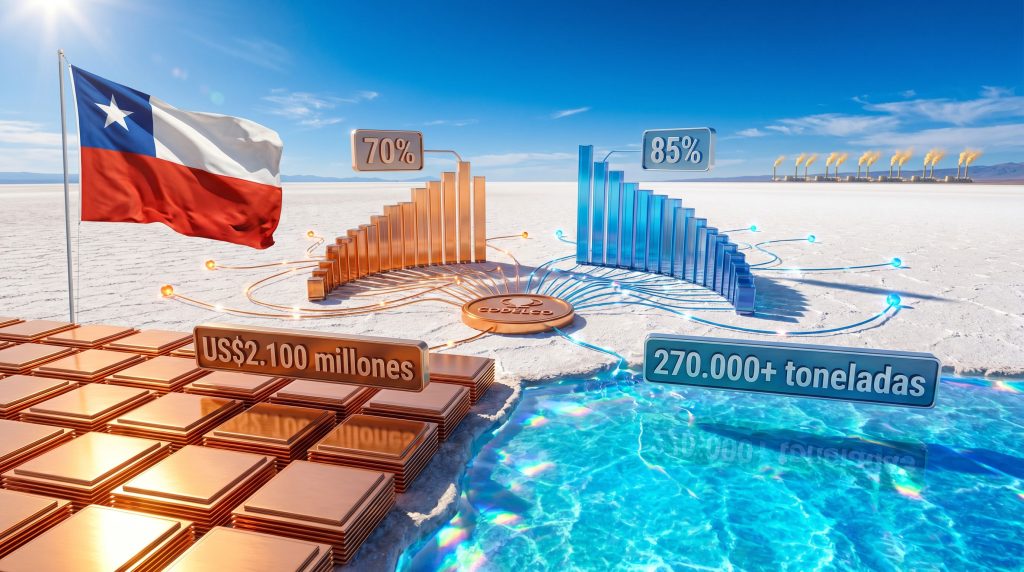
| NovaAndino (to 2030) | ~70% of operational margins | Maximises during high-price periods |
| NovaAndino (post-2030) | ~85% of operational margins | Captures supermajority of upside |
This architecture means that in scenarios where lithium prices remain elevated, the Chilean state captures the overwhelming majority of economic rent. In lower-price environments, the margin-based structure provides natural protection against locking the state into unfavourable fixed royalty commitments.
Scale and Economic Projections
The production and revenue projections associated with NovaAndino carry significant weight for Chile's fiscal planning:
- Total projected production from the Salar de Atacama is expected to exceed 270,000 tonnes in 2026
- Estimated state revenue attributable to lithium operations is projected at approximately US$2,100 million in 2026
- Direct employment in the Atacama region linked to these operations ranges between 2,500 and 3,500 workers
- Products from the operation reach 34 countries across multiple continents
Note: Revenue projections are inherently sensitive to lithium price assumptions. Actual outcomes will vary based on prevailing lithium carbonate and lithium hydroxide spot prices and long-term contract structures in effect at the time of production.
The three-year negotiation process that produced this agreement reflects the genuine complexity of restructuring operating rights in a resource with active production history. Codelco was not entering a greenfield negotiation but redesigning a value-sharing architecture around one of the world's most productive brine operations.
Salar Futuro: The Next Production Horizon
Beyond current operational parameters, an expansion programme referred to as Salar Futuro is progressing through Chile's environmental assessment framework. The Environmental Impact Assessment process for this expansion will determine whether production capacity can scale significantly beyond current levels post-2026. The outcome of this regulatory process will have direct implications for Chile's lithium strategy and its export trajectory across the following decade.
The Debt Debate: Misreading a Sovereign Balance Sheet
Few aspects of Codelco's financial profile generate more analytical confusion than its debt levels. This confusion typically stems from applying standard corporate finance frameworks to an entity that operates under a fundamentally different ownership and governance structure.
Pacheco's defence of his management before the commission was precise: the level of indebtedness at Codelco is not a variable determined by corporate management or the board of directors. It is a function of three decisions made by the company's owner, the Chilean state. These decisions are:
- How much the state chooses to capitalise the company directly
- How much the state allows the company to reinvest from operational cash flows
- How much the state extracts from the company as fiscal contributions to the national budget
These three variables exist in permanent tension. When the state extracts aggressively as fiscal contributions during high copper price cycles, it reduces the capital available for reinvestment. When it simultaneously does not recapitalise adequately, the company must access debt markets to fund capital programmes. This is not a sign of mismanagement. It is the predictable mathematical consequence of sovereign resource allocation decisions.
Evaluating a state-owned enterprise's debt using the same metrics applied to a listed private company is analytically equivalent to criticising a central bank for having a large balance sheet. The framework is fundamentally inapplicable.
The more meaningful indicator of Codelco's financial health is the confidence of international capital markets. The company's bonds are consistently valued favourably by institutional investors globally, and its debt is financed at competitive interest rates. This independent external validation reflects the implicit sovereign backing of the Chilean state, the company's dominant market position in global copper, and the diversification trajectory that the NovaAndino arrangement has introduced.
Chile's Position in the Global Critical Minerals Hierarchy
The convergence of copper and lithium under a single state enterprise creates a strategic profile that no other country or company currently possesses at equivalent scale. To appreciate the significance, consider the roles these two metals play in the energy transition:
| Mineral | Primary Role in Energy Transition | Chile's Global Standing |
|---|---|---|
| Copper | Electrical conductivity in grids, motors, EV wiring, renewable infrastructure | World's largest producer |
| Lithium | Core component of lithium-ion battery chemistries | Second-largest global reserves, highest brine grades |
An electric vehicle contains roughly four times more copper than a conventional internal combustion engine vehicle. Wind turbines require approximately 3.6 tonnes of copper per megawatt of capacity. Solar photovoltaic systems, transmission grid expansions, and battery storage installations all create structural demand that is expected to drive copper consumption significantly higher across the coming decades, according to the International Energy Agency's critical minerals assessments.
Lithium demand growth is even more concentrated in its trajectory, driven almost entirely by battery manufacturing. Global battery capacity is expanding across Asia, Europe, and North America simultaneously, creating demand that current supply pipelines are challenged to meet.
Chile's position at the intersection of both supply curves is not coincidental. It is the product of geology, infrastructure investment accumulated over six decades, and now deliberate institutional strategy. Indeed, Chile's lithium reserves represent one of the country's most powerful long-term strategic assets.
The next major ASX story will hit our subscribers first
The Competitive Landscape: Argentina's Rising Challenge
The strategic context for Codelco's transformation is not static. Argentina has publicly projected lithium and copper export revenues of approximately US$32,700 million over the next ten years, driven by its own lithium triangle deposits and copper development pipeline. The Argentina lithium brine market offers a credible alternative supply source for battery manufacturers seeking diversification away from Chilean concentration.
This competitive dynamic creates several important strategic imperatives for Chile and Codelco:
- Cost competitiveness: Maintaining production costs below emerging Argentine operations requires continued operational efficiency gains
- Sustainability differentiation: Premium buyers increasingly require detailed supply chain traceability and environmental certification, areas where established operations can build defensible advantages
- Product sophistication: Moving up the value chain from raw brine products toward refined lithium chemicals reduces commoditisation risk
- Partnership depth: The 18 global strategic partnerships Codelco maintains, including relationships with major international miners, create market access that newer entrants cannot replicate immediately
Water Scarcity and the Desalination Imperative
Any serious analysis of Codelco's operational sustainability must engage with water. Northern Chile's mining operations sit in some of the world's most water-stressed environments. The company currently consumes approximately 5,500 litres per second across its operations, a figure that places enormous pressure on regional hydrological systems.
The response has been an accelerating transition toward desalinated seawater as the primary input source. Codelco now operates 24 active desalination installations, with the Tocopilla facility the most recent addition to this network. The strategic shift toward desalination achieves multiple objectives simultaneously:
- Reduces dependence on declining Andean water tables and glacial meltwater
- Reduces regulatory and community conflict risk in water-sensitive areas
- Aligns with increasingly stringent international sustainability requirements from premium copper buyers
- Positions operations favourably in environmental, social, and governance assessments conducted by institutional investors
The energy cost of desalination at altitude is non-trivial, and optimising this cost structure represents an ongoing technical challenge. However, the alternative — continuing to draw from freshwater sources in hyper-arid environments — carries regulatory, social, and reputational risks that far exceed the energy cost premium.
The Chemistry Industry as Strategic Partner
As ore grades in Codelco's mature deposits decline over time, chemical processing efficiency becomes an increasingly critical competitive variable. The company has explicitly identified chemical industry suppliers as strategic partners rather than commodity vendors in this context.
Lower-grade ores require more sophisticated reagent chemistry to achieve equivalent recovery rates. In flotation circuits, where copper minerals are separated from waste rock using chemical collectors and frothers, the performance of reagent formulations directly affects how much copper is recovered per tonne of ore processed. A 1% improvement in recovery rates at Codelco's production volumes translates into thousands of additional tonnes of copper annually.
Priority areas for chemical innovation in Codelco's context include:
- Next-generation flotation reagents optimised for low-grade, complex ore mineralogy
- Leaching solutions with improved selectivity and reduced environmental persistence
- Water-efficient tailings management chemistries that reduce pond volumes and contamination risk
- Secondary mineral recovery processes that extract value from processing streams previously treated as waste
Scenario Analysis: Three Pathways for Codelco Through 2030
Scenario One: Successful Structural Consolidation
If the structural projects cycle closes on schedule and operational indicators normalise as projected, Codelco enters a cash flow generation phase that reduces balance sheet pressure and establishes the financial foundation for the next investment cycle. Under this scenario, copper production recovers toward its long-term potential and NovaAndino begins contributing meaningfully to state revenue from 2026 onward.
Scenario Two: Lithium Market Recovery Accelerates Value Capture
If lithium demand growth from battery manufacturing accelerates beyond current projections, driven by faster-than-expected electric vehicle penetration and grid storage deployment, the NovaAndino margin-sharing structure would deliver state revenues substantially above the US$2,100 million baseline projection. Under this scenario, Chile's fiscal position would benefit disproportionately given the 70–85% margin participation structure.
Scenario Three: Margin Compression from Regional Competition
If Argentine lithium production scales rapidly and new African copper producers gain global market share simultaneously, Codelco faces margin compression across both commodity pillars. Under this scenario, the company's competitive response would depend on its ability to accelerate cost reduction through chemical innovation, operational efficiency gains, and the premium positioning that its sustainability credentials and established supply chain relationships can command.
Disclaimer: All scenario projections are illustrative and speculative in nature. They are based on publicly available information and structural analysis, not financial forecasts. Investors should conduct independent due diligence before making decisions based on commodity market or company-specific projections.
A New Institutional Identity for a New Commodity Era
The significance of what Máximo Pacheco Codelco cobre y litio represented before Chile's Chamber of Deputies in May 2026 extends well beyond Codelco's own corporate narrative. It represents a data point in a much larger question about the future of state-owned resource enterprises in a world where the definition of strategic commodities is being rewritten in real time.
For five decades, Codelco accumulated approximately US$160 billion in fiscal contributions to the Chilean state by doing one thing exceptionally well. Consequently, the institutional challenge of the next five decades is whether the same organisation can build equal dominance in a second commodity while sustaining, and ultimately growing, its top copper producer status.
The structural projects cycle provides the operational foundation. NovaAndino provides the lithium platform. The desalination network addresses water security. The chemical innovation agenda addresses grade decline. Each element addresses a specific vulnerability in the long-term production thesis.
Furthermore, Pacheco's public statements on Codelco's strategic direction underscore that what remains to be proven is execution at scale across both commodity streams simultaneously, in a competitive, geopolitically complex, and environmentally constrained operating environment. That proof will be written not in boardroom presentations but in production data, cost reports, and environmental compliance records across the coming years.
Want to Capitalise on the Next Major Mineral Discovery Before the Market Does?
Discovery Alert's proprietary Discovery IQ model delivers real-time alerts on significant ASX mineral discoveries — transforming complex commodity data into actionable investment insights for traders and long-term investors alike. Start your 14-day free trial today and see why historic mineral discoveries have generated extraordinary returns for those positioned early.