
May 12, 2026
The Hidden Scarcity Premium Reshaping Copper Project Finance
Across the global mining landscape, a quiet but accelerating transformation is underway. The world's inventory of large-scale, undeveloped copper deposits is being drawn down faster than exploration is replenishing it. New discoveries of genuine scale have become increasingly rare, and the average time from discovery to first production now stretches beyond 16 years for major copper projects. Against this backdrop, the handful of genuinely large, technically advanced, and institutionally backed copper development projects remaining in the global pipeline carry a scarcity premium that is fundamentally reshaping how they are financed, who invests in them, and what terms capital providers are willing to accept.
It is within this supply-constrained context that the McEwen Copper Los Azules financing story becomes so instructive. The project is not simply another mining development competing for institutional capital. It represents one of the last major undeveloped copper assets of genuine global scale, advancing toward production at a moment when structural copper demand from electric vehicles, grid modernisation, and data centre infrastructure is compressing the timeline for new supply availability. Furthermore, the copper supply crunch intensifying across global markets only strengthens the strategic case for projects of this calibre.
When big ASX news breaks, our subscribers know first
What Makes Los Azules One of the World's Most Consequential Undeveloped Copper Projects
Scale, Location, and Physical Characteristics
Los Azules sits within the Calingasta Department of San Juan Province in the Argentine Andes, positioned at approximately 3,500 metres (11,480 feet) above sea level. This elevation introduces operational complexity that would be prohibitive for many development teams but is increasingly manageable with modern heap leach technology and renewable energy infrastructure.
The deposit ranks among the ten largest undeveloped copper projects on Earth, a distinction that carries significant implications for financing dynamics. At this level of scale and resource quality, the project transcends ordinary mining finance conversations and enters the territory of strategic industrial infrastructure, attracting capital from automotive manufacturers, global mining majors, export credit agencies, and multilateral development institutions simultaneously.
The processing approach selected for Los Azules is heap leach with solvent extraction-electrowinning (SX-EW) recovery, a methodology that produces copper cathodes directly rather than copper concentrate requiring subsequent smelting. This distinction matters enormously for the project's commercial positioning. End-users, particularly industrial manufacturers and EV battery supply chains, increasingly prefer cathode-grade copper that bypasses the concentrate-to-smelter pathway, reducing supply chain complexity and carbon intensity.
Production Economics at a Glance
| Metric | Detail |
|---|---|
| Peak Annual Copper Cathode Output | ~204,800 metric tonnes (first five years) |
| Broader Production Range | 148,000-200,000 metric tonnes annually |
| Mine Life (Base Case) | 21-27 years |
| Extended Mine Life (Nuton Technology) | 50+ years |
| Break-Even Copper Price | ~$2.85-$3.10 per pound |
| Carbon Neutrality Target | 2038 |
| Energy Strategy | 100% renewable energy |
| First Production Target | 2029-2030 |
| Construction Commencement Target | Late 2026 |
A Landmark for Argentine Mining
Beyond the global significance of its scale, Los Azules carries a particular historical weight within Argentina. If development proceeds as planned, the project will become Argentina's first mine to produce copper cathodes at commercial scale, a milestone that has eluded the country's mining sector despite decades of exploration activity in the Andes. The October 2025 completion of the feasibility study represents the critical de-risking milestone that transforms a promising development asset into a bankable project capable of supporting international debt finance at the scale being targeted.
Dissecting the $4 Billion Financing Architecture
The Capital Structure Logic
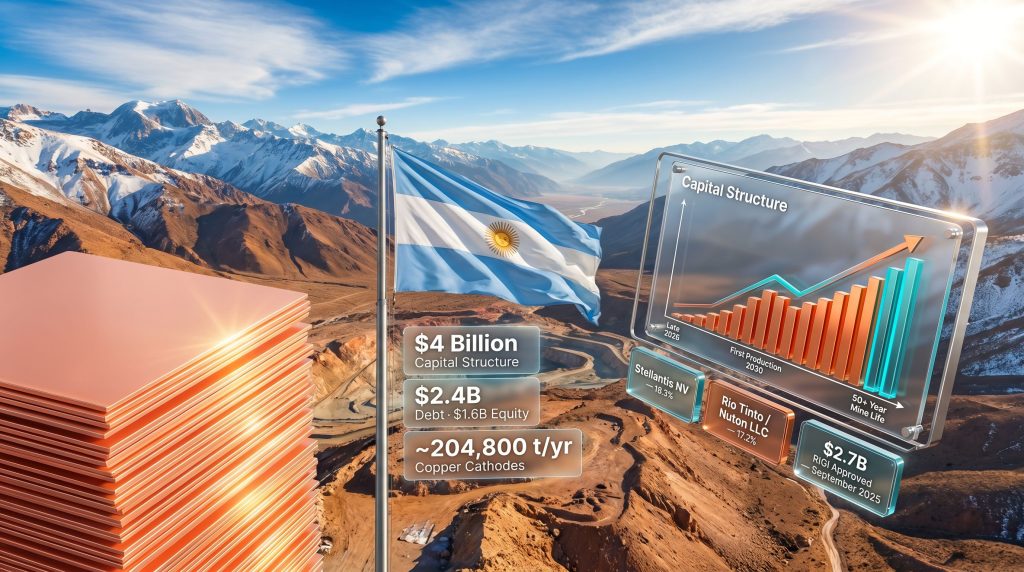
The total financing requirement for the Argentina copper project stands at approximately $4 billion, anchored by a base capital expenditure of roughly $3.2 billion with the remainder covering working capital, contingency reserves, and financing costs. The company is targeting a capital structure weighted 40% equity and 60% debt, a split that reflects both the project's risk profile and the exceptional institutional appetite that has emerged from the financing process.
For context, the 40-60 equity-to-debt ratio is common in large infrastructure and mining project finance where:
- Long-duration, predictable cash flows support high leverage
- Multilateral and export credit agency debt is available at preferential rates
- Strategic equity investors provide both capital and de-risking signals to lenders
- Commodity price floors provide defensible base-case revenue assumptions
This means the McEwen Copper Los Azules financing package involves approximately $2.4 billion in debt coordinated through a single international financial institution, with $1.6 billion in equity sourced through a combination of strategic investors, parent company participation, and a planned IPO.
The $2.4 Billion Debt Facility: How Export Credit Agency Financing Works
The debt component introduces a financing mechanism that is less familiar to retail investors but is the backbone of large-scale industrial project development in emerging markets: export credit agency (ECA) coordinated lending.
McEwen Copper has secured a mandate with an undisclosed international financial institution that will coordinate the full $2.4 billion debt package across multiple global export credit agencies. The coordinating entity acts as a single point of contact and administrative hub for what would otherwise be a complex web of bilateral lending relationships.
How ECA co-lending typically functions in major mining projects:
- A lead financial institution is mandated to structure and coordinate the debt facility
- Multiple ECAs from different countries participate based on the origin of equipment and services procured for the project
- Each ECA finances a portion linked to procurement from its home country (e.g., U.S. Ex-Im Bank finances U.S.-sourced equipment, Canada's EDC finances Canadian-sourced equipment)
- The coordinating institution manages the master loan agreement, drawdown schedules, and covenant compliance across all participating ECAs
- The ECAs' involvement provides implicit sovereign risk mitigation, since governments stand behind ECA commitments
Crucially, the ECAs involved have indicated capacity to finance up to 85% of eligible equipment procurement costs, an unusually high coverage ratio that reflects genuine institutional confidence in the project's bankability. Furthermore, over $1.1 billion in letters of interest were received from lenders before the feasibility study was published, a pre-feasibility signal that is genuinely exceptional and suggests the institutional investment community had already developed strong conviction about Los Azules' credit quality.
"The pre-feasibility letters of interest exceeding $1.1 billion are a meaningful indicator of lender conviction. In project finance, receiving this volume of interest before a full feasibility study is completed suggests the project's risk-adjusted return profile was already compelling enough to attract serious institutional commitment at an early stage."
The U.S. Export-Import Bank is among the institutions engaged in discussions, a development that carries strategic significance given the current policy environment around critical mineral supply chain security in North America. Those exploring copper investment strategies will recognise that ECA-backed debt at this scale represents a fundamentally different risk profile compared to conventional corporate lending.
Equity Financing Channels: Strategic Investors and Institutional Capital
The $1.6 billion equity component is being assembled through several complementary channels, each bringing not just capital but strategic value to the project.
| Investor | Stake | Capital Committed |
|---|---|---|
| McEwen Mining (Parent) | Majority | Ongoing contributions |
| Stellantis NV | 18.3% | ~$275 million |
| Rio Tinto / Nuton LLC | 17.2% | ~$100 million |
| Planned IPO | TBD | ~$300 million targeted |
| Additional strategic groups | Under discussion | North American, European, Asian industrials |
Stellantis' 18.3% stake represents one of the most strategically significant automotive OEM investments in an upstream copper mining asset in recent history. For an automaker facing intense pressure to secure raw material supply for EV battery systems, acquiring a direct equity position in one of the world's largest undeveloped copper deposits is a supply chain hedge with decades of optionality. This is industrial capital deployed with a fundamentally different motivation than financial investors seeking returns, and it demonstrates that the project has achieved validation from a sophisticated, copper-consuming industrial user.
Rio Tinto's Role: Technology, Capital, and Long-Term Optionality
Nuton LLC: More Than a Financial Stake
Rio Tinto copper expansion ambitions are clearly reflected through its involvement in Los Azules via its Nuton LLC subsidiary, which represents one of the more technically nuanced aspects of the project's capital story. Nuton is Rio Tinto's copper leaching technology venture, developed to improve copper recovery rates from ore bodies that are not amenable to conventional processing pathways.
The significance of Nuton's technology deployment at Los Azules goes beyond the $100 million invested for its 17.2% stake. According to the project's feasibility study, the application of Nuton's proprietary heap leach technology is projected to extend the productive life of Los Azules by 33 years, potentially taking the mine life from a 21-year base case to beyond 50 years. This single technological contribution transforms the project's long-term cash flow modelling from a medium-duration mine to a multi-generational asset.
For lenders conducting discounted cash flow analysis over a 20-25 year debt facility, the difference between a 21-year and a 50+ year mine life is material to their credit assessment. A mine life substantially exceeding the debt tenor reduces the lender's exposure to residual value risk and provides a larger cash flow buffer against operational disruptions or commodity price weakness in the early years of production.
Why Rio Tinto's Potential Stake Increase Matters
Rio Tinto is reportedly evaluating an increase in its ownership stake in Los Azules, a development that would carry significant implications for the project's institutional profile. When a Tier-1 global mining major increases its financial commitment to a development-stage project, it functions as a powerful de-risking signal for other capital providers, particularly export credit agencies and development finance institutions that use co-investor quality as a proxy for execution risk.
Rio Tinto brings operational expertise in large-scale copper development, established relationships with equipment suppliers and engineering firms, and a track record of managing complex mine builds in challenging jurisdictions. Its deeper involvement would also create natural alignment with its own stated copper growth strategy, as the company has publicly identified copper as a priority metal for its portfolio repositioning toward critical minerals.
Argentina's RIGI Framework: Converting Political Risk Into Structured Protection
Understanding the Large Investment Incentive Regime
One of the most consequential developments for the McEwen Copper Los Azules financing process was the project's receipt of formal RIGI approval in September 2025, securing a $2.7 billion investment endorsement under Argentina's Régimen de Incentivo para Grandes Inversiones (Large Investment Incentive Regime).
RIGI is designed to attract foreign direct investment into capital-intensive sectors by providing:
- Long-term fiscal stability with locked-in tax treatment for qualifying projects
- Legal protection against retroactive regulatory changes
- Currency repatriation rights and export tax certainty
- A contractual framework that limits sovereign discretion over project economics
For international lenders evaluating an emerging market project, RIGI approval serves a critical function in project finance documentation. Export credit agencies and multilateral development banks require sovereign-level legal certainty before committing to large debt facilities in countries with complex regulatory histories. RIGI effectively converts what would otherwise be an uncertain sovereign risk exposure into a structured, contractually protected investment framework.
"RIGI approval is not merely a policy benefit for Los Azules. In the context of international project finance, it is a legal architecture that allows lenders to model cash flows with higher confidence that the regulatory and fiscal environment will remain stable across the project's debt tenor."
The framework also reduces the sovereign risk premium embedded in the project's cost of debt, potentially lowering interest rates on the ECA facility and improving overall project economics. This is a meaningful financial benefit that compounds over a 20-25 year loan repayment schedule.
The IFC Collaboration Agreement: ESG as a Capital Access Mechanism
In September 2025, McEwen Copper signed a formal collaboration agreement with the International Finance Corporation (IFC), the private sector lending arm of the World Bank Group. This agreement aligns Los Azules with IFC's Environmental, Social, and Governance (ESG) performance standards, which include requirements around community engagement, environmental management systems, labour practices, and biodiversity protection.
The strategic value of IFC alignment extends well beyond ESG compliance signalling. In practice, IFC performance standard certification unlocks access to a significantly broader universe of institutional capital:
- Sovereign wealth funds with ESG investment mandates and exclusion screens
- Pension funds subject to responsible investment policies
- Development finance institutions that require IFC standard compliance for co-investment
- Green bond and sustainability-linked debt markets where IFC alignment enables preferential pricing
- European institutional investors subject to EU Sustainable Finance Disclosure Regulation requirements
For a project located in Argentina, historically subject to sovereign risk discounts in institutional capital markets, the IFC's imprimatur materially de-risks the project's reputation in international capital markets and broadens the addressable investor universe in ways that are difficult to quantify but strategically significant.
The $300 Million IPO: Timing, Strategy, and Market Psychology
Why the IPO Window Matters
McEwen Copper is targeting an IPO of approximately $300 million toward the fourth quarter of the year, with the October-to-December window identified as strategically optimal given current copper price conditions and the commodity market outlook. This is not simply a capital-raising exercise but a strategic step that establishes a public equity market reference price for the company.
The timing logic reflects sophisticated market psychology. Copper price sentiment and forward market conditions directly influence the valuation multiples institutional investors are willing to assign to development-stage mining equities. An IPO executed in a strong copper price environment achieves several compounding benefits:
- Higher valuation multiples reduce the dilution experienced by existing strategic shareholders
- A public market reference price enables future capital raises at known valuation benchmarks
- Listed equity can be used as acquisition currency, employee incentive instruments, and collateral for structured financing
- Institutional investors seeking pure-play copper exposure gain a liquid vehicle that is otherwise unavailable in the public markets
"A successful IPO at premium valuation not only raises the targeted $300 million more efficiently but establishes a publicly traded instrument that creates structural capital flexibility for the entire development phase, compounding strategic value well beyond the immediate financing need."
The planned IPO proceeds represent approximately 19% of the total $1.6 billion equity component, meaning the remaining 81% must be sourced from strategic investors including existing shareholders, additional industrial groups, and parent company McEwen Mining. Active discussions are reportedly underway with large North American, European, and Asian industrial groups, suggesting the equity book is being assembled from multiple strategic rather than purely financial sources.
The next major ASX story will hit our subscribers first
Comparative Positioning Among Tier-1 Undeveloped Copper Projects
Understanding where Los Azules sits in the global landscape of undeveloped copper assets provides important context for assessing the project's financing momentum. In addition, examining comparable projects highlights how the combination of completed feasibility work, RIGI protection, and IFC alignment sets this asset apart from peers.
| Project | Location | Annual Production Target | Development Stage | Key Backers |
|---|---|---|---|---|
| Los Azules | Argentina | ~200,000 t/yr cathode | Feasibility Complete | McEwen Copper, Rio Tinto, Stellantis |
| Resolution Copper | USA (Arizona) | ~400,000 t/yr | Permitting stage | BHP, Rio Tinto |
| Tampakan | Philippines | ~375,000 t/yr | Suspended | Indophil/Sagittarius |
| Reko Diq | Pakistan | ~200,000 t/yr | Development | Barrick Gold, Government of Pakistan |
The Reko Diq project in Pakistan offers an instructive parallel, as another large-scale copper asset advancing through complex sovereign and financing challenges. However, Los Azules distinguishes itself through the combination of a completed feasibility study, advanced financing momentum with over $1.1 billion in pre-feasibility lender interest already documented, RIGI fiscal protection, IFC ESG alignment, and a cathode-direct production model. Several competing projects of comparable scale remain stuck in permitting disputes, suspended states, or geopolitical complexity that prevents comparable institutional financing progress.
Key Risks and Structural Challenges
Construction and Execution Risk at Altitude
High-altitude construction at 3,500 metres introduces a cluster of operational challenges that have derailed or significantly delayed other large mining projects. Air density at this elevation is roughly 65% of sea-level density, which affects combustion engine performance, worker physiological productivity, and chemical reaction rates in processing facilities. Heap leach operations at high altitude require careful calibration of reagent dosing, evaporation management, and temperature compensation to achieve target copper recovery rates.
The multi-year construction timeline from late 2026 through to 2029-2030 also exposes the project to:
- Commodity input cost inflation (steel, cement, copper wire, diesel)
- Equipment supply chain disruption and lead time extension
- Labour market competition from other large mining projects advancing simultaneously in the region
- Weather-related construction delays typical of high-altitude Andean environments
Sovereign and Regulatory Risk: The Residual Concern
Despite RIGI protections and IFC alignment, Argentina's historical record of policy reversals, currency controls, and export tax volatility remains a consideration that conservative institutional lenders cannot entirely dismiss. The RIGI framework addresses much of this risk through contractual protections, but the framework itself is a product of the current administration's reform agenda and would theoretically be subject to future political reassessment.
Multilateral agency involvement, particularly the IFC and the export credit agencies engaged in the debt facility, creates an implicit sovereign pressure dynamic. Governments are typically reluctant to take actions that would damage relationships with multilateral institutions upon which they depend for broader development finance access. Consequently, those evaluating copper project partnerships will note that the multi-stakeholder structure here provides meaningful distributed protection against unilateral sovereign action.
Copper Price Sensitivity
With a break-even copper price in the range of $2.85-$3.10 per pound, Los Azules maintains viable project economics well below current market prices, providing a meaningful margin of safety. The heap leach SX-EW processing methodology offers a structurally lower operating cost profile compared to conventional concentrator-based operations, reducing the project's vulnerability to copper price cyclicality. Furthermore, the copper project partnerships underpinning Los Azules provide additional resilience through shared risk across well-capitalised strategic investors.
Disclaimer: This article is intended for informational purposes only and does not constitute financial advice or a solicitation to invest. Forward-looking statements, production targets, financing timelines, and project economics referenced herein are subject to material risks, uncertainties, and assumptions that may cause actual results to differ significantly from projections. Readers should conduct their own due diligence and consult qualified financial advisors before making investment decisions. Past performance of comparable projects does not guarantee future results.
Want to Be First When the Next Major Copper Discovery Hits the ASX?
Discovery Alert's proprietary Discovery IQ model scans ASX announcements in real time, delivering instant alerts on significant mineral discoveries — including copper assets with the potential to reshape supply chains — so subscribers can act ahead of the broader market. Explore historic discovery returns that demonstrate just how transformative early positioning can be, and begin your 14-day free trial at Discovery Alert to secure your market-leading edge.