June 26, 2026
Why European Ferro-Alloy Markets Have Long Operated Without a Critical Pricing Reference
Commodity pricing infrastructure rarely receives attention until its absence creates measurable commercial pain. In most mature metals markets, price reporting agencies (PRAs) have spent decades building benchmark architecture that underpins billions of dollars in physical contracts, hedging strategies, and procurement agreements. Yet within the European ferro-alloy sector, one strategically important material has continued to trade in a relative information vacuum, with buyers and sellers negotiating without a credible, published reference point.
That gap has now been formally addressed. The Europe medium carbon ferro-manganese price launch, effective Friday June 26, 2026, introduces a monthly benchmark assessment that serves a market segment whose pricing complexity has long been underappreciated by participants outside the specialty steel supply chain.
Understanding why this matters requires stepping back from the announcement itself and examining the structural mechanics of how ferro-manganese grades are differentiated, priced, and consumed across European industrial supply chains. Furthermore, the broader steel market dynamics shaping demand across the continent provide essential context for appreciating the commercial stakes of this benchmark launch.
When big ASX news breaks, our subscribers know first
The Carbon Spectrum: Why Grade Differentiation Drives Pricing Logic
Ferro-manganese is not a single commodity. It exists across a carbon gradient, and each position on that gradient corresponds to a distinct set of metallurgical applications, production costs, and pricing dynamics. The three primary commercial grades are high-carbon, medium-carbon, and low-carbon ferro-manganese, and the differences between them are far more consequential than the terminology suggests.
| Grade | Carbon Content | Typical Price Range (EUR/MT) | Primary Application |
|---|---|---|---|
| High-Carbon (HC FeMn) | Above 2% C | €950 – €1,100 | Bulk steel deoxidation |
| Medium-Carbon (MC FeMn) | Up to 1.5% C max | €1,150 – €1,250 | Specialty steel, EV platforms |
| Low-Carbon (LC FeMn) | 1.0% C or below | €1,300 – €1,450 | Stainless, precision alloys |
High-carbon ferro-manganese is produced through a relatively straightforward submerged arc furnace process using manganese ore and coke. It is the dominant volume grade globally and benefits from well-established benchmark coverage across multiple PRAs.
Low-carbon ferro-manganese, by contrast, requires additional refining steps to reduce carbon content, making it more expensive to produce and commanding a corresponding price premium. It is used in applications where even small carbon concentrations compromise final product integrity, such as stainless steel and precision engineering alloys.
Medium-carbon ferro-manganese occupies the space between these two grades, and its production pathway is what makes it particularly interesting from both a technical and commercial standpoint. MC FeMn is typically produced through silicothermic reduction, a process that uses ferrosilicon to reduce manganese oxide without introducing carbon from coke. This method is more energy-intensive and operationally complex than the submerged arc route used for high-carbon grades, which partly explains why MC FeMn has historically commanded a price premium above high-carbon material.
The silicothermic production route for MC FeMn is inherently sensitive to energy price fluctuations, meaning that European power market dynamics feed directly into production economics in ways that high-carbon FeMn producers experience less acutely.
Full Technical Specifications of the New MC FeMn Price Assessment
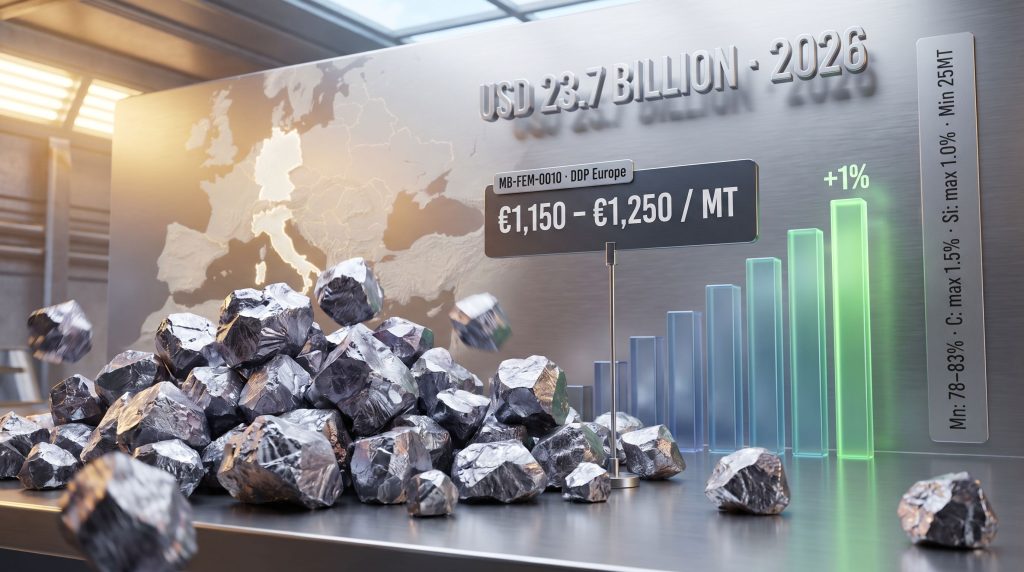
The new benchmark, carrying the instrument code MB-FEM-0010, is denominated in euros per tonne and assessed on a Delivered Duty Paid basis to European main ports. The specification parameters define exactly which material qualifies for inclusion in the assessment.
Chemical and Physical Requirements
| Parameter | Specification |
|---|---|
| Manganese (Mn) content | 78–83% |
| Carbon (C) maximum | 1.5% |
| Silicon (Si) maximum | 1.0% |
| Phosphorus (P) maximum | 0.3% |
| Sulfur (S) range | 0.1–0.5% |
| Lump sizing | 10–50mm or 10–80mm |
Operational Parameters
- Minimum transaction size: 25 tonnes per qualifying deal
- Incoterm: Delivered Duty Paid (DDP)
- Delivery location: European main ports
- Currency: EUR per tonne
- Delivery window: Within 90 days of the assessment date
- Payment terms: 30 to 60 days, with alternative terms subject to normalisation
- Data submission deadline: 2:00 PM on the relevant Friday
- Publication schedule: Last Friday of each month, aligned with the Steel and Ferro-alloys calendar
The manganese content band of 78 to 83 percent is worth examining closely. This range is tighter than what is typically accepted for high-carbon FeMn specifications, reflecting the higher-purity end-use applications that MC FeMn serves. Material falling outside this band, even if the carbon content qualifies, would not be captured within the benchmark's scope.
The DDP incoterm structure is significant for European buyers because it transfers the full cost burden of customs clearance, import duties, and inland delivery to the seller. This creates a genuinely clean landed-cost reference, eliminating the price ambiguity that arises when buyers must independently model duty exposure and freight variables into FOB or CIF assessments.
Why European Markets Needed a Dedicated MC FeMn Benchmark
The absence of a formal MC FeMn benchmark in Europe was not simply an inconvenience. It represented a structural inefficiency embedded in procurement workflows across the continent's steel industry.
Without a published reference, European buyers and sellers were navigating contracts using one of several imperfect proxies. Some relied on high-carbon ferro-manganese assessments as a floor, applying informal premiums based on bilateral negotiations. Others referenced low-carbon grades as a ceiling, working downward through estimates of production cost differentials. Neither approach provided a defensible, market-representative price signal.
The Scale of the European Market
The commercial stakes behind this benchmark are substantial. Key market metrics include:
- Europe represented approximately USD 22.7 billion of the global ferro-manganese market in 2025, accounting for roughly 26.6% of global market share
- The European market is projected to reach approximately USD 23.7 billion in 2026, reflecting continued structural demand growth
- Germany and Italy together consume more than 350,000 metric tonnes of ferro-manganese annually, making them the two dominant demand centres within the region
- Annual European production capacity exceeds 900,000 metric tonnes, with Norway and Ukraine serving as the continent's primary production hubs
Norway's production base is particularly noteworthy. Norwegian smelters benefit from access to low-cost hydroelectric power, which partially offsets the energy intensity disadvantage of the silicothermic MC FeMn production process. This structural energy advantage has made Norwegian producers competitive at the higher-quality end of the European ferro-alloy supply mix. In addition, South African ferroalloys play a meaningful role in supplying broader European demand, further influencing regional availability and price dynamics.
The Automotive Sector's Growing Role
One of the less widely understood dynamics in the European MC FeMn market is the growing influence of electric vehicle platform architectures on specialty steel procurement patterns. Coated steels used in EV body structures and battery enclosures require precise deoxidation and desulfurisation during steelmaking, processes for which medium-carbon ferro-manganese is particularly well suited.
MC FeMn's dual function as both a deoxidiser and desulfuriser in specialty steel production means it cannot simply be substituted with high-carbon or low-carbon alternatives without compromising the metallurgical outcome. This application specificity is precisely what makes a dedicated price benchmark necessary: buyers cannot use a proxy that reflects a different material's supply-demand dynamics.
A surge in last-minute coated steel procurement linked to EV platform supply chains in early 2026 coincided with constrained MC FeMn availability, exposing just how significant the absence of real-time, credible price discovery had become for procurement teams operating under tight margins.
Current European MC FeMn Price Levels and What Drove Recent Movement
As of late 2025 into early 2026, European MC FeMn prices were transacting in the approximate range of €1,150 to €1,250 per tonne on a DDP basis, with a modest upward trend of roughly 1% observed through November 2025 before more pronounced upside pressure emerged. These steel price trends broadly align with pressures observed across other regional markets during the same period.
Three converging market forces tightened the European MC FeMn market simultaneously in early 2026:
- Unplanned furnace outages across Northern European smelting operations reduced weekly production volumes by an estimated 12%, creating a supply shortfall precisely when forward order books were filling
- Rising energy input costs, particularly in the German power forward market, elevated production economics for silicothermic smelters and increased logistics costs at major port facilities
- Demand acceleration from EV-linked coated steel procurement created a demand spike that amplified the impact of already-constrained supply availability
Consider the position of a mid-sized German steel mill operating a quarterly supply agreement for MC FeMn without a published price reference. When furnace outages reduce available spot material and energy cost escalation simultaneously shifts seller pricing expectations upward, procurement teams face a fundamental information asymmetry. Sellers know their internal cost base; buyers are negotiating against an opaque market. The new benchmark directly addresses this structural disadvantage.
How MC FeMn Benchmarking Fits Within the Broader Ferro-Alloy Pricing Ecosystem
Ferro-alloy pricing sits at a critical juncture in the steel supply chain's cost structure. Manganese ore assessments anchor the upstream input cost, while finished steel product indices capture the downstream output value. Between these two pricing layers, ferro-alloy benchmarks serve as the connective tissue that enables steelmakers to model cost-of-production with precision.
Comparing MC FeMn to Other Ferro-Alloy Benchmarks
| Ferro-Alloy | Benchmark Availability | Publication Frequency | Key Market |
|---|---|---|---|
| High-Carbon FeMn | Established, multiple PRAs | Weekly and Monthly | Global |
| Medium-Carbon FeMn (Europe) | Newly launched | Monthly | Europe |
| Low-Carbon FeMn | Limited coverage | Monthly | Regional |
| Ferro-silicon | Well established | Weekly | Global |
| Ferro-chrome | Well established | Monthly | Global |
The gap in MC FeMn coverage stands out clearly. While high-carbon FeMn has benefited from weekly and monthly assessments across multiple PRAs for years, the medium-carbon grade had no equivalent. Low-carbon ferro-manganese coverage remains limited even now, suggesting that the Europe medium carbon ferro-manganese price launch may also create pressure for similar initiatives in adjacent grades.
One important but underappreciated aspect of ferro-alloy benchmarking is how PRAs handle payment term normalisation. When market participants transact on terms outside the standard 30 to 60 day window, a raw price comparison between transactions becomes misleading. The normalisation process adjusts these divergent payment structures back to a common basis, ensuring that the published assessment reflects an apples-to-apples market signal rather than a distorted average of structurally different deals.
The next major ASX story will hit our subscribers first
Assessment Methodology: How Credibility Is Built Into the Framework
A benchmark's commercial utility depends entirely on the credibility of its methodology. Market participants will only index contracts to a published price if they trust that the underlying data collection and validation process is robust, transparent, and resistant to manipulation.
The MC FeMn assessment framework incorporates several layers of validation:
- Submissions received after the 2:00 PM Friday deadline are excluded from the relevant assessment cycle
- Transactions falling outside the 78 to 83 percent Mn specification band or exceeding the 1.5 percent carbon cap are excluded or subject to normalisation
- Sizing requirements of 10 to 50mm or 10 to 80mm must be met; material outside these parameters is not considered representative of the assessed grade
- Payment terms outside the 30 to 60 day standard are normalised to ensure cross-submission comparability
Beyond the technical validation framework, the methodology incorporates transparency mechanisms that are central to market trust. Comments submitted to the assessment team that are not designated as confidential are made available upon request, allowing market participants to understand what pricing intelligence informed each assessment. Full methodology documentation is publicly accessible through Fastmarkets' methodology page, providing complete disclosure of assessment rules and criteria.
Fastmarkets serves more than 14,000 global customers across commodity markets. This scale of market reach means that a newly launched benchmark can achieve meaningful adoption relatively quickly, as the existing customer base provides an immediate pool of potential data contributors and benchmark users. For a new assessment to function effectively, it requires a critical mass of data submissions; a PRA with limited market penetration would struggle to generate this liquidity even with technically sound methodology.
Strategic Implications for Steel Mills, Traders, and Downstream Industries
For Steel Mills and Alloy Procurement Teams
- Contract indexation becomes viable once a published benchmark exists, allowing supply agreements to be linked directly to the assessed price rather than renegotiated from scratch each cycle
- Budget forecasting accuracy improves when procurement teams can reference a market-representative price rather than relying on informal indications or high-carbon proxy adjustments
- Hedging strategy development becomes more tractable as risk management desks gain a credible price reference against which to model ferro-alloy cost exposure
For Ferro-Alloy Producers and Traders
- Sellers operating in a supply-constrained environment gain a market reference that reflects genuine scarcity premiums, reducing the risk of underpricing material relative to true market value
- Cross-border traders operating across multiple European jurisdictions benefit from a standardised DDP pricing convention that simplifies contract structures and reduces administrative friction
- The benchmark creates the foundational price reference required for financial instrument development, including options, forward contracts, or swap structures referencing the MC FeMn index
For the Automotive and Capital Goods Sectors
The downstream implications extend well beyond the immediate steel procurement function. EV platform manufacturers relying on coated specialty steels gain improved visibility into one of their upstream cost variables. Furthermore, the evolution of green steel pricing is increasingly intersecting with specialty alloy procurement, as low-emissions steel production pathways place greater demands on precise input cost management.
Construction sector buyers of structural steel benefit indirectly as their steel supplier counterparts gain better cost management tools. Capital goods manufacturers dependent on high-quality steel grades can incorporate MC FeMn price signals into longer-term supply chain cost modelling with a level of precision that was previously unattainable.
Frequently Asked Questions: Europe Medium Carbon Ferro-Manganese Price
What is medium carbon ferro-manganese used for?
MC FeMn functions as both a deoxidiser and desulfuriser in specialty steel production. It is particularly valued in coated steel applications for automotive manufacturing and EV platform construction, where precise carbon content control is critical to final product performance and surface quality.
What does DDP Europe mean for ferro-manganese pricing?
DDP means the seller absorbs all costs associated with delivering material to the buyer's location, including freight, insurance, and import duties. For European buyers, this produces a clean landed-cost benchmark that eliminates ambiguity around duty exposure and logistics variables, making the assessed price directly usable for contract negotiation and budget planning.
How often is the European MC FeMn price published?
The assessment is published monthly, on the last Friday of each month, aligned with the Steel and Ferro-alloys publication calendar. Data submissions must be received by 2:00 PM on that Friday.
What manganese content is required for the benchmark?
The specification requires manganese content of 78 to 83 percent Mn, with a maximum carbon of 1.5 percent, maximum silicon of 1 percent, maximum phosphorus of 0.3 percent, and sulfur within a range of 0.1 to 0.5 percent. Material must be supplied in lump form, sized at either 10 to 50mm or 10 to 80mm.
Why does Europe need a regionally specific MC FeMn price?
European market conditions differ meaningfully from global FOB or CIF benchmarks. Regional energy costs, DDP logistics structures, import duty frameworks, and the specific demand profiles of German and Italian steelmakers create price dynamics that a global benchmark cannot accurately capture. A regionally specific DDP assessment provides a more actionable and precise reference for European participants.
What is the minimum qualifying transaction size?
The minimum transaction size is 25 tonnes per qualifying deal.
Looking Ahead: What the Market Will Watch as the Benchmark Matures
The Europe medium carbon ferro-manganese price launch represents a structural improvement in European ferro-alloy market infrastructure, but its long-term significance will ultimately be determined by how quickly market participants integrate it into commercial workflows. Consequently, the global crude steel outlook for 2025 and beyond will play a decisive role in shaping the pace of benchmark adoption across the region.
Several indicators will signal whether the benchmark achieves the depth and liquidity needed to function as a true market anchor:
- Adoption rates among European steel mills and ferro-alloy traders as the assessment completes its first quarterly cycle
- Publication frequency evolution, with monthly assessment potentially shifting toward fortnightly or weekly cadence if data submission volumes support more granular price discovery
- Price trajectory through 2026 as energy cost pressures, EV-driven demand growth, and Northern European production capacity utilisation interact within a market that now has a formal price reference for the first time
Disclaimer: This article contains forward-looking statements, market projections, and price range estimates based on publicly available data and third-party sources. These should not be construed as financial or investment advice. Commodity markets are subject to rapid change, and actual price outcomes may differ materially from estimates referenced herein. Readers should conduct independent due diligence before making procurement, hedging, or investment decisions based on ferro-alloy market data.
Want to Spot the Next Major ASX Mineral Discovery Before the Broader Market Does?
Discovery Alert's proprietary Discovery IQ model delivers real-time alerts on significant ASX mineral discoveries across more than 30 commodities, turning complex data into actionable investment insights for both short-term traders and long-term investors — explore the historic returns major discoveries have generated and begin your 14-day free trial today to secure a genuine market-leading edge.