June 26, 2026
When Green Ambitions Collide With Ground-Level Reality
The global pivot toward clean energy is routinely framed as one of the most progressive policy shifts in modern history. Nations compete to announce net-zero targets, automakers race to electrify their fleets, and investors pour capital into battery technology and renewable infrastructure. Yet beneath this optimistic narrative lies a geography of extraction that tells a far more complicated story. The minerals enabling this transition, principally cobalt, copper, lithium, and coltan, are not evenly distributed across the Earth's crust. They are concentrated, often overwhelmingly, in parts of sub-Saharan Africa where institutional capacity, regulatory enforcement, and community protection frameworks remain critically underdeveloped.
This is not incidental. It is structural. And the evidence emerging from systematic monitoring of rights abuses in Africa mining for clean energy minerals suggests that the transition is accelerating the very conditions it claims to oppose.
When big ASX news breaks, our subscribers know first
Africa's Geological Endowment and the Dependency It Creates
The Democratic Republic of Congo supplies approximately 75% of global cobalt production, a mineral indispensable for lithium-ion battery cathodes used in electric vehicles and grid-scale energy storage. Zambia copper production ranks among the world's leading outputs, and copper remains the foundational conductive material for virtually every renewable energy system, from wind turbine generators to solar panel wiring. Niger holds some of the African continent's most significant uranium deposits, feeding nuclear energy supply chains across Europe.
This concentration creates what economists describe as structural supply dependency, where importing nations have no practical alternative to sourcing from a small number of jurisdictions, regardless of the governance conditions present in those jurisdictions. When a country's clean energy roadmap cannot be achieved without Congolese cobalt or Zambian copper, the negotiating leverage held by communities and local regulators is fundamentally weakened before any agreement is even drafted.
Furthermore, the rising critical minerals demand linked to the energy transition is placing unprecedented pressure on these already fragile jurisdictions. What makes this particularly acute is the speed at which demand signals are being transmitted into extraction activity. The transition is not unfolding over decades in the way earlier industrial cycles did. It is being compressed into a timeframe measured in years, driven by national legislation, corporate net-zero commitments, and capital market pressure.
The geological reality is that the minerals enabling a low-carbon future are disproportionately located in nations with the fewest institutional safeguards to manage the social and environmental consequences of rapid extraction at scale.
The Numbers Behind a Worsening Crisis
The Business and Human Rights Resource Centre publishes the annual Transition Minerals Tracker, which systematically records allegations of human rights and environmental abuse connected to the extraction of minerals classified as critical for the clean energy transition. Its most recent data paints a stark picture.
Global and African Abuse Metrics
| Metric | Figure | Context |
|---|---|---|
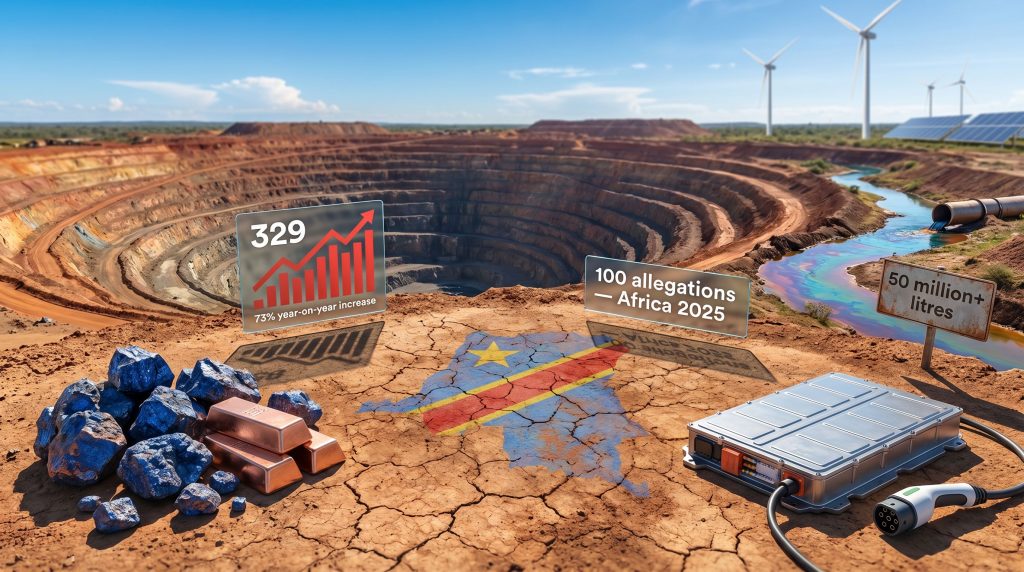
| Global abuse allegations (2025) | 329 | 73% year-on-year increase |
| Africa-specific allegations (2025) | 100 | Sharpest regional rise globally |
| Total global allegations (2010-2024) | 835 | Across all transition mineral jurisdictions |
| Africa's share of global allegations (2010-2024) | 178 (21%+) | Disproportionate to jurisdictional share |
| Africa allegations in 2024 | 45 | Up from 26 in 2023 |
| DRC share of Africa allegations | 91 of 178 | More than 51% of African total |
| Companies linked to 50% of Africa allegations | 10 large international miners | High concentration of accountability |
| Toxic spill volume, Zambia 2025 | 50 million+ litres | Into Kafue River tributary |
| Compensation claim, Zambia lawsuit | $80+ billion | Filed by affected communities |
| Radioactive waste, Niger uranium mining | 20 million tonnes | Contaminating groundwater for 100,000 people |
| Glencore bribery fine (2022) | $1.1 billion | Across multiple African jurisdictions |
The 73% year-on-year increase in global allegations is not merely a statistical artefact of improved reporting. Research organisations working in this space have noted that this trajectory reflects both a genuine intensification of extractive pressure and the growing capacity of civil society organisations to document and formally record incidents that previously went unreported. The implication is that the real rate of harm may have been significantly understated in earlier years.
What the Africa-specific data reveals is equally significant. Africa recorded 26 allegations in 2023, rising to 45 in 2024, and then surging to 100 in 2025. This is not a gradual trend. It is an acceleration, and it is directly correlated with the expansion of industrial-scale mining activity tied to clean energy mineral demand.
The DRC: Where Cobalt, Conflict, and Impunity Intersect
No country concentrates the rights abuses in Africa mining for clean energy minerals more intensely than the Democratic Republic of Congo. Accounting for more than 51% of all recorded African allegations between 2010 and 2024, DRC's mineral wealth presents a case study in how geological abundance and governance fragility interact to produce chronic harm.
Child Labour in the Artisanal Cobalt Sector
Over 70% of the world's cobalt originates from the DRC, and a meaningful share of that production flows through the artisanal and small-scale mining sector, which operates largely outside formal regulatory frameworks. Children as young as eight years old have been documented working in open-pit artisanal mines, using hand tools to extract ore from unstable ground, exposed to toxic cobalt dust, and at constant risk from structural collapses.
The artisanal mining sector in the DRC is not a peripheral activity. It is deeply integrated into the cobalt supply chain that feeds battery manufacturers supplying global automakers. The pathway from a child miner in the Lualaba province to a battery cell in a European electric vehicle is shorter and more direct than most consumers understand.
The Militarisation Problem
A pattern documented by multiple monitoring organisations involves mining companies engaging state security forces to enforce site perimeters, a practice with deeply counterproductive consequences. Military units deployed to remove artisanal miners from industrial concessions have been subsequently reported to participate in the illegal seizure of those same concessions. Soldiers operating across both industrial and artisanal mining zones operate with reported impunity, with checkpoint systems functioning as mechanisms for extracting bribes from local residents.
The M23 rebel movement, which multiple international observers including the United States government have linked to Rwandan state support, controls significant mineral-producing territory in eastern DRC. Revenue derived from mining operations under M23 control has been identified as a primary funding mechanism for continued armed operations. The United States has imposed sanctions on networks alleged to be involved in smuggling conflict minerals out of the DRC to finance M23. Rights organisations have documented M23-linked atrocities including sexual violence, torture, and extrajudicial killing across affected communities.
The security calculus in eastern DRC has reached a point where military deployments intended to protect mineral assets are actively generating the conditions that draw armed groups deeper into extractive activity.
The DRC government's 2025 announcement of a dedicated paramilitary unit to protect mining operations, with reported funding discussions involving the United States and the United Arab Emirates, drew immediate criticism from rights advocates. The concern was straightforward: introducing an additional armed actor into an already heavily militarised environment is more likely to amplify community displacement and looting than to reduce it. The United States subsequently denied it would fund such a unit, but the episode illustrated how the security dimension of mineral extraction is being addressed with instruments that may worsen the underlying problem.
Zambia and the Environmental Cost of Copper
Zambia's copper sector presents a different dimension of the rights abuse spectrum, one centred on environmental contamination and corporate accountability.
In February 2024, a dam failure at the Sino-Metals Leach Zambia Copper Mine released a minimum of 50 million litres of toxic effluent into a stream feeding the Kafue River, the primary water source for drinking, irrigation, and fishing across a densely populated region. Research conducted following the incident suggested the actual volume of contamination was significantly greater than initial estimates, with one analysis placing the true figure at approximately 30 times higher than originally reported by the operator.
Communities affected by the spill, represented in part by the Southern African Litigation Centre, have filed legal claims seeking more than $80 billion in compensation and environmental remediation. This figure reflects not only the immediate damage to water systems and livelihoods but also the long-term costs of ecological restoration and the health consequences of heavy metal contamination in an already vulnerable population.
The situation in Kabwe, Zambia, adds a historical dimension to the contemporary crisis. Residents of this former lead and zinc mining hub carry blood lead levels among the highest ever recorded in a civilian population, producing irreversible cognitive impairment and organ damage across multiple generations. The Kabwe case illustrates that the environmental consequences of mining in weak regulatory environments are not resolved when extraction ends. They compound across decades.
The Corporate Concentration of Accountability
One of the most analytically significant findings in the Transition Minerals Tracker data is the concentration of abuse allegations among a small number of corporate actors. Just 10 large international mining companies were associated with approximately half of all recorded allegations in Africa in 2025.
This concentration has important implications for how the problem is addressed. It suggests that systemic reform targeting a relatively small group of high-footprint operators could produce disproportionately large improvements in overall outcomes. It also indicates that the pattern of abuse is not an unavoidable feature of African mining in general but is clustered around specific corporate behaviours and operational approaches.
The 2022 case of Glencore, one of the world's largest commodity trading and mining corporations, provides a reference point. Glencore was fined $1.1 billion for bribery offences spanning multiple African jurisdictions including the DRC, Nigeria, and Cameroon. Concealed payments to government officials secured preferential access to extraction licences and regulatory leniency. At this scale, corruption does not merely benefit a corporation. It systematically dismantles the state capacity that would otherwise enforce the environmental and labour standards constraining harmful practices.
Coltan, Consumer Electronics, and the Demand Chain
Coltan, a mineral containing tantalum essential for capacitors in smartphones, gaming hardware, and semiconductors, has been traced from conflict-affected mining zones in eastern DRC into the supply chains of major global technology manufacturers. This creates a direct link between consumer electronics purchasing decisions in wealthy nations and the funding of armed groups operating in one of the world's most conflict-affected regions.
The due diligence legislation now in force across the European Union, the United States through the Dodd-Frank Act's conflict minerals provisions, and the United Kingdom creates legal obligations for companies to investigate and disclose the provenance of minerals in their products. However, enforcement of these frameworks remains inconsistent, and the traceability infrastructure required to follow mineral flows from artisanal mining sites through multiple intermediary traders to final product assembly does not yet exist at the required scale.
The next major ASX story will hit our subscribers first
The Governance Gap in Strategic Mineral Agreements
The acceleration of strategic mineral partnership agreements between African governments and global powers including the United States, European Union member states, and Gulf sovereign wealth entities has introduced a new dimension to the rights crisis. The critical minerals and energy transition agenda is, in many respects, the primary driver behind these agreements, yet human rights safeguards consistently remain secondary to supply security objectives.
These agreements are negotiated at the intergovernmental level, typically with limited consultation with the communities whose land and livelihoods are directly implicated. A consistent pattern identified across multiple agreements is the absence of binding human rights and environmental protection clauses. Without enforceable safeguards embedded in the agreement architecture itself, host governments retain discretion over whether to apply domestic protections, and that discretion is frequently exercised in favour of extraction speed.
Joseph Kibugu, Africa regional manager at the Business and Human Rights Resource Centre, has characterised this pattern as agreements often negotiated without meaningful engagement with affected rightsholders and without the binding safeguards that would make human rights protection a structural condition rather than a stated aspiration. This observation encapsulates a governance gap that sits at the heart of the crisis.
What Systemic Reform Would Actually Require
The reform agenda advanced by rights organisations and legal advocacy groups is both comprehensive and operationally specific. It addresses the problem at multiple levels simultaneously.
Legislative and Regulatory Reforms:
- Mandatory binding human rights and environmental due diligence requirements embedded in all strategic mineral agreements, not as aspirational language but as enforceable conditions
- Legally codified free, prior, and informed consent standards requiring genuine community consultation and approval before mining operations commence on or near affected land
- Independent environmental monitoring with public reporting obligations across all transition mineral extraction sites, with findings accessible to affected communities
Corporate Accountability Measures:
- End-to-end supply chain traceability systems mandated by law, not offered voluntarily, enabling accountability at the point of procurement
- Prohibition on sourcing from operations with unresolved forced eviction, child labour, or environmental contamination allegations
- Mandatory community benefit agreements with legally binding compensation and remediation commitments, replacing the discretionary payment structures currently used by most operators
Community-Level Protections:
- Legal protection frameworks specifically designed for human rights defenders operating in mining-affected zones, where intimidation and violence are documented risks
- Funded rehabilitation programmes for contaminated land and water systems
- Anti-corruption enforcement mechanisms operating independently of the government ministries that hold mineral sector interests
Furthermore, the global cobalt mining industry requires specific legislative attention given its disproportionate representation in documented abuse cases. The Southern African Litigation Centre's executive director Anneke Meerkotter has framed the challenge clearly: Africa's transition mineral sector is increasingly characterised by a dangerous combination of weak government oversight and corporate disregard for local laws, and the energy transition cannot be built on a foundation of local exploitation and impunity.
Advocacy groups have also called on international institutions to centre human rights in critical minerals frameworks, arguing that a rights-based approach to the just transition is not merely aspirational but operationally necessary if the clean energy shift is to avoid replicating the harms of previous extractive cycles.
Frequently Asked Questions
Which minerals are most associated with rights abuses in African mining?
Cobalt and copper, primarily from the DRC and Zambia, account for the largest documented share of abuse allegations. Uranium mining in Niger and coltan extraction in eastern DRC are also significantly implicated. The common thread is that all four minerals are classified as critical for clean energy or digital technology supply chains, creating intense extraction pressure.
Why does the DRC account for such a disproportionate share of allegations?
The DRC's dominance in cobalt production, combined with the presence of active armed conflict, weak state institutions, and a large informal artisanal mining sector, creates conditions where multiple categories of abuse can occur simultaneously. The intersection of industrial mining, military actors, and armed groups in the same geographic zones produces a compounding effect not replicated in most other mining jurisdictions.
What is the Transition Minerals Tracker?
It is an annual monitoring publication produced by the Business and Human Rights Resource Centre, systematically recording allegations of human rights and environmental abuse linked to the extraction of minerals essential for clean energy technologies. It is one of the most comprehensive cross-jurisdictional datasets available for analysing rights abuses in Africa mining for clean energy minerals and other global jurisdictions.
What does FPIC mean and why does it matter?
Free, Prior and Informed Consent is an internationally recognised standard requiring that Indigenous and local communities receive genuine, advance consultation and must provide consent before mining or resource extraction commences on or near their land. Its consistent absence in African mining agreements is identified as a primary driver of forced eviction, community conflict, and long-term displacement.
Are there legal cases underway?
Yes. Communities affected by the Sino-Metals copper mine spill in Zambia are pursuing claims exceeding $80 billion. In Kabwe, Zambia, approximately 100,000 residents pursued a class-action claim against Anglo American over historic lead contamination. These cases represent a growing willingness by affected communities to pursue corporate accountability through legal systems, including international litigation frameworks.
This article draws on data from the Business and Human Rights Resource Centre's Transition Minerals Tracker and reporting from the Thomson Reuters Foundation. It is intended for informational purposes only and does not constitute legal, financial, or investment advice. Statistics and allegations referenced reflect documented claims and should not be interpreted as legal findings unless otherwise stated.
Want To Track ASX Discoveries in the Minerals Powering the Energy Transition?
Discovery Alert's proprietary Discovery IQ model delivers real-time alerts on significant ASX mineral discoveries — including copper, cobalt, and other critical minerals — transforming complex data into actionable insights for investors at every level. Explore historic examples of major discoveries and their market returns, then begin your 14-day free trial at Discovery Alert to position yourself ahead of the broader market.