
June 26, 2026
The Hidden Mechanics of Rough Diamond Supply Management
The global diamond industry has always operated differently from most commodity markets. Unlike copper or iron ore, where price discovery happens on open exchanges with transparent order books, rough diamond pricing is heavily influenced by the decisions of a handful of dominant producers who control when, how much, and to whom they sell. This structural reality means that when a major producer voluntarily pulls back output, the signal carries more interpretive weight than the tonnage figures alone might suggest.
Understanding what the Alrosa Severalmaz mining suspension actually means requires looking beyond the headline and into the mechanics of how diamond supply chains function, how sanctions reshape commercial options, and why a three-month pause at a secondary asset can reflect pressures that run much deeper than the asset itself.
When big ASX news breaks, our subscribers know first
Why Severalmaz Is Being Paused, and Why Now?
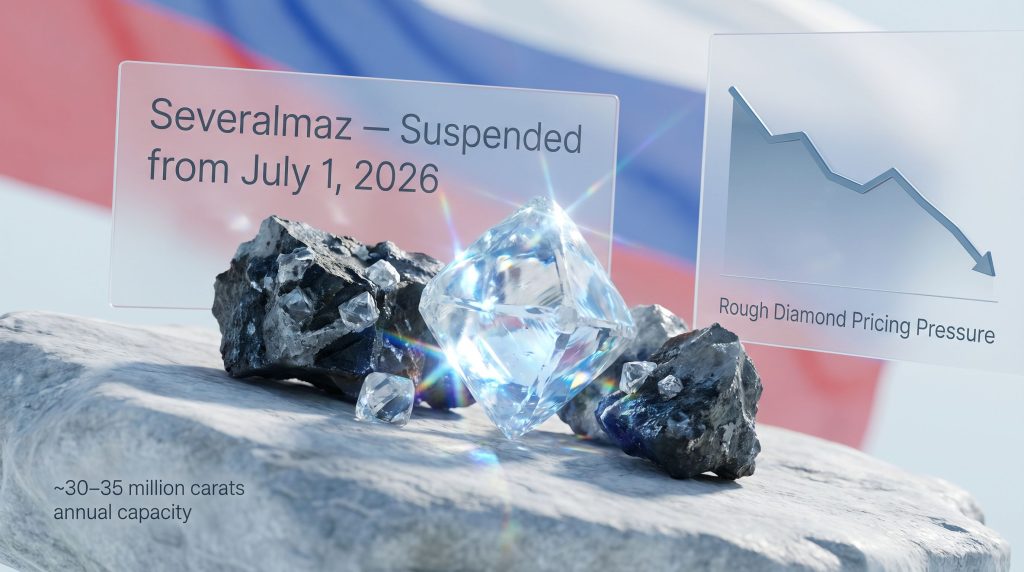
Alrosa announced in late June 2026 that its Severalmaz subsidiary would suspend mining extraction and transport logistics from July 1 for approximately three months. The company's stated reasoning centres on maintaining what it describes as operational and financial resilience, alongside disciplined management of rough diamond sales flows. In plain commercial terms, this is a producer choosing not to dig because selling what it already has is proving difficult enough.
Processing at the facility will continue throughout the suspension, drawing on existing ore stockpiles. This distinction is operationally significant. Keeping the processing plant running preserves the workforce, maintains equipment in operational condition, and ensures that polished and semi-processed stones continue moving downstream. What stops is the extraction of new ore and its transport to processing infrastructure.
Key Distinction: The Alrosa Severalmaz mining suspension targets the upstream extraction and logistics chain exclusively. Downstream processing continues, indicating a deliberate inventory drawdown strategy rather than a complete operational shutdown.
This bifurcated approach is a tool that experienced diamond producers understand well. By halting new ore input while continuing to process existing stockpiles, a company can reduce its visible supply additions to the market without abandoning its workforce or compromising plant maintenance cycles.
Severalmaz as an Asset: What the Lomonosov Deposit Represents
Severalmaz operates the Lomonosov diamond deposit in Russia's Arkhangelsky region, situated in the country's far northwest. Geologically, the Lomonosov deposit is notable for its kimberlite pipe cluster, a formation type that underlies virtually all economically significant diamond deposits worldwide. Kimberlite pipes are ancient volcanic conduits that transported diamonds from deep mantle depths to near-surface levels hundreds of millions of years ago, and the quality of stones recovered depends heavily on the pipe's grade, expressed in carats per hundred tonnes of ore processed.
The Arkhangelsky deposits are generally considered lower grade relative to the flagship operations Alrosa runs in the Sakha Republic (Yakutia), where assets like the Jubilee and Udachnaya pipes rank among the most productive diamond production sites globally. Severalmaz recorded approximately 2.8 million carats in 2020, representing a secondary but still meaningful contribution to Alrosa's overall production capacity, which sits in the range of 30 to 35 million carats annually.
| Asset Category | Location | Operational Status (2026) | Approximate Output Share |
|---|---|---|---|
| Core Yakutia operations | Sakha Republic | Active | Majority of total output |
| Severalmaz (Lomonosov deposit) | Arkhangelsky region | Suspended from July 1, 2026 | Secondary contributor |
| Smaller low-margin deposits | Anabar Valley / Verkhne-Munskoye | Paused since 2025 | ~3% of total output |
It is worth separating two distinct curtailment events. The 2025 suspension of smaller, lower-margin deposits including Khara-Mas, Ochuos, Zapolyarny, and Magnitny was a separate decision from the 2026 Severalmaz halt. Each reflects its own cost-benefit calculation, though both point toward the same underlying market reality: Alrosa is managing output to avoid accumulating inventory it cannot profitably clear.
The 2020 Precedent and What It Teaches Investors
This is not the first time Severalmaz has gone quiet. Between May 13 and November 1, 2020, the subsidiary underwent a seasonal operational halt during the peak of the COVID-19 demand shock. What made that episode instructive for observers was the speed of the recovery. The Lomonosov processing plant was back online in February 2021, approximately one month earlier than originally planned, as diamond demand rebounded faster than most analysts had anticipated.
| Dimension | 2020 Suspension | 2026 Suspension |
|---|---|---|
| Duration | ~May to November (seasonal) | ~3 months from July 1 |
| Primary trigger | Seasonal timing combined with COVID-19 demand collapse | Strategic rough diamond sales flow management |
| Processing continuity | Limited | Confirmed active via stockpile drawdown |
| Restart outcome | Early resumption in February 2021 | Timeline to be determined by market conditions |
The 2021 demand recovery was partly driven by a surge in US consumer jewellery spending, itself fuelled by pandemic-era savings and pent-up retail demand. The 2026 environment is structurally different. Recovery pathways are less obvious, and the competitive landscape has shifted materially.
Decoding Supply Discipline: How Diamond Producers Manage Pricing
Unlike base metals traded on the London Metal Exchange or similar open platforms, rough diamonds do not have a centralised price mechanism. Pricing is negotiated through a system of periodic sales events, known as tenders or sights, where buyers inspect parcels of rough stones and bid accordingly. The producer controls which parcels are offered, at what minimum prices, and in what volumes.
When a major producer withholds supply, several downstream effects follow:
- Midstream buyers in cutting and polishing centres face tighter rough availability over a 6 to 12 month lag period
- Polished diamond inventory at the wholesale level gradually tightens as new rough input declines
- Rough diamond prices can stabilise or edge upward as buyer competition for available parcels increases
The three-month Alrosa Severalmaz mining suspension represents what analysts sometimes call a secondary asset lever, a lower-cost intervention than curtailing primary operations. Pausing Severalmaz avoids disrupting the flagship Yakutian mines while still reducing the volume of rough entering a market that is already struggling to absorb supply at current price levels.
Market Mechanic: In rough diamond markets, voluntary supply discipline at a secondary asset sends a price signal to midstream buyers without triggering the kind of investor alarm that would follow a curtailment at a flagship operation.
The Sanctions Dimension: How Restricted Market Access Amplifies the Problem
The commercial context surrounding the Alrosa Severalmaz mining suspension cannot be fully understood without accounting for the sanctions landscape that has reshaped Alrosa's market access since 2022. The United States, European Union, and G7 nations have progressively implemented restrictions on Russian diamond imports. Furthermore, the geopolitical pressures on metals and mining have tightened through 2024 and 2025, with the G7 diamond traceability initiative now requiring stones passing through major cutting centres to be accompanied by verifiable origin documentation, effectively screening out diamonds of Russian origin from significant portions of the global jewellery supply chain.
The practical consequence is that Alrosa's available buyer pool has contracted substantially from pre-2022 conditions. Sales have been redirected toward markets that have not adopted the G7 traceability framework, notably India, the UAE, and China. India is particularly relevant because the Surat cutting and polishing industry processes a dominant share of the world's rough diamonds. However, Indian midstream operators have themselves faced inventory pressure since 2023, with polished diamond stockpiles at elevated levels relative to demand.
When fewer buyers can legally or commercially engage with your product, maintaining full production capacity becomes a balance sheet liability rather than a revenue opportunity. Unsold rough diamond inventory carries storage costs, ties up working capital, and creates downward price pressure at future sales events. Suspending mining at Severalmaz reduces the rate at which new inventory accumulates, preserving financial flexibility.
The next major ASX story will hit our subscribers first
Global Rough Diamond Market: Structural Pressures Beyond Sanctions
The market headwinds Alrosa is navigating extend well beyond geopolitical constraints. Several converging forces have created one of the more challenging rough diamond pricing environments in recent memory.
Demand weakness in key consumer markets: China and the United States together represent the world's two largest diamond jewellery markets. Chinese demand has remained subdued as consumer confidence has not fully recovered to pre-2022 levels. In addition, the impact of China's recent gold discovery on broader precious commodity sentiment has drawn investor attention toward alternative stores of value, indirectly dampening appetite for diamond-related assets.
Lab-grown diamond competition: The lab-grown diamond (LGD) segment has grown from a niche curiosity to a structurally significant competitive force. LGD prices have declined by an estimated 70 to 80 percent since 2020, driven by rapid capacity expansion in India and China. At current price points, lab-grown stones are available to consumers at a fraction of the cost of natural diamonds of comparable visual quality, making substitution increasingly attractive across a wide price tier.
Midstream inventory overhang: Cutting and polishing centres, particularly in Surat, India, accumulated excess polished diamond inventory through 2023 and into 2024. This overhang has suppressed demand for new rough as midstream operators work through existing stock before committing to additional purchases.
| Historical Supply Curtailment Event | Producer Action | Market Outcome |
|---|---|---|
| 2015 to 2016 demand slowdown | Multiple producers reduced tender volumes | Partial price stabilisation by mid-2016 |
| 2020 COVID-19 shock | Alrosa and De Beers reduced supply | Prices recovered sharply in the second half of 2021 |
| 2023 to 2024 LGD pressure | De Beers reduced rough sales volumes | Limited price recovery; structural headwinds persisted |
What the Suspension Means for Global Supply: Quantifying the Impact
A three-month pause at Severalmaz represents approximately 25 percent of an annual production cycle at that specific asset. Given that Severalmaz contributes a secondary share of Alrosa's total output, the net reduction in global rough supply is meaningful but not dramatic in isolation.
The cumulative effect is more significant when viewed alongside earlier curtailments. The 2025 suspension of lower-margin deposits, combined with the 2026 Severalmaz halt, represents a deliberate multi-year effort to rebalance Alrosa's production profile against a market that cannot absorb supply at prior volume levels without further price deterioration. Consequently, commodity prices and mining company performance metrics are being watched closely by analysts tracking the downstream implications of these compounding curtailments.
| Producer | Estimated Annual Output (carats) | Country | Market Position |
|---|---|---|---|
| Alrosa | ~30 to 35 million | Russia | Global leader by volume |
| De Beers | ~25 to 30 million | Botswana / Namibia / Canada | Second largest globally |
| Rio Tinto (Argyle closed) | Minimal post-2020 | Australia | Formerly significant |
| Petra Diamonds | ~3 to 4 million | South Africa / Tanzania | Mid-tier producer |
| Lucara Diamond | ~300,000 to 400,000 | Botswana | Specialty large stones |
Consumer and Retail Implications: Reading the Timeline Correctly
For jewellery retailers and consumers, the immediate impact of the Alrosa Severalmaz mining suspension is likely to be limited. The rough-to-retail pipeline in the diamond industry involves multiple processing stages, each introducing a time lag between a change in rough supply and any corresponding movement in polished diamond prices at retail.
A reasonable timeline for the transmission of this supply reduction might look like:
- Months one to three (July to September 2026): Rough supply from Severalmaz extraction ceases; processing of existing stockpiles continues
- Months four to six: Reduced rough availability begins filtering into tender volumes at midstream purchasing events
- Months seven to twelve: Polished diamond availability at wholesale level tightens gradually as midstream overhang is absorbed
- Q4 2026 to Q1 2027: Modest upward pressure on polished diamond costs potentially visible at the retail procurement level
This trajectory assumes no material changes in demand conditions or lab-grown diamond pricing. The LGD variable remains the most significant wildcard. Any natural diamond supply tightening is partially offset by the continued expansion of LGD production capacity, which has shown no signs of reversing. Moreover, the critical minerals tariff landscape continues to add further uncertainty for producers navigating an already complex trade environment.
Speculative Consideration: If LGD prices continue declining and natural diamond supply curtailments prove insufficient to stabilise rough pricing, the industry may be approaching a structural inflection point where voluntary supply discipline at secondary assets becomes insufficient to restore price equilibrium without deeper curtailments at primary operations. This is not a consensus view but reflects the trajectory of current market forces.
Frequently Asked Questions: Alrosa Severalmaz Mining Suspension
What is Severalmaz?
Severalmaz is a wholly owned Alrosa subsidiary operating the Lomonosov diamond deposit in Russia's Arkhangelsky region. It has historically contributed several million carats annually to Alrosa's total production.
Why is the suspension happening now?
The decision reflects strategic management of rough diamond sales flows in a market experiencing sustained pricing pressure, compounded by restricted market access resulting from Western sanctions on Russian diamond imports.
Will processing stop during the suspension?
Processing operations will continue throughout the three-month period, supported by existing ore stockpiles. New ore extraction and transport logistics are the only activities being halted.
How long will the suspension last?
The suspension begins July 1, 2026, and is expected to run for approximately three months, suggesting a potential resumption around October 2026. Alrosa has indicated the timeline may be adjusted based on prevailing market conditions.
Has this happened before?
Yes. A comparable halt occurred between May and November 2020. On that occasion, the Lomonosov plant resumed in February 2021, approximately one month ahead of the original schedule, as demand recovered faster than anticipated.
Will this push diamond prices higher?
The direct supply impact is moderate given Severalmaz's secondary role in Alrosa's production portfolio. Over the medium term, cumulative curtailments across multiple assets could contribute to gradual rough price stabilisation, though the extent of any recovery will depend heavily on demand conditions and the continued growth of lab-grown diamond competition.
Key Takeaways at a Glance
- Effective date: July 1, 2026
- Duration: Approximately three months
- Scope: Mining extraction and transport logistics suspended; processing operations continue
- Strategic rationale: Rough diamond sales flow discipline and financial resilience under sanctions-constrained market access
- Precedent: A similar suspension occurred in 2020; the Lomonosov plant reopened in February 2021, one month ahead of schedule
- Market context: Sustained rough diamond pricing pressure, narrowed buyer pools due to G7 sanctions, midstream inventory overhang, and structural LGD competition
- Global supply impact: Moderate and gradual; a secondary asset curtailment is unlikely to trigger immediate retail price movements but contributes to cumulative tightening across multiple timeframes
Disclaimer: This article contains forward-looking observations and speculative analysis regarding diamond market pricing and supply dynamics. These views are not investment advice and should not be relied upon for financial decision-making. Commodity markets involve significant uncertainty, and outcomes may differ materially from projections presented here.
Want to Stay Ahead of the Next Major Mineral Discovery on the ASX?
While rough diamond supply dynamics offer a compelling case study in commodity market mechanics, Discovery Alert's proprietary Discovery IQ model delivers real-time alerts on significant ASX mineral discoveries across more than 30 commodities — turning complex geological and market data into actionable investment insights the moment they hit the exchange. Explore Discovery Alert's dedicated discoveries page to understand how historic discoveries have generated substantial returns, and begin your 14-day free trial today to position yourself ahead of the broader market.