June 26, 2026
The Hidden Bottleneck Shaping Latin America's Mining Future
Long before a tonne of copper cathode or lithium carbonate reaches a battery factory in Guangzhou or a refinery in South Korea, it must navigate some of the world's most logistically demanding terrain. The Andean plateau sits above 4,000 metres in places, the Amazon basin defies road construction economics, and coastal deserts create water and power challenges that compound every kilometre of freight movement. In regions like these, the mine itself is rarely the binding constraint on value creation. The binding constraint is everything that happens between the orebody and the export terminal.
This reality is reshaping how capital flows into Latin American mining, how mining companies structure their project economics, and which deposits ultimately get developed. Understanding mining logistics projects in Latin America is no longer a niche operational concern — it has become a central strategic variable in the global critical minerals supply chain.
When big ASX news breaks, our subscribers know first
Why Geography Is a Financial Variable, Not Just a Physical One
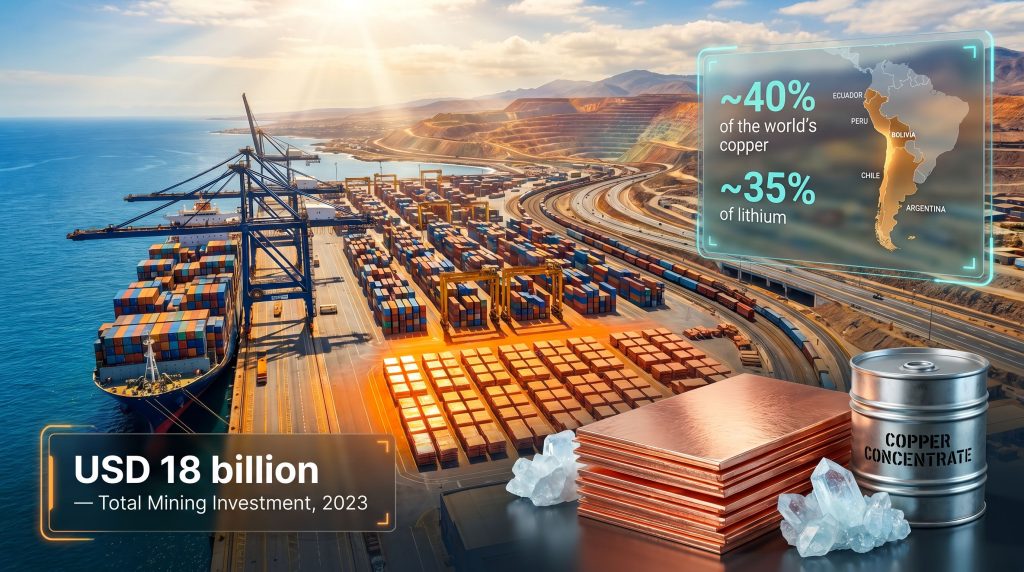
Latin America's mineral endowment is extraordinary by any measure. The region holds approximately 40% of the world's copper reserves, concentrated primarily across Chile, Peru, and increasingly Ecuador, while the lithium triangle spanning Chile, Argentina, and Bolivia accounts for roughly 35% of global lithium reserves. Brazil dominates iron ore and niobium output, and the region's gold and silver production remains globally significant.
Yet endowment alone does not determine competitiveness. Infrastructure quality does. Studies of mining project economics across the region consistently point to a 15–20% cost premium imposed on project development relative to mature mining jurisdictions like Australia or Canada. This premium does not stem from higher labour costs or regulatory complexity alone. It is fundamentally a logistics cost — the cumulative financial burden of inadequate road networks, undercapitalised rail corridors, and port terminals operating near or beyond their design capacity.
For marginal deposits, this premium can be decisive. A copper project with a rock-solid orebody but poor road access and no rail connectivity may never reach a final investment decision, not because the geology fails, but because the logistics economics do. This creates a counterintuitive dynamic where infrastructure investment can unlock geological value that already exists but remains commercially stranded.
The compounding effect across foreign direct investment appetite is measurable. Institutional investors and major mining houses apply higher discount rates to projects in logistics-constrained corridors, requiring proportionally higher ore grades or larger resource scales to justify capital commitment. This structural penalty is one reason why mid-tier deposits in Peru and Bolivia attract substantially less capital per tonne of contained metal than comparable assets in Chile or Brazil, where logistics infrastructure is more developed.
The Commodity Corridors Driving Infrastructure Investment
Chile and Peru: The Pacific Mining Backbone
Chile's position as the world's leading copper producer anchors the entire Pacific mineral export corridor. The northern ports of Antofagasta and Mejillones serve as the primary gateways for copper concentrate, copper cathodes, and a rapidly growing volume of lithium carbonate and lithium hydroxide. As the Chile lithium strategy continues to evolve, port terminals have faced pressure to expand specialised handling capacity for battery-grade mineral products that require different storage and loading protocols than bulk copper concentrate.
Peru presents a more complex picture. The country holds enormous copper reserves, particularly in the southern Andes, but its logistics execution has lagged its resource endowment. As of 2023, only approximately 40% of planned mining road and rail upgrades had been completed, creating persistent bottlenecks between mine sites and the ports of Callao and Matarani. This execution gap has real commercial consequences: delayed concentrate shipments, increased demurrage costs, and investor caution around new project commitments.
Ecuador: The Fastest-Evolving Logistics Market in the Region
Perhaps no country better illustrates the transformative potential of mining logistics investment than Ecuador. Before 2019, Ecuador was not meaningfully part of the global copper supply chain. Its export identity was built around petroleum, bananas, and cut flowers. That changed with the commissioning of the Mirador copper mine, operated by CRCC-Tongguan, a Chinese-backed entity. Mirador's first copper concentrate shipment through Puerto Bolívar in 2019 marked Ecuador's entry into the Pacific mineral corridor, and the country has not looked back.
DP World's Posorja terminal has emerged as a parallel export node, providing container-capable infrastructure that can handle refined mineral products without requiring the purpose-built bulk terminals that take years and hundreds of millions of dollars to construct. Lundin Gold's Fruta del Norte mine has added a gold export dimension to Ecuador's logistics evolution, demonstrating that the country can support multiple commodity streams through a relatively compact port infrastructure footprint.
Within five years of its first copper concentrate export, Ecuador had become a recognised Pacific corridor node. This speed of integration is exceptional by regional standards and reflects a specific set of enabling conditions: existing port infrastructure capable of adaptation, Chinese capital willing to integrate mine ownership with logistics investment, and government openness to foreign-operated concessions.
Key Insight: Ecuador's rapid logistics integration is not simply a development success story. It is a template demonstrating that containerisation and port adaptation can compress the timeline from mine commissioning to active export participation far more quickly than greenfield bulk terminal construction.
Containerisation: The Structural Shift Redefining Logistics Economics
For most of the twentieth century, mining logistics in Latin America was synonymous with bulk shipping. Copper concentrate moved in open bulk vessels. Iron ore filled purpose-built Capesize terminals. The assumption embedded in every logistics plan was that volume and scale required specialised infrastructure.
Containerisation is dismantling that assumption for a growing range of mineral products. Copper cathodes, lithium carbonate, lithium hydroxide, and refined gold products are all suited to container-based movement because their physical properties allow standard loading, palletisation, and handling without specialised terminal equipment. Furthermore, the copper supply crunch facing global markets is accelerating the adoption of more flexible logistics models across the region.
| Mineral Product | Transport Method | Key Advantage | Primary Export Ports |
|---|---|---|---|
| Copper cathodes | Containerised | Standard handling, market flexibility | Antofagasta, Callao, Puerto Bolívar |
| Lithium carbonate | Containerised | Leverages existing port infrastructure | Mejillones, Antofagasta |
| Lithium hydroxide | Containerised | Suited to battery-grade product handling | Antofagasta, Matarani |
| Copper concentrate | Bulk / Containerised hybrid | Flexibility for emerging export regions | Puerto Bolívar, Posorja |
| Iron ore | Bulk | Volume efficiency at scale | Brazilian Atlantic ports |
| Bauxite | Bulk | High-volume, low-value density | Dedicated terminals |
The commercial implication is significant. New mining regions entering the export market can use existing general-purpose port infrastructure immediately rather than waiting years for a dedicated bulk terminal to be financed, approved, and built. This dramatically reduces the capital threshold for entering the export market and lowers the volume requirements needed to justify logistics investment.
There is also a sustainability dimension often overlooked in logistics planning. Containerised mineral exports enable more precise carbon accounting per tonne of product shipped, which is increasingly important to European and Japanese off-takers with Scope 3 emissions commitments. As battery supply chain transparency requirements tighten, the ability to document logistics carbon intensity from mine gate to port will become a differentiating commercial factor.
Infrastructure Investment Across Road, Rail, and Port Networks
Total mining investment across Latin America exceeded USD 18 billion in 2023, and logistics infrastructure is capturing a growing proportion of that capital as operators recognise that extraction capacity without export capacity creates stranded operational leverage.
Road and Highway Networks
Access road construction remains the most immediate logistics lever for new mine development. A deposit that requires a 200-kilometre unpaved access road to reach the nearest paved highway faces fundamentally different economics than one adjacent to existing transport corridors. Highway widening programmes in Chile and Peru — particularly in northern mining districts — are targeting the heavy-vehicle freight volumes that expanded copper and lithium output will generate. Concession-based road development models are attracting private capital into infrastructure that historically depended on public budget cycles, accelerating delivery timelines.
Freight Rail
Rail remains the most capital-efficient solution for high-volume, long-distance mineral movement across flat or semi-arid terrain. The challenge in Latin America is that much of the terrain between major deposits and coastal ports is neither flat nor semi-arid. Andean topography creates genuine engineering complexity and cost escalation that pushes rail economics toward unviable territory for all but the largest, longest-life operations.
Rolling stock investment gaps compound this challenge. Several Peruvian and Argentine rail corridors that could theoretically support increased mineral freight are constrained not by track condition alone but by locomotive and wagon fleet limitations that require sustained capital commitment to resolve.
Port Infrastructure and the Concession Model
Maritime port capacity expansion is the critical final link in the export chain, and it is increasingly financed through public-private concession structures. In Chile, Peru, and Ecuador, terminal operators including DP World and ICTSI have taken concession positions that bring international operational expertise and private capital to infrastructure that national port authorities cannot fund unilaterally. According to the Latin America mining market outlook, demand for export capacity is set to intensify considerably through the latter part of this decade.
Brazil's logistics profile is bifurcated. Its Atlantic deepwater terminals, anchored by Vale's iron ore export infrastructure, represent some of the most efficient bulk mineral handling in the world. However, inland connectivity, particularly along the Paraguay-Paraná waterway system, remains underdeveloped relative to the mineral production potential of Brazil's interior and the landlocked mining regions of Paraguay and Bolivia. Dredging programmes aimed at deepening navigation channels along this waterway system are among the most capital-efficient infrastructure investments available for unlocking inland mineral transport capacity.
Multilateral development banks — including the Inter-American Development Bank (IDB), the Andean Development Corporation (CAF), and the World Bank — play a meaningful de-risking role in logistics infrastructure financing, particularly in higher political-risk jurisdictions where purely commercial project finance structures struggle to reach bankability thresholds.
Country-by-Country Strategic Assessment
| Country | Primary Minerals | Logistics Maturity | Key Infrastructure Gap | Investment Attractiveness |
|---|---|---|---|---|
| Chile | Copper, Lithium | High | Port capacity expansion | Very High |
| Peru | Copper, Gold, Silver | Medium | Road/rail completion deficit | High |
| Ecuador | Copper, Gold | Emerging | Port deepening, access roads | High (rising) |
| Brazil | Iron Ore, Bauxite, Niobium | High (Atlantic) | Inland waterway connectivity | High |
| Argentina | Lithium, Copper | Medium | Rail and road to Atacama | Medium-High |
| Colombia | Coal, Nickel, Copper (emerging) | Medium | Diversification infrastructure | Medium |
| Paraguay | Iron Ore (transit) | Low-Medium | Waterway dredging | Medium |
| Mexico | Gold, Silver, Copper | Medium | Northern corridor roads | Medium |
In addition, the Argentina lithium brines sector is emerging as a logistics priority in its own right, with rail and road connectivity between Atacama-region deposits and Pacific export terminals requiring urgent capital attention. Consequently, Argentina's position in the regional logistics hierarchy is likely to shift upward as brine production volumes scale through the second half of the decade.
The next major ASX story will hit our subscribers first
Structural Barriers That Capital Cannot Easily Overcome
Three barriers consistently constrain the pace at which logistics investment converts into operational capacity improvements.
Political and regulatory risk affects the bankability of logistics infrastructure across the region. Concession frameworks that appear stable at the time of investment have been renegotiated or cancelled in jurisdictions including Peru and Bolivia, raising the cost of capital for private infrastructure developers and deterring the patient, long-duration capital that logistics infrastructure requires.
The mid-scale financing gap is less discussed but arguably more damaging to overall logistics system performance. Large port and rail projects attract multilateral and institutional capital. However, mid-scale projects — a 50-kilometre access road, a river port upgrade, a navigation channel dredging programme — fall below the deal size thresholds that major infrastructure investors require. Mining companies frequently end up financing these gaps themselves, distorting project economics and diverting capital from core mining operations.
Community and environmental opposition to road and port development in ecologically sensitive corridors is a growing constraint. Several Amazonian and Andean road projects have faced sustained legal and social challenges that extended timelines by years, converting what appeared to be straightforward infrastructure investments into complex multi-stakeholder negotiations. Furthermore, as explored in responsible minerals supply chains frameworks, community engagement is increasingly a prerequisite for project advancement rather than an optional consideration.
How Latin America Compares to Global Peer Mining Regions
| Dimension | Latin America | Australia | West Africa | Central Asia |
|---|---|---|---|---|
| Infrastructure Cost Premium | 15–20% above baseline | Near baseline | 20–30% above baseline | 25–35% above baseline |
| Port Connectivity | High (Pacific/Atlantic coasts) | Very High | Moderate | Very Low (landlocked) |
| Rail Network Maturity | Low-Medium | High | Low | Low |
| Containerisation Adoption | Growing rapidly | Mature | Early stage | Minimal |
| Political Risk Index | Medium-High | Low | High | Very High |
Latin America's coastal geography provides an inherent structural advantage over Central Asian and landlocked African mining regions. Direct container shipping routes to Asian battery manufacturing hubs and European refineries reduce transit times and logistics complexity in ways that no amount of infrastructure investment can replicate for landlocked competitors.
The Near-Term Catalysts and Long-Term Thesis
Between 2025 and 2027, several concrete catalysts are expected to advance logistics capacity materially:
- Completion of port capacity expansions at northern Chilean terminals to accommodate growing lithium export volumes
- Acceleration of Ecuador's copper export logistics as additional phases of Mirador and potential new mine commissioning add to Pacific corridor freight demand
- Waterway dredging programmes along the Paraguay-Paraná system unlocking new inland mineral transport pathways
- Rolling stock procurement and freight rail upgrades in Peru and Argentina targeting copper and lithium corridor throughput
The longer-term structural thesis rests on a straightforward but powerful logic. Mining logistics projects in Latin America hold an irreplaceable share of the minerals that electrification and energy transition require. The question is not whether those minerals will eventually be extracted and exported. The question is which deposits get developed first, and at what cost. Logistics infrastructure quality is increasingly the answer to both questions.
In this context, the Chile copper outlook and broader copper investment strategies being pursued by major mining houses both point in the same direction: logistics capacity is as critical to value realisation as ore grade itself.
Strategic Takeaway: Mining companies and logistics operators that invest in connectivity infrastructure today are not merely solving an operational problem. They are determining which Latin American mineral deposits become globally competitive assets over the next decade, and which remain commercially stranded despite their geological merit.
This article contains forward-looking statements and projections based on publicly available industry data and analyst assessments. Infrastructure timelines, investment figures, and market development trajectories are subject to change based on political, regulatory, and macroeconomic conditions. Readers should conduct independent due diligence before making investment decisions based on information contained herein.
Frequently Asked Questions: Mining Logistics Projects in Latin America
What types of infrastructure are most critical for mining logistics in Latin America?
- Roads and access corridors connecting remote deposits to processing facilities
- Freight rail networks for high-volume bulk mineral movement across long distances
- Maritime and river ports with bulk commodity terminal and container handling capacity
- Navigable waterway systems, particularly in Brazil, Paraguay, and Argentina, for inland mineral transport
Why is containerisation becoming more important in Latin American mining logistics?
- It allows refined mineral products to move through standard port infrastructure without requiring specialised bulk terminals
- It reduces the capital investment threshold for new mining regions entering export markets
- It enables faster time-to-first-export for newly commissioned operations
- It supports carbon accounting requirements increasingly demanded by downstream off-takers
Which Latin American country has the most advanced mining logistics ecosystem?
Chile maintains the most mature logistics infrastructure, anchored by established port capacity at Antofagasta and Mejillones and decades of copper and lithium export experience. Ecuador is the fastest-evolving market, driven by copper and gold mine commissioning since 2019 and the adaptation of Pacific port infrastructure to mineral export requirements.
For ongoing coverage of mining project pipelines, infrastructure developments, and company activity across Latin America, industry practitioners may find value in the regional intelligence available through BNamericas.
Want to Stay Ahead of the Next Major Mineral Discovery Driving the Critical Minerals Supply Chain?
Discovery Alert's proprietary Discovery IQ model delivers real-time alerts on significant ASX mineral discoveries, instantly translating complex geological and commodity data into actionable investment insights — whether you're tracking copper, lithium, or gold opportunities. Explore how historic discoveries have generated substantial market returns on Discovery Alert's dedicated discoveries page, and begin your 14-day free trial today to position yourself ahead of the broader market.