July 21, 2026
The Quiet Crisis Reshaping Global Aluminium Recycling
The global recycling economy has long operated on an assumption that scrap materials flow freely toward the highest bidder. For decades, this logic served international trade well enough. But a structural shift is now underway in aluminium markets, one driven not by price signals alone but by a growing recognition among policymakers that scrap is no longer simply waste. It is, increasingly, a strategic industrial input, and Europe is moving to treat it accordingly.
The EU delays aluminium scrap export curbs till September 2026, pushing back from an earlier spring deadline that was missed amid competing institutional and stakeholder pressures. That delay, while frustrating for domestic producers, has opened a defined and time-limited window for global buyers. Understanding what is really at stake, and why the postponement matters far beyond a simple administrative reschedule, requires looking at the deeper structural forces now reshaping aluminium scrap trade worldwide.
When big ASX news breaks, our subscribers know first
What the EU's Waste Shipment Regulation Actually Does
The EU's Waste Shipment Regulation is the foundational legal architecture governing how materials classified as waste, including aluminium scrap, can move across borders. It was not designed exclusively for aluminium, but aluminium scrap has become one of its most contested applications, largely because of the speed at which export volumes have grown.
The WSR's relevance to scrap export controls lies in its ability to distinguish between waste materials destined for legitimate recycling and those contributing to what policymakers describe as "green raw material leakage." This concept refers to the transfer of high-value recyclable feedstocks out of the EU, depriving domestic recyclers of the inputs they need to operate efficiently and undermining the bloc's decarbonisation objectives.
A critical nuance often overlooked in mainstream coverage is the distinction between scrap grades. Not all aluminium scrap is equal. High-grade, low-contamination scrap, particularly from post-industrial sources, commands premium pricing and is directly usable in demanding applications such as automotive sheet or aerospace alloys. Lower-grade post-consumer scrap requires more processing and carries higher impurity loads.
The EU's proposed restrictions are principally targeting the retention of high-grade material domestically. This scrap quality dimension is central to understanding why different industry groups have taken such divergent positions on the policy. Furthermore, the aluminium and alumina markets are already absorbing significant structural pressures from multiple directions simultaneously.
From Announcement to Postponement: The Policy Sequence
The decision to restrict aluminium scrap exports was formally signalled in November 2025 by Maros Sefcovic, the European Trade Commissioner, with a spring 2026 implementation target. That deadline was not met. Industry sources point to the difficulty of aligning the interests of upstream aluminium producers, mid-stream recyclers, and downstream consumers in sectors such as automotive, packaging, and construction.
The EU's August institutional recess has further compressed the active decision-making calendar, effectively deferring substantive regulatory movement to September 2026. The European Commission has not officially commented on the revised timeline, leaving industry participants in a state of structured uncertainty. September 9, 2026, has been cited within industry circles as a likely rollout reference point, though no formal confirmation has been issued at the time of writing.
Europe's Scrap Leakage Problem by the Numbers
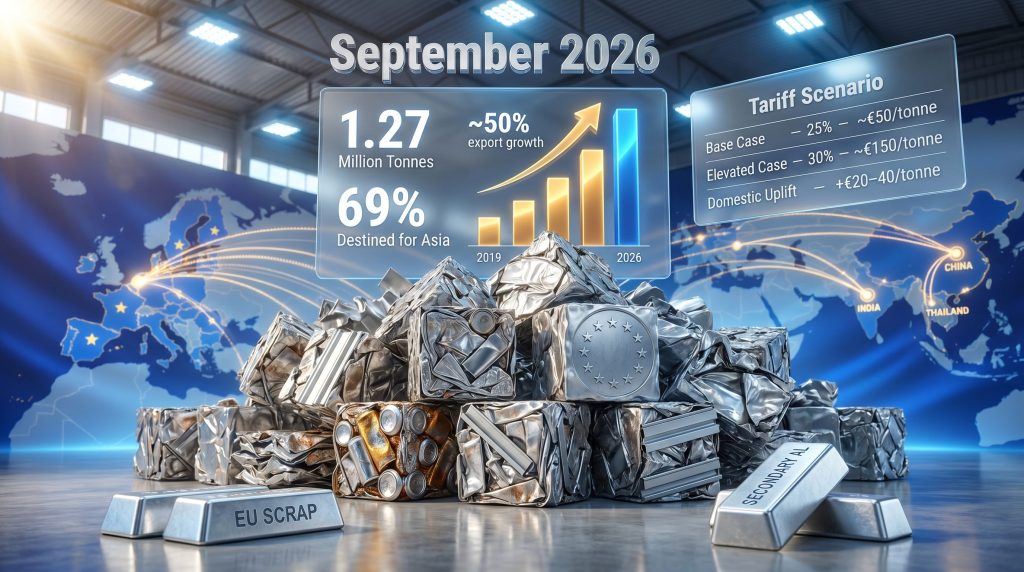
The scale of Europe's aluminium scrap outflows is genuinely striking when examined through a historical lens. Exports climbed to a record 1.27 million tonnes in 2025, representing roughly a 50% increase compared to 2019 levels. To contextualise that figure, it equates to approximately 25% of the EU's total aluminium recycling capacity being effectively gifted to third-country buyers each year, in the words of FACE President Mario Conserva.
That volume, Conserva has argued, represents a structural challenge for Europe's industrial competitiveness and its ability to meet internal recycling targets. The Q1 2026 data reinforces this trajectory. The EU exported 328,134 tonnes of aluminium scrap in the first quarter of 2026 alone, with 69% of that volume destined for Asian markets according to Eurostat.
| Metric | Value |
|---|---|
| EU aluminium scrap exports (2025) | 1.27 million tonnes (record high) |
| Growth vs. 2019 baseline | ~50% increase |
| Share of EU recycling capacity lost to exports | ~25% |
| EU aluminium scrap exports in Q1 2026 | 328,134 tonnes |
| Share of Q1 2026 exports destined for Asia | 69% |
| Secondary aluminium as share of global output (2025) | ~35% |
Secondary aluminium accounted for approximately 35% of total global aluminium output in 2025, and global recycling volumes are projected to expand from 39.35 million tonnes in 2025 to 41.14 million tonnes in 2026. That trajectory of growing demand for recycled content is precisely why control over scrap feedstock is becoming a geopolitical, not merely an economic, concern.
What Drives Scrap Offshore
The structural drivers of European scrap outflows are not mysterious. Several reinforcing dynamics work simultaneously:
- International buyers, particularly in India, Thailand, and China, have consistently offered prices that exceed what EU domestic processors will pay, creating a persistent arbitrage that pulls material eastward.
- Certain EU member states lack the downstream processing infrastructure to absorb all available scrap grades efficiently, meaning some material has no economically viable domestic outlet.
- Asian industrial demand has grown substantially, particularly for secondary aluminium used in the automotive supply chain, consumer electronics, and construction sectors across South and Southeast Asia.
- The UAE's announcement in June 2026 of its own aluminium scrap export ban added a further supply constraint, tightening available feedstock for Asian buyers and amplifying the strategic importance of EU supply continuity.
Why the Policy Is Stalled: The Competing Interests
The delay is not a product of indifference. It reflects genuine structural complexity in aligning interests across the full aluminium value chain.
The pro-restriction camp, led by European Aluminium, argues from a carbon logic as much as an economic one. Recycled aluminium requires up to 95% less energy to produce than primary aluminium derived from bauxite mining. Retaining high-grade scrap within the EU is therefore not merely an industrial policy choice — it is a decarbonisation imperative. In addition, low-carbon aluminium operations elsewhere in the world are demonstrating that green transition investment in this sector is both viable and accelerating.
European Aluminium's Director General, Paul Voss, has acknowledged stakeholder impatience over the delay while reinforcing that the policy's five-year structural ambition remains intact and that the institution expects meaningful regulatory movement to follow the August recess. The concern about what might be called a "double pressure" scenario is also significant. European recyclers face rising costs under the EU's Emissions Trading System, while simultaneously watching premium-grade scrap migrate toward higher-paying offshore markets.
The anti-restriction camp, represented by Recycling Europe, counters that the industry-wide framing overstates the export problem. The organisation maintains that only around 20% of EU aluminium scrap is exported, and that a meaningful portion of that exported volume consists of lower-grade material for which there is no efficient domestic processing pathway. Restricting those flows, the argument goes, would reduce the economic viability of scrap collection itself — potentially resulting in less recyclable aluminium entering the system overall, an outcome that would directly undermine circular economy goals.
This is a genuinely contested empirical and policy question, and it explains why the European Commission has found alignment difficult to achieve. Consequently, green metals pricing signals across related industrial materials have begun to reflect this regulatory uncertainty.
The Tariff Mechanics: What Buyers Would Actually Face
When restrictions do take effect, the financial impact on overseas buyers will depend heavily on final tariff design. Current industry intelligence points to proposed export tariff levels in the range of 25 to 30% on aluminium scrap values, with projected cost additions of €50 to €150 per tonne for international purchasers depending on scrap grade and market conditions.
| Scenario | Export Tariff Rate | Estimated Cost Addition per Tonne | Impact on Asian Buyers |
|---|---|---|---|
| Base Case | 25% | ~€50/tonne | Moderate margin compression for secondary smelters |
| Elevated Case | 30% | ~€150/tonne | Significant cost escalation; potential supply chain restructuring |
| Domestic Price Uplift (EU) | N/A | +€20–40/tonne | Incentivises EU recycling investment |
For secondary smelters and recyclers in Asia, the elevated-case scenario would represent a material input cost shock, particularly given that high-grade aluminium scrap has limited global substitutes. Unlike bulk commodities where alternative origins are readily accessible, premium low-contamination scrap from industrialised European sources is not easily replicated from markets in Africa, Latin America, or parts of Southeast Asia where end-of-life collection infrastructure remains underdeveloped.
This scarcity premium on quality feedstock is a structural feature of the global aluminium recycling market that is frequently underappreciated. The real constraint facing secondary aluminium producers is not the total volume of scrap in circulation but the availability of scrap clean enough to use in high-specification applications without costly pre-treatment.
India's Strategic Exposure and the September Window
No country has more at stake in this regulatory transition than India. The numbers are unambiguous.
| India's EU Scrap Import Metrics | Value |
|---|---|
| India's EU scrap imports (2025) | 382,525 tonnes |
| India's share of total EU scrap exports (2025) | ~30% |
| India's EU scrap imports (Q1 2026) | 88,205 tonnes |
| India's share of EU Q1 2026 exports | 26.88% |
| India's domestic scrap import dependency | ~80% of total aluminium scrap demand |
India's aluminium industry imports approximately 80% of its total aluminium scrap requirements, making it structurally exposed to any disruption in global scrap supply. The EU has been its single largest source, and the combination of potential EU export restrictions and the UAE export ban creates a simultaneous two-front supply risk.
India's Ministry of Commerce escalated the issue formally on June 8, 2026, transmitting an official memorandum to the FT (Europe) Division outlining the threat that EU and US export restrictions on quality scrap would pose to Indian secondary industry. However, broader aluminium tariff impacts from other jurisdictions are compounding the pressure on markets already navigating significant supply chain uncertainty.
The memorandum made the case that restrictions on high-quality scrap exports from developed economies could materially undermine the availability of suitable feedstock for Indian aluminium recyclers and producers. In response, EU Ambassador to India Hervé Delphin offered a degree of reassurance, indicating that the ongoing audit process for Indian recycling facilities had not identified negative findings — a statement that provides cautious near-term comfort but no formal guarantee against future restrictions.
The Procurement Window: A Time-Limited Opportunity
For Indian importers and procurement strategists, the September 2026 delay creates a defined accumulation window. The logic is straightforward:
- EU scrap exports remain unrestricted until WSR measures formally take effect.
- The September implementation target, even if confirmed, compresses the window to a matter of weeks from the current period.
- Thailand and China are competing for the same EU scrap volumes in the same procurement window, adding urgency to Indian sourcing decisions.
- Building inventory ahead of restrictions is a lower-risk strategy than attempting to source alternative origins under supply-constrained post-restriction conditions.
- The UAE export ban simultaneously reduces one of India's alternative supply options, reinforcing EU sourcing as the priority channel.
This procurement logic is not speculative. It reflects established commodity market behaviour in anticipation of supply-restricting regulatory events, comparable to the dynamics seen in rare earth markets, steel scrap markets, and battery materials ahead of export policy changes in other jurisdictions.
Converging Forces Reshaping Long-Term Scrap Markets
Stepping back from the immediate policy timeline, the EU delays aluminium scrap export curbs till September as part of what is, in fact, a single data point in a broader structural reconfiguration of global recycling markets. Several supply-side constraints are converging simultaneously:
- EU WSR export restrictions, pending September 2026 implementation.
- UAE aluminium scrap export ban, effective June 2026.
- Longer product lifecycles in automotive and electronics, which extend the time between a product's manufacture and its end-of-life scrap availability — a phenomenon sometimes called the "hibernation effect" in materials flow analysis.
- Underinvestment in scrap collection and processing infrastructure across key emerging market economies, limiting their ability to generate domestic secondary feedstock.
On the demand side, decarbonisation mandates across automotive, aerospace, and packaging sectors are accelerating the adoption of recycled aluminium content targets. Major automakers have committed to increasing recycled content in vehicle production as part of broader supply chain emissions reduction strategies. These commitments translate directly into sustained and growing demand for high-grade aluminium scrap as a production input.
Furthermore, top aluminium producers globally are repositioning their strategies in response to this tightening scrap supply environment, adding further momentum to the structural transition underway. According to Reuters, the delay has been confirmed by both industry groups and sources close to the European Commission process, lending credibility to the September timeline.
The convergence of tightening regulatory controls on scrap exports, rising demand for recycled content across industrial sectors, and structurally constrained scrap supply from multiple directions suggests aluminium scrap is transitioning from a commodity input to a strategically managed resource. Pricing, access, and trade flows will increasingly reflect regulatory frameworks and geopolitical considerations, not pure market economics.
This transition has profound implications for how secondary aluminium producers, scrap traders, and industrial buyers construct their supply chains over the next decade. The era of freely accessible, competitively priced EU scrap flowing to the highest international bidder appears to be ending. Fastmarkets analysis has highlighted that what replaces it will be shaped by how effectively the EU designs its tariff architecture, how quickly Asian buyers diversify their sourcing, and whether emerging market scrap generation can scale fast enough to partially offset the reduction in EU export availability.
The next major ASX story will hit our subscribers first
Frequently Asked Questions
Why has the EU delayed its aluminium scrap export curbs until September 2026?
The delay reflects the difficulty of aligning competing interests across producers, recyclers, collectors, and downstream industrial consumers within the EU framework. The August institutional recess has further compressed the active policy window, and the European Commission has not formally commented on the revised implementation timeline.
What export tariff levels is the EU considering for aluminium scrap?
Proposed measures indicate tariffs in the 25 to 30% range on aluminium scrap values, representing cost additions of approximately €50 to €150 per tonne for international buyers, depending on scrap grade and prevailing market conditions.
Which countries import the most EU aluminium scrap?
India is the largest single recipient, accounting for approximately 30% of total EU scrap exports in 2025 at 382,525 tonnes. Thailand and China are the next largest buyers, with 69% of Q1 2026 EU exports collectively directed toward Asian markets.
How does the UAE scrap export ban affect global aluminium scrap supply?
The UAE's June 2026 prohibition on aluminium scrap exports removes a significant supply source for Asian importers, particularly India, which historically sourced around one-fifth of its scrap requirements from Gulf countries. This compounds the potential disruption created by EU restrictions.
Does the September 2026 delay benefit Indian aluminium importers?
In the near term, yes. The postponement extends the unrestricted procurement window during which Indian buyers can source EU aluminium scrap without facing tariff barriers, providing a practical opportunity to build inventory ahead of WSR implementation.
Disclaimer: This article contains forward-looking statements, regulatory projections, and market forecasts that involve uncertainty. Implementation timelines, tariff structures, and trade flow projections may change as the EU policy process evolves. This content is intended for informational purposes only and does not constitute financial or investment advice. Readers are encouraged to consult primary regulatory sources and professional advisers before making decisions based on this analysis.
Want to Stay Ahead of the Next Major Commodity Shift?
The structural reconfiguration of global aluminium scrap markets is just one example of how regulatory and supply-side forces can rapidly reshape commodity investment landscapes — and Discovery Alert's proprietary Discovery IQ model delivers real-time alerts on significant ASX mineral discoveries, turning complex market signals into actionable insights before the broader market catches on. Explore how historic mineral discoveries have generated substantial returns by visiting Discovery Alert's dedicated discoveries page, and begin your 14-day free trial today to position yourself ahead of the next major market movement.