June 26, 2026
When Benchmarks Go Quiet: What the Nickel Sulfate CIF Japan and Korea Frequency Change Really Signals
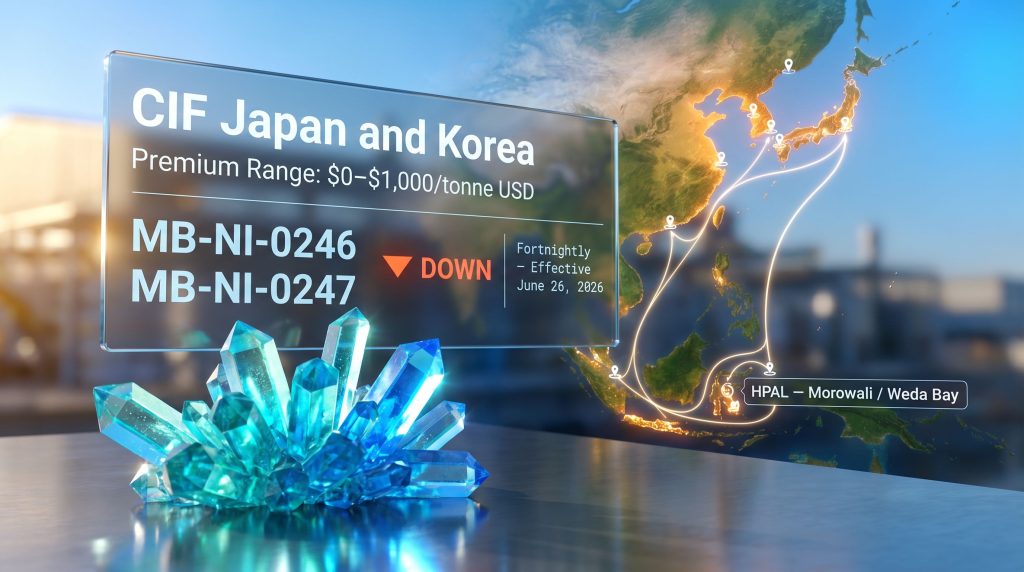
Price reporting agencies rarely reduce the publication frequency of an established benchmark without reason. When they do, it is worth paying attention, because the decision typically reflects something deeper than administrative convenience. The move to fortnightly publication of the nickel sulfate CIF Japan and Korea assessments (MB-NI-0246 and MB-NI-0247), effective June 26, 2026, is one such moment. It is not a routine update. It is a structural signal embedded within a governance process, pointing toward a market where the traditional mechanics of spot price discovery are quietly eroding.
Understanding what this change means, who it affects, and what it reveals about the battery raw materials market supply chain requires unpacking several layers of market dynamics at once.
When big ASX news breaks, our subscribers know first
Understanding CIF Pricing in the Battery-Grade Nickel Sulfate Market
In commodity markets, pricing basis matters enormously. A CIF (Cost, Insurance, and Freight) price differs from an FOB or ex-works benchmark in one critical way: it represents the all-in delivered cost of a material arriving at a specified destination port. For nickel sulfate, this destination is the major import ports of Japan and South Korea, the two countries that collectively host the largest concentration of precursor cathode active material (PCAM) manufacturing outside of China.
The two assessments affected by this change serve distinct but complementary purposes:
- MB-NI-0246 is an all-in delivered price, expressed in USD per tonne, representing the full cost of battery-grade nickel sulfate arriving CIF at Japanese and Korean ports.
- MB-NI-0247 is a premium assessment that measures the spread between that delivered price and the weekly average LME nickel cash price, isolating the value-add components layered on top of exchange-traded nickel.
The MB-NI-0247 premium captures the combined economics of chemical conversion, freight logistics, purity qualification, and regional supply-demand balance. When this premium compresses, it tells the market that battery-grade processing margins are under pressure or that supply is running ahead of demand.
This distinction matters for contract counterparties. Supply agreements indexed to MB-NI-0246 price the material in absolute terms, while those referencing MB-NI-0247 use a floating structure anchored to LME nickel, with the premium component adjusting to reflect physical market conditions.
The Specification Framework: What Has and Has Not Changed
A critical point for procurement professionals and contract managers to absorb immediately is that the physical quality specifications governing both assessments remain entirely unchanged. The frequency amendment is purely administrative in scope.
| Specification | Detail |
|---|---|
| Nickel content range | 22% minimum, 22.3% maximum |
| Cobalt ceiling | 50 ppm maximum |
| Minimum trade quantity | 1 tonne |
| Delivery basis | CIF major ports, Japan and Korea |
| Settlement window | Within 60 days |
| Pricing unit | USD per tonne |
| Price package | Fastmarkets base metals |
| New publication frequency | Fortnightly, 5:00 pm to 6:00 pm China time |
The cobalt threshold of 50 ppm is particularly significant from a battery chemistry perspective. Cathode active material manufacturers in Japan and Korea operate with extremely tight impurity tolerances, and cobalt contamination above this level can compromise electrochemical performance in NMC (nickel manganese cobalt) battery cells. The specification reflects the exacting demands of end-use battery applications rather than general industrial nickel sulfate grades.
The Consultation Timeline and Governance Process
The frequency change followed a structured and transparent governance process that is worth documenting precisely:
- May 20, 2026: Formal consultation period opened with a public proposal to amend assessment frequency.
- June 18, 2026: Consultation period closed; decision confirmed on the same date.
- June 26, 2026: Amendment took effect, with the first fortnightly publication cycle beginning.
The 29-day consultation window reflects deliberate procedural transparency. Price reporting agencies operating under frameworks such as the IOSCO Principles for Financial Benchmarks are required to consult with market participants before implementing specification changes, particularly those affecting publication frequency. Market participants who submitted confidential feedback were protected, while non-confidential responses remain available upon request through Fastmarkets' standard methodology governance channels.
Why Spot Liquidity Collapsed in This Market Corridor
The stated rationale for the frequency change is low spot liquidity and reduced price volatility in the CIF Japan and Korea nickel sulfate corridor. However, the underlying drivers are structural, not cyclical, and they deserve careful examination.
The LFP Chemistry Displacement Effect
The single most consequential force reshaping nickel sulfate demand globally is the accelerating adoption of lithium iron phosphate (LFP) cathode chemistry in electric vehicles. LFP batteries contain zero nickel. As Chinese automakers and increasingly global OEMs shift toward LFP for standard-range and entry-level vehicles, the addressable demand pool for nickel sulfate contracts at the margin.
By the mid-2020s, LFP had captured a majority share of new EV battery chemistry deployments in China, the world's largest EV market. Furthermore, this shift does not eliminate NMC demand, but it fundamentally restructures its growth trajectory, compressing the expansion of nickel sulfate consumption that was once projected to drive sustained spot market activity. The broader push towards battery storage expansion has, consequently, favoured LFP chemistry in many deployment scenarios.
The Indonesian HPAL Corridor and Relationship-Driven Trade
The second structural force is the consolidation of battery-grade nickel sulfate supply through Indonesian high-pressure acid leach (HPAL) processing facilities, predominantly located in industrial estates such as Morowali and Weda Bay. These operations have grown rapidly since 2019 and now supply the majority of battery-grade nickel sulfate reaching Northeast Asian cathode manufacturers.
Critically, this supply corridor operates primarily through long-term offtake agreements between Indonesian HPAL producers (often backed by Chinese battery material companies) and Japanese or Korean PCAM manufacturers. Monitoring Indonesian nickel trends is therefore essential for understanding how these trade flows evolve. Trade flows through these bilateral channels are largely invisible to spot price discovery mechanisms. The fewer the arm's-length transactions that occur at observable market prices, the less data is available to support statistically robust weekly assessments.
The Self-Reinforcing Liquidity Spiral
There is a well-documented dynamic in commodity price reporting where reduced liquidity leads to lower publication frequency, which in turn accelerates the migration of remaining spot participants toward bilateral negotiation, further reducing observable liquidity. Battery raw materials markets have seen this pattern before:
- Cobalt sulfate assessments underwent frequency adjustments during the 2019 to 2020 cobalt price correction as spot volumes contracted.
- Lithium hydroxide assessments in certain regional corridors have faced similar reviews during periods of severe oversupply.
The nickel sulfate CIF Japan and Korea market now appears to be entering a comparable phase. In addition, shifts in nickel price momentum have further dampened the incentive for spot market participation.
Decomposing the MB-NI-0247 Premium: A Layered Cost Anatomy
For market participants who use MB-NI-0247 as a reference price, understanding precisely what the premium measures is essential for contract design and hedging strategy. The spread between LME nickel cash and physically delivered battery-grade nickel sulfate in Northeast Asia reflects four distinct cost and value layers:
- Chemical conversion premium: Refining LME-grade nickel or mixed hydroxide precipitate (MHP) into battery-specification nickel sulfate requires acid leaching, purification, and crystallisation processes. This conversion cost constitutes the largest single component of the premium under normal market conditions.
- Freight and logistics: CIF delivery from Indonesian HPAL facilities to Japanese and Korean ports adds a logistical cost component that fluctuates with shipping rates, port congestion, and vessel availability in the Southeast Asia to Northeast Asia corridor.
- Quality and qualification premium: Not all nickel sulfate is equal. Material that has been formally qualified and approved by a specific cathode manufacturer commands a premium over unqualified supply, reflecting the time and cost of the battery manufacturer's material approval process.
- Spot supply-demand signal: When HPAL output exceeds PCAM procurement appetite, the premium compresses. When downstream demand accelerates or supply disruptions occur, the premium expands. This component makes MB-NI-0247 a real-time indicator of physical market tightness.
A directional correction was issued to the June 2026 MB-NI-0247 assessment, revising the characterisation from flat to down, while the assessed price range of $0 to $1,000 per tonne remained unchanged. In price reporting practice, directional corrections signal that the market's momentum indicator was initially mischaracterised, and their issuance reflects the rigorous data quality processes that underpin assessment integrity. In the current context, a downward directional reading combined with reduced publication frequency points toward a near-term bearish premium outlook.
The next major ASX story will hit our subscribers first
Operational Implications for Physical Market Participants
Basis Risk for Traders Holding Dual Positions
Physical traders who simultaneously hold nickel sulfate inventory positions and LME nickel hedges face a specific technical risk under the fortnightly schedule. Previously, a weekly price reset provided a relatively short window during which physical price moves and hedge positions could diverge without a reference price reset. Under fortnightly publication, this unhedged basis risk window doubles, increasing exposure to intra-period price divergence in volatile market conditions.
Contract Renegotiation Priorities
Supply agreements referencing MB-NI-0246 or MB-NI-0247 by code should be reviewed against the following checklist:
- Reset frequency clauses: Does the contract specify weekly or fortnightly pricing resets? If the agreement was drafted under the prior weekly schedule, it may require amendment.
- Averaging period definitions: Contracts that average multiple weekly assessments over a month will now have fewer data points available per averaging period.
- Fallback pricing provisions: What mechanism applies if a scheduled assessment publication date falls on a public holiday or is delayed? The fortnightly cadence reduces the number of available fallback publications.
Supply Chain Planning in Japan and Korea
Japanese and Korean PCAM manufacturers that use CIF assessments for internal transfer pricing, quarterly cost forecasting, or procurement benchmarking will need to recalibrate their models. A producer operating on a monthly procurement cycle previously had four weekly price signals to inform purchasing decisions. Under the fortnightly schedule, that number drops to two, requiring either updated internal pricing policy or revised contract language that accommodates the new publication cadence.
The Broader Supply Chain: Where This Assessment Fits
| Supply Chain Stage | Key Geography | Relevance to MB-NI-0246 and MB-NI-0247 |
|---|---|---|
| Nickel ore extraction | Indonesia, Philippines | Primary feedstock origin for HPAL |
| HPAL processing | Indonesia (Morowali, Weda Bay) | Main nickel sulfate production origin |
| Nickel sulfate refining | China, Indonesia | Battery-grade specification conversion |
| PCAM manufacturing | Japan, South Korea, China | Primary end-demand destination |
| Cathode active material | Japan, South Korea | Final battery input stage |
| EV battery cell assembly | China, Japan, South Korea, Europe | Downstream demand driver |
Long-Term Outlook: Can Nickel Sulfate Demand Recover?
The structural headwinds facing the CIF Japan and Korea nickel sulfate market are real, but they are not necessarily permanent. Several scenarios could re-accelerate nickel sulfate demand and restore the spot liquidity needed to support weekly price discovery:
- High-nickel NMC revival: NMC 811 (80% nickel, 10% manganese, 10% cobalt) and emerging NMC 9-series cathodes require substantially more nickel per kWh than earlier formulations. Premium EV segments, including performance vehicles and long-range platforms, continue to favour high-nickel chemistry.
- Solid-state battery commercialisation: Several Japanese battery manufacturers, including Toyota, have publicly targeted solid-state battery commercialisation timelines that centre on high-nickel cathode architectures, which could reinvigorate Northeast Asian nickel sulfate demand materially if timelines are met.
- Grid-scale energy storage growth: While LFP dominates stationary storage at present, high-energy-density NMC configurations are being evaluated for space-constrained grid applications, representing a potential incremental demand channel.
- A battery recycling breakthrough could, furthermore, alter the economics of nickel sulfate supply by reintroducing recovered material into the battery-grade stream, potentially reshaping spot market volumes over time.
Disclaimer: The scenarios above represent speculative market pathways based on publicly available industry forecasts and technology development timelines. They do not constitute investment advice and are subject to significant uncertainty.
Why PRA Methodology Transparency Is Now a Compliance Imperative
For any organisation with contractual exposure to MB-NI-0246 or MB-NI-0247, monitoring Fastmarkets pricing notices is no longer optional. The June 2026 frequency change illustrates how a benchmark specification update can ripple through contract mechanics, hedging frameworks, and procurement processes simultaneously.
Best practice protocol for procurement and legal teams includes:
- Establishing an internal alert system for Fastmarkets methodology and pricing notices relevant to referenced benchmark codes.
- Reviewing all supply agreements referencing these codes against the updated fortnightly publication schedule before the next pricing period.
- Consulting Fastmarkets' published methodology documentation to understand the full governance framework, including data submission processes and confidential feedback protections.
Market participants who wish to contribute price data to these assessments, or provide feedback on the revised methodology, can engage directly through Fastmarkets' designated pricing team contacts, ensuring the broadest possible market view is captured in each fortnightly publication.
Frequently Asked Questions
What is the difference between MB-NI-0246 and MB-NI-0247?
MB-NI-0246 is an all-in delivered price for battery-grade nickel sulfate arriving CIF at major Japanese and Korean ports, expressed in USD per tonne. MB-NI-0247 measures the spread of that delivered price above the LME nickel cash weekly average, isolating the processing, logistics, and quality premium components from the underlying exchange price.
Why did the assessment frequency change from weekly to fortnightly?
Insufficient spot market transaction volume and reduced price volatility in the CIF Japan and Korea corridor meant that observable arm's-length data was no longer sufficient to support statistically robust weekly assessments. A formal consultation process confirmed the frequency reduction was appropriate.
Do the quality specifications change under the new schedule?
No. The nickel content range of 22% to 22.3% and the cobalt ceiling of 50 ppm remain intact. Only the publication cadence has been amended.
When are the assessments now published?
Both MB-NI-0246 and MB-NI-0247 are now published fortnightly between 5:00 pm and 6:00 pm China time, effective June 26, 2026.
What should contract counterparties do now?
Review all supply agreements referencing either code to assess whether reset frequency clauses, averaging period definitions, or fallback pricing provisions require amendment to align with the fortnightly publication schedule.
Want To Stay Ahead of Significant ASX Mineral Discoveries Before the Broader Market Notices?
Discovery Alert's proprietary Discovery IQ model delivers real-time alerts on significant ASX mineral discoveries, translating complex commodity data across more than 30 materials into clear, actionable insights for both traders and long-term investors — explore historic discovery returns on the Discovery Alert discoveries page to understand the opportunity, then begin your 14-day free trial to position yourself ahead of the market.