August 21, 2026
The Structural Mechanics Behind Asia's Most Watched Capital Markets Move
When capital markets evolve, they rarely do so in isolation. The instruments, frameworks, and venues that gain or lose relevance are shaped by forces far larger than any single company or transaction. Depositary receipts, in their various forms, have played a pivotal role in connecting domestic-listed companies to offshore pools of institutional capital for nearly a century. Yet the Hong Kong variant of this instrument has remained largely dormant since 2014, surviving only through a single issuer while its American counterpart became a cornerstone of global equity markets. The proposed listing of Merdeka Gold Hong Kong depositary receipts has the potential to change that dynamic entirely, and in doing so, redefine how Southeast Asian resource companies access international capital.
When big ASX news breaks, our subscribers know first
Understanding the HDR Instrument: Structure, Purpose, and Precedent
How Hong Kong Depositary Receipts Actually Work
A Hong Kong Depositary Receipt functions as a traded financial instrument on the Hong Kong Stock Exchange (HKEX) that provides economic exposure to shares in a foreign-listed company. Crucially, the issuing company is not required to establish a share register in Hong Kong or issue new shares under local law. This structural design was deliberately crafted to accommodate companies domiciled in markets where domestic regulation prohibits the direct issuance of shares to foreign investors or the maintenance of an offshore share registry.
Introduced by HKEX in 2008, HDRs were modelled conceptually on the American Depositary Receipt (ADR) system, which has operated since 1927 and facilitated billions of dollars in cross-border capital flows annually. However, the two instruments have diverged dramatically in terms of adoption and market depth. Furthermore, the Hong Kong mining finance ecosystem has been actively developing frameworks to support exactly these kinds of cross-border instruments.
| Feature | HDR (Hong Kong) | ADR (United States) | Standard Dual Listing |
|---|---|---|---|
| Underlying instrument | Depositary receipt | Depositary receipt | Actual shares |
| Share register abroad | Not required | Not required | Required |
| Market adoption | Extremely limited | Widely adopted globally | Common globally |
| Year introduced | 2008 | 1927 | Varies by market |
| Primary regulatory driver | Home market share issuance restrictions | Offshore market access | Capital raising flexibility |
The Indonesian regulatory environment is a textbook example of why HDRs exist. Indonesian corporate law has historically constrained the ability of locally listed companies to issue shares directly on foreign exchanges or maintain parallel share registers overseas. For a company like PT Merdeka Gold Resources Tbk, the HDR structure is not merely a preference but the legally compliant pathway to accessing Hong Kong capital markets at scale.
The HKEX-Indonesia Cooperation Agreement: A Quiet Regulatory Enabler
A frequently overlooked structural prerequisite for this transaction is the cooperation agreement signed between HKEX and the Indonesia Stock Exchange in 2023. This bilateral framework was designed to explore and facilitate cross-border listings between the two markets, representing a deliberate strategic push by Hong Kong to broaden its issuer base beyond mainland Chinese and locally domiciled companies. Southeast Asia had been explicitly identified as a priority recruitment region for new listings, and the Indonesia agreement was an early and concrete expression of that ambition.
The HDR's Troubled History: Twelve Years of Declining Relevance
From Debut to Near-Dormancy
The HDR instrument's trajectory since its 2008 launch is a case study in how financial instruments can struggle to achieve self-sustaining liquidity. The initial wave of listings generated considerable institutional interest, but trading volumes deteriorated steadily as early adopters discovered that price discovery remained anchored to the primary listing exchange, creating persistent arbitrage friction that deterred active secondary market participation.
High-profile departures accelerated the instrument's credibility decline. Both Tapestry Inc., the parent company of the Coach luxury brand, and Glencore Plc, one of the world's largest commodity trading and mining groups, delisted their HDRs after failing to achieve meaningful trading activity. These departures sent a clear signal to prospective issuers that the HDR vehicle carried structural liquidity risks that could not easily be resolved through marketing effort alone.
By 2014, when Fast Retailing Co., the Japanese operator of the Uniqlo clothing brand (ticker: 6288.HK), debuted its HDRs, the market had already narrowed considerably. Fast Retailing's listing has since become the sole surviving active HDR in Hong Kong, and its trading data reveals a stark picture of the instrument's ongoing challenges.
The Fast Retailing Data: A Cautionary Benchmark
| Metric | First Year of HDR Trading | Recent Monthly Average (2026) |
|---|---|---|
| Average daily HDR volume (Hong Kong) | ~198,000 HDRs | ~8,600 HDRs |
| Average daily share volume (Tokyo Stock Exchange) | Not comparable | ~1.2 million shares |
| Implied Hong Kong liquidity as share of Tokyo volume | Not comparable | ~0.7% |
The numbers are unambiguous. Hong Kong HDR trading volume for Fast Retailing has declined to roughly 4.3% of its first-year average, while the primary Tokyo listing continues to attract volumes approximately 140 times greater than its Hong Kong depositary receipt counterpart.
Kenny Ng, a strategist at China Everbright Securities International Co., has noted that trading inactivity tends to become self-reinforcing over time, as declining volumes discourage institutional participation, which in turn further erodes liquidity. His view is that the near-term trajectory for thin-volume HDRs is unlikely to reverse without a meaningful catalyst, specifically the arrival of high-profile issuers capable of attracting a different quality of institutional demand.
This observation is critical context for assessing Merdeka Gold's proposed transaction. The question is not simply whether the company can raise US$500 million at listing, but whether the HDR instrument can, over time, sustain sufficient secondary market liquidity to validate the structure for future issuers.
PT Merdeka Gold Resources: Company Profile and Capital Markets Context
From Indonesia's Largest 2025 IPO to a US$6 Billion Market Capitalisation
PT Merdeka Gold Resources Tbk operates as a subsidiary of PT Merdeka Copper Gold, one of Indonesia's most prominent diversified mining groups with significant gold and copper assets across the archipelago. The company's Jakarta IPO in September 2025 was Indonesia's largest initial public offering of that year, immediately establishing it as a benchmark transaction for the domestic market.
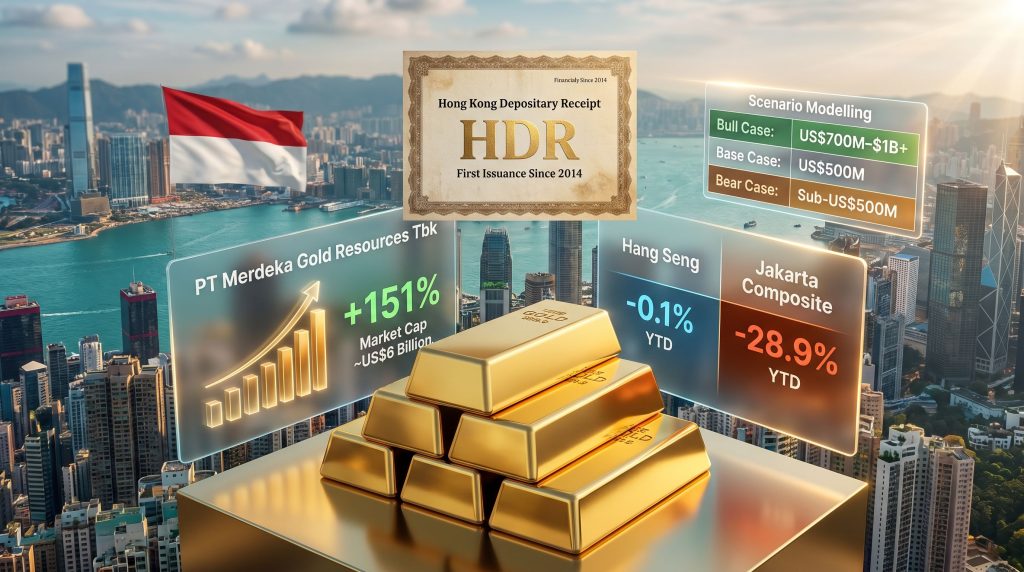
Since that debut, Merdeka Gold shares have appreciated by approximately 151%, driving the company's market capitalisation to roughly US$6 billion at the time of reporting. This performance has occurred despite a broader Jakarta market in significant distress, which speaks directly to the company's perceived asset quality and the strength of investor appetite for gold exposure in the current macroeconomic environment.
Gold futures were trading above US$4,700 per troy ounce at the time of this article's publication, a level that amplifies both the strategic logic and the capital-raising potential of the proposed Hong Kong transaction. In addition, the gold price outlook remains a central variable influencing the deal's ultimate valuation and final fundraising quantum during the book-building period.
Indonesia's Gold Sector: Structural Advantages for Regional Investors
Indonesia's geological endowment in gold is substantial. The country sits within the highly productive Sunda Arc, a volcanic belt stretching through Sumatra, Java, and the Lesser Sunda Islands, which has generated significant epithermal gold-silver and porphyry copper-gold deposits. This tectonic setting, characterised by subduction-related magmatism, creates the hydrothermal systems responsible for gold mineralisation at scale.
For regional investors, Indonesian gold assets offer exposure to a jurisdiction with established production infrastructure, proximity to Asian refining and processing capacity, and a regulatory framework that, despite its complexity, has supported major international mining investment over multiple decades. The combination of geological prospectivity and operational scale makes Indonesian gold a compelling commodity investment thesis within a pan-Asian portfolio context.
Why Jakarta's Deterioration Makes Hong Kong Strategically Essential
The Jakarta Composite: A Benchmark in Freefall
The structural catalyst for Merdeka Gold's offshore listing ambitions cannot be separated from the dramatic underperformance of Indonesia's domestic equity market. The Jakarta Composite Index has declined approximately 28.9% year-to-date in 2026, making it the worst-performing major stock benchmark globally during this period. This is not a routine correction but a confluence of structural pressures:
- Fiscal discipline concerns that have raised questions about Indonesia's sovereign creditworthiness
- The risk of an MSCI Inc. market reclassification, which would have severe consequences for index-tracking capital flows into Indonesian equities
- Potential sovereign credit rating downgrade risk, which could increase the cost of capital for Indonesian corporates broadly
- Free-float, liquidity, and transparency deficiencies that have drawn critical attention from global institutional investors
Mohit Mirpuri, a partner at SGMC Capital Pte., has articulated the strategic logic clearly: the MSCI situation has exposed structural weaknesses in Indonesia's equity market that make offshore listing access not a luxury but a practical necessity for companies seeking to maintain access to global institutional capital. A Hong Kong listing offers a credibility signal that extends well beyond the immediate fundraising, implicitly communicating a commitment to international governance and disclosure standards.
Hong Kong as a Stable Counterpoint
Against Jakarta's turbulence, Hong Kong's relative stability is striking. The Hang Seng Index is down only 0.1% year-to-date, and Hong Kong's overall listing proceeds in 2026 are on track to exceed the four-year high set in 2025. The city's capital markets are experiencing a genuine renaissance, driven partly by the same macro forces, including elevated commodity prices and increased regional investor risk appetite, that make a gold miner's debut particularly well-timed. Consequently, the gold market outlook for Asian investors remains central to understanding precisely why Hong Kong has re-emerged as the preferred venue for resource sector capital raising.
Scenario Analysis: Three Possible Outcomes for the Merdeka HDR Transaction
| Scenario | Key Conditions | Likely Outcome |
|---|---|---|
| Bull Case | Gold prices recover toward cycle highs, strong long-only institutional demand, cornerstone investor commitments secured | US$700M to US$1B+ raised; HDR revival narrative gains momentum; pipeline of Southeast Asian HDR candidates accelerates |
| Base Case | Gold prices stable, moderate institutional interest, HDR structure accepted with limited enthusiasm | US$500M raised at listing; transaction completes successfully but secondary market liquidity remains thin; market watches 90-day trading volumes closely |
| Bear Case | Gold price weakness, HDR liquidity concerns dominate investor feedback, book-building disappoints | Sub-US$500M raised or transaction postponed; HDR instrument remains dormant; HKEX reconsiders structural incentives for future candidates |
The range of outcomes reflects the compounding uncertainties inherent in this transaction. Gold price sensitivity is particularly acute given that bullion has already retreated from its March 2026 peaks following geopolitical developments, including the onset of the Iran conflict and associated market repricing. Any further deterioration in the gold price before book-building commences could meaningfully reduce the achievable valuation multiple and therefore the total proceeds.
The next major ASX story will hit our subscribers first
The Broader Implications for Asian Capital Markets
A Proof-of-Concept for Southeast Asian Issuers
The significance of this transaction extends far beyond Merdeka Gold itself. Several other Southeast Asian and non-Chinese companies are reportedly monitoring the outcome closely before committing to their own HDR filings. Jeckle Chiu, a partner advising on transactions at Johnson Stokes & Master, has noted that companies pursuing HDR structures have typically been those required by home market regulation to use this route rather than companies seeking maximum secondary market liquidity.
If Merdeka Gold's HDR generates sustained trading activity and institutional engagement, it would fundamentally change the cost-benefit calculus for other potential issuers. Furthermore, the broader metals and mining geopolitics context is actively reshaping which capital markets destinations Asian resource companies prioritise.
Other companies already in the HKEX pipeline from Indonesia include PT MNC Digital Entertainment, part of an Indonesian media conglomerate, and the China operations of Italian industrial manufacturer Carraro Group, illustrating that Merdeka Gold is not an isolated case but part of a broader wave of non-Chinese issuers targeting Hong Kong.
Zijin Gold's US$3.2 billion Hong Kong IPO provides a useful sector benchmark for investor appetite in the gold mining space, demonstrating that Hong Kong institutional investors can absorb large-scale mining equity transactions when the asset quality and price environment are supportive.
Investor Risk Framework: What HDR Buyers Must Understand
Prospective investors in Merdeka Gold Hong Kong depositary receipts should carefully consider a layered set of risk factors that differ meaningfully from ordinary share investments:
-
Liquidity risk: The Fast Retailing precedent demonstrates that HDR secondary market volumes can collapse to a fraction of primary exchange activity, potentially trapping investors in illiquid positions during periods of market stress.
-
Price discovery and arbitrage friction: Because the underlying shares trade primarily in Jakarta, the HDR price is subject to dislocations driven by currency movements (Indonesian Rupiah versus Hong Kong Dollar), time zone differences, and the mechanical costs of arbitrage between the two markets.
-
Gold price sensitivity: Both the post-listing valuation and the strategic rationale for the company are directly linked to gold price trajectories. A sustained decline in bullion prices would compress the company's earnings multiple and potentially trigger secondary market selling pressure in the HDR.
-
Indonesian regulatory and sovereign risk: The MSCI reclassification risk, potential credit rating downgrade, and evolving Indonesian mining regulatory framework remain material overhanging risks for any investor with exposure to Indonesian-domiciled assets.
-
Book-building composition: The proportion of long-only institutional investors versus short-term hedge fund participation in the IPO book will significantly influence post-listing trading behaviour and price stability.
Frequently Asked Questions: Merdeka Gold Hong Kong Depositary Receipts
What are Hong Kong depositary receipts and how do they work?
A Hong Kong Depositary Receipt is a financial instrument listed and traded on the Hong Kong Stock Exchange that provides economic exposure to the underlying shares of a foreign-listed company. The issuing company does not need to create a Hong Kong share register or issue new shares under local law. HKEX introduced the instrument in 2008 to provide a compliant listing pathway for companies from markets where domestic regulations prohibit direct overseas share issuance. HDRs are conceptually similar to American Depositary Receipts but have achieved far more limited market adoption.
Why is Merdeka Gold using an HDR structure rather than a conventional Hong Kong IPO?
Indonesian corporate and securities regulations constrain the ability of Jakarta-listed companies to issue new shares directly on foreign exchanges or maintain an overseas share register. The HDR structure was specifically designed to resolve this regulatory constraint, making it the legally compliant vehicle for Indonesian issuers seeking Hong Kong exchange access without restructuring their corporate architecture.
How much capital is Merdeka Gold targeting through the Hong Kong listing?
The reported minimum fundraising target is US$500 million, though sources familiar with the transaction indicate that the final proceeds will be materially influenced by gold price movements between now and the close of the book-building process. Deliberations on size and timing were described as ongoing at the time of reporting.
When was the last Hong Kong depositary receipt debut before this transaction?
Fast Retailing Co., the Japanese parent of the Uniqlo clothing brand, listed HDRs in Hong Kong in 2014, representing a gap of approximately 12 years to Merdeka Gold's proposed transaction.
How has Merdeka Gold performed since its Jakarta IPO?
Since debuting on the Jakarta Stock Exchange in September 2025 in what was described as Indonesia's largest IPO of that year, Merdeka Gold shares have appreciated by approximately 151%, giving the company a market capitalisation of roughly US$6 billion. Shares have retreated from their March 2026 peaks following gold price weakness linked to geopolitical developments.
Key Transaction Data: Merdeka Gold HDR at a Glance
| Data Point | Detail |
|---|---|
| Issuer | PT Merdeka Gold Resources Tbk |
| Parent company | PT Merdeka Copper Gold |
| Primary listing venue | Jakarta Stock Exchange |
| Jakarta IPO date | September 2025 |
| Proposed Hong Kong instrument | Hong Kong Depositary Receipts (HDRs) |
| Reported minimum fundraising target | US$500 million |
| Market capitalisation at reporting | ~US$6 billion |
| Share price appreciation since Jakarta IPO | ~151% |
| Last prior HDR listing in Hong Kong | Fast Retailing Co. (Uniqlo), 2014 |
| HDR instrument introduced | 2008 |
| Jakarta Composite Index YTD performance | -28.9% (worst-performing major index globally) |
| Hang Seng Index YTD performance | -0.1% |
| Gold Futures price at time of publication | Above US$4,700/ozt |
A Structural Inflection Point, Regardless of Outcome
Whether the Merdeka Gold Hong Kong depositary receipts transaction closes at its minimum target, significantly exceeds it, or faces delays from adverse gold price movements, the transaction itself has already reshaped the conversation around cross-border listing architecture in Asia. It has forced institutional investors, legal practitioners, and exchange officials to revisit an instrument that many had quietly written off as a structural curiosity.
The dual test embedded in this transaction is genuinely consequential. First, it will reveal whether Hong Kong's institutional investor base has the depth and willingness to support non-Chinese mining issuers at meaningful scale. Second, it will determine whether the HDR instrument can evolve from a regulatory workaround into a genuinely liquid and credible capital markets vehicle.
For Southeast Asian resource companies evaluating their long-term capital market strategies, the outcome will provide irreplaceable empirical data. A successful listing with sustained secondary market liquidity would compress the perceived risk premium associated with the HDR structure and open a viable pathway for a pipeline of Indonesian and broader regional issuers. However, a disappointing outcome would reinforce the caution that has kept the instrument dormant for over a decade. In addition, the global mining market trends emerging across multiple jurisdictions suggest that appetite for well-structured offshore listings remains robust among institutional investors.
The structural significance of this moment in Asian mining finance should not be underestimated. The decisions made in Hong Kong's book-building rooms in the coming weeks will reverberate through capital markets boardrooms across Southeast Asia for years.
This article is for informational purposes only and does not constitute financial advice or a solicitation to invest in any security mentioned. Forecasts, scenario projections, and market analysis represent assessments based on publicly available information and are subject to change. Investors should conduct their own due diligence and seek independent financial advice before making investment decisions.
Want to Catch the Next Major Mineral Discovery Before the Broader Market Does?
While cross-border capital market structures like HDRs reshape how resource companies access institutional funding, Discovery Alert's proprietary Discovery IQ model delivers real-time alerts on significant ASX mineral discoveries the moment they hit the exchange — translating complex geological and commodity data into actionable investment insights for both short-term traders and long-term investors. Explore how historic discoveries have generated extraordinary returns on Discovery Alert's dedicated discoveries page, and begin your 14-day free trial today to secure a genuine market-leading edge.