July 29, 2026
The Metallurgical Foundation of Critical Mineral Control
The global economy's transition toward electrification has created unprecedented demand for specialized materials that exist in abundance geologically but require extraordinary technical expertise to refine into usable products. This structural reality has positioned certain nations at critical chokepoints in industrial supply chains, where control over processing technology and metallurgical knowledge determines strategic influence far beyond what raw material extraction alone could provide.
Understanding how these processing advantages develop and persist requires examining the intersection of chemistry, economics, and industrial policy across decades of sustained investment. The rare earth sector exemplifies this dynamic most clearly, where China's rare earth processing advantage has created a template for strategic resource control that extends well beyond geological endowments.
When big ASX news breaks, our subscribers know first
China's Structural Framework for Critical Material Refinement
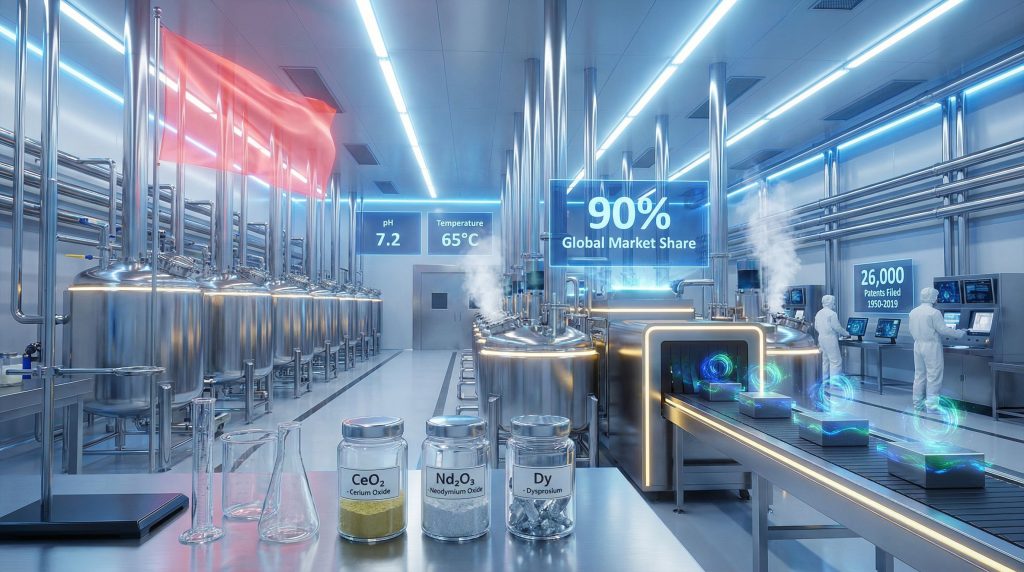
The concentration of rare earth processing capacity within Chinese facilities represents one of modern industry's most significant supply chain asymmetries. Current data indicates that Chinese operations control approximately 85-90% of global rare earth refining capacity, transforming raw concentrates from mines worldwide into the purified materials essential for permanent magnets, catalysts, and electronic components.
This dominance extends far beyond simple market share statistics. The technical infrastructure required for rare earth separation includes specialized extraction equipment, trained metallurgical personnel, quality control laboratories, and environmental management systems that collectively represent $500 million to $2 billion in capital investment for new facilities. Furthermore, the complexity of these requirements creates natural barriers to entry that persist even when competing nations possess adequate geological resources.
China's processing facilities typically achieve operational efficiency levels that international competitors struggle to match. Modern Chinese separation plants process 50,000-100,000 tons of rare earth concentrates annually while maintaining recovery rates between 92-97% depending on target purity specifications. These efficiency metrics reflect decades of accumulated operational experience and continuous process optimization that newer facilities in other jurisdictions have not replicated.
The financial scale of this processing advantage translates into substantial revenue streams. China's rare earth processing industry generates estimated annual revenues of $2.5-3.2 billion USD, with operational margins significantly exceeding international competitors due to integrated cost advantages across multiple operational categories. The industry directly employs approximately 15,000-20,000 technical workers concentrated primarily in Jiangxi, Guangdong, and Inner Mongolia provinces.
Patent analysis reveals the depth of China's accumulated technical expertise. Chinese institutions hold approximately 26,000 rare earth-related patents filed between 1950-2019, compared to Japan's 13,920 patents and the United States' 9,810 patents during the same period. This intellectual property concentration reflects sustained research and development investment that created proprietary advantages in extraction chemistry, equipment design, and process optimization.
The Technical Complexity Behind Separation Technologies
Rare earth processing represents a unique category of metallurgical challenge requiring both theoretical understanding and empirical optimization. The fundamental difficulty stems from the chemical similarity of the seventeen rare earth elements, which include fifteen lanthanides plus scandium and yttrium. These elements possess atomic radii ranging from 100.1 picometers for lanthanum to 86.1 picometers for lutetium, creating minimal variation in physical and chemical properties that makes individual separation technically demanding.
Multi-Stage Extraction Requirements
The separation process employs solvent extraction technology using organic molecules called extractants that selectively bind rare earth elements from aqueous solutions. Distribution coefficients, which measure the relative preference of extractant molecules for different elements, typically range from 1.2:1 to 4:1 between adjacent rare earth elements in modern extraction systems. This narrow separation factor necessitates multiple sequential stages to achieve high purity materials.
Modern processing facilities operate 40-60+ extraction stages in series, with each stage designed to further concentrate target elements while rejecting unwanted materials. Individual extraction stages operate at residence times of 2-10 minutes, requiring precise flow control systems and consistent temperature maintenance within ±2°C specifications. The complexity of maintaining these parameters across dozens of sequential stages represents a significant operational challenge that requires skilled personnel and sophisticated control systems.
Chemical Processing Infrastructure
The equipment specifications for rare earth processing demonstrate the capital intensity of these operations. Extraction columns must handle 5,000-50,000 liters per hour of processing solution depending on the specific stage and throughput requirements. These vessels require construction from corrosion-resistant materials, typically stainless steel with specialized coatings, due to the aggressive chemical environment created by acidic solutions and organic solvents.
Quality control infrastructure represents another significant capital requirement. Complete analytical laboratories require inductively coupled plasma mass spectrometry (ICP-MS), X-ray fluorescence (XRF), and high-performance liquid chromatography (HPLC) equipment for verifying purity specifications. The instrumentation costs for comprehensive quality control typically range from $500,000 to $1.5 million USD, representing a substantial barrier for smaller operations.
Environmental containment systems add additional complexity and cost. Processing facilities must implement closed-loop solvent recovery systems that achieve 95-98% organic extractant recovery through distillation columns and specialized separation equipment. These systems require significant ongoing energy costs for solvent regeneration while meeting increasingly stringent environmental regulations regarding organic waste disposal.
Radioactive Byproduct Management
Many rare earth ores contain uranium and thorium at concentrations of 0.1-2% by weight, creating specialized handling requirements throughout the processing chain. During acid leaching of ore concentrates, radioactive elements dissolve alongside rare earth elements, requiring specific precipitation stages and waste management protocols. The regulatory requirements for radioactive byproduct handling exist globally but are implemented more stringently in Western jurisdictions than in Chinese facilities, creating operational cost differentials.
Chinese processing facilities benefit from regulatory frameworks that permit radioactive waste management approaches that would require more expensive containment and disposal methods in North American and European jurisdictions. This regulatory arbitrage contributes to processing costs as low as $11 per kilogram for certain rare earth oxides produced in Chinese facilities compared to $16-22 per kilogram for equivalent materials processed in Western nations.
Economic Structures Enabling Cost Leadership
The cost advantages enjoyed by Chinese rare earth processing operations stem from multiple structural factors that create cumulative competitive benefits extending far beyond simple labor cost differentials. While wage disparities contribute to cost advantages, their impact is smaller than commonly assumed due to the capital-intensive nature of modern processing technology.
Labor and Technical Personnel Costs
Hourly wages for technical personnel in Chinese rare earth processing facilities range from $3-6 USD per hour compared to $20-35 USD per hour in the United States and $22-40 USD per hour in Western Europe. However, labor typically represents only 12-18% of total processing costs in modern facilities, meaning labor cost differentials contribute approximately 2-4% to overall cost structure advantages rather than the 15-25% reduction sometimes cited in policy discussions.
The more significant advantage lies in the availability of trained metallurgical personnel. Chinese universities graduate approximately 3,000-4,000 metallurgical engineers annually with specialized training in hydrometallurgy and extraction processes. This educational infrastructure ensures consistent personnel availability for facility expansion and replacement, while international competitors often struggle to recruit qualified technical staff for rare earth operations.
Energy and Infrastructure Advantages
Energy costs represent 25-35% of total processing expenses in rare earth facilities due to the energy-intensive nature of chemical separation, solvent recovery, and environmental control systems. Chinese industrial electricity rates for rare earth processors range from $0.06-0.09 USD per kWh compared to $0.12-0.18 USD per kWh in competing jurisdictions, creating substantial operational cost advantages.
Government electricity subsidies for strategic industries further reduce effective energy costs for Chinese processors. These subsidies, provided through state-owned utilities, effectively reduce processing costs by an additional 8-12% compared to facilities operating under market-rate electricity pricing. The cumulative impact of subsidized energy creates cost advantages that persist regardless of global electricity market conditions.
Transportation infrastructure provides additional cost benefits. Integrated rail and shipping networks reduce logistics costs for raw material inputs and finished product distribution. Chinese processors benefit from $50-80 per ton lower transportation costs compared to geographically isolated facilities in Australia, North America, or other processing locations. For facilities processing 50,000+ tons annually, these logistics advantages translate into $2.5-4 million USD annual cost savings.
Chemical Supply Chain Integration
The availability of processing chemicals represents a critical cost factor often overlooked in competitive analyses. Rare earth separation requires specialized extractants, complexing agents, and process chemicals that are produced by a limited number of global suppliers. Chinese processors benefit from domestic chemical production that reduces import costs, eliminates currency exchange risks, and provides shorter supply chains.
Chemical costs typically represent 15-20% of total processing expenses. Chinese facilities achieve 10-15% lower chemical costs compared to international competitors due to domestic sourcing advantages and volume purchasing arrangements with Chinese chemical manufacturers. These chemical cost advantages compound over time as processing volumes increase and long-term supply agreements provide price stability.
Vertical Integration and Supply Chain Control
China's strategic advantage extends beyond processing into comprehensive control of downstream manufacturing operations that convert refined rare earth materials into finished industrial products. This vertical integration creates structural dependencies that persist even when alternative processing capacity is developed in other regions.
Downstream Manufacturing Dominance
Chinese manufacturers control approximately 90% of global permanent magnet production using neodymium, praseodymium, dysprosium, and terbium processed from rare earth concentrates. This manufacturing capacity includes both the technical knowledge required for magnet metallurgy and the production infrastructure capable of meeting global demand for electric vehicle motors, wind turbine generators, and electronic device applications.
The integration advantages extend into specialized applications where technical expertise and production capacity are closely linked:
• Catalyst manufacturing: 75% global capacity for automotive and industrial catalysts
• Polishing compounds: 85% global production of cerium-based precision polishing materials
• Electronic phosphors: 80% global capacity for display and lighting applications
• Advanced ceramics: 70% global production of rare earth-enhanced ceramic materials
Strategic Bottleneck Creation
Even mining operations located outside China frequently depend on Chinese processing facilities to convert ore concentrates into market-ready materials. The Mountain Pass mine in California, operated by MP Materials, historically required shipping concentrates to Chinese facilities for separation into individual rare earth elements. While MP Materials has since developed domestic processing capability, the historical dependency illustrates how processing bottlenecks create strategic vulnerabilities.
The Lynas Rare Earths operation in Australia demonstrates the challenges of establishing independent processing chains. Despite operating the Mount Weld mine and processing facility in Malaysia, Lynas has struggled to achieve consistent profitability due to higher processing costs and limited access to downstream manufacturing markets dominated by Chinese companies. The facility completed in 2012 at a capital cost of approximately $1 billion AUD operates at costs 40-60% higher than equivalent Chinese operations.
Market Leverage Through Supply Chain Position
Chinese processors employ their supply chain position to influence global rare earth pricing through production adjustments and inventory management. During periods of international competition or geopolitical tension, Chinese facilities can increase production to flood global markets, making new processing investments economically unattractive for international competitors. In addition, China export controls strategies demonstrate how supply chain dominance enables broader strategic influence.
This market leverage was demonstrated during 2010-2012 when Chinese export restrictions created rare earth price increases of 300-2000% for individual elements. When restrictions were subsequently relaxed, prices declined to levels that made many proposed international processing projects economically unviable. The cycle illustrates how supply chain control enables market manipulation that extends beyond normal competitive dynamics.
Government Policy and Strategic Industrial Development
China's rare earth processing advantage reflects decades of coordinated industrial policy that treated these materials as strategic resources requiring state support and protection. The policy framework encompasses technology development, market protection, export controls, and international investment restrictions that collectively maintain Chinese advantages.
Technology Transfer and Investment Restrictions
Chinese regulations limit foreign investment in rare earth processing facilities and restrict technology transfer related to separation equipment and extraction processes. The Catalogue of Industries for Guiding Foreign Investment classifies rare earth processing as a restricted sector where foreign ownership is limited to minority stakes and subject to government approval. These restrictions prevent international competitors from accessing Chinese technical expertise while protecting domestic technological advantages.
Export licensing requirements for separation equipment create additional barriers to technology dissemination. Chinese manufacturers of extraction columns, solvent recovery systems, and specialized processing equipment require government approval for international sales. These controls prevent competitors from purchasing state-of-the-art Chinese processing technology while protecting the technical advantages that Chinese facilities have developed.
Strategic Stockpiling and Market Intervention
The Chinese government maintains strategic rare earth stockpiles estimated at 30,000-50,000 tons of refined materials, equivalent to 6-12 months of global consumption for certain elements. These stockpiles provide market intervention capability during periods of supply disruption or price volatility. The government can release strategic inventory to suppress prices during international competition or withhold supply to create market tightness when strategically advantageous.
Credit subsidies for domestic processors during market downturns provide additional competitive advantages. State-owned banks offer processing facilities low-interest loans during periods of low rare earth prices, enabling Chinese operators to maintain production when international competitors reduce operations or exit the market. These subsidies effectively socialize losses during downturns while privatizing profits during favorable market conditions.
Export Quotas and Resource Nationalism
Although China eliminated formal rare earth export quotas in 2015 following World Trade Organization disputes, the government retains multiple policy tools for influencing global supply. Export licensing, environmental inspections, production quotas, and tax policies collectively provide supply control mechanisms that can be adjusted based on strategic considerations rather than purely economic factors.
Resource tax policies favor domestic processing over raw material exports. Higher tax rates on rare earth concentrates compared to processed materials encourage value-added domestic processing while discouraging the export of unprocessed ores that could support international processing development. This tax structure reinforces China's rare earth processing advantage by making raw material exports less attractive economically.
The next major ASX story will hit our subscribers first
International Response and Diversification Challenges
Western nations and allied countries have recognised the strategic vulnerabilities created by Chinese rare earth processing dominance and have initiated multiple programmes aimed at developing alternative processing capacity. However, these efforts face substantial technical, economic, and timeline challenges that illustrate the difficulty of rapidly establishing competitive alternatives.
United States Diversification Initiatives
The U.S. Department of Defense has invested approximately $500 million since 2019 in domestic rare earth processing capacity through various programmes including the Defense Production Act and strategic partnership initiatives. Key investments include funding for MP Materials' processing expansion at Mountain Pass, research grants for alternative separation technologies, and partnerships with allied nations for supply chain development.
The CHIPS and Science Act allocated additional funding for critical mineral processing research and development, with specific emphasis on rare earth separation technologies that could reduce dependence on Chinese processing capacity. However, the timeline for developing competitive domestic processing extends 7-10 years from initial investment to full operational capability, meaning near-term supply chain independence remains elusive.
Private sector initiatives include partnerships between technology companies and mining operations aimed at securing dedicated rare earth supplies. Apple, Tesla, and other manufacturers have announced supply agreements with non-Chinese processors, though these arrangements typically involve premium pricing 20-40% above Chinese market rates to compensate for higher processing costs. Meanwhile, broader energy transition impact considerations drive continued investment in alternative supply chains.
European Union Strategic Autonomy Programmes
The Critical Raw Materials Act implemented by the European Union establishes targets for domestic processing capacity covering 40% of EU rare earth consumption by 2030. The legislation includes funding for public-private partnerships, research and development grants, and regulatory streamlining for processing facility development. However, achieving these targets requires overcoming significant technical and economic obstacles.
European processing initiatives face particular challenges related to environmental regulations and energy costs. Rare earth processing generates radioactive waste streams and requires energy-intensive separation processes that conflict with EU climate goals and environmental standards. Balancing environmental protection with strategic resource security creates regulatory complexity that increases facility development timelines and operational costs. Furthermore, the European CRM facility initiatives demonstrate the regional approach to addressing supply chain vulnerabilities.
The European Raw Materials Alliance coordinates private sector investment in processing capacity, with announced projects totaling approximately €2.5 billion in planned investments through 2030. However, these projects remain in early development stages with uncertain commercial viability given current cost structure disadvantages compared to Chinese operations.
Technical and Economic Implementation Barriers
International processing facilities consistently face capital requirements 40-60% higher than equivalent Chinese operations due to stricter environmental standards, higher construction costs, and limited availability of specialised equipment and technical expertise. New processing facilities require $500 million to $2 billion initial investment with 5-7 year construction and commissioning timelines before reaching full operational capacity.
The technical expertise required for rare earth processing represents a critical constraint for international development efforts. Universities in the United States and Europe graduate fewer than 500 metallurgical engineers annually with relevant hydrometallurgy training, compared to 3,000-4,000 graduates annually in China. This human capital deficit creates ongoing recruitment challenges for international processing projects.
Operational challenges include securing reliable supplies of specialised processing chemicals, many of which are produced primarily in China. International processors face 10-15% higher chemical costs due to import requirements and smaller volume purchasing compared to Chinese facilities with domestic chemical supply access. These ongoing cost disadvantages persist even after facilities achieve operational status.
Strategic Implications for Global Industrial Systems
The concentration of rare earth processing capacity creates systemic vulnerabilities across multiple industrial sectors that depend on these materials for critical applications. Understanding these implications requires analysing both direct dependencies and secondary effects that could cascade through interconnected manufacturing systems.
Critical Industry Dependencies
Electric vehicle manufacturing represents the largest and fastest-growing market for rare earth materials, with each vehicle requiring 1-2 kilograms of neodymium and praseodymium for traction motor magnets. Global EV production of approximately 10 million units annually creates demand for 10,000-20,000 tons of rare earth materials, with growth projections indicating 50,000-70,000 tons annual demand by 2030.
Wind turbine generation depends on rare earth permanent magnets for direct-drive generators that eliminate mechanical gearboxes and improve reliability. Each 3-megawatt wind turbine requires approximately 600-800 kilograms of rare earth materials. Global wind installation targets of 1,000+ GW additional capacity by 2030 create rare earth demand growth of 30,000-40,000 tons annually beyond current consumption levels.
Defense applications include guidance systems, radar equipment, precision munitions, and electronic warfare systems that require rare earth materials for specialised functions. While defense consumption represents less than 5% of total rare earth demand by volume, these applications often require the highest purity specifications and most strategically sensitive elements including dysprosium, terbium, and europium. Consequently, the broader mining industry evolution continues to adapt to these strategic requirements.
Supply Chain Vulnerability Assessment
Single points of failure exist throughout the rare earth supply chain due to processing concentration and limited substitution options for many applications. Disruption scenarios include natural disasters affecting Chinese processing facilities, geopolitical conflicts restricting Chinese exports, or environmental incidents requiring facility shutdowns. Each scenario could create supply shortages affecting global industrial production.
The 2010-2012 rare earth crisis provides historical precedent for understanding vulnerability impacts. Chinese export restrictions created immediate supply shortages for manufacturers worldwide, forcing production adjustments, material substitution efforts, and emergency inventory building. Price increases reached 300-2000% for individual rare earth elements, creating cost pressures throughout affected supply chains.
Secondary effects include potential impacts on sectors that do not directly consume rare earth materials but depend on products that require them. Automotive manufacturers without electric vehicle production could face supply constraints if rare earth shortages force EV producers to compete for alternative materials such as copper or steel used in conventional vehicles.
Scenario Planning and Risk Modelling
Scenario 1: Continued Chinese Dominance (65% probability)
Current trends continue with Chinese processors maintaining 85-90% global market share through ongoing cost advantages and technical expertise. International diversification efforts achieve limited success, creating alternative processing capacity representing 10-15% of global demand by 2030. Industries adapt through inventory management, material efficiency improvements, and limited substitution where technically feasible.
Scenario 2: Gradual Diversification (25% probability)
Successful establishment of processing facilities in North America, Europe, and allied nations creates alternative capacity representing 30-40% of global demand by 2035. Higher processing costs create permanent price premiums for non-Chinese materials, but supply security considerations justify premium pricing for critical applications. Regional processing centres serve specific geographic markets with limited global competition.
Scenario 3: Technological Disruption (10% probability)
Development of alternative separation technologies, material substitutions, or recycling processes significantly reduces dependence on traditional rare earth processing. Breakthrough technologies include advanced recycling systems, alternative magnetic materials, or novel separation chemistry that reduces capital and operational costs. Chinese advantages diminish as new technologies become commercially viable.
Investment Frameworks and Strategic Responses
The rare earth processing landscape presents distinct investment opportunities and risk management challenges that require sophisticated analysis extending beyond traditional commodity market evaluation. Successful strategies must account for technical complexity, geopolitical considerations, and long-term supply chain evolution.
Risk Assessment and Portfolio Positioning
Industrial companies dependent on rare earth materials face strategic decisions regarding supply chain security versus cost optimisation. Premium pricing for non-Chinese materials typically ranges 20-40% above Chinese market rates, creating ongoing cost pressures that must be balanced against supply security considerations. Companies must evaluate the probability and potential cost of supply disruptions against the certain cost of supply diversification.
Supply Chain Risk Mitigation Strategies:
• Diversified sourcing: Contracts with multiple suppliers across different geographic regions
• Strategic inventory management: Increased working capital investment in rare earth inventory stocks
• Long-term agreements: Multi-year contracts providing supply security at premium pricing
• Vertical integration: Investment in processing capacity or equity stakes in processing operations
• Material efficiency: Engineering improvements reducing rare earth content per unit of production
Financial Impact Assessment:
Supply diversification typically increases material costs by 3-8% of total product cost for rare earth-intensive products. For electric vehicle manufacturers, this translates to approximately $200-500 per vehicle in additional material costs. Companies must evaluate whether these costs are justified by reduced supply chain risks and potential competitive advantages from secure material access. However, developments in lithium processing innovation offer insights into alternative approaches for critical mineral processing.
Investment Opportunities in Processing Infrastructure
Direct investment in rare earth processing facilities offers potential returns but requires substantial capital commitments and technical expertise. Successful processing investments typically require:
• Capital investment: $500 million to $2 billion for commercial-scale facilities
• Technical partnerships: Access to separation technology and metallurgical expertise
• Long-term supply agreements: Secured raw material inputs and customer commitments
• Regulatory navigation: Environmental permits and operational licensing
• Patient capital: 7-10 year development timelines before achieving positive cash flow
Private equity and infrastructure funds have announced approximately $5-8 billion in planned rare earth processing investments globally, though most projects remain in early development stages. Successful investments require realistic assessment of cost structures, market pricing, and competitive positioning relative to Chinese operations.
Alternative Investment Themes
Recycling and Circular Economy Technologies:
End-of-life recycling from electronic devices, electric vehicles, and industrial equipment could provide 20-30% of rare earth supply by 2035. Recycling technologies achieve 80-95% recovery rates for rare earth materials while reducing dependence on primary mining and processing. Investment opportunities include specialised recycling facilities, collection infrastructure, and purification technologies for recycled materials.
Alternative Materials Development:
Research into substitute materials that reduce or eliminate rare earth requirements presents long-term investment opportunities. According to research on China's rare earth processing dominance, promising developments include iron nitride permanent magnets, advanced ceramic capacitors, and alternative catalyst chemistries. While technical challenges remain significant, successful substitutes could create substantial market disruption and reduce strategic material dependencies.
Processing Technology Innovation:
Novel separation technologies including microfluidic extraction, ionic liquid systems, and selective precipitation methods offer potential processing improvements. These technologies could reduce capital requirements, improve separation efficiency, or enable economic processing of lower-grade deposits. Investment in technology development requires substantial research and development funding with uncertain commercialisation timelines.
Market Psychology and Investor Sentiment
Rare earth markets exhibit cyclical behaviour influenced by geopolitical tensions, policy announcements, and supply disruption fears. Price volatility creates both opportunities and risks for investors depending on market timing and strategic positioning. Furthermore, analysis from geopolitical research indicates that historical patterns show rare earth prices tend to spike during supply concerns but decline when excess capacity enters the market.
Investor Behaviour Patterns:
Policy announcements regarding strategic reserves, export restrictions, or domestic processing initiatives typically create immediate price reactions that may not reflect underlying supply and demand fundamentals. Sophisticated investors can capitalise on sentiment-driven volatility through careful timing and fundamental analysis of actual supply chain impacts versus perception-driven price movements.
Market Timing Considerations:
The current investment cycle reflects heightened awareness of supply chain vulnerabilities following recent geopolitical tensions and pandemic-related disruptions. Investment capital flowing into alternative processing projects could eventually create oversupply conditions that depress prices and reduce investment returns. Timing market entry relative to the investment cycle becomes critical for achieving attractive risk-adjusted returns.
The Metallurgical Knowledge Advantage
China's sustained dominance in rare earth processing demonstrates that strategic influence in critical material supply chains derives primarily from technical capabilities rather than geological resources. The concentration of metallurgical expertise, processing infrastructure, and downstream manufacturing creates structural advantages that resist rapid competitive displacement through policy initiatives or capital investment alone.
The technical complexity of rare earth separation requires decades of accumulated knowledge in extraction chemistry, equipment design, process optimisation, and quality control systems. This expertise cannot be quickly replicated through technology transfer or facility construction, creating natural barriers to entry that protect established processors from new competition. Countries and companies seeking to develop independent processing capacity must commit to long-term capability building rather than short-term supply diversification.
For industrial users of rare earth materials, understanding these supply chain dynamics becomes essential for strategic planning and risk management. The geopolitical implications of concentrated processing capacity extend beyond trade policy into fundamental questions of technological sovereignty and industrial resilience. Companies dependent on rare earth materials must balance cost optimisation against supply security while evaluating the long-term evolution of processing capacity and pricing structures.
Investment Perspectives and Strategic Implications:
The rare earth processing sector illustrates broader principles applicable to critical mineral supply chains globally. Control over midstream refining and downstream manufacturing consistently proves more strategically valuable than ownership of primary mining operations. This dynamic applies across lithium, cobalt, nickel, and other materials essential for energy transition technologies.
For investors and policymakers alike, the lesson extends beyond specific materials to encompass the relationship between technical expertise and strategic influence. Nations and companies that develop and maintain sophisticated processing capabilities position themselves advantageously regardless of resource endowments or market conditions. In contrast, those that focus solely on resource extraction risk becoming supplier appendages to more technically sophisticated operations.
Future Development Trajectories:
The evolution of rare earth processing capacity over the next decade will likely determine whether current supply chain concentration persists or gradually diversifies across multiple regions. Success in establishing competitive alternatives depends on sustained commitment to technical excellence, realistic assessment of cost structures, and patient capital willing to accept extended development timelines.
The metallurgical knowledge embedded in processing operations represents the true strategic asset in critical mineral supply chains. Countries and companies that recognise this fundamental dynamic and invest accordingly will be better positioned to navigate an increasingly complex landscape where technological capabilities determine competitive advantage and strategic autonomy.
Want to Capitalise on Critical Mineral Supply Chain Disruptions?
Discovery Alert's proprietary Discovery IQ model delivers instant notifications when significant mineral discoveries are announced on the ASX, empowering investors to identify critical mineral opportunities before broader market recognition. With rare earth and other critical mineral supply chains under increasing geopolitical pressure, subscribers gain essential market-leading insights into emerging mineral discoveries that could reshape strategic resource availability. Begin your 30-day free trial today to position yourself ahead of the market during this critical period of supply chain transformation.