May 16, 2026
What Makes Metals "Strategic" for Space Applications?
The engineering challenges of space exploration demand materials that can withstand conditions far beyond any terrestrial application. Strategic metals for space exploration require unique properties that maintain structural integrity across temperature ranges spanning over 1,900 degrees Celsius, from the absolute cold of deep space to the intense heat of atmospheric re-entry.
Temperature Extremes and Material Performance Requirements
Space environments subject materials to thermal stresses that would destroy conventional alloys within minutes. During orbital operations, spacecraft surfaces facing the sun can reach temperatures exceeding 120°C, while shadowed areas plunge to -180°C. This thermal cycling occurs repeatedly, creating metal fatigue that requires specialized alloy compositions to prevent catastrophic failure.
The most extreme thermal challenge occurs during atmospheric re-entry, where friction generates temperatures approaching 1,650°C on leading edges of spacecraft. Materials must not only survive these temperatures but maintain their structural properties while protecting critical internal systems. This requirement eliminates most conventional metals and demands specialized compositions like ultra-high temperature ceramics combined with refractory metal matrices.
Strength-to-Weight Ratios in Zero-Gravity Operations
Launch costs remain the primary economic constraint in space exploration, with current estimates ranging from $2,000 to $10,000 per kilogram to low Earth orbit. This economic reality makes weight optimization critical, driving demand for materials with exceptional strength-to-weight ratios that can reduce overall mission costs.
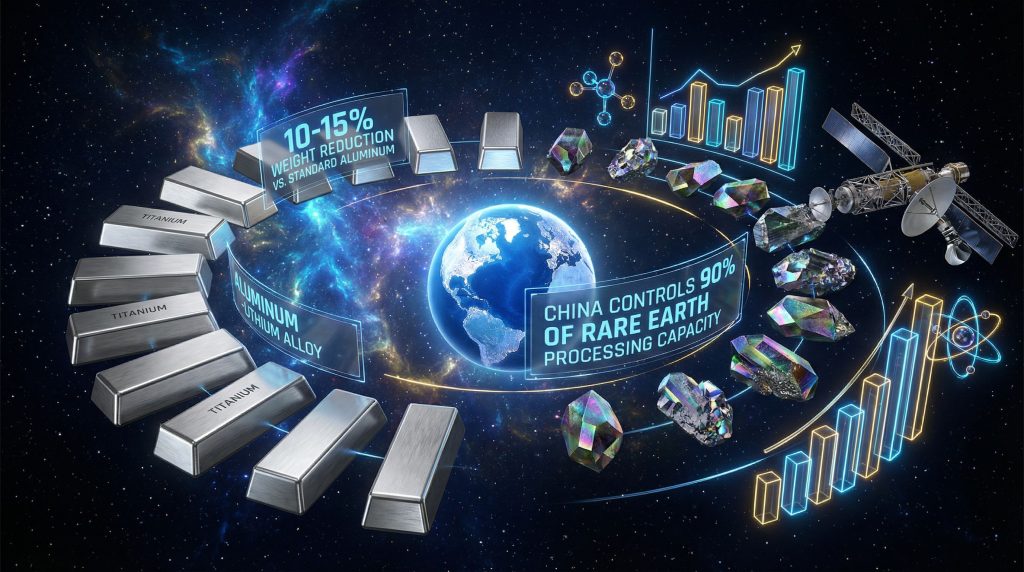
Aluminum-lithium alloys represent the current industry standard for structural applications, offering 10-15% weight reduction compared to conventional aluminum while maintaining equivalent strength characteristics. These specialized alloys enable significant payload increases or cost reductions, making them essential for commercial space ventures where economic viability depends on operational efficiency.
When big ASX news breaks, our subscribers know first
Which Metals Power Modern Space Infrastructure?
The strategic metals essential for space applications fall into distinct categories, each serving critical functions that cannot be substituted with conventional materials. Understanding these material requirements reveals why critical minerals energy security has become a national security concern for spacefaring nations.
Primary Structural Materials
| Metal Category | Key Applications | Performance Metrics |
|---|---|---|
| Aluminum-Lithium Alloys | Fuel tanks, crew modules | 10-15% weight reduction vs. standard aluminum |
| Titanium Alloys | Engine components, satellite frames | 40% lighter than steel with equivalent strength |
| Nickel Superalloys | Turbopumps, combustion chambers | Operating temperatures up to 1,100°C |
| Magnesium Alloys | Lightweight structures, missile components | 35% lighter than aluminum |
Titanium serves as the backbone material for rocket engines and satellite structures due to its exceptional corrosion resistance and high-temperature performance. The aerospace industry requires Grade 5 titanium (Ti-6Al-4V), which maintains strength at temperatures where aluminum alloys fail completely. This specification drives demand for specialized titanium processing capabilities that exist in only a handful of global facilities.
Nickel superalloys enable the extreme operating conditions within rocket engines, where turbopump assemblies experience pressures exceeding 1,000 atmospheres while spinning at rates above 30,000 RPM. These applications demand materials with precise chemical compositions that can only be achieved through sophisticated metallurgical processes controlled by a limited number of suppliers worldwide.
Electronic and Precision Systems
Modern spacecraft rely heavily on specialty metals for space exploration for guidance systems, communication equipment, and precision instrumentation. Neodymium enables the powerful permanent magnets required for attitude control systems, while dysprosium provides the thermal stability needed for electronic components operating in the harsh space environment.
The miniaturisation of spacecraft electronics has created intense demand for high-purity copper and specialised copper alloys for thermal management systems. Space-grade copper must meet stringent purity standards exceeding 99.99% to prevent outgassing that could contaminate sensitive optical instruments or solar panels.
Platinum group metals play crucial roles in fuel cell systems for long-duration missions and catalytic systems for life support equipment. The International Space Station relies on platinum-based catalysts for water recovery systems, demonstrating the essential nature of these materials for sustained human presence in space.
Emerging Material Technologies
Aluminum-scandium alloys represent a significant advancement in aerospace materials, offering strength improvements of up to 20% over conventional aluminum-lithium compositions. However, scandium's extreme rarity, with global production measured in tons rather than thousands of tons, creates supply constraints that limit widespread adoption despite superior performance characteristics.
Tungsten and rhenium find applications in the most extreme thermal environments, particularly in rocket engine nozzles and heat shields for interplanetary missions. Rhenium's unique properties allow it to maintain ductility at high temperatures where other refractory metals become brittle, but global annual production of only 50-60 tons creates severe supply limitations.
How Do Supply Chain Vulnerabilities Threaten Space Programs?
The concentration of strategic metal production in politically sensitive regions creates systemic risks for space programs worldwide. Unlike consumer electronics, aerospace applications cannot accept substitute materials, making supply disruptions potentially catastrophic for mission timelines and national security objectives.
Geographic Concentration Risks
Critical Supply Dependencies:
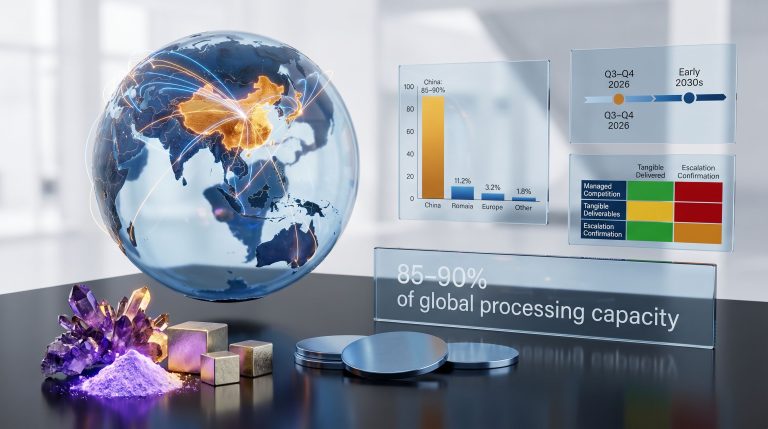
China controls approximately 85-90% of rare earth processing capacity globally, despite holding only 35% of known reserves. This processing monopoly affects every aspect of modern spacecraft design, from guidance systems to solar panel manufacturing.
Russia's dominance in titanium sponge production creates particular vulnerabilities for Western aerospace manufacturers. Russian facilities produce approximately 20% of global titanium sponge, the raw material required for aerospace-grade titanium alloys. Economic sanctions and trade restrictions can severely impact production schedules for major aerospace programs.
The Democratic Republic of Congo supplies over 70% of global cobalt production, essential for aerospace batteries and electronic systems. This concentration mirrors challenges seen in cobalt mining expansion projects, where political instability and infrastructure limitations create ongoing supply risks that aerospace manufacturers must factor into long-term planning.
Geopolitical Impact Scenarios
Trade restrictions on strategic metals can cascade through aerospace supply chains with amplified effects. A satellite manufacturing programme requiring hundreds of different components can face complete shutdown if even one critical material becomes unavailable, regardless of the availability of all other materials.
The 2010 rare earth export restrictions imposed by China demonstrated how quickly geopolitical tensions can translate into industrial disruptions. Aerospace companies experienced immediate supply concerns and price volatility that persisted for several years, prompting major investments in alternative supply chain development.
Price Volatility and Project Economics
Strategic metal prices can exhibit extreme volatility due to concentrated supply chains and inelastic demand from aerospace applications. Rhodium prices increased by over 3,000% between 2019 and 2021, primarily driven by supply constraints and industrial demand for catalytic applications similar to those used in space systems.
Long-term aerospace projects face particular challenges from price volatility, as contracts often span multiple years whilst material costs can fluctuate dramatically. This mismatch between planning horizons and market dynamics creates financial risks that can threaten project viability.
What Are the Investment Implications for Strategic Metal Markets?
The convergence of expanding space activities with constrained supply chains creates compelling investment opportunities in strategic metals. However, these opportunities require careful analysis of both demand growth trajectories and supply response capabilities across global markets.
Demand Growth Projections
Commercial satellite deployments are driving unprecedented demand for aerospace-grade materials. SpaceX's Starlink constellation alone plans to deploy over 40,000 satellites, each requiring significant quantities of specialised alloys and electronic materials. This single programme represents material demand equivalent to traditional aerospace industry consumption over multiple years.
Government space programmes are experiencing renewed investment following strategic competition concerns. NASA's Artemis programme budget allocation of $93 billion through 2025 will generate substantial demand for titanium, aluminium alloys, and specialised materials required for lunar operations.
The emerging space manufacturing sector creates additional demand vectors beyond traditional launch vehicles and satellites. Furthermore, in-space manufacturing facilities will require raw materials and processing equipment that must meet aerospace specifications, expanding the addressable market for strategic metals suppliers.
Supply Response Mechanisms
Mining companies face extended lead times for capacity expansion, particularly for specialised aerospace-grade materials. Developing a new titanium sponge facility requires 5-7 years from initial planning to commercial production, creating persistent supply-demand imbalances during periods of rapid space industry growth.
Processing facility development represents a critical bottleneck in strategic metals supply chains. Converting raw ore into aerospace-grade materials requires sophisticated metallurgical capabilities that cannot be rapidly scaled. This processing constraint often represents a more significant limitation than raw material availability.
Market Concentration Analysis
Aerospace material suppliers tend toward oligopolistic market structures due to high barriers to entry and stringent qualification requirements. Allegheny Technologies and VSMPO-AVISMA control significant portions of global aerospace titanium supply, creating concentration risks but also pricing power for established suppliers.
Vertical integration strategies are becoming increasingly common as aerospace manufacturers seek supply chain security. Boeing and Airbus have made strategic investments in key material suppliers, demonstrating how supply chain concerns are driving industry consolidation.
How Will Future Space Exploration Change Metal Demand?
Ambitious space exploration programmes currently in development will create entirely new categories of material demand whilst potentially reducing dependence on Earth-based supply chains through in-situ resource utilisation technologies.
Mars Mission Material Requirements
Extended Mars missions lasting 18-24 months create material durability requirements far exceeding current space programmes. Radiation exposure over these timeframes demands specialised alloys with enhanced radiation resistance, driving research into advanced titanium-aluminium compositions and novel protective materials.
Mars atmospheric conditions, including dust storms with particles carrying electrostatic charges, require materials with specific electrical and mechanical properties. These environmental factors are driving development of specialised coatings and surface treatments that could create new market segments for materials technology companies.
In-situ resource utilisation on Mars could fundamentally alter strategic metals for space exploration demand by enabling local production of construction materials and basic alloys. Mars contains significant iron oxide deposits that could support steel production, potentially reducing requirements for Earth-launched structural materials.
Asteroid Mining Economic Scenarios
Near-Earth asteroids contain platinum group metal concentrations potentially exceeding terrestrial ore grades by factors of 10-100. A single metallic asteroid could contain more platinum than has ever been mined on Earth, with profound implications for space-based applications requiring these materials. Consequently, asteroid mining advances represent a potential paradigm shift for materials supply chains.
Timeline projections for commercial asteroid mining operations suggest initial demonstration missions within 10-15 years, with commercial viability potentially achievable by the 2040s. These developments could create oversupply scenarios for certain strategic metals whilst maintaining scarcity for others requiring complex processing.
Lunar Base Construction Demands
NASA's Artemis programme plans for sustained lunar operations requiring substantial infrastructure development. Lunar base construction will demand specialised materials capable of withstanding the unique challenges of the lunar environment, including extreme temperature cycling and micrometeorite impacts.
Lunar manufacturing capabilities could enable processing of lunar regolith into construction materials, potentially reducing Earth launch requirements for bulk materials. However, specialised alloys and electronic materials will likely remain dependent on Earth-based supply chains for the foreseeable future.
Which Companies Are Positioned to Benefit from Space Metal Demand?
The space materials supply chain encompasses multiple tiers of companies, from primary metal producers to specialised aerospace material suppliers, each facing distinct opportunities and challenges from expanding space activities. Additionally, the broader mining industry evolution is creating new opportunities for companies that can adapt to space-grade requirements.
Aerospace Material Suppliers
Companies specialising in aerospace-grade materials face complex qualification processes but enjoy long-term contract relationships once established. Carpenter Technology Corporation and Haynes International represent examples of specialised suppliers with deep aerospace industry integration and proprietary alloy technologies.
Quality certification requirements create significant barriers to entry but also protect established suppliers from competition. AS9100 aerospace quality management certification requires substantial investments in process control and documentation systems that smaller companies often cannot justify economically.
Mining Operations with Space-Grade Production
Primary metal producers with aerospace certification capabilities occupy strategic positions in the supply chain. Rio Tinto's titanium operations and Alcoa's aerospace aluminium production represent examples of large-scale mining operations with specialised aerospace market exposure.
Strategic metal recycling companies are gaining importance as aerospace manufacturers seek to reduce supply chain risks and environmental impacts. Urban Mining Company and similar operations recover valuable materials from aerospace manufacturing waste streams, creating alternative supply sources for critical materials.
Emerging Technology Developers
Additive manufacturing technologies are enabling new approaches to aerospace component production that could alter material demand patterns. Desktop Metal and Relativity Space represent companies applying 3D printing technologies to aerospace applications with potential to reduce material waste and enable new alloy compositions.
Advanced processing technologies for in-space manufacturing represent emerging opportunities for companies developing space-qualified production equipment. These technologies could enable processing of space-derived materials into finished components, reducing Earth launch requirements.
The next major ASX story will hit our subscribers first
What Risk Mitigation Strategies Should Investors Consider?
Strategic metals investment in the context of space applications requires sophisticated risk assessment encompassing technical, geopolitical, and market timing factors that traditional commodity investing approaches may not adequately address.
Portfolio Diversification Approaches
Geographic diversification across multiple production regions can reduce concentration risks but may increase complexity and due diligence requirements. Australian lithium producers, Canadian rare earth developers, and African platinum miners offer exposure to strategic metals whilst reducing dependence on any single geopolitical region. However, countries like India are also securing lithium supply through strategic partnerships.
Technology diversification between traditional and alternative materials helps investors position for potential substitution scenarios. Companies developing advanced ceramics, carbon fibre composites, and novel alloy systems may capture market share if traditional materials face supply constraints or performance limitations.
Supply Chain Resilience Investments
Backup supplier development requires substantial time and capital investments but provides essential redundancy for critical materials. Aerospace manufacturers increasingly value suppliers with multiple production facilities across different regions, creating opportunities for diversified materials companies.
Strategic inventory management for critical materials represents a significant investment opportunity as aerospace companies seek to buffer against supply disruptions. Specialised commodity financing and warehousing companies serve this market with tailored solutions for aerospace industry requirements.
Regulatory and Policy Considerations
Export control regulations significantly impact strategic metals trading, particularly for materials with dual-use military and civilian applications. International Traffic in Arms Regulations (ITAR) and similar restrictions create complex compliance requirements that can affect investment returns and market access.
Government strategic reserve policies can create artificial demand or supply that affects market dynamics. The U.S. Strategic National Stockpile periodically adjusts holdings of critical materials, creating investment opportunities for companies positioned to supply these requirements. For instance, Australia's critical minerals list provides insights into national strategic priorities.
Strategic Outlook: The Future of Space Metal Economics
The intersection of expanding space activities with constrained strategic metal supply chains creates a unique investment environment characterised by long-term demand growth, supply constraints, and technological disruption potential. Understanding these dynamics requires analysis of multiple interconnected trends affecting both space industry development and global materials markets.
Technology Convergence Opportunities
Integration of space exploration technologies with terrestrial applications creates cross-industry demand for advanced materials. Electric vehicle battery technologies share material requirements with space power systems, whilst renewable energy infrastructure requires many of the same rare earth elements used in spacecraft electronics.
Economies of scale from expanding space activities could reduce costs for terrestrial applications of aerospace materials. As space industry volumes grow, specialised alloy production costs may decline sufficiently to enable broader industrial adoption, expanding addressable markets for materials producers.
Investment Timeline Considerations
Short-term opportunities exist in companies serving current space programmes, particularly those supporting government contracts with predictable funding streams. Medium-term prospects emerge from commercial space expansion, including satellite constellations, space tourism, and manufacturing applications.
Long-term potential from space colonisation initiatives requires patient capital and acceptance of substantial execution risks. However, companies establishing dominant positions in space materials supply chains could achieve extraordinary returns if space settlement scenarios materialise as envisioned. Moreover, developments in mining space exploration could fundamentally alter the economics of strategic metals.
Strategic metals for space exploration represent the fundamental building blocks of humanity's expansion beyond Earth. Investment success in this sector requires understanding both the technical requirements of space applications and the geopolitical realities of global supply chains. As space activities accelerate, companies controlling access to these critical materials will hold increasingly powerful positions in the new space economy.
Investment Disclaimer: This analysis is for educational purposes only and does not constitute investment advice. Strategic metals markets involve significant risks including price volatility, geopolitical factors, and technological change. Investors should conduct thorough due diligence and consider professional advice before making investment decisions. Past performance does not guarantee future results, and all investments carry risk of loss.
Want to Profit from the Next Major Strategic Metal Discovery?
Discovery Alert provides instant notifications on significant ASX mineral discoveries, powered by its proprietary Discovery IQ model, ensuring subscribers identify actionable opportunities in strategic metals before the broader market reacts. Begin your 14-day free trial today and discover why major mineral discoveries can generate exceptional returns by exploring historic examples of companies that have delivered substantial gains for early investors.