July 24, 2026
Underground mining operations worldwide face mounting pressure to address fugitive methane emissions from ventilation systems. These uncontrolled releases represent a significant environmental challenge, particularly as regulatory frameworks tighten and carbon pricing mechanisms gain traction across major mining jurisdictions. The implementation of specialized thermal treatment technologies offers a pathway for operations to substantially reduce their greenhouse gas footprint while maintaining productivity, as demonstrated by recent advancements in mining industry evolution.
Methane emissions from coal mining ventilation systems carry a global warming potential approximately 28-34 times greater than carbon dioxide over a 100-year timeframe, according to the Intergovernmental Panel on Climate Change Sixth Assessment Report. Over shorter 20-year periods, this multiplier effect increases to 80-86 times, making immediate abatement efforts particularly valuable for near-term climate targets.
The scale of these emissions challenges traditional mitigation approaches. Typical underground coal operations generate ventilation airflows ranging from 200-500 cubic meters per second, containing methane concentrations between 0.1-1.0% by volume. These low-concentration, high-volume characteristics require specialized engineering solutions capable of processing massive airflows while maintaining economic viability.
What Is Regenerative Thermal Oxidation Technology in Mining Applications?
Core Technology Principles
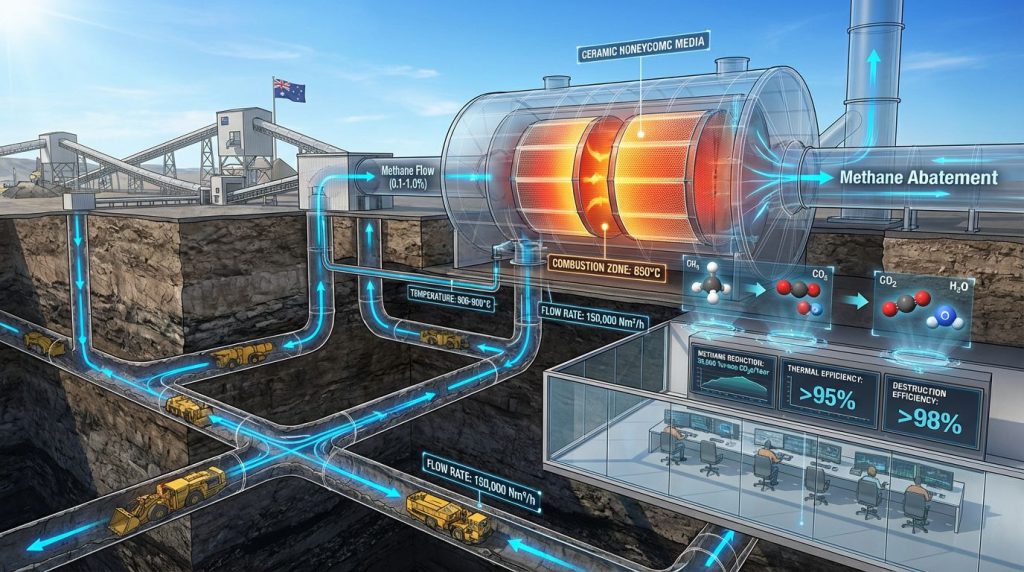
Regenerative thermal oxidation systems capture dilute methane from mine ventilation air and process it through high-temperature combustion chambers. The technology operates by heating contaminated air to approximately 850°C, breaking molecular bonds in methane and converting it to carbon dioxide and water vapor through the stoichiometric reaction: CH₄ + 2O₂ → CO₂ + 2H₂O.
The regenerative aspect refers to heat recovery systems that capture combustion energy to preheat incoming air. Ceramic heat exchange media stores thermal energy during the heating cycle and releases it to incoming air streams, achieving thermal efficiencies exceeding 95%. This heat recovery dramatically reduces auxiliary fuel requirements and operating costs.
Operational Parameters and Performance Metrics
| Parameter | Specification | Performance Impact |
|---|---|---|
| Operating Temperature | 800-900°C | Ensures complete oxidation |
| Residence Time | 0.5-2.0 seconds | Maximizes destruction efficiency |
| Methane Concentration Range | 0.1-1.0% by volume | Handles typical VAM levels |
| Destruction Efficiency | 98%+ | Minimizes fugitive emissions |
| Heat Recovery Rate | 95%+ | Reduces fuel consumption |
Advanced control systems monitor inlet methane concentrations and automatically adjust combustion parameters to maintain optimal operating conditions. When methane levels fall below combustion thresholds, supplemental fuel systems ensure continuous operation and thermal stability. These innovations align with broader renewable energy solutions being adopted across the mining sector.
When big ASX news breaks, our subscribers know first
How Significant Are the Environmental Impact Reductions at Appin Mine?
Quantified Emissions Reduction Analysis
The Illawarra Coal Appin mine emissions reduction project demonstrates the substantial environmental benefits achievable through thermal oxidation technology. The NSW government-approved installation targets an annual reduction of 36,000 tonnes CO₂-equivalent emissions, representing one of the most significant single-point methane abatement projects in Australian mining.
| Metric | Annual Reduction | Equivalent Impact |
|---|---|---|
| CO₂-equivalent emissions | 36,000 tonnes | 8,500 passenger vehicles |
| Methane destruction volume | 1,500 tonnes | 42 million cubic meters |
| Energy content recovered | 120,000 GJ | 3,300 MWh electricity equivalent |
| Global warming impact | 20-year timeframe benefit | 86x multiplier effect |
This reduction scale positions the Appin facility among leading international methane abatement installations. The 8,500 vehicle equivalency calculation aligns with Australian Department of Climate Change, Energy, Environment and Water standards, which estimate average passenger vehicle emissions at approximately 4.2 tonnes CO₂-equivalent annually.
Comparative Industry Performance
Underground coal operations typically generate 180,000-240,000 tonnes CO₂-equivalent in ventilation air methane emissions annually, making the Appin reduction represent approximately 15-20% of baseline fugitive emissions. This percentage reduction demonstrates both the scale of the thermal oxidation system and the substantial remaining opportunity for industry-wide implementation.
Furthermore, the project exemplifies how decarbonisation mining benefits extend beyond emissions reduction to encompass operational efficiency improvements.
"The 80-times greater warming potential of methane compared to carbon dioxide applies to the 20-year assessment timeframe used in near-term climate modeling, making immediate methane destruction particularly valuable for meeting 2030 emission reduction targets."
What Are the Technical Challenges in Ventilation Air Methane Processing?
Low-Concentration Methane Handling Complexity
Ventilation air methane operates at significantly lower concentrations than drainage gas systems, requiring specialized burner technologies and supplemental fuel systems. Unlike gas-to-energy applications that utilize methane concentrations of 1.0-8.0%, thermal oxidation must process dilute streams while maintaining combustion stability.
The challenge lies in achieving complete oxidation without excessive auxiliary fuel consumption. Advanced burner designs incorporate:
• Multi-stage combustion chambers for enhanced mixing and residence time
• Supplemental natural gas injection during low-concentration periods
• Flame monitoring systems to ensure continuous combustion
• Temperature control mechanisms preventing thermal shock to equipment
Airflow Volume Management Requirements
Processing ventilation airflows exceeding 400 cubic meters per second demands large-scale oxidation systems with sophisticated flow distribution capabilities. The engineering challenge involves:
• Pressure drop minimisation to avoid disrupting underground ventilation
• Flow distribution uniformity across multiple combustion chambers
• Heat management systems preventing thermal stress on structural components
• Emergency bypass capabilities maintaining mine ventilation during maintenance
Integration with Existing Mine Infrastructure
The integration of thermal oxidation systems with existing mine ventilation infrastructure requires careful consideration of pressure dynamics, safety protocols, and operational continuity. Underground air quality management cannot be interrupted, necessitating redundant systems and fail-safe mechanisms.
Critical design considerations include:
- Pressure balance maintenance across the ventilation network
- Safety system integration with mine emergency protocols
- Monitoring system connectivity to mine control rooms
- Maintenance access planning for ongoing system reliability
These technical challenges highlight the importance of AI optimization in mining for enhanced system monitoring and predictive maintenance capabilities.
How Does This Technology Compare to Alternative Methane Abatement Methods?
Comprehensive Technology Comparison
| Abatement Method | Methane Concentration | Capital Investment | Operating Costs | Destruction Efficiency |
|---|---|---|---|---|
| Regenerative Thermal Oxidation | 0.1-1.0% | $8-15 million | Medium | 98%+ |
| Catalytic Oxidation | 0.3-1.5% | $5-10 million | Low | 95%+ |
| Gas Engine Generation | 1.0-8.0% | $3-8 million | Very Low | 85-90% |
| Direct Flaring | 2.0%+ | $1-3 million | Low | 95%+ |
| Microturbine Systems | 1.5-5.0% | $4-9 million | Medium | 88-92% |
Economic Viability Assessment Factors
Regenerative thermal oxidation requires substantial capital investment but offers superior environmental performance for low-concentration applications. Economic viability improves significantly under several conditions:
• Carbon pricing mechanisms exceeding $25-35 per tonne CO₂-equivalent
• Regulatory requirements mandating emissions reductions
• Heat recovery applications utilising thermal energy for mine operations
• Carbon credit generation under emissions reduction programs
Catalytic oxidation presents a lower-cost alternative but faces operational challenges in dusty mine environments where catalyst fouling reduces efficiency and increases maintenance requirements. The technology requires methane concentrations above 0.3% for reliable operation.
Gas-to-energy systems generate revenue through electricity production but require minimum methane concentrations of 1.0% and face economic challenges when power purchase agreements offer unfavourable rates.
What Regulatory and Policy Frameworks Drive Methane Abatement Implementation?
Australian Climate Policy Context
The NSW government approval for the Appin thermal oxidation project aligns with Australia's legislated climate commitments under the Climate Change Act 2022. The national framework establishes:
• 2030 emissions reduction target: 43% below 2005 levels
• 2050 net-zero commitment: Legally binding pathway
• National Greenhouse and Energy Reporting obligations for large emitters
• Emissions Reduction Fund eligibility for methane abatement projects
Minister for Planning and Public Space Paul Scully noted the project allows operations to improve environmental performance while continuing metallurgical coal production for steelmaking, emphasising the technology's role in meeting legislated targets.
International Best Practice Standards
The implementation follows International Energy Agency methane abatement guidelines and incorporates lessons from similar projects deployed across major mining jurisdictions since the early 2000s. Key international developments include:
• European Union methane regulations requiring monitoring and reporting
• United States EPA methane standards for coal mining operations
• Canadian federal methane reduction framework targeting 75% reductions by 2030
• Global Methane Pledge commitments driving national policy development
Australia's approach demonstrates proactive industry engagement with climate policy rather than reactive compliance, positioning domestic mining operations as technology leaders in emissions reduction.
How Do Employment and Economic Factors Influence Project Implementation?
Workforce Impact Analysis
The Illawarra Coal Appin mine emissions reduction project creates employment opportunities across multiple phases while maintaining the operation's existing 1,100-person workforce. The employment profile includes:
| Project Phase | Job Creation | Duration | Skill Requirements |
|---|---|---|---|
| Construction | 20-30 positions | 12 months | Specialised technicians, welders, electricians |
| Commissioning | 5-8 positions | 6 months | Process engineers, instrumentation specialists |
| Operations | 3-5 positions | Ongoing | Environmental compliance, maintenance technicians |
Training investment requirements include specialised certification programs for thermal oxidation operation, estimated at $200,000-300,000 for comprehensive operator development. Key competency areas encompass:
• Process engineering fundamentals for thermal oxidation systems
• Instrumentation and control systems operation and maintenance
• Environmental compliance protocols and emissions monitoring
• Safety procedures specific to high-temperature industrial processes
Regional Economic Benefits
Minister for Finance and Natural Resources Courtney Houssos emphasised the project demonstrates investments by the coal mining industry to reduce greenhouse gas emissions while extracting metallurgical coal critical to steel production, describing it as achieving fewer emissions and more jobs.
The project maintains operational employment while adding advanced environmental technology capabilities to the Illawarra region. This transition model demonstrates how traditional mining operations can evolve toward lower-emission profiles without sacrificing local employment opportunities.
Long-term economic implications include:
- Skills development in environmental technology sectors
- Supply chain opportunities for specialised equipment and services
- Technology transfer potential to other regional mining operations
- Enhanced operational sustainability supporting long-term employment
The next major ASX story will hit our subscribers first
What Are the Broader Implications for Coal Mining Industry Transformation?
Technology Transfer and Scaling Potential
Successful implementation at the Appin mine creates a demonstration case for other Australian underground coal operations. The technical data and operational experience provide valuable benchmarking for industry-wide methane abatement scaling across approximately 70 underground coal mines operating nationwide.
Key transferability factors include:
• Standardised equipment specifications reducing deployment costs
• Proven operational procedures minimising implementation risks
• Performance verification data supporting investment decisions
• Regulatory approval precedents streamlining future project approvals
Investment and Innovation Trends
The project represents broader capital allocation trends toward environmental technology in traditional mining sectors. Similar investments are emerging across major coal producers as Environmental, Social, and Governance considerations increasingly influence operational decisions and access to capital markets.
Industry transformation drivers include:
• Institutional investor ESG requirements affecting project financing
• Insurance provider risk assessments considering climate impact
• Customer sustainability mandates from steel producers
• Regulatory trajectory toward stricter emissions standards
The thermal oxidation technology deployment signals mining industry recognition that environmental performance increasingly determines operational viability and market access. This shift reflects the broader mining sustainability transformation occurring across the sector.
How Does Methane Abatement Integrate with Broader Mine Decarbonisation Strategies?
Comprehensive Emissions Management Framework
Methane abatement through thermal oxidation complements broader decarbonisation initiatives across mining operations. Integrated approaches typically encompass:
Direct emissions reduction:
• Renewable energy procurement for surface operations and processing facilities
• Electric vehicle adoption in underground transport systems
• Energy efficiency optimisation across ventilation and processing equipment
• Alternative fuel systems for mobile equipment and power generation
Indirect emissions management:
• Supply chain decarbonisation requirements for contractors and suppliers
• Transportation optimisation reducing logistics-related emissions
• Waste management improvements including methane capture from tailings
• Land use management supporting carbon sequestration activities
Future Technology Integration Roadmap
Advanced methane abatement systems are evolving toward greater automation and integration with other mine systems. Future developments may include:
• Artificial intelligence optimisation of thermal oxidation parameters based on real-time methane concentration data
• Modular system designs enabling flexible deployment across multiple ventilation points
• Integrated carbon utilisation converting CO₂ output to useful products
• Hybrid renewable energy integration reducing auxiliary fuel requirements
These technological advancements promise to enhance both environmental performance and economic returns from methane abatement investments.
What Monitoring and Verification Protocols Ensure Effective Performance?
Continuous Emissions Monitoring Systems
Effective thermal oxidation requires sophisticated monitoring protocols to verify performance and maintain regulatory compliance. Real-time measurement systems include:
Inlet monitoring capabilities:
• Methane concentration measurement via infrared spectroscopy
• Airflow volume quantification using ultrasonic or thermal mass flow meters
• Temperature and pressure monitoring ensuring optimal feed conditions
• Oxygen content analysis confirming combustion air adequacy
Outlet verification systems:
• Stack emissions testing for residual methane and combustion products
• Thermal efficiency calculation based on heat recovery performance
• Destruction efficiency determination through mass balance analysis
• NOx emissions monitoring ensuring environmental compliance
Third-Party Verification and Carbon Credit Generation
Independent verification protocols follow Australian National Greenhouse Accounts standards and may qualify for carbon credit generation under the Emissions Reduction Fund. The verification process includes:
- Baseline establishment documenting pre-installation emission levels
- Performance testing confirming destruction efficiency claims
- Continuous monitoring validation ensuring ongoing effectiveness
- Annual reporting compliance meeting regulatory requirements
Carbon credit eligibility under Australian Carbon Credit Units provides additional economic incentives for project continuation and expansion. Current carbon pricing mechanisms value verified emissions reductions at $25-35 per tonne CO₂-equivalent, potentially generating $900,000-1.26 million annually from the Appin project's 36,000-tonne reduction.
Detailed technical specifications for the Appin mine air quality management systems demonstrate the comprehensive approach required for effective emissions monitoring and compliance.
Advanced Engineering Solutions Transform Mining Environmental Performance
The regenerative thermal oxidation project at Illawarra Coal's Appin mine demonstrates how advanced engineering solutions can address complex environmental challenges in traditional mining operations. By achieving a 36,000-tonne annual reduction in CO₂-equivalent emissions while maintaining operational continuity, the project establishes both technical feasibility and economic frameworks for broader industry transformation.
The successful integration of thermal oxidation technology with existing mine infrastructure provides valuable insights for similar operations globally, contributing to the development of commercially viable methane abatement strategies that balance environmental performance with economic sustainability. As regulatory frameworks continue evolving and carbon pricing mechanisms expand, such technological innovations represent essential pathways for mining industry adaptation to climate policy requirements.
Consequently, the project's employment creation during construction and operation phases, combined with skills development in environmental technology sectors, demonstrates that the Illawarra Coal Appin mine emissions reduction initiatives can simultaneously support regional economic development and workforce transition toward emerging technology applications.
Want to Stay Ahead of Revolutionary Mining Technology Developments?
Discovery Alert's proprietary Discovery IQ model instantly identifies ASX-listed mining companies pioneering environmental technologies and sustainable operations, delivering real-time alerts on significant discoveries and technological breakthroughs. Subscribers gain immediate access to actionable opportunities in the evolving mining sector, ensuring they're positioned ahead of major market movements driven by innovation and regulatory changes.