June 12, 2026
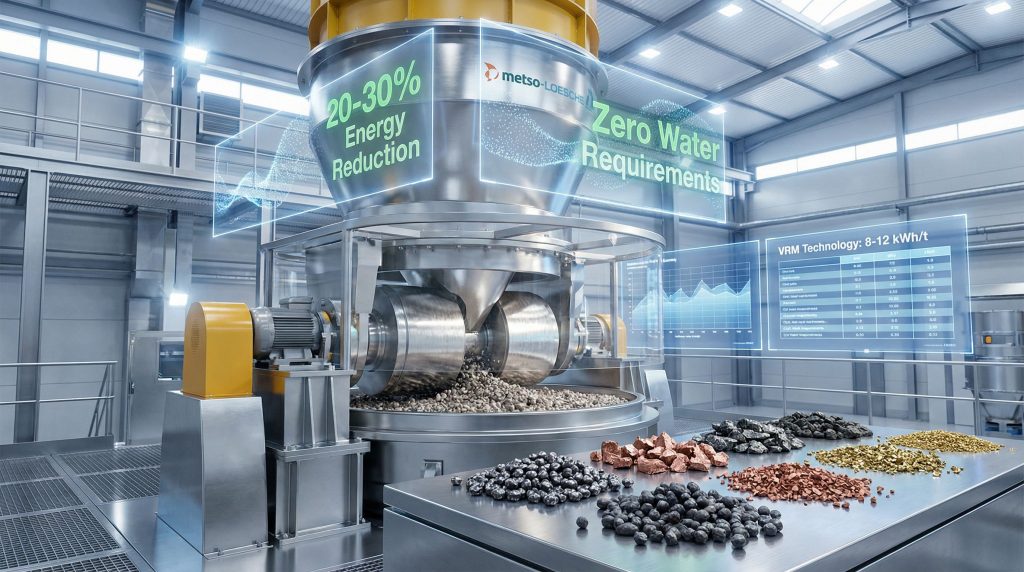
The mining industry stands at a transformative crossroads where traditional comminution methods face mounting pressure from sustainability requirements and operational efficiency demands. Metso Loesche VRM dry grinding technology represents a paradigm shift that addresses these challenges through innovative pressure-based grinding mechanisms, eliminating water requirements while achieving superior energy performance compared to conventional systems.
Traditional grinding circuits have long depended on impact-based mechanisms where steel balls cascade within rotating drums, generating particle reduction through collision forces. This approach, while proven, demands substantial energy inputs and creates inherent inefficiencies in material preparation and size distribution control.
Understanding VRM Fundamentals in Mineral Comminution
Vertical roller mill technology operates through pressure application within a prepared material bed, where feed material is continuously introduced and compacted by rotating rollers against a stationary grinding table. This pressure-grinding mechanism creates controlled fracture patterns that differ significantly from the random impact forces generated in ball mill systems.
The material bed preparation process occurs continuously as fresh feed integrates with partially ground material, creating a dynamic grinding environment. Particles experience multiple compression cycles, with each pass through the grinding zone contributing to size reduction while maintaining consistent particle morphology characteristics.
According to industry analysis, this grinding approach produces a steeper, more consistent product particle size distribution compared to conventional systems. The controlled pressure environment also results in less oxidation of sulfide mineral particles, which enhances downstream beneficiation performance and supports more resource-efficient mineral processing operations.
When big ASX news breaks, our subscribers know first
Key Performance Differentiators in Industrial Applications
The technical advantages of Metso Loesche VRM dry grinding technology become apparent when examining operational metrics across different grinding methodologies. Energy consumption patterns reveal significant disparities between pressure-based and impact-based comminution approaches, particularly when considering data-driven mining operations that optimize performance metrics.
Grinding Technology Performance Comparison
| Parameter | VRM Technology | HPGR Systems | Ball Mills |
|---|---|---|---|
| Energy Consumption (kWh/t) | 8-12 | 12-18 | 15-25 |
| Water Requirements | Zero | Minimal | High |
| Wear Part Lifespan (hrs) | 8,000-12,000 | 3,000-6,000 | 2,000-4,000 |
| Product Size Distribution | Narrow | Moderate | Wide |
These performance differentials translate into measurable operational advantages across multiple dimensions. Energy efficiency improvements of 20-30% compared to ball mill circuits represent substantial cost savings, particularly in regions with elevated electricity costs or carbon pricing mechanisms.
Wear part longevity extends equipment availability while reducing maintenance interventions. The 8,000-12,000 hour operational life of VRM components significantly exceeds conventional grinding media replacement cycles, creating opportunities for extended production runs and simplified maintenance scheduling.
Why Are Mining Companies Shifting to Dry Grinding Solutions?
Water scarcity challenges have fundamentally altered mining project economics across multiple jurisdictions. Operations in arid regions face increasing regulatory pressures on water usage, while water procurement and treatment costs continue escalating. Consequently, these constraints have accelerated interest in dry grinding alternatives that eliminate water requirements entirely.
Furthermore, the shift towards sustainable mining transformation has driven companies to seek technologies that reduce environmental impact whilst maintaining operational efficiency.
Water Scarcity Challenges in Global Mining Operations
Regional water availability constraints affect project feasibility assessments, particularly in desert mining locations where competing water demands from agricultural and municipal users create supply limitations. Mining companies increasingly factor water security into long-term operational planning, recognizing that water access represents a critical resource alongside ore reserves.
Regulatory frameworks governing water usage have tightened across major mining jurisdictions. Environmental compliance requirements often mandate water recycling systems, treatment infrastructure, and monitoring programs that add complexity and cost to traditional wet grinding circuits.
The economic implications extend beyond direct water costs. Water treatment systems require specialised equipment, skilled operators, and ongoing consumable supplies. Tailings management becomes more complex when wet grinding circuits produce slurried waste streams requiring containment and treatment infrastructure.
Environmental Compliance and Sustainability Metrics
Carbon footprint reduction through lower energy consumption aligns with mining companies' environmental, social, and governance (ESG) commitments. The substantial energy savings achievable through VRM technology directly translate into reduced greenhouse gas emissions from electrical power consumption.
Elimination of tailings dam requirements for grinding circuits removes significant environmental liabilities. Wet grinding systems generate slurried waste streams that require containment infrastructure with associated long-term monitoring and closure obligations. In contrast, dry grinding processes eliminate these concerns by producing dry waste materials suitable for conventional waste rock disposal methods.
Dust management systems integrated with air classification equipment provide effective particulate control while maintaining operational efficiency. These systems capture fine particles that would otherwise require water suppression, demonstrating how advanced engineering solutions address environmental concerns without compromising performance.
What Technical Advantages Does VRM Offer Over Traditional Grinding Methods?
The transition from impact-based to pressure-based grinding represents a fundamental change in comminution physics. Understanding these technical distinctions illuminates why VRM technology delivers superior performance across multiple operational parameters.
Comparative Analysis: VRM vs. HPGR vs. Ball Mills
High pressure grinding rolls (HPGR) systems occupy an intermediate position between traditional ball mills and advanced Metso Loesche VRM dry grinding technology. While HPGR represents an improvement over ball mills in energy efficiency, VRM systems provide additional advantages in water elimination and particle morphology control.
Energy consumption differentials reflect the efficiency of pressure-grinding mechanisms compared to impact-based approaches. VRM systems achieving 8-12 kWh/t energy consumption compare favourably against HPGR systems at 12-18 kWh/t and conventional ball mills requiring 15-25 kWh/t.
Water requirements create the most dramatic distinction between technologies. VRM systems operate entirely without water, HPGR requires minimal water for dust suppression and cooling, while ball mills demand substantial water volumes for slurry preparation and transport. This fundamental difference affects facility design, environmental permitting, and operational flexibility.
Wear part lifespan variations impact maintenance scheduling and operational continuity. VRM technology's extended component life reduces planned maintenance frequency while improving equipment availability for continuous production campaigns.
Particle Morphology and Downstream Processing Benefits
Particle shape characteristics significantly influence downstream beneficiation performance. VRM grinding produces particles with controlled morphology that enhances liberation characteristics in flotation circuits and improves magnetic separation efficiency through consistent particle geometry.
Reduced sulfide mineral oxidation rates result from the controlled grinding environment within VRM systems. Sulfide particles maintain their original surface characteristics more effectively than in conventional grinding circuits, improving flotation collector effectiveness and recovery performance.
Enhanced liberation characteristics enable more efficient separation of valuable minerals from gangue materials. The consistent particle breakage patterns created by pressure grinding optimise mineral exposure at particle surfaces, supporting improved concentration ratios in subsequent processing steps.
Magnetic separation processes benefit from uniform particle shapes that promote consistent magnetic susceptibility responses. Irregular particles produced by impact grinding can create magnetic interference patterns that reduce separation efficiency and product quality.
How Does the Metso-Loesche Partnership Address Industry Challenges?
The exclusive partnership between Metso Corporation and Loesche GmbH combines complementary expertise to deliver comprehensive grinding solutions. Metso's cutting-edge dry grinding technology integrates with Loesche's proven vertical roller mill technology, creating a unified approach to comminution innovation.
Moreover, this collaboration supports the broader mining industry innovation trajectory by combining established cement industry expertise with mining-specific applications.
Technology Transfer from Cement Industry Applications
VRM technology benefits from extensive operational experience across cement industry applications, with more than 2,400 reference installations providing comprehensive performance data. This established track record demonstrates reliability metrics across diverse material types and operating conditions, reducing technology risk for mining applications.
Proven scalability factors enable technology transfer from pilot installations to full commercial operations. The cement industry experience includes systems ranging from small regional plants to large-scale production facilities, providing operational knowledge applicable to mining circuit design requirements.
Reliability metrics derived from cement industry operations indicate consistent performance across extended operational periods. Equipment availability percentages and maintenance interval data support investment decisions by demonstrating long-term operational stability and predictable maintenance requirements.
Service Network Integration and Support Infrastructure
Metso's global service capabilities provide comprehensive support infrastructure for VRM installations worldwide. This service network combines local technical expertise with centralised spare parts management to ensure operational continuity for mining operations regardless of geographic location.
Remote monitoring systems enable predictive maintenance scheduling based on actual equipment performance data rather than predetermined time intervals. These systems analyse operational parameters continuously, identifying potential issues before they affect production and optimising maintenance interventions for maximum cost effectiveness.
Spare parts availability through integrated supply chain management reduces inventory carrying costs while ensuring critical components remain accessible. Strategic parts positioning and logistics optimisation support operational requirements across multiple time zones and geographic regions.
What Are the Economic Implications for Mining Operations?
Capital expenditure considerations encompass equipment costs, installation complexity, and infrastructure requirements. VRM systems require different facility designs compared to conventional ball mills, with implications for civil works, electrical systems, and materials handling equipment.
Capital Expenditure Analysis
Equipment cost comparisons must account for complete system requirements including grinding equipment, classification systems, dust collection, and materials handling infrastructure. VRM installations may require higher initial capital investment offset by simplified flowsheet designs that eliminate ancillary equipment.
Installation complexity affects project execution timelines and construction costs. VRM systems typically require specialised foundation designs to accommodate vertical equipment configurations, while conventional ball mills utilise horizontal installations with different structural requirements.
Payback period calculations depend on operational cost savings achieving sufficient magnitude to recover additional capital investments. Energy cost reductions, maintenance savings, and improved product quality benefits contribute to overall economic returns across equipment operational lifespans.
Operating Cost Reduction Opportunities
Energy cost savings represent the most significant operational benefit, with potential reductions of $2-5 per tonne processed depending on local electricity rates and grinding circuit efficiency improvements. These savings compound over high-tonnage operations to generate substantial annual cost reductions.
"VRM technology can reduce total grinding circuit operating costs by 15-25% while eliminating water requirements entirely, creating dual benefits of cost reduction and environmental compliance simplification."
Reduced water treatment and management expenses eliminate costs associated with water procurement, treatment chemicals, monitoring systems, and disposal infrastructure. These savings extend beyond direct operational costs to include regulatory compliance expenses and long-term environmental liabilities.
Lower maintenance costs through extended wear part life reduce both materials expenses and labour requirements for component replacement activities. Simplified maintenance procedures and longer intervals between overhauls contribute to improved operational continuity and reduced downtime costs.
The next major ASX story will hit our subscribers first
Which Mineral Processing Applications Benefit Most from VRM Technology?
Iron ore pellet feed preparation represents an ideal application for dry grinding technology, where consistent particle size distribution and controlled morphology enhance pelletising performance. The elimination of water requirements simplifies pellet plant operations while reducing energy consumption in subsequent pellet drying processes.
Primary Application Categories
Copper concentrate grinding for leaching circuits benefits from reduced sulfide oxidation and consistent particle preparation. The controlled grinding environment preserves mineral surface characteristics that optimise leaching kinetics and copper recovery performance in subsequent hydrometallurgical processes.
Gold ore processing in water-constrained regions demonstrates clear advantages for Metso Loesche VRM dry grinding technology implementation. Operations in arid environments can eliminate water requirements for grinding circuits while maintaining processing efficiency and gold liberation characteristics necessary for effective recovery.
Industrial mineral size reduction applications including limestone, gypsum, and barite processing align well with VRM capabilities. These materials often require precise size control and consistent particle characteristics that pressure grinding delivers more effectively than impact-based alternatives.
Flowsheet Integration Considerations
Single-stage grinding circuit simplification eliminates classification equipment in certain applications where VRM technology produces acceptable product size distributions without additional processing steps. This simplification reduces capital costs, energy consumption, and maintenance requirements.
Elimination of classification equipment becomes feasible when VRM systems generate narrow particle size distributions that meet downstream processing requirements without additional sizing operations. Circuit complexity reduction translates into improved operational reliability and reduced maintenance obligations.
Integration with coarse particle beneficiation technologies enables optimised flowsheet designs that maximise valuable mineral recovery while minimising processing costs. VRM systems can prepare feed materials for gravity separation, magnetic separation, or flotation processes with enhanced efficiency compared to conventional grinding approaches.
How Does VRM Technology Support Future Mining Trends?
Industry 4.0 initiatives emphasise digital integration, automation, and data-driven optimisation across mining operations. VRM technology incorporates advanced process control capabilities that align with these modernisation trends while supporting autonomous operation objectives.
Alignment with Industry 4.0 Initiatives
Advanced process control integration enables real-time optimisation of grinding parameters based on feed characteristics, product quality requirements, and energy efficiency targets. These systems adjust operational parameters continuously to maintain optimal performance across varying operational conditions.
Machine learning algorithms analyse operational data to identify optimisation opportunities and predict equipment performance trends. These insights support decision-making processes for maintenance scheduling, operational adjustments, and long-term equipment planning initiatives.
Predictive maintenance scheduling utilises equipment performance data to optimise component replacement timing and reduce unplanned downtime occurrences. Data analytics identify patterns that precede equipment failures, enabling proactive maintenance interventions that prevent production disruptions.
Resource Efficiency and Circular Economy Principles
Reduced waste generation through precise size control minimises material losses and improves valuable mineral recovery rates. Consistent particle preparation enhances subsequent processing efficiency, reducing waste streams and improving overall resource utilisation across processing circuits.
Enhanced mineral recovery rates in downstream processes result from improved particle preparation and liberation characteristics. Higher recovery percentages reduce waste production while maximising valuable mineral extraction from available ore resources.
Lower environmental impact through energy and water savings supports circular economy principles by reducing resource consumption and waste generation. These improvements contribute to sustainable mining practices that align with industry sustainability commitments and regulatory requirements, particularly when integrated with renewable energy solutions for mining operations.
What Implementation Challenges Should Operators Consider?
Material handling characteristics vary across different ore types, requiring careful assessment of grinding behaviour and product quality requirements. Some materials may require specific grinding media selection or operational parameter adjustments to achieve optimal performance in VRM systems.
Technical Risk Assessment
Grinding media selection affects particle morphology and wear part longevity across different mineral types. Operators must evaluate grinding media options based on ore characteristics, product quality requirements, and maintenance cost considerations to optimise system performance.
Process control system complexity requires skilled operators and comprehensive training programmes. VRM systems incorporate advanced control algorithms that demand technical expertise for effective operation and troubleshooting activities.
Integration with existing plant infrastructure may require modifications to materials handling, electrical systems, and process control networks. Compatibility assessments ensure seamless integration while minimising disruption to ongoing operations during installation and commissioning phases.
Project Execution Factors
Equipment delivery timelines affect project scheduling and operational planning activities. VRM systems may require longer lead times compared to conventional equipment due to specialised manufacturing requirements and quality assurance procedures.
Commissioning requirements include performance testing protocols that validate system capabilities against design specifications. Comprehensive testing programmes ensure operational readiness while providing baseline performance data for ongoing optimisation efforts.
Performance testing protocols establish operational parameters and validate system capabilities across expected operating conditions. These tests provide confidence in system performance while identifying optimisation opportunities for long-term operational efficiency.
Why Consider VRM Technology for Future Projects?
The convergence of environmental regulations, energy costs, and water scarcity creates compelling drivers for mining companies to evaluate dry grinding alternatives. VRM technology addresses these challenges while delivering measurable performance improvements across multiple operational parameters.
Furthermore, the alignment with energy transition strategies positions VRM technology as a forward-looking solution that supports industry sustainability objectives whilst maintaining competitive operational performance.
"The mining sector's transition toward sustainable processing technologies creates opportunities for innovative solutions that deliver both economic and environmental benefits. Dry grinding represents a fundamental shift in comminution approaches that addresses critical industry challenges while improving operational performance."
The technology's proven track record in cement applications, combined with mining-specific adaptations through the Metso-Loesche partnership, provides confidence in implementation success. Transformative grinding solutions continue demonstrating their potential to reshape mineral processing economics whilst addressing environmental compliance requirements.
Disclaimer: This analysis presents technical information and industry trends for educational purposes. Mining companies should conduct comprehensive feasibility studies and equipment evaluations before implementing new grinding technologies. Operational results may vary based on specific ore characteristics, facility configurations, and operating conditions.
Ready to Capitalise on the Next Mining Technology Breakthrough?
Discovery Alert's proprietary Discovery IQ model delivers instant notifications on significant ASX mineral discoveries, including companies developing cutting-edge processing technologies like advanced grinding systems. Subscribers gain immediate insights into actionable trading and investment opportunities within the mining technology sector, positioning themselves ahead of broader market recognition. Begin your 14-day free trial today and secure your competitive advantage in identifying the next transformative mining innovation.