
June 12, 2026
Ore Grade Decline and the Mineralogical Intelligence Gap
Every ton of rock processed through a modern concentrator carries within it a hidden variable that bulk chemical assays consistently fail to capture: the spatial relationship between individual mineral grains. As the mining industry progresses deeper into its lower-grade, higher-complexity resource base, the precision of ore characterisation has become as commercially important as the grade itself. The mineral exploration importance of rigorous ore characterisation is evident when considering that global copper mining average grades have declined from roughly 1.5% in the early twentieth century to below 0.6% today, effectively doubling the volume of material that must be processed to produce an equivalent unit of refined metal.
For gold, the trajectory is equally pronounced, with average head grades at producing mines falling from above 12 grams per tonne in the mid-twentieth century to under 2 grams per tonne across many current operations. In this context, Metso upgrades mineralogy lab capabilities to directly address the analytical demands these structural trends create.
What makes this trend particularly challenging for process engineers is not the number itself but what accompanies it. Residual ore domains typically feature finer mineral grain sizes, more intricate interlocking of valuable minerals with gangue phases, and greater spatial variability across ore domains. These characteristics directly govern how minerals respond to grinding, flotation, and leaching, yet they remain invisible to conventional head grade assays. The resulting disconnect between what resource models predict and what processing plants actually recover has become one of the industry's most persistent sources of economic underperformance.
Industry analysis consistently shows that inadequate ore characterisation at the feasibility stage is among the primary contributors to metallurgical underperformance at operating mines, with recovery shortfalls of 5 to 15 percentage points documented in cases where mineral associations were inadequately defined prior to circuit commissioning.
When big ASX news breaks, our subscribers know first
What Automated Mineralogy Actually Measures
The Analytical Engine Behind the Technology
Automated mineralogy platforms resolve this characterisation gap by generating quantitative, statistically robust datasets at the microscale. The technology integrates field emission scanning electron microscopy (FE-SEM) with multidetector energy-dispersive X-ray spectrometry (EDS), allowing the simultaneous imaging and chemical identification of mineral phases at spatial resolutions approaching 3 to 5 nanometres. This level of resolution is particularly critical for fine-grained mineralisation that conventional optical petrography cannot adequately characterise.
Where manual point counting yields perhaps 200 to 300 identifications per session with a coefficient of variation that can exceed 20%, modern automated platforms execute thousands of mineral identifications per hour without operator intervention. The output is not qualitative but fully quantitative, encompassing the complete set of parameters that process metallurgists require to design and optimise circuits.
Key Parameters Generated by Automated Mineralogy Systems
| Output Parameter | Metallurgical Application |
|---|---|
| Mineral abundance (vol. %) | Feed grade reconciliation and process targeting |
| Grain size distribution | Grinding circuit optimisation and liberation modelling |
| Mineral liberation data | Flotation and leach circuit design |
| Mineral association matrices | Penalty element identification and selectivity planning |
| Textural classification | Geometallurgical domain definition |
Each of these parameters addresses a specific failure mode that arises when ore characterisation relies solely on chemical assays. Furthermore, cut-off grade economics are directly influenced by mineral liberation data, which quantifies the proportion of a target mineral that exists as free particles versus particles locked within composite grains. This governs the grind size required to achieve acceptable concentrate grades and recoveries. Without this information, comminution circuits are frequently either over-grinding ore at unnecessary energy cost or under-grinding it and leaving recoverable value locked in tailings.
How TESCAN TIMA Advances the Field
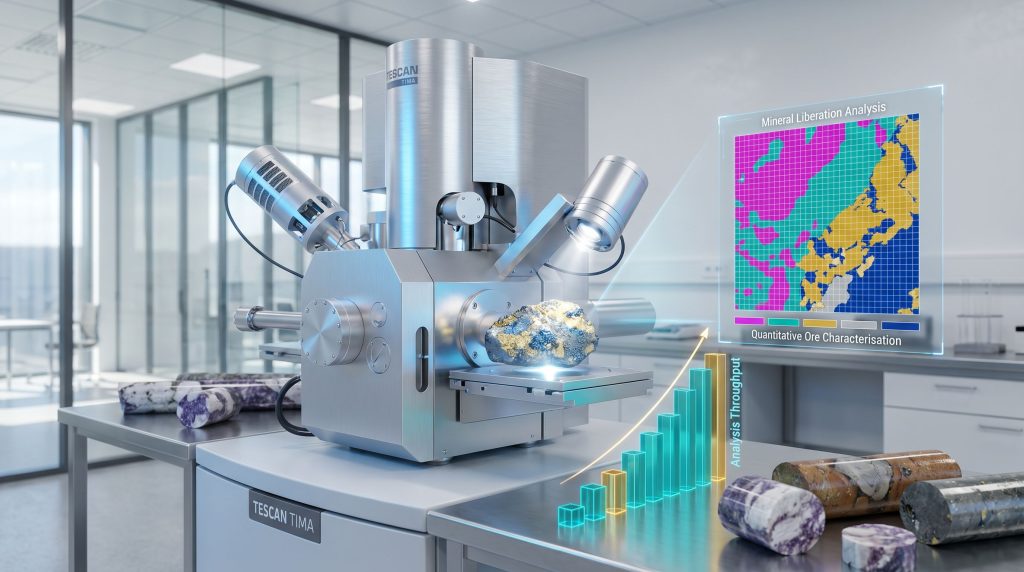
The TESCAN TIMA (Tescan Integrated Mineral Analyser) represents a current-generation implementation of automated mineralogy technology, combining high-resolution FE-SEM imaging with multidetector EDS analysis in a single automated workflow. Its architecture allows simultaneous data acquisition across multiple detectors, compressing the time required to generate statistically representative mineralogical datasets from several days using conventional methods to a window measured in hours.
The platform supports both liberation analysis and association analysis modes, making it applicable across the full spectrum of ore types encountered in modern mining operations. For sulphide base metal deposits, liberation data informs flotation circuit configuration. For oxide gold systems, association data identifies refractory gold carriers. For lithium pegmatites and rare earth carbonatites, textural classification underpins the geometallurgical domain models that feed mine planning software.
Metso Upgrades Mineralogy Lab at Pori: Reading the Strategic Signal
Inside the Pori Research Centre Enhancement
The announcement that Metso strengthens mineralogy capabilities with the installation of a TESCAN TIMA automated mineralogy analyser at its Research Centre in Pori, Finland represents more than a laboratory equipment purchase. It is one of several capability developments at the Pori site, and it reflects a deliberate strategy to deepen the analytical infrastructure available to mining customers navigating an increasingly complex ore landscape.
The Pori Research Centre has operated as a process development facility for decades, providing metallurgical testing and flowsheet development services to mining companies across the globe. The mineralogy upgrade expands both the analytical throughput and the sample processing capacity available within the facility, enabling Metso's team of mineralogical specialists to deliver quantitative ore characterisation data on compressed timelines. For mining customers, this translates directly into faster access to the foundational data that drives feasibility study progression.
Why This Investment Matters Across the Project Lifecycle
The value of the Pori upgrade is best understood by mapping it onto the distinct phases of a mining project, each of which has specific mineralogical data requirements:
-
Exploration and early-stage project development: Rapid screening of drill core and composite samples to define geometallurgical domains and inform resource estimation frameworks, reducing the risk that processing assumptions embedded in early-stage economics will require costly revision at feasibility stage.
-
Feasibility and flowsheet design: Quantitative liberation and association data feeding directly into process modelling tools for flotation, leach, and comminution circuit design, underpinning the metallurgical assumptions that determine capital and operating cost estimates.
-
Operating mine optimisation: Continuous ore variability monitoring to support real-time adjustments to plant operating parameters, reducing metallurgical losses attributable to feed variability as mines transition between ore domains.
The decision to invest in automated mineralogy infrastructure at a vendor-operated research facility reflects an increasingly visible commercial model in the mining technology sector, where equipment suppliers are differentiating not solely on hardware capability, but on the quality of analytical services they can offer throughout the customer relationship.
Why Mineralogical Data Bridges Geology and Metallurgy
The Geometallurgical Connection
Geometallurgy, the discipline that integrates geological variability data with metallurgical process modelling to predict spatial variability in plant performance, is fundamentally dependent on high-resolution mineralogical inputs to function as a predictive engineering tool rather than a qualitative approximation. Without accurate mineral liberation data, comminution models cannot reliably forecast the optimal grind size that balances energy consumption against liberation efficiency.
Without mineral association data, flotation models cannot accurately predict the complex relationships between grind size, reagent suite, and achievable concentrate grade and recovery combinations. This dependency creates a data pipeline requirement that runs from drill core through to plant operating parameters. Automated mineralogy platforms sit at the headwaters of this pipeline, generating the quantitative mineral datasets that every downstream modelling tool requires as its foundational input.
Where Mineralogical Precision Is Most Critical
The integration challenge is particularly acute for complex polymetallic ores and low-grade critical mineral deposits, where the economic margin between viable and unviable processing is narrow and process sensitivity to feed characteristics is high. For these ore types, the spatial relationship between individual mineral phases can determine not only recovery but also concentrate marketability, as penalty element deportment into product streams creates downstream commercial consequences that are difficult to manage without prior mineralogical characterisation.
Modern flowsheet simulation tools, including population balance models for grinding circuits and kinetic flotation models, require mineralogically-derived inputs to generate reliable performance predictions. The linkage between automated mineralogy outputs and these simulation platforms creates an integrated analytical framework that transforms geometallurgical modelling from an interpretive exercise into a quantitatively grounded engineering discipline.
How Automated Mineralogy Reduces Mining Project Risk
Managing Metallurgical Uncertainty at Feasibility Stage
Metallurgical risk — the probability that a processing plant will underperform its design recovery targets — is most effectively managed during feasibility studies, before capital is committed to plant construction. Consistent with sound drilling results interpretation practice, automated mineralogy provides the liberation and association data needed to identify potential processing challenges before they become operational surprises.
Common challenges that mineralogical analysis identifies at feasibility stage include:
- Fine-grained mineralisation requiring finer grind targets than conventional processing infrastructure can achieve economically
- Refractory gold associations with arsenopyrite or carbonaceous material that reduce cyanide leach recoveries below economic thresholds without pre-treatment
- Clay mineral interference creating rheological challenges in flotation circuits and slurry handling systems
- Penalty element co-deportment where deleterious elements preferentially report to concentrate streams, affecting smelter payability
- Complex sulphide mineral associations where incomplete liberation generates composite particles that behave differently from both end-member minerals during flotation
Identifying these challenges during feasibility rather than post-commissioning can be the difference between a circuit designed to address a known complexity and one that discovers it expensively after production starts.
Compressing Development Timelines Through Faster Data
One of the primary commercial drivers behind the Pori mineralogy lab upgrade is the ability to compress the time between sample submission and actionable mineralogical data delivery. Conventional petrographic analysis of a representative core composite can require two to three working days per sample. However, current-generation automated systems operating within a well-resourced facility can reduce this to four to eight hours, depending on required resolution and sample complexity.
For mining companies operating under capital market pressure to advance projects efficiently, this compression of analytical turnaround represents a tangible project development advantage. Faster mineralogical data feeds directly into accelerated feasibility study timelines, shortening the critical path from exploration success to production decision.
The Ore Characterisation Technology Landscape
Comparative Overview of Available Methods
Automated mineralogy does not exist in isolation but occupies a specific position within a broader ecosystem of ore characterisation technologies. Understanding where each method delivers maximum value helps mining companies build appropriate analytical workflows:
| Technology | Resolution | Speed | Quantitative Output | Best Application |
|---|---|---|---|---|
| Traditional optical microscopy | Medium | Slow | Semi-quantitative | Preliminary petrographic screening |
| XRD (X-ray diffraction) | Bulk mineral ID | Fast | Quantitative (bulk only) | Mineral abundance, no textural data |
| QEMSCAN | High | Medium-fast | Fully quantitative | Established automated mineralogy standard |
| TESCAN TIMA / FE-SEM based | Very high | Fast | Fully quantitative | Complex ores, fine mineralisation, critical minerals |
| Micro-CT scanning | Very high (3D) | Slow | Quantitative (3D) | Texture and porosity analysis |
A critical but often underappreciated distinction in this table is the difference between bulk quantitative outputs from XRD and the spatially resolved quantitative outputs from FE-SEM-based systems. XRD can tell a metallurgist what minerals are present and in what proportions, but it cannot reveal how those minerals are distributed at the grain scale, whether they are liberated or locked, or what they are physically associated with. These spatial relationships are precisely what process performance depends on, making the step up to automated SEM-EDS analysis fundamental for any ore type where texture matters.
Critical Minerals and the Rising Demand for Mineralogical Precision
The global energy transition has created concentrated demand for lithium, cobalt, nickel, rare earth elements, and other critical minerals, many of which occur in mineralogically complex host environments. Lithium-bearing pegmatites, for instance, frequently contain multiple lithium mineral phases with distinct processing behaviours, including spodumene, lepidolite, and petalite, whose relative proportions and liberation characteristics directly govern recoverable lithium yields and processing route selection.
Nickel laterite deposits present comparable complexity through the spatial distribution of nickel between goethite, smectite, and serpentine phases, each of which responds differently to hydrometallurgical extraction routes. For all of these ore types, investment in automated mineralogy capability by major equipment suppliers directly supports the industry's capacity to advance complex critical mineral projects through feasibility to production with greater technical confidence.
The next major ASX story will hit our subscribers first
Evaluating Ore Characterisation Partners: What Mining Companies Should Consider
Key Selection Criteria
For mining companies assessing external mineralogy testing partners, the following criteria represent the most commercially significant differentiators:
- Instrument capability: Whether the facility operates current-generation automated mineralogy platforms capable of high-resolution FE-SEM analysis, rather than older-generation systems with lower spatial resolution or slower acquisition speeds
- Integration with process modelling: Whether mineralogical outputs can be directly formatted for input into the client's preferred flowsheet simulation tools, avoiding manual data translation steps that introduce error and delay
- Turnaround time and sample capacity: The realistic timeline from sample submission to final report delivery, and whether the facility can handle concurrent sample volumes consistent with feasibility study workflows
- Domain expertise: Whether the facility employs mineralogists with specific experience in the relevant ore type, since interpretation of mineralogical data requires specialist knowledge that is not generic across deposit styles
- Lifecycle continuity: Whether the same facility can support ore characterisation needs from early-stage exploration screening through to operational optimisation, maintaining institutional knowledge of the deposit's mineralogical character across project phases
The Vendor-Integrated Model: Strengths and Considerations
Equipment suppliers operating integrated research and testing facilities, such as Metso's Pori Research Centre, offer a model where ore characterisation data and equipment selection recommendations exist within the same organisational context. Consequently, this proximity can accelerate the translation of mineralogical insight into processing solution, particularly for customers evaluating new equipment configurations or novel process routes. The Metso Pori mineralogy upgrade provides a useful case study in how flowsheet design and risk management benefit from this integrated approach.
Mining companies should, however, assess whether vendor-integrated mineralogy services are positioned to deliver analytical objectivity alongside equipment-specific expertise. The most effective use of vendor-based mineralogy services typically involves understanding them as one input within a broader analytical programme that may include independent laboratory validation at key decision points.
Frequently Asked Questions: Automated Mineralogy in Mining
What is automated mineralogy used for in mining?
Automated mineralogy generates quantitative data on mineral composition, grain size, mineral liberation, and mineral associations within ore samples. This data informs grinding circuit design, flotation and leach circuit optimisation, geometallurgical domain modelling, and plant operational control across the full project lifecycle.
How does TESCAN TIMA differ from QEMSCAN?
Both platforms deliver automated quantitative mineralogy through SEM-EDS technology. TESCAN TIMA utilises field emission SEM imaging, which provides higher spatial resolution that is particularly advantageous for fine-grained mineralisation. Both systems produce comparable output datasets, with instrument-specific differences in acquisition speed, detector configuration, and analytical software frameworks.
Why is mineralogy important for declining ore grades?
As ore grades decline, deposits typically exhibit finer mineral grain sizes, more complex mineral associations, and greater variability across ore domains. Furthermore, interpreting drill results alongside automated mineralogy data provides the detailed characterisation needed to design processing circuits capable of efficiently recovering value from these increasingly challenging ore types.
What is the relationship between mineralogy and geometallurgy?
Geometallurgy uses spatial mineralogical variability data, typically generated by automated mineralogy, to construct predictive models of how different ore domains will behave during processing. This enables mine planners to anticipate and manage metallurgical variability across the mine life rather than reacting to it operationally.
How does automated mineralogy support flowsheet design?
Liberation and association data directly inform grinding target selection, flotation reagent regimes, and circuit configurations. It identifies mineralogical constraints such as locked mineral associations or penalty element deportment that must be addressed in the flowsheet design before capital commitments are made.
The Strategic Value of Mineralogy Infrastructure Investment
The decision by Metso to upgrade its mineralogy laboratory capabilities at Pori with TESCAN TIMA technology reflects dynamics that extend well beyond a single facility enhancement. It signals recognition that in a mining industry operating on structurally declining ore grades and increasing deposit complexity, the quality of ore characterisation infrastructure is becoming a meaningful competitive variable. Consequently, where grade is king in resource evaluation, the analytical rigour applied to understanding that grade becomes equally decisive.
Several converging forces are reinforcing this dynamic:
- The long-term structural decline in global ore grades is increasing the mineralogical complexity of feed materials processed by operating mines, raising the analytical bar for adequate ore characterisation
- The growth of critical mineral project pipelines for lithium, cobalt, nickel, and rare earth elements is generating demand for mineralogical services from ore types and deposit styles that require higher analytical sophistication than conventional base metal operations
- The integration of automated mineralogy outputs with process modelling software is creating data pipelines that make mineralogical characterisation an embedded component of project development workflows rather than a standalone analytical service
- The compression of project development timelines driven by capital market pressures is increasing the commercial value of analytical facilities capable of delivering high-quality mineralogical data rapidly
For mining companies, the practical implication is clear: the resources allocated to ore characterisation during feasibility represent one of the highest-return investments available in the project development budget. The cost differential between adequate and inadequate mineralogical characterisation at feasibility is vastly smaller than the cost differential between a plant that performs to design and one that discovers its ore complexity after commissioning. In this respect, the Metso upgrades mineralogy lab investment at Pori is not merely a technical enhancement — it is a commercially rational response to an industry at an inflection point.
This article is intended for informational purposes only and does not constitute financial or investment advice. Readers should conduct independent due diligence and consult qualified professionals before making investment or commercial decisions related to the mining sector or specific companies mentioned.
Want to Identify the Next Major Mineral Discovery Before the Market Does?
Discovery Alert's proprietary Discovery IQ model delivers real-time alerts on significant ASX mineral discoveries, instantly translating complex mineralogical and geological data into actionable investment insights for both short-term traders and long-term investors. Explore how historic discoveries have generated substantial returns and begin your 14-day free trial today to position yourself ahead of the broader market.