May 8, 2026
Metso's Advanced Pelletizing Solution for Green Steel Transformation
The Metso targets green steel shift with Grate Kiln upgrade initiative represents a pivotal advancement in pelletizing technology designed to meet the evolving demands of hydrogen-based steelmaking processes. This comprehensive upgrade addresses the critical need for superior iron ore pellet quality whilst supporting the global transition towards sustainable steel production. Furthermore, the technology integrates seamlessly with emerging iron ore market trends and evolving industry requirements for low-carbon feedstock solutions.
When big ASX news breaks, our subscribers know first
What Makes Iron Ore Pellets Critical for Green Steel Manufacturing?
The transition from conventional steelmaking to direct reduction iron (DRI) processes fundamentally reshapes quality requirements for pelletized feedstock. Unlike blast furnace operations that rely on high-temperature carbon reduction, hydrogen-based systems operate at temperatures between 500-800°C, requiring pellets with enhanced porosity and reducibility characteristics.
Understanding Direct Reduction Iron Quality Requirements
Direct reduction processes demand pellets with specific physical and metallurgical properties that differ significantly from traditional blast furnace specifications. Cold crush strength requirements typically exceed 300-400 N per pellet, ensuring structural integrity during transport, handling, and charging into reduction reactors without fragmentation.
Key quality parameters include:
• Porosity optimization: Enhanced gas permeability enabling rapid reaction kinetics with hydrogen atmospheres
• Reducibility characteristics: Superior performance under hydrogen-rich environments compared to carbon monoxide reduction
• Low-temperature breakdown resistance: Tolerance below 5% degradation under specified test conditions
• Swelling behavior control: Minimal volume expansion during reduction processes to maintain reactor efficiency
The International Energy Agency reports that steel production accounts for approximately 8% of global CO₂ emissions, representing roughly 1,830 million tonnes annually. Transitioning from blast furnace to DRI-based routes using renewable hydrogen could reduce direct steelmaking emissions by 50-70% depending on hydrogen sourcing methodologies.
The Shift from Blast Furnace to Direct Reduction Pathways
Energy consumption comparisons reveal significant advantages for alternative ironmaking routes. Traditional blast furnace operations require approximately 13-14 GJ of energy per tonne of hot metal, whereas advanced hydrogen-based direct reduction systems achieve 8-10 GJ per tonne equivalent when utilizing renewable hydrogen sources.
Economic drivers accelerating green steel adoption:
• EU Carbon Border Adjustment Mechanism implementation beginning 2026
• Premium pricing for low-carbon steel products reaching 10-20% above conventional steel
• Regulatory mandates for decarbonization across major steel-producing regions
• Supply chain advantages in emerging carbon-conscious markets
Companies like SSAB and H2 Green Steel have publicly committed to hydrogen-based DRI facilities, validating the technical emphasis on pellet quality metrics aligned with direct reduction requirements. These developments underscore the strategic importance of advanced pelletizing capabilities.
How Does Grate Kiln Technology Optimize Pellet Induration?
Advanced pelletizing systems employ multi-stage thermal processing architecture that provides independent control across grate, kiln, and cooler sections. This modularity enables operators to optimize drying efficiency, firing intensity, and heat recovery without compromising product quality across varying feedstock compositions. Additionally, these systems integrate perfectly with modern digital mining operations to maximise efficiency and performance.
Multi-Stage Thermal Processing Architecture
The travelling grate preheating mechanism captures exhaust gases from the rotary kiln and recycles thermal energy to remove 80-90% of free moisture from raw pellets. Temperature progression from ambient conditions to approximately 150-250°C occurs over 20-40 minutes depending on pellet size and system configuration.
Stage-by-stage processing parameters:
| Processing Stage | Temperature Range | Residence Time | Primary Function |
|---|---|---|---|
| Grate Preheating | 25-250°C | 20-40 minutes | Moisture removal and initial heating |
| Rotary Kiln | 250-1,350°C | 15-25 minutes | Uniform mixing and induration |
| Cooler Section | 1,350-200°C | Variable | Heat recovery and stabilisation |
Rotary kiln induration ensures uniform mixing through mechanical rotation while achieving temperatures between 1,200-1,350°C for complete pellet consolidation. This thermal profile develops the metallurgical characteristics essential for direct reduction applications, including optimal porosity distribution and reducibility enhancement.
Advanced Combustion and Heat Management Systems
Modern combustion systems provide fuel diversification capabilities supporting biomass and hydrogen integration alongside conventional natural gas or coal firing. Independent flame control allows operators to adjust positioning within the kiln to optimise induration profiles for specific ore types and product quality targets.
Heat recovery optimisation features:
• Counter-current cooler design capturing 30-40% of thermal energy from discharged pellets
• Air preheating systems reducing overall energy consumption by 10-15% compared to earlier generation equipment
• Dynamic control of excess air levels ensuring precise stoichiometry for hydrogen applications
• Multi-burner configurations enabling seamless fuel switching without operational disruption
Scandinavian pellet plants have successfully integrated 30-50% biomass as supplementary fuel, achieving biogenic carbon neutrality while maintaining product quality standards. These implementations validate the fuel flexibility capabilities of advanced grate kiln systems.
What Digital Enhancements Drive Performance Improvements?
Digital integration encompasses real-time quality monitoring, predictive maintenance algorithms, and energy optimisation protocols that deliver measurable performance improvements. Modern systems achieve energy savings of several percentage points while enhancing pellet quality characteristics by over 10% through advanced process controls.
Process Control and Monitoring Technologies
Real-time quality adjustment systems employ optical scanning technology measuring 1,000+ pellets per second through high-speed cameras with machine learning algorithms. Deviations in size distribution trigger automatic corrections to kiln residence time or temperature profiles, maintaining consistent product specifications.
Advanced monitoring capabilities include:
• X-ray fluorescence analysers providing continuous chemical composition analysis
• Automated compression testing measuring cold crush strength at 15-30 minute intervals
• Vibration analysis predicting bearing degradation 2-4 weeks before potential failure
• Temperature trending detecting refractory wear and heat exchanger fouling
Quantified Performance Benefits
Manufacturing plants implementing comprehensive digital optimisation typically achieve 15-25% energy efficiency gains and 8-12% quality consistency improvements across 3-5 year implementation cycles. These metrics align with industry innovation trends emphasising real-time monitoring and predictive analytics.
Specific energy consumption benchmarks:
• Modern plants: 800-950 kWh per tonne equivalent (thermal plus electrical)
• Legacy systems: 1,100-1,300 kWh per tonne equivalent
• Potential savings: 200-350 kWh per tonne through digital optimisation
Anomaly detection algorithms identify when specific energy consumption drifts above baseline levels, alerting operators to investigate root causes such as uncontrolled air infiltration or burner performance degradation.
Which Feedstock Flexibility Features Support Diverse Operations?
Ore type compatibility extends across magnetite and hematite feedstock with processing adaptations enabling low-grade ore beneficiation through enhanced pelletizing techniques. Feedstock blending strategies maintain consistent output quality while accommodating varying iron content and mineralogical characteristics.
Ore Type Compatibility and Processing Adaptations
Magnetite ores generally produce superior pellets compared to hematite due to favourable mineralogical properties and magnetic beneficiation capabilities. However, advanced grate kiln systems accommodate both ore types through adjustable processing parameters and blending optimisation.
Feedstock processing considerations:
• Magnetite advantages: Superior pellet strength, enhanced reducibility, magnetic separation efficiency
• Hematite adaptations: Modified binding agents, adjusted thermal profiles, alternative flux additions
• Blending strategies: Optimisation ratios maintaining 65-68% iron content in finished pellets
• Low-grade ore processing: Beneficiation through selective pelletizing and quality enhancement
Fuel Diversification and Sustainability Options
Alternative fuel integration supports decarbonisation objectives while maintaining operational flexibility. In addition, biomass utilisation achieves biogenic carbon neutrality, while hydrogen fuel pathway development prepares systems for future zero-carbon applications aligned with green iron production initiatives.
Fuel compatibility specifications:
• Natural gas baseline: Standard combustion with established thermal efficiency
• Coal alternatives: Solid fuel handling with modified burner configurations
• Biomass integration: 30-50% thermal input capability with appropriate handling systems
• Hydrogen readiness: Burner modifications supporting precise stoichiometric control
The HYBRIT project consortium has demonstrated hydrogen fuel integration in pilot-scale operations, validating that existing kiln infrastructure can accommodate hydrogen combustion with appropriate burner upgrades and combustion air management modifications.
How Does Global Installation Data Validate Technology Reliability?
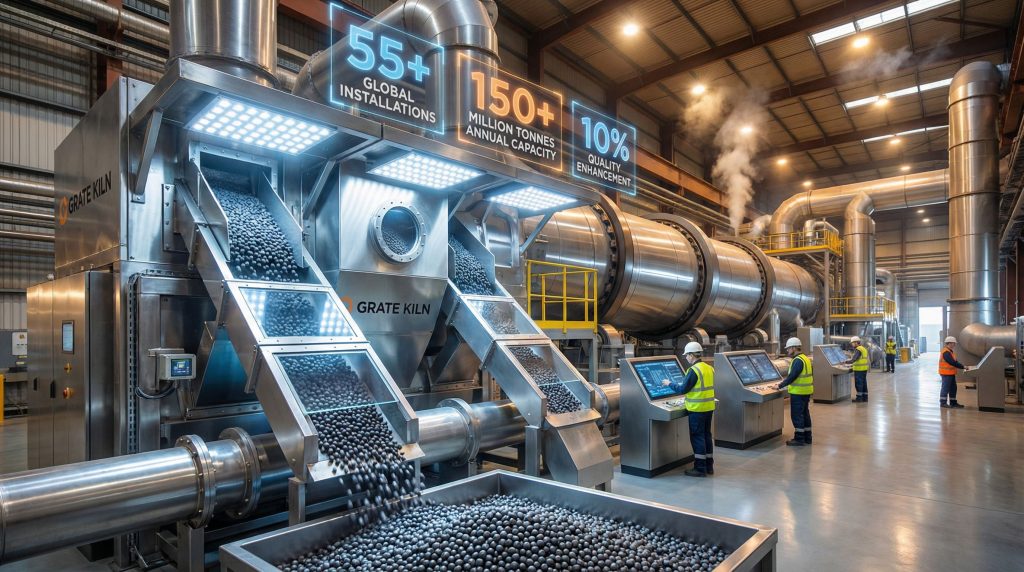
Worldwide deployment statistics demonstrate technology maturity through 55+ systems globally with 150+ million tonnes combined annual capacity. This installed base represents 65+ years of operating experience across diverse geographical regions and feedstock conditions.
Worldwide Deployment Statistics and Performance Metrics
The global distribution of advanced pelletizing systems validates technology reliability across varying operational conditions and regulatory environments. Installation experience encompasses major iron ore producing regions with demonstrated capacity utilisation exceeding industry averages.
| Performance Metric | Achieved Value | Industry Significance |
|---|---|---|
| Global installations | 55+ systems | Technology maturity validation |
| Combined capacity | 150+ million tonnes annually | Scale demonstration |
| Operating experience | 65+ years | Continuous improvement cycle |
| Geographic distribution | Multiple continents | Operational flexibility proof |
Regional Distribution and Market Penetration
Technology adoption patterns reflect regional steel industry development and decarbonisation mandates. European installations emphasise green steel transition capabilities, while Asia-Pacific deployments focus on capacity expansion and efficiency improvements.
Regional implementation characteristics:
• North America: Focus on ore quality improvement and energy efficiency
• Europe: Emphasis on alternative fuel integration and emission reductions
• Asia-Pacific: Capacity expansion with advanced process controls
• South America: Feedstock flexibility and operational reliability
Modern grate kiln systems typically achieve coefficient of variation below 5% in cold crush strength measurements, compared to legacy systems showing variation exceeding 10%. This consistency improvement directly impacts downstream steel production economics.
The next major ASX story will hit our subscribers first
What Economic Benefits Drive Investment in Advanced Pelletizing?
Total cost of ownership analysis encompasses capital expenditure considerations, operating cost reductions, and maintenance optimisation factors. Economic benefits extend beyond immediate efficiency gains to include market positioning advantages for green steel transition.
Total Cost of Ownership Analysis
Investment evaluation must consider capital expenditure requirements alongside operational improvements and maintenance cost reductions. Advanced systems typically demonstrate payback periods of 3-7 years depending on throughput capacity and local energy costs.
Economic benefit categories:
• Energy cost reductions: 10-15% savings through improved thermal efficiency and heat recovery
• Maintenance optimisation: Predictive algorithms reducing unplanned downtime costs of $500K-$2M+ per day
• Product quality premiums: Enhanced pellet specifications enabling access to premium DRI markets
• Fuel flexibility value: Ability to optimise fuel selection based on availability and pricing
Market Positioning for Green Steel Transition
Premium pricing potential for high-quality DRI pellets reflects growing demand from steelmakers transitioning to lower-carbon production routes. Supply chain advantages emerge as carbon-conscious markets prioritise low-emission feedstock sourcing. Furthermore, implementing comprehensive mining sustainability transformation strategies strengthens competitive positioning.
Market positioning advantages:
• Green premium capture: 10-20% pricing differential for certified low-carbon pellets
• Supply chain security: Preferred supplier status with major steel producers
• Regulatory compliance: Meeting emerging emission standards and carbon border adjustments
• Technology leadership: Competitive positioning against alternative reduction technologies
Wood Mackenzie and Bloomberg NEF report growing price differentials for green steel products, with some producers achieving 15-25% premiums over conventional steel in carbon-conscious markets.
How Do Quality Specifications Meet Modern Steel Industry Demands?
Physical property benchmarks for DRI applications exceed traditional blast furnace requirements across multiple characteristics. Cold crush strength, porosity optimisation, and metallurgical performance must align with hydrogen-based reduction environments and electric arc furnace steelmaking routes.
Physical Property Benchmarks for DRI Applications
Quality specifications reflect the demanding requirements of modern steel production pathways where pellet performance directly impacts downstream process efficiency and product quality consistency.
Critical quality metrics:
• Cold crush strength: 300-400+ N per pellet ensuring handling and transport integrity
• Porosity characteristics: 25-35% optimising gas permeability for rapid reduction kinetics
• Size distribution: -6.3mm + 9.5mm minimising fines generation during handling
• Chemical composition: 65-68% iron content with controlled gangue mineral levels
Metallurgical Performance in Direct Reduction Environments
Reducibility characteristics under hydrogen-rich atmospheres require pellets with favourable iron oxide phase composition and controlled microstructure. Swelling behaviour during reduction processes must remain within acceptable limits to maintain reactor efficiency.
Performance requirements in DRI applications:
• Reducibility index: >85% under standardised test conditions
• Swelling characteristics: <20% volume expansion during reduction
• Low-temperature breakdown: <5% degradation under thermal cycling
• Metallurgical consistency: Predictable behaviour enabling automated process control
ASTM E1875-13 and ISO 3271:2021 define standardised testing protocols ensuring pellet quality consistency across global markets. These specifications enable steel producers to optimise reduction parameters and achieve predictable metallurgical outcomes.
What Future Developments Support Continued Green Steel Growth?
Technology roadmap development emphasises enhanced sustainability through next-generation combustion systems and advanced materials integration. Process intensification opportunities enable capacity expansion whilst reducing environmental footprint and operational costs.
Technology Roadmap for Enhanced Sustainability
Future developments focus on further emission reductions through improved equipment durability and process optimisation. Advanced materials applications extend equipment life whilst reducing maintenance requirements and operational disruptions.
Development priorities include:
• Next-generation burners: Enhanced hydrogen compatibility with improved efficiency
• Advanced refractories: Extended service life reducing maintenance frequency
• Process intensification: Higher throughput capacity with reduced footprint requirements
• Digital integration: Machine learning optimisation for predictive quality control
Integration with Emerging Steel Production Technologies
Compatibility with hydrogen-based direct reduction plants requires pellet specifications aligned with evolving reduction reactor designs. Synergies with electric arc furnace steelmaking routes optimise material flow and energy utilisation across integrated production networks.
Integration opportunities:
• Hydrogen DRI plants: Pellet quality optimisation for emerging reactor technologies
• Electric arc furnaces: Material specifications supporting charge mix optimisation
• Novel iron production: Potential applications in breakthrough ironmaking processes
• Circular economy: Waste heat utilisation and by-product valorisation strategies
The Metso targets green steel shift with Grate Kiln upgrade represents a crucial step in steel industry transformation toward lower-carbon production, creating opportunities for pelletizing technology providers to establish competitive advantages through technical innovation and operational excellence.
Frequently Asked Questions About Advanced Pelletizing Technology
What distinguishes Grate Kiln from other pelletizing methods?
Grate Kiln systems provide independent control of thermal processing stages enabling optimisation across diverse feedstock types and fuel sources. Multi-stage architecture delivers superior heat recovery and product quality consistency compared to alternative pelletizing technologies.
How does pellet quality impact downstream steel production costs?
Enhanced pellet quality reduces direct reduction time, improves material yield, and minimises equipment wear in steel production facilities. Quality improvements of 10%+ in reducibility characteristics can translate to 5-8% energy savings in downstream steelmaking processes.
What are the key considerations for retrofitting existing pellet plants?
Retrofit projects must evaluate existing infrastructure compatibility, utility requirements, and integration challenges with current operations. Modular upgrade approaches enable phased implementation whilst maintaining production continuity and minimising capital expenditure requirements.
Positioning Pelletizing Technology for Steel Industry Transformation
Strategic Importance in Decarbonisation Pathways
Advanced pelletizing technology enables steel industry decarbonisation through superior feedstock quality supporting hydrogen-based direct reduction processes. Investment implications for integrated steel producers include competitive positioning in emerging low-carbon markets and regulatory compliance advantages.
The long-term market outlook for high-quality pellet demand reflects growing commitment to green steel production pathways across major steel-producing regions. However, technology providers maintaining innovation leadership and operational excellence will capture value creation opportunities as the industry transitions toward sustainable production methods. Consequently, the Metso targets green steel shift with Grate Kiln upgrade initiative positions stakeholders advantageously within this evolving market landscape.
For instance, integrated steel producers implementing advanced pelletizing capabilities can access premium markets whilst meeting increasingly stringent environmental regulations. Furthermore, advanced sintering and pelletizing solutions continue driving technological advancement across the sector, establishing new benchmarks for sustainable production methodologies.
Disclaimer: This analysis represents an independent technical assessment of pelletizing technology capabilities and green steel production methods based on publicly available information. Investment decisions should consider multiple factors including market conditions, regulatory developments, and company-specific circumstances. Performance projections involve inherent uncertainties and actual results may vary from estimates presented.
Looking to Capitalise on the Green Steel Revolution?
Discovery Alert's proprietary Discovery IQ model delivers instant notifications on significant iron ore and steel-related mineral discoveries across the ASX, helping you identify emerging opportunities in Australia's expanding green steel supply chain. Explore historic examples of exceptional returns from major mineral discoveries and begin your 14-day free trial today to position yourself ahead of this transformative market shift.