May 22, 2026
The Capital Commitment Behind a SAG Mill Order: Reading Between the Lines of Equipment Procurement
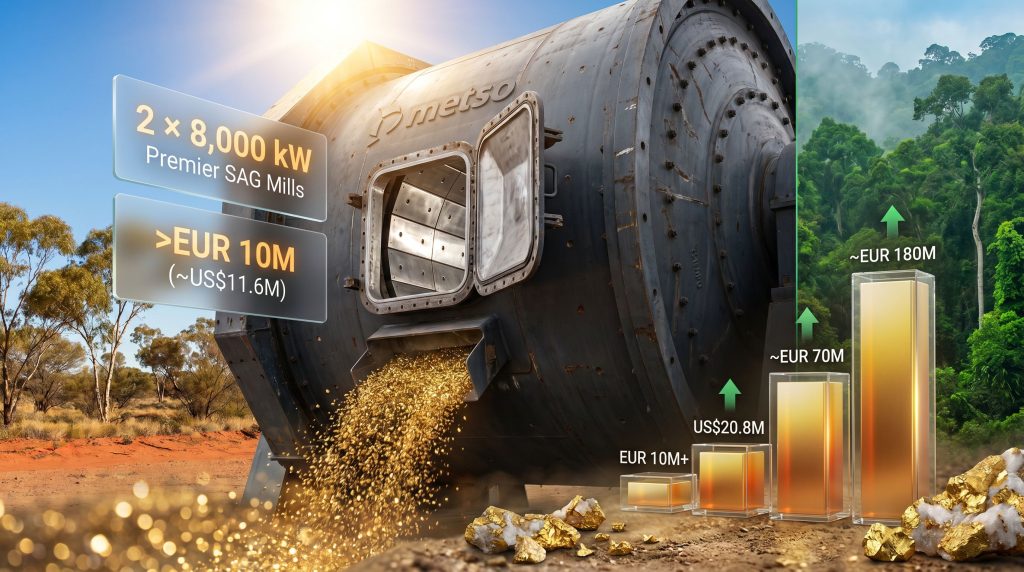
When a mid-tier gold producer commits to purchasing two 8,000-kilowatt grinding mills for simultaneous deployment across opposite sides of the globe, the headline contract value is rarely the most informative signal. The decision architecture behind large-format comminution equipment procurement reveals far more about a company's production ambitions, balance sheet confidence, and long-term ore body strategy than any press release summary can convey. The announcement that Metso wins Emerald mill orders worth more than EUR 10 million (approximately US$11.6 million) is a case study in exactly this kind of strategic reading.
When big ASX news breaks, our subscribers know first
Understanding the Anatomy of a SAG Mill Contract
Semi-autogenous grinding mills sit at the heart of virtually every modern hard-rock gold processing circuit. Unlike conventional crushing, which relies entirely on mechanical force applied by steel components, SAG milling exploits the ore itself as part of the grinding media. Coarse rock fragments lifted by the rotating mill shell cascade and collide with steel balls and other ore particles, progressively reducing particle size to the fine fractions required for downstream recovery processes such as carbon-in-leach or flotation circuits.
This grinding mechanism makes SAG mills particularly well-suited to gold ore bodies that exhibit variable hardness, mineralogical heterogeneity, or high silica content, characteristics common across many Australian and Southeast Asian deposits. Understanding ore mineralogy economics helps contextualise why the power rating of a SAG mill, measured in kilowatts, is the most direct indicator of its throughput capability. Higher rated mills can process larger tonnage volumes per hour, accept coarser feed material, and maintain throughput rates even when ore hardness spikes unexpectedly.
Why 8,000 kW Matters in Practical Mining Terms
The two Metso Premier SAG mills specified in this procurement, each rated at 8,000 kW, sit firmly in the upper-mid tier of the global installed fleet. To contextualise this:
| Power Rating (kW) | Typical Application Scale | Indicative Throughput Range |
|---|---|---|
| 2,000 to 4,000 | Small to mid-scale operations | 150 to 400 tph |
| 4,000 to 7,000 | Mid-tier producers | 400 to 800 tph |
| 8,000 to 10,000 | Growth-stage to major producers | 700 to 1,200+ tph |
| 12,000 to 22,000+ | Large-scale copper and iron ore | 1,500 tph and above |
Note: Throughput figures are indicative and vary considerably based on ore hardness (measured by Bond Work Index and SAG Power Index), feed size distribution, circuit configuration, and liner condition.
For a gold operation, commissioning an 8,000 kW SAG mill represents a deliberate choice to build for volume, not for optionality. It signals that the operator has sufficient confidence in reserve size, ore characterisation data, and projected gold prices to justify locking in a high fixed-cost infrastructure footprint for a decade or more of operation.
The Metso Premier Series: Engineering Characteristics That Influence OEM Selection
Metso's Premier series occupies the flagship tier of the company's grinding mill portfolio. Several engineering features distinguish this product line in competitive procurement evaluations:
- Shell and trunnion construction optimised for high-stress cyclic loading, reducing the risk of fatigue cracking in remote operating environments where unplanned outages carry disproportionate cost penalties
- Modular liner systems using combinations of high-chrome alloy and rubber composite materials, allowing operators to tune wear profiles to specific ore abrasivity without full liner replacement campaigns
- Drive configuration flexibility, with options ranging from conventional ring-gear and pinion arrangements to gearless mill drives (GMDs) that eliminate mechanical transmission losses and reduce maintenance intervention frequency
- Bearing technology designed for high radial and axial load tolerance, directly influencing mill availability rates over multi-year operating cycles
- Digital integration readiness, with sensor mounting provisions and condition monitoring interfaces aligned with modern process control architectures
A frequently underappreciated aspect of large SAG mill procurement is that the physical equipment cost represents only a portion of the total ownership equation. Liner consumption, energy costs, and maintenance labour over a ten-year operating life can collectively exceed the initial capital outlay by a factor of two to three for mills processing hard, abrasive ores.
The energy cost dimension deserves particular attention. In gold processing, the comminution circuit typically consumes between 30% and 50% of total site electricity demand. At an 8,000 kW nameplate rating, a single SAG mill running at 85% utilisation over a full year consumes approximately 59,500 megawatt-hours of electricity. In Australia, where grid electricity prices for industrial consumers in mining regions can range from AU$80 to AU$130 per megawatt-hour, annual energy costs per mill can reach AU$5 to AU$8 million or higher, depending on renewable energy contract structures and grid connectivity.
This cost reality explains why energy efficiency benchmarks have become increasingly important in OEM selection, often weighted alongside capital cost and delivery lead time in formal procurement scoring matrices.
Emerald Resources: A Dual-Jurisdiction Growth Strategy Decoded
Emerald Resources is an ASX-listed gold producer with operating assets across two geographically distinct regions. The simultaneous procurement of two identically specified SAG mills for an Australian project and a Cambodian project is strategically revealing on multiple levels. According to Metso's official announcement, the contract underscores a clear commitment to long-term production growth across both jurisdictions.
The Logic of Equipment Standardisation Across Borders
Deploying identical mill models across two jurisdictions is not a coincidence of specification alignment. It reflects a deliberate procurement philosophy that generates compounding operational benefits:
- Spare parts rationalisation: A standardised mill fleet allows a single inventory of critical wear components, including liners, bearing assemblies, and drive components, to serve both operations, reducing working capital tied up in parts holdings.
- Workforce knowledge transfer: Maintenance crews trained on one mill configuration can transfer that expertise to the second site with minimal retraining overhead, particularly valuable when deploying into frontier jurisdictions where skilled millwright labour is scarce.
- Vendor leverage: Committing to a single OEM for two major mill contracts creates commercial leverage for negotiating favourable service agreement terms, extended warranty provisions, and priority scheduling for field service support.
- Engineering documentation: Standardised equipment means unified operational manuals, commissioning procedures, and process control logic, reducing engineering project management complexity during concurrent construction programs.
The Cambodian context adds a layer of significance beyond engineering efficiency. Southeast Asian gold mining is still in a relatively early stage of large-scale infrastructure investment compared to established jurisdictions like Western Australia or Nevada. Deploying institutional-grade, European-engineered processing equipment into Cambodia signals a level of operational commitment and long-term site tenure confidence that distinguishes serious producers from speculative project developers.
Cambodia as a Frontier Gold Mining Jurisdiction
Cambodia's mineral sector has historically attracted limited attention from major Western equipment suppliers and institutional mining investors. That dynamic is shifting. Emerald Resources' Okvau gold mine in Mondulkiri Province entered commercial production in 2021 and has established a track record of consistent gold output, providing the operational credibility underpinning further capital investment decisions.
The commitment to 8,000 kW mill infrastructure at a Cambodian asset reflects accumulated confidence in both the geological resource and the regulatory operating environment, rather than speculative exploration-stage optimism.
Investors evaluating junior and mid-tier gold producers in Southeast Asia should note that equipment procurement decisions of this scale are typically preceded by definitive feasibility studies, reserve audits, and infrastructure assessments. A SAG mill order of this specification is rarely placed without a robust ore reserve estimate supporting the projected mill feed requirements over the asset's economic life.
Disclaimer: The above represents analytical interpretation of publicly available procurement information and should not be construed as financial advice. Investors should conduct independent due diligence before making investment decisions.
Metso's Broader Order Pipeline: Contextualising the Emerald Contract
Understanding what the Emerald contract represents within Metso's commercial trajectory requires situating it within the company's recent order activity. The following comparison illustrates both the scale diversity of Metso's pipeline and its geographic breadth:
| Project Region | Approximate Contract Value | Equipment Category | Commodity |
|---|---|---|---|
| Australia and Cambodia (Emerald) | EUR 10M+ (~US$11.6M) | Premier SAG Mills, 2 x 8,000 kW | Gold |
| La Caridad, Mexico | ~US$20.8M | Nordberg MP800 Cone Crushers | Copper |
| Zambia (Barrick Gold) | ~EUR 70M | Grinding and Processing Equipment | Gold |
| Asia (Copper Smelter) | Smelting and Process Equipment | Copper |
The Emerald contract sits at the smaller end of this order spectrum but carries qualitative significance that raw value metrics do not fully capture. It confirms Metso's ability to compete and win across mid-tier gold producers simultaneously managing multi-country growth programmes, a customer segment that differs materially from the large integrated miners that dominate Metso's highest-value contracts.
Why Declining Ore Grades Are Driving Mill Procurement Cycles
One of the most consequential long-term trends shaping global grinding equipment demand is the secular decline in average gold ore grades being processed at operating mines worldwide. According to data published by the World Gold Council and various industry research bodies, the average grade of gold ore processed globally has fallen from approximately 3.0 grams per tonne (g/t) in the early 2000s to under 1.5 g/t for many large operations today.
Lower grades require operators to move and process proportionally more ore to produce the same quantity of gold. This tonnage inflation directly translates into demand for higher-throughput grinding circuits, and consequently, larger, more powerful SAG mills. Furthermore, cut-off grade economics play a critical role here: an operation processing ore at 0.8 g/t that targets the same annual gold output as a 2.5 g/t deposit must push roughly three times the ore volume through its grinding circuit, assuming comparable recovery rates.
This structural reality underpins a sustained, multi-cycle demand environment for large-format comminution equipment that is largely independent of short-term gold price fluctuations.
SAG Mill Economics: What Project Finance Teams Actually Model
For project finance analysts and mining equity investors, the comminution circuit warrants closer scrutiny than it typically receives in non-technical investment analysis. Several critical economic parameters are determined at the mill selection stage:
- Specific energy consumption (kWh per tonne): This metric, which typically ranges from 8 to 20 kWh/t for gold ore depending on hardness, directly governs the operating cost per tonne processed and thus the project's cash cost per ounce of gold produced.
- Mill availability rate: Industry benchmarks for well-maintained large SAG mills run between 92% and 96% planned availability. A 2% difference in availability at 8,000 kW equates to substantial annual production variance.
- Liner replacement frequency and cost: Hard, siliceous ores can consume liner packages in as few as 6 to 9 months, with replacement campaigns costing hundreds of thousands of dollars per event including scheduled downtime.
- Comminution circuit share of processing CAPEX: Across a typical gold processing plant, grinding circuit equipment, including SAG mills, ball mills, and associated classification equipment, accounts for 30% to 50% of total processing plant capital expenditure.
These parameters collectively explain why equipment selection decisions made early in a project's engineering phase have long-duration financial consequences that compound across the asset's operating life.
The next major ASX story will hit our subscribers first
ESG Dimensions of Large-Format Grinding Technology
The sustainability implications of mill selection decisions have gained material weight in mining procurement over the past several years. Energy intensity per tonne processed has emerged as a key ESG reporting metric, particularly for operators seeking to reduce Scope 2 emissions associated with purchased electricity. In this context, mining decarbonisation benefits are increasingly factored into equipment procurement frameworks at an institutional level.
Modern SAG mill design addresses this through several mechanisms. Mill drive optimisation, for instance, is now supported by AI-assisted control systems that continuously adapt operational parameters to minimise energy waste. Gearless mill drives (GMDs), available as a configuration option on the Premier series, eliminate the mechanical losses inherent in ring-gear and pinion transmission systems, typically recovering 2% to 4% of input power as usable grinding energy compared to conventional drive trains.
Advanced process control systems that continuously optimise mill load, speed, and feed rate can achieve additional energy savings of 3% to 8% without hardware modifications. For operations in Australia, where the National Greenhouse and Energy Reporting (NGER) framework requires disclosure of energy consumption and emissions, and increasingly in Southeast Asia where corporate ESG reporting standards are tightening, the energy efficiency profile of installed grinding equipment carries direct reporting and reputational implications.
Frequently Asked Questions: Metso SAG Mills and the Emerald Resources Contract
What are SAG mills used for in gold mining?
SAG mills function as primary grinding units within hard-rock gold processing circuits. They reduce blasted ore from coarse feed material into fine particles suitable for subsequent recovery processes. The mechanism uses a combination of steel grinding media and the ore itself, making the process particularly efficient for high-tonnage, variable-hardness applications.
What does the Metso and Emerald Resources contract cover?
The contract is valued at more than EUR 10 million (approximately US$11.6 million) and covers the supply of two Metso Premier SAG mills, each rated at 8,000 kW, for gold projects located in Australia and Cambodia respectively. Reporting by Australian Mining confirmed the dual-jurisdiction scope of the agreement.
Why are 8,000 kW SAG mills considered high-capacity equipment?
An 8,000 kW power rating positions these mills in the upper-mid tier of the global installed SAG mill fleet. Operations deploying mills of this scale typically target throughput rates ranging from several hundred to over one thousand tonnes per hour, depending on ore characteristics and circuit configuration.
What distinguishes the Metso Premier SAG mill series?
The Premier series is engineered for high availability, energy efficiency, and adaptability across ore types. Key design advantages include modular liner systems, flexible drive configurations, and condition monitoring integration, all of which contribute to reduced total cost of ownership over a mill's multi-decade operating life.
How significant is this contract within Metso's total order pipeline?
The Metso wins Emerald mill orders contract represents one of several recent major orders across Metso's global portfolio. While smaller in absolute value than concurrent contracts in Zambia and Asia, it is strategically meaningful as a dual-jurisdiction order from a growth-oriented mid-tier gold producer managing simultaneous project development timelines in two countries.
Key Takeaways for Equipment Analysts and Mining Investors
The decision reflecting how Metso wins Emerald mill orders, and Emerald's corresponding commitment to this procurement, encodes a series of signals that extend well beyond the transaction itself:
- The 8,000 kW specification reflects a deliberate high-throughput production strategy rather than a capital-conservative, phased development approach
- Dual-jurisdiction standardisation reduces operational complexity and lifecycle costs across two geographically separated assets
- The deal demonstrates that Cambodia is attracting institutional-grade mining infrastructure investment, reinforcing the country's emergence as a credible mid-tier gold jurisdiction
- Metso's ability to win across multiple customer tiers and geographies confirms the breadth and commercial resilience of its processing equipment pipeline
- The declining global ore grade environment represents a structural, multi-decade demand driver for high-capacity SAG mill installations that is independent of near-term commodity price cycles
- For project finance practitioners, comminution circuit equipment selection decisions made at engineering design stages have long-duration financial consequences that deserve more analytical weight than they typically receive in equity research coverage
This article is intended for informational purposes only and does not constitute financial or investment advice. Readers should conduct independent research and consult qualified advisers before making capital allocation decisions related to mining equities or equipment sector investments.
For additional coverage of global grinding equipment markets and SAG mill technology applications, Mining Magazine at miningmagazine.com provides ongoing reporting on processing equipment procurement across international mining jurisdictions.
Want to Track the Next Major ASX Gold Discovery Before the Market Catches On?
Discovery Alert's proprietary Discovery IQ model scans ASX announcements in real time, instantly identifying significant mineral discoveries across gold and 30+ other commodities — turning complex data into actionable investment insights the moment they're announced. Explore how historic ASX mineral discoveries have generated extraordinary returns, and begin your 14-day free trial at Discovery Alert to position yourself ahead of the broader market.