
June 18, 2026
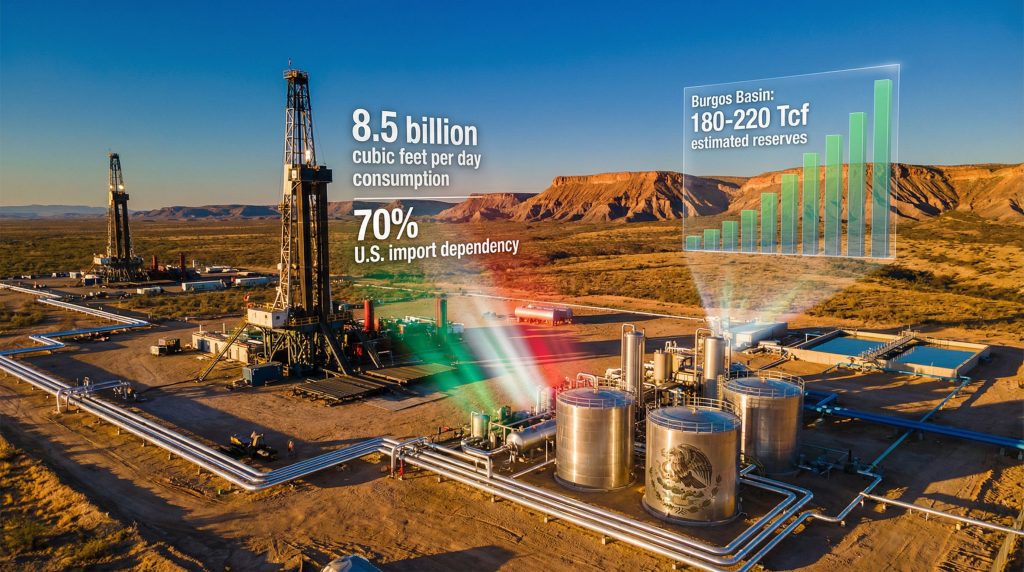
Mexico signals policy shift with open support for fracking as federal authorities recalibrate national energy priorities to address critical infrastructure vulnerabilities. This fundamental strategic realignment moves beyond previous ideological frameworks toward pragmatic resource optimization, reflecting how supply chain disruptions and geopolitical tensions have elevated domestic energy production capabilities as essential national security assets.
The northern basin focus, particularly targeting Burgos and Sabinas formations, demonstrates Mexico's commitment to unlocking substantial unconventional gas potential that has remained largely dormant despite geological assessments confirming significant reserves. Technical studies and pilot project frameworks indicate a methodical approach designed to integrate international expertise while addressing Mexico-specific operational challenges including water management, regulatory adaptation, and community engagement protocols.
This policy evolution occurs within a broader context where gas-fired combined-cycle plants generate the majority of Mexico's electricity, making natural gas supply stability a cornerstone of industrial competitiveness and grid reliability. Manufacturing sectors, particularly automotive and petrochemical industries concentrated in northern states, face mounting pressure from volatile energy costs that directly impact their ability to compete with Asian production hubs in global markets.
Decoding Mexico's Energy Security Transformation
Mexico signals policy shift with open support for fracking as federal authorities recalibrate national energy priorities to address critical infrastructure vulnerabilities. Furthermore, this transformation reflects broader energy transition insights that emphasise the strategic importance of domestic resource development in an era of heightened geopolitical uncertainty.
The Mexican government's strategic pivot toward embracing unconventional gas extraction represents a calculated response to mounting energy vulnerability pressures. This fundamental strategic realignment moves beyond previous ideological frameworks toward pragmatic resource optimization, reflecting how supply chain disruptions have elevated domestic energy production capabilities as essential national security assets.
The northern basin focus, particularly targeting Burgos and Sabinas formations, demonstrates Mexico's commitment to unlocking substantial unconventional gas potential that has remained largely dormant despite geological assessments confirming significant reserves. Technical studies and pilot project frameworks indicate a methodical approach designed to integrate international expertise while addressing Mexico-specific operational challenges.
When big ASX news breaks, our subscribers know first
Economic Vulnerability Drivers Behind Mexico's Strategic Pivot
Import dependency has reached critical thresholds, with Mexico's natural gas consumption increasingly reliant on U.S. pipeline infrastructure that has demonstrated vulnerability to extreme weather events and supply disruptions. The economic exposure extends beyond simple price volatility to encompass supply chain reliability risks that affect everything from electricity generation to industrial process heating across multiple sectors.
Manufacturing competitiveness pressures have intensified as global supply chains undergo restructuring, with Mexico positioned to benefit from nearshoring trends if energy security concerns can be adequately addressed. Industries requiring stable, affordable natural gas inputs include:
• Chemical and petrochemical production facilities requiring consistent feedstock pricing
• Steel and metals processing operations dependent on reliable heating fuel supplies
• Glass and ceramics manufacturing with high-temperature process requirements
• Food processing and refrigeration systems requiring uninterrupted power generation
• Automotive assembly plants where energy costs significantly impact total production expenses
External price shock vulnerability became particularly evident during recent U.S. cold weather events that constrained cross-border gas flows, demonstrating how meteorological conditions in Texas and other producing states can disrupt Mexican industrial operations. This dynamic has elevated energy security considerations above traditional environmental opposition, particularly as industrial reshoring accelerates under evolving US‑China trade tensions.
The fiscal implications of sustained import dependency extend beyond immediate purchase costs to include currency exposure risks and reduced government revenue from domestic energy development. Consequently, Mexico's policy shift reflects the recognition that energy sovereignty directly correlates with economic competitiveness in an increasingly complex global marketplace.
What Are Mexico's Geological Foundations for Unconventional Development?
Mexico's unconventional gas potential centers on three primary geological formations, each presenting distinct technical challenges and development timelines that require specialized extraction approaches tailored to local subsurface conditions.
| Formation | Estimated Reserves | Development Status | Primary Technical Challenges |
|---|---|---|---|
| Burgos Basin | 180-220 Tcf | Pilot project planning phase | Water scarcity, midstream infrastructure gaps |
| Sabinas Basin | 120-150 Tcf | Comprehensive technical studies | Land access negotiations, permitting frameworks |
| Tampico-Misantla | 80-100 Tcf | Early exploration activities | Environmental impact assessments |
Geological complexity factors differentiate Mexican formations from established U.S. shale plays, requiring customized drilling and completion techniques adapted to local rock characteristics, pressure regimes, and structural geology. In addition, advanced drilling technology developments offer Mexico the opportunity to implement state-of-the-art extraction methods from the outset of development.
Unlike the Marcellus or Eagle Ford formations with extensive infrastructure networks, Mexico's target basins require comprehensive midstream development including processing facilities, compression stations, and pipeline connections to monetise production effectively. Technical parameters critical to extraction success include total organic carbon content, thermal maturity levels, and permeability characteristics that vary significantly across different zones within each basin.
Water management considerations present particularly acute challenges in northern Mexican basins where agricultural and municipal demands compete with industrial water requirements. Each fracking operation typically requires 2-5 million gallons per well, necessitating comprehensive water sourcing agreements and recycling infrastructure development to ensure sustainable operations.
Contrasting Regulatory Approaches in Global Fracking Development
Mexico's state-led development model through Pemex leadership represents a significant departure from the private operator-dominated frameworks that characterise North American and Australian unconventional gas development. This approach emphasises government control over strategic resource development rather than relying primarily on independent producers and service company competition.
Regulatory innovation requirements must address Mexico-specific environmental monitoring protocols, community benefit frameworks, and technical standards that accommodate local geological and social conditions. Unlike imported regulatory templates from other jurisdictions, Mexico's framework development emphasises stakeholder engagement and transparent environmental oversight tailored to regional water availability and seismic activity baselines.
However, Mexico signals policy shift with open support for fracking through a carefully structured approach that acknowledges previous environmental concerns while prioritising energy security objectives. The technology transfer mechanism focuses on selective adoption of proven international techniques while developing Mexico-specific operational protocols.
Pemex's operational track record in conventional oil and gas development provides institutional knowledge for project management and regulatory compliance, though unconventional resource extraction requires substantially different technical expertise and risk management approaches. Environmental compliance frameworks must balance international best practices with Mexico's specific biodiversity protection requirements.
Investment Capital Requirements and Economic Modelling
Comprehensive unconventional gas development in Mexico requires substantial financial commitments across multiple phases, from initial geological assessment through full-scale production operations. Industry projections suggest cumulative investment needs of $15-25 billion through 2035 to achieve meaningful production levels capable of reducing import dependency below 50%.
Capital deployment phases include:
- Seismic survey and geological assessment: $500 million – $1 billion initial investment
- Pilot well drilling and completion: $2-3 billion for initial development phases
- Midstream infrastructure development: $8-12 billion for processing and transportation
- Full-scale production operations: $5-10 billion for sustained development programs
Revenue impact projections indicate potential import substitution savings of $3-5 billion annually by 2030, assuming successful production ramp-up and stable domestic pricing structures. These calculations incorporate assumptions about the US natural gas prices forecast which directly impacts Mexico's import costs and domestic production economics.
Financing mechanisms must accommodate Pemex's debt constraints and Mexico's broader fiscal priorities, potentially requiring partnerships with international development banks, private equity investors, or foreign national oil companies with unconventional expertise. Risk-adjusted return calculations depend heavily on regulatory certainty, environmental compliance costs, and community relations management effectiveness.
Economic multiplier effects extend beyond direct energy sector investment to encompass manufacturing competitiveness improvements, job creation in target regions, and fiscal revenue generation from increased domestic production activity.
Geopolitical Timing Factors Driving Policy Acceleration
Mexico signals policy shift with open support for fracking amid broader regional security considerations that have elevated energy independence above previous environmental policy constraints. Global supply chain reconfiguration following recent geopolitical tensions has prioritised domestic resource security as countries seek to reduce external vulnerability exposure.
Trade relationship dynamics with the United States introduce additional complexity, as Mexico's energy policy must balance import reduction goals with maintaining cooperative bilateral energy infrastructure relationships. Pipeline capacity constraints and potential future trade disputes create incentives for diversified supply sources that reduce dependence on any single external provider.
Technology maturation advantages allow Mexico to benefit from advanced drilling techniques, emissions reduction systems, and water recycling technologies that were unavailable during earlier fracking development phases in other countries. These improvements address many environmental concerns that previously constrained unconventional gas development support.
Regional energy market integration opportunities position Mexico as a potential supplier to Central American markets currently dependent on expensive LNG imports, creating additional revenue streams beyond domestic demand satisfaction. Consequently, this strategic positioning could enhance Mexico's regional influence while generating export revenue.
The timing intersection with global energy transition dynamics allows Mexico to position natural gas as a bridge fuel supporting renewable energy integration while maintaining grid reliability during intermittent solar and wind generation periods.
The next major ASX story will hit our subscribers first
Infrastructure Development Bottlenecks and Solutions
Pipeline network expansion requirements represent the most significant infrastructure challenge for Mexico's unconventional gas development, as existing transportation systems lack adequate capacity to handle increased production from northern basins. Current pipeline utilisation rates approach maximum capacity during peak demand periods, necessitating substantial midstream investment.
Critical infrastructure gaps include:
• Compression station networks to maintain pipeline pressure across extended distances
• Gas processing facilities to separate and treat raw production streams
• Storage capacity for demand balancing and emergency supply reserves
• Distribution systems connecting transmission pipelines to industrial and residential customers
• Interconnection facilities enabling bidirectional flow for import backup during maintenance
Furthermore, waste management solutions developed for mining operations could provide valuable frameworks for managing produced water and drilling waste in Mexico's unconventional gas development.
Water management infrastructure requires comprehensive development across multiple fronts, including sourcing agreements with municipal authorities, recycling facility construction, and wastewater treatment capabilities that meet environmental discharge standards. These systems must accommodate variable water demand patterns as drilling activity fluctuates across different basin development phases.
Regional coordination mechanisms must align federal infrastructure investment with state and local development priorities, ensuring that gas production increases translate into reliable supply availability for industrial consumers throughout Mexico's manufacturing corridors.
Regional Energy Market Transformation Implications
Mexico's unconventional gas development success could fundamentally reshape North American energy flow patterns, potentially reducing southbound pipeline utilisation while creating opportunities for Mexican exports to Central American markets lacking domestic production capacity.
U.S. export market adjustments may redirect previously Mexico-bound gas supplies toward Asian LNG markets, affecting regional pricing dynamics and cross-border infrastructure utilisation rates. This rebalancing could influence long-term pipeline capacity planning and investment decisions across the broader North American gas network.
Central American energy security improvements could emerge if Mexico develops sufficient production surplus to supply regional markets currently dependent on expensive LNG imports from distant suppliers. Guatemala, Honduras, and other regional consumers could benefit from pipeline-delivered gas at more competitive pricing than current supply arrangements.
Manufacturing competitiveness impacts extend throughout the USMCA region as Mexican energy costs stabilise and potentially decrease relative to other production locations. This dynamic could accelerate nearshoring trends while enhancing Mexico's position in global supply chain restructuring efforts.
Environmental and Social Risk Management Frameworks
Water resource competition presents complex challenges in northern Mexico's arid regions where agricultural, municipal, and industrial demands already strain available supplies. Fracking operations must integrate comprehensive water management strategies that avoid displacing existing users while meeting operational requirements.
Effective water stewardship approaches include:
• Brackish water utilisation reducing competition with freshwater agricultural needs
• Recycling system implementation minimising total water consumption per well
• Aquifer protection protocols preventing contamination of underground water supplies
• Community compensation mechanisms providing benefits to affected water users
Community benefit frameworks must establish transparent revenue-sharing models that provide tangible economic advantages to local populations while maintaining operational efficiency. These mechanisms could include employment preference programs, local contractor utilisation requirements, and infrastructure investment contributions.
Environmental monitoring requirements encompass air quality assessment, groundwater protection, and seismic activity tracking to detect and address potential negative impacts before they escalate into operational constraints or community opposition.
Success Measurement Criteria and Performance Targets
Production benchmark achievement focuses on specific volume targets designed to measurably reduce import dependency while supporting industrial demand growth. Government projections anticipate domestic gas production increasing from current levels to 5+ billion cubic feet per day by 2030, reducing import dependency from approximately 70% to below 50%.
Economic impact metrics include:
• Manufacturing competitiveness indices measuring energy cost impacts on industrial production
• Job creation statistics in target regions and supporting service industries
• Fiscal revenue generation from increased domestic production activity
• Balance of payments improvements through reduced energy import expenditures
• Regional development indicators showing economic diversification beyond traditional activities
Environmental performance standards must demonstrate responsible development through measurable improvements in water management efficiency, emissions reduction compared to conventional alternatives, and ecosystem protection maintenance throughout operational phases.
Future Development Scenarios and Strategic Implications
Optimistic development trajectory assumes successful technology transfer, regulatory framework effectiveness, and community acceptance leading to rapid production increases that transform Mexico into a regional energy supplier. This scenario could position Mexico as a natural gas hub serving Central American markets while maintaining domestic energy security.
However, the Mexico oil and gas policy shift represents just the beginning of a complex implementation process that will require sustained political commitment and technical expertise development.
Moderate progression scenario anticipates gradual production increases providing partial import substitution benefits while managing environmental and social challenges through adaptive regulatory approaches. This pathway balances energy security improvements with sustainable development considerations across extended timelines.
Challenging implementation scenario recognises potential regulatory delays, technical difficulties, or sustained environmental opposition that could limit production gains while creating political pressure against continued unconventional development.
Regional integration outcomes vary significantly based on Mexico's production success, with potential implications for Central American energy security, U.S. export market dynamics, and broader North American energy infrastructure investment patterns.
The strategic implications extend beyond immediate energy security benefits to encompass Mexico's broader economic competitiveness, regional leadership positioning, and long-term sustainability transition management as the country balances fossil fuel development with renewable energy expansion commitments.
Disclaimer: This analysis contains forward-looking projections based on current policy announcements and industry assessments. Actual development outcomes may vary significantly due to regulatory changes, market conditions, technical challenges, or other factors not currently anticipated. Investment and policy decisions should consider comprehensive risk assessments beyond the scope of this overview.
Ready to Navigate Mexico's Energy Transformation Investment Opportunities?
Discovery Alert's proprietary Discovery IQ model delivers real-time alerts on significant energy and resource discoveries across global markets, instantly empowering subscribers to identify actionable opportunities ahead of the broader market. Begin your 14-day free trial today and secure your market-leading advantage in this rapidly evolving energy landscape.