August 5, 2026
When Revenue Records Mask a Capital Crisis
Global commodity markets have a well-documented tendency to create optical illusions. When metal prices surge, production values climb regardless of whether a single additional tonne of ore has been extracted. Fiscal receipts balloon. Headlines celebrate historic highs. And underneath all of it, the actual machinery of long-term sector growth — the exploration programmes, the new mine builds, the project pipelines — quietly stalls.
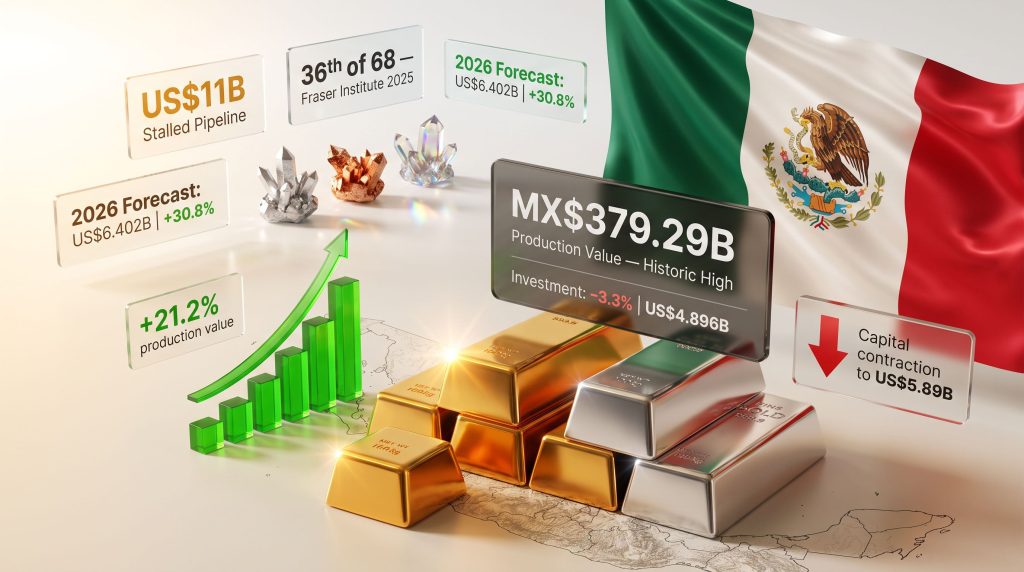
That is precisely the dynamic playing out in Mexico's mining sector right now. In 2025, Mexico mining investment fell 3.3% to US$4.896 billion, even as the country's mining-metallurgical production value reached a record MX$379.29 billion. Understanding why those two figures moved in opposite directions is more instructive than either number in isolation.
When big ASX news breaks, our subscribers know first
The Numbers Behind the Contradiction
Production value does not equal sector health. Mexico's 21.2% jump in production value during 2025 was driven overwhelmingly by precious metals price appreciation rather than volume growth. Silver production value rose 34.9% and gold climbed 31.8%, while industrial metals including copper, zinc, and molybdenum contributed a more modest 12.1% gain. These are price effects, not output expansions.
The contrast becomes starker when viewed against the GDP contribution data. Mining's share of Mexico's GDP contracted 3.2% in 2025, marking the third consecutive annual decline. A sector generating record fiscal contributions of MX$78.14 billion (up 72.3% year-on-year) while simultaneously shrinking its GDP footprint is not expanding. It is running faster on the same track.
| Metric | 2024 | 2025 | Change |
|---|---|---|---|
| Total Mining Investment | US$5.063B | US$4.896B | -3.3% |
| Mining Production Value | Baseline | MX$379.29B | +21.2% |
| Mining GDP Contribution | Baseline | Declined | -3.2% (3rd consecutive year) |
| Fiscal Contributions | Baseline | MX$78.14B | +72.3% |
| Silver Production Value | Baseline | Record high | +34.9% |
| Gold Production Value | Baseline | Record high | +31.8% |
| Industrial Metals Growth | Baseline | Steady | +12.1% |
A Deliberate Capital Reallocation, Not a Sector Retreat
The headline investment decline conceals a more nuanced story about where capital actually moved within the sector. Mexico's mining operators did not simply pull back across the board. They executed a calculated reallocation, directing spending away from activities that require regulatory approvals and toward categories entirely within their operational control.
Categories That Contracted Sharply
- New project development: -49.2% year-over-year
- Project expansions: -47.8%
- Community development programmes: -22.4%
- Clean energy investments: -17.7%
Categories That Expanded Significantly
- Training and productivity programmes: +62.8%
- Environmental compliance expenditure: +55.6%
- Machinery and equipment procurement: +38.5%
- Exploration programmes: +23.4%
The pattern tells a consistent story: operators maintained and optimised existing assets while deferring any commitment that depended on external approvals. This is not capital flight. It is capital in a holding pattern, waiting for the regulatory environment to stabilise before committing to irreversible long-cycle expenditures.
The exploration spending increase of 23.4% deserves particular scrutiny. Exploration budgets only convert into future value if the concession issuance system keeps pace. With new concession grants operating at suppressed levels following Mexico's 2023 Mining Law reform, exploration dollars risk being deployed into discoveries that cannot be advanced without the legal framework to support them.
The US$11 Billion Frozen Pipeline
How Permit Delays Became the Primary Investment Constraint
Commodity prices, financing conditions, and geopolitical risk are all relevant factors in mining investment decisions. In Mexico's case in 2025, none of them were the primary constraint. The dominant impediment was domestic regulatory processing — a challenge familiar to those who have studied mining permitting challenges in other resource-rich jurisdictions.
According to CAMIMEX President Pedro Rivero, approximately US$11 billion in project investment sits immobilised awaiting regulatory authorisations. That figure represents more than double the sector's entire 2025 capital deployment. CAMIMEX Director General Karen Flores indicated the industry stands ready to deploy more than US$14 billion if enabling conditions materialise, a figure that underscores just how large the latent capital queue has become.
The Mexican government inherited 176 stalled mining projects at the start of the current administration. Through an accelerated review process, 110 of those projects received determinations by late 2025, leaving 66 still pending, with officials targeting resolution by mid-2026.
| Permit Status | Volume |
|---|---|
| Projects inherited as stalled | 176 |
| Resolved through accelerated review | 110 |
| Remaining pending (late 2025) | 66 |
| Government normalisation target | Mid-2026 |
Industry executives operating in Chihuahua estimated roughly 160 stalled projects nationally as of early 2025, with approximately 60% already cleared at the primary approval level. The dominant remaining bottleneck: missing environmental permits from SEMARNAT, which has become the operational chokepoint across multiple project categories regardless of where they sit in the broader approval chain.
The 2023 Mining Law's Structural Knock-On Effect
The 2023 Mining Law reform introduced changes that went beyond individual project approvals. By significantly curtailing new concession issuance activity, the legislation created a structural gap at the earliest stage of the exploration-to-production pipeline.
This matters because mining development operates on long lead times. A concession not granted today means a discovery not made in two years, a feasibility study stage not completed in five years, and a mine not built in eight to ten years. The compounding effect of suppressed concession activity will not show up in investment statistics immediately. It will show up in production capacity a decade from now.
This is an industry dynamic that is frequently underappreciated by observers focused on near-term investment figures. The exploration cycle and the concession cycle are inseparable, and any analysis of Mexico's mining investment trajectory must account for both.
Mexico's Global Investment Ranking: Context Behind the Improvement
Mexico advanced 13 positions in the Fraser Institute's Investment Attractiveness Index in 2025, climbing from 49th to 36th place among 68 assessed jurisdictions. This is a meaningful directional signal and the most significant single-year ranking gain Mexico has recorded in recent assessment cycles.
However, the absolute position warrants careful interpretation:
- Jurisdictions ranked in the top quartile (positions 1 through 17) attract disproportionately large shares of global exploration capital relative to their size.
- Mexico's second-quartile position reflects a market that is improving but has not yet reached the competitive threshold of leading destinations such as Canada, Australia, or Nevada.
- The ranking improvement is best understood as a directional signal confirming that international capital allocators are beginning to register incremental regulatory progress, not as confirmation that Mexico has resolved its underlying structural constraints.
For investors, the distinction between trajectory and destination is critical. A jurisdiction moving from 49th to 36th is more attractive than one moving from 36th to 49th, but it remains materially different from one that has held a top-15 position for consecutive years.
The 2026 Rebound Forecast: What the Projections Assume
CAMIMEX projects total mining investment will reach US$6.402 billion in 2026, representing a 30.8% increase over 2025 levels. The category-level breakdown reveals which assumptions are carrying the most weight in that forecast.
| Investment Category | 2025 Estimate | 2026 Forecast | Change |
|---|---|---|---|
| Maintenance | Baseline | US$1.113B | Leading category |
| Project Expansions | Baseline | US$976M | Recovery from -47.8% |
| Equipment Purchases | Baseline | US$835M | Continued growth |
| Environmental Actions | Baseline | US$735M | Compliance-driven |
| Exploration | US$513.56M | US$630.35M | +22.8% |
| New Project Development | US$166.8M | US$485.13M | +190.8% |
The new project development line is the critical variable. A projected 190.8% increase from what was already a severely compressed 2025 base is an optimistic forecast that rests almost entirely on a single assumption: that the government processes remaining permit backlogs at a rate sufficient to unlock meaningful project initiation activity before capital allocation cycles close for the year.
Economy Minister Marcelo Ebrard has publicly committed to prioritising permit approvals, framing supply chain security as a national strategic objective and identifying CAMIMEX as a key partner in the regulatory normalisation process. Whether that commitment translates into processing throughput at SEMARNAT and other approving agencies at the pace the forecast requires remains the central execution risk.
If the 66 remaining stalled projects are not resolved by mid-2026, and if new project approvals do not begin flowing at a normalised rate, the new project development category will again underperform. That single line item has enough weight in CAMIMEX's forecast that its shortfall would pull the total investment rebound materially below the US$6.4 billion projection.
The next major ASX story will hit our subscribers first
Critical Minerals: The Strategic Layer Reshaping Mexico's Investment Calculus
Why Mexico's Mineral Portfolio Has Acquired Geopolitical Relevance
Mexico's mining sector does not operate in isolation from North American industrial policy shifts. The country produces more than 25 minerals classified as industrial development priorities and 12 minerals designated as critical for North American supply chains — a portfolio that intersects directly with electromobility, clean energy infrastructure, semiconductor manufacturing, and advanced technology production. Furthermore, the broader surge in critical minerals demand driven by the global energy transition is amplifying the strategic importance of Mexico's resource endowment.
This geopolitical dimension is not reflected in the 2025 investment figures but is increasingly relevant to the 2026 and beyond outlook. As North American manufacturers and policymakers accelerate efforts to reduce dependence on Asian supply chains for critical inputs, global supply chain shifts are making Mexico's geographic position and mineral endowment an increasingly logical part of nearshoring-driven restructuring.
| Critical Mineral Application | Relevant Mexican Production |
|---|---|
| Electric vehicle batteries | Lithium, cobalt, manganese |
| Clean energy infrastructure | Copper, molybdenum, zinc |
| Technology manufacturing | Silver, gold, rare earths |
| Semiconductor supply chains | Industrial minerals portfolio |
The US$43 Billion Horizon
A fully implemented critical minerals policy framework, including a potential bilateral agreement with the United States, could attract up to US$43 billion in investment by 2030 and generate approximately 500,000 employment positions, according to CAMIMEX projections. Those figures reframe the current US$11 billion stalled pipeline not as a crisis, but as a fraction of the addressable opportunity.
CAMIMEX has explicitly linked its investment outlook to Plan México, the government's national industrialisation framework. The mining sector's connection to 192 manufacturing and technology production chains positions it as a foundational input supplier across multiple downstream industries, including the nearshoring-driven manufacturing expansion that has attracted significant foreign direct investment to Mexico in recent years.
The Concession Gap as a Long-Cycle Risk
One aspect of Mexico's mining outlook that receives insufficient attention in short-term investment discussions is the compounding effect of reduced concession activity on the sector's geological discovery rate. Major mineral deposits are not found quickly. The typical timeline from initial concession grant to resource definition can span five to ten years, meaning that concessions not issued in 2023 and 2024 represent a gap in the mineral exploration pipeline that will not become visible in production statistics until the early 2030s.
For investors with long time horizons, this is the most consequential structural risk embedded in Mexico's current regulatory environment, and it is one that an improving Fraser Institute ranking and easing permit backlogs at existing projects cannot fully address on their own. Consequently, maintaining a healthy concession issuance rate is as important as resolving the existing backlog.
Three Conditions That Determine Whether the Recovery Is Real
The 2026 investment rebound scenario is achievable but not guaranteed. Its realisation depends on three specific execution requirements:
- Permit backlog resolution: The remaining 66 stalled projects must receive determinations by mid-2026, with a transparent and consistent processing timeline established for new applications entering the system.
- Concession issuance normalisation: New mining concession grants must resume at a pace sufficient to sustain the exploration pipeline and provide the long-cycle predictability that international capital allocators require before committing to multi-year exploration programmes.
- Critical minerals framework development: Progress toward a formal bilateral arrangement with the United States on critical minerals supply chains would unlock institutional capital flows that currently remain in a wait-and-see posture pending clearer policy direction.
Mexico's mining sector enters 2026 with a rare combination of improving external indicators and persistent internal constraints. The Fraser Institute ranking is moving in the right direction. Production values are at historic highs. Fiscal contributions demonstrate the sector's revenue-generating capacity. And the latent capital waiting for deployment — at US$11 billion in stalled projects and US$14 billion in stated industry readiness — is substantial.
What has not yet been demonstrated is that the regulatory processing system can operate at the throughput rate required to convert that latent capital into active investment. Furthermore, the CAMIMEX Annual Report highlights that until that execution gap closes, Mexico mining investment fell 3.3% in 2025 should be understood not as a sector in decline, but as a sector in administrative suspension — with the geological endowment, the capital availability, and the geopolitical relevance to support a significant and sustained recovery the moment the enabling conditions arrive.
This article contains forward-looking projections and investment forecasts sourced from CAMIMEX's 2026 Annual Report. These projections are subject to regulatory, commodity price, and macroeconomic variables that could cause actual outcomes to differ materially from those described. This content does not constitute financial or investment advice.
Want to Capitalise on Major Mineral Discoveries Before the Broader Market?
While Mexico's mining sector navigates regulatory bottlenecks and deferred capital deployment, significant discovery opportunities continue to emerge across the ASX — and Discovery Alert's proprietary Discovery IQ model delivers real-time alerts the moment they're announced, transforming complex mineral data into actionable insights for investors at every experience level. Explore historic examples of major discoveries and their market returns, then begin your 14-day free trial at Discovery Alert to position yourself ahead of the market.