
August 5, 2026
The Fiscal Trap: Why Capital Is Abandoning the UK North Sea
Mature offshore basins do not collapse overnight. They erode through a slow accumulation of unfavourable conditions: rising costs, declining reservoir pressure, ageing infrastructure, and, crucially, fiscal frameworks that fail to keep pace with the evolving economics of late-life production. The UK Continental Shelf (UKCS) has been navigating these forces for two decades, but the pace of deterioration is now accelerating in ways that should concern policymakers, energy analysts, and anyone who depends on the UK's domestic energy capacity. The bp North Sea exit and UK investment challenges it represents are therefore far more than a single corporate story.
BP's decision to market its UK North Sea business is not simply a corporate restructuring event. It is a legible signal from one of the world's most experienced offshore operators that the UKCS no longer clears the investment threshold required to justify long-cycle capital commitment. Understanding why that threshold has been missed requires looking well beyond any single company's balance sheet.
When big ASX news breaks, our subscribers know first
Understanding the UKCS as a Mature Offshore Province
The UK North Sea reached peak production in the late 1990s, when output exceeded 4.5 million barrels of oil equivalent per day. Since then, the basin has followed the classic decline curve of a mature hydrocarbon province: smaller discovered fields, higher finding costs, rising water cuts, and growing decommissioning liabilities. Today, production sits at a fraction of those peak levels, and the remaining reserve base is concentrated in increasingly marginal accumulations that require sustained capital commitment to develop economically.
What makes basin maturity particularly challenging for large integrated operators is the shift it creates in the risk-return profile. In growth-phase basins, high upfront capital is justified by long production plateaus and extensive reserve life. In mature provinces like the UKCS, however, operators face a fundamentally different proposition:
- Shorter remaining field lives that compress the payback window for new investment
- Higher per-barrel lifting costs driven by ageing subsea infrastructure and smaller reservoir volumes
- Escalating decommissioning liabilities that must be carried on the balance sheet, reducing net asset value
- Greater operational complexity from managing legacy infrastructure alongside new development activity
For an operator like BP, which is simultaneously managing debt reduction targets, energy transition commitments, and pressure from shareholders for capital discipline, the UKCS increasingly represents a set of characteristics that compete poorly with higher-return opportunities elsewhere in its global portfolio.
How the Energy Profits Levy Reshaped the Investment Landscape
The Architecture of UK Upstream Taxation
To understand the depth of the investment challenge, it is necessary to trace the evolution of the UK's upstream tax regime. North Sea operators have historically operated under a layered structure consisting of ring-fence corporation tax (RFCT), petroleum revenue tax (PRT) on older fields, and a supplementary charge. This framework was already more complex than most competing offshore jurisdictions when the government introduced the Energy Profits Levy (EPL) in May 2022 in response to elevated commodity prices.
The EPL was introduced as a temporary windfall measure, but its effective life and rate have shifted multiple times since inception, creating precisely the kind of fiscal uncertainty that upstream operators find most damaging. At its peak, the combined marginal tax rate facing North Sea producers exceeded 75% of profits, placing the UKCS among the highest-taxed offshore provinces globally. Furthermore, the crude oil price trends of recent years have done little to offset this fiscal burden, compressing margins further across the basin.
A critical but underappreciated aspect of the EPL architecture is the investment allowance mechanism. Designed to soften the levy's impact by rewarding capital expenditure, the allowance functioned as intended in theory. In practice, however, operators with constrained development pipelines or uncertain project economics found the allowance insufficient to offset the levy's deterrent effect on sanctioning decisions. Projects that might have been marginally viable under the previous tax structure became uneconomic once the EPL was applied.
"The combination of an elevated effective tax rate and repeated modifications to the levy's structure creates a planning environment where long-cycle capital commitments become economically irrational, regardless of where commodity prices sit at any given moment."
The Measurable Impact on Drilling and Development Activity
The consequences of the EPL on operator behaviour have been tangible and well-documented across the industry. Key metrics illustrating the deterioration include:
- Exploration budgets across the UKCS have contracted sharply since the levy's introduction
- Development drilling programmes at multiple operated fields have been deferred or cancelled entirely
- Several project sanctions anticipated in the 2023–2025 period have not proceeded
- UK North Sea investment levels are tracking toward their lowest sustained levels in decades
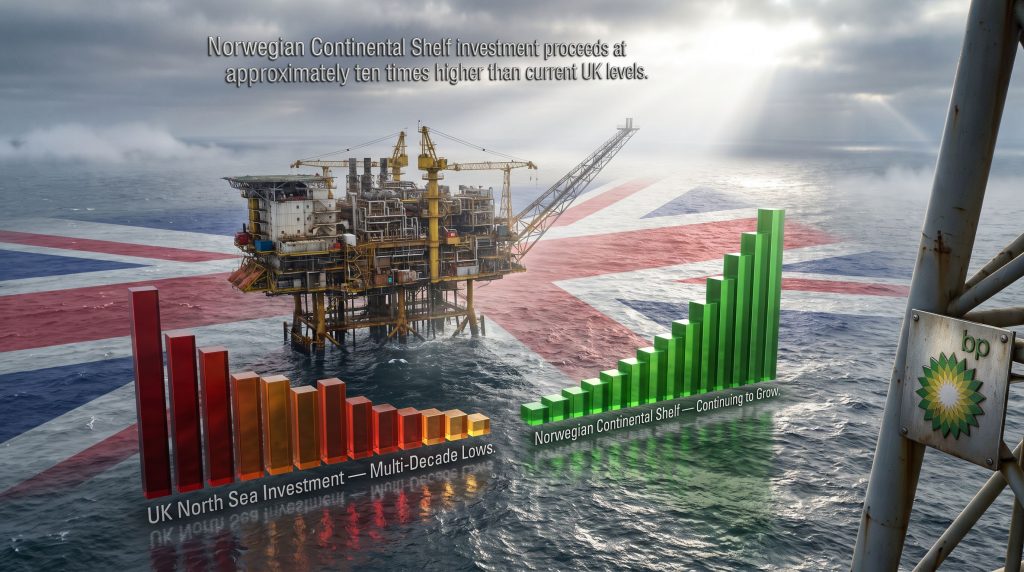
Brian Gilvary, former chief financial officer of BP and current chairman of INEOS Energy, has been one of the most direct industry voices on this issue. Gilvary has stated publicly that the combination of the Energy Profits Levy and the ban on new exploration drilling has effectively closed down meaningful investment in the basin, while Norwegian sector activity continues to grow at approximately ten times the rate of UK investment. This comparison is not incidental. It reflects a structural divergence that has widened under current UK policy settings, and the government intervention risks associated with repeated fiscal changes have only deepened operator scepticism.
UK vs. Norway: A Study in Fiscal Divergence
The contrast between the UKCS and the Norwegian Continental Shelf (NCS) provides perhaps the clearest evidence that fiscal framework quality, not resource quality alone, determines long-term basin investment levels.
| Dimension | UK North Sea | Norwegian Continental Shelf |
|---|---|---|
| Fiscal Regime Stability | Frequent changes; EPL introduced 2022, modified multiple times | Decades-long stable petroleum tax framework |
| Effective Tax Rate | Peak combined rate exceeding 75% | Approximately 78%, but with full refund of exploration costs |
| Investment Trajectory | Declining sharply toward multi-decade lows | Active project sanctioning and growing capex |
| Exploration Activity | Constrained by levy and drilling restrictions | Active licensing and exploration programmes |
| Operator Confidence | Low; capital redirecting to competing provinces | High; major project commitments ongoing |
| Decommissioning Pressure | Accelerating ahead of field economic life | Managed within long-term production plans |
Why Norway's Model Works Differently
A common misconception is that Norway simply taxes its operators less aggressively. In fact, Norway's headline petroleum tax rate is broadly comparable to the UK's peak combined rate. The critical difference lies in how the system is designed rather than the absolute rate.
Norway operates a petroleum tax refund mechanism under which exploration costs qualify for a cash rebate from the government. This effectively means the Norwegian state shares in exploration risk, dramatically lowering the barrier for operators to drill new wells and sustain an active exploration pipeline. For smaller independent operators with constrained balance sheets, this mechanism is particularly powerful, as it removes the binary risk of spending capital on a dry hole with no tax offset.
The UK system offers no equivalent mechanism. Exploration risk in the UKCS is borne entirely by the operator, while the upside is taxed at rates that leave limited margin for the kind of risk-taking that sustains a healthy exploration cycle. Policy consistency also functions as an invisible competitive advantage. When operators evaluate capital allocation across a global portfolio, they assign a risk premium to jurisdictions where the fiscal rules may change materially between investment decision and first production — a window that can span five to ten years for complex offshore developments.
The Economic Consequences That Extend Beyond Barrels
Supply Chain Exposure and Employment Multipliers
Upstream oil and gas investment does not exist in isolation. Each pound of operator capital expenditure generates downstream economic activity across an extensive supply chain encompassing subsea engineering, specialist drilling contractors, logistics and marine services, inspection and integrity management, and a wide range of professional and technical services.
The concentration of this activity in specific UK regions amplifies the economic stakes. Aberdeen has historically functioned as the operational hub for UKCS activity, supporting tens of thousands of direct and indirect jobs across the northeast of Scotland. The Shetland Islands, Teesside, and other northeast England industrial clusters also carry significant exposure to North Sea operator spending.
When major operators reduce capital programmes or exit the basin entirely, the effects cascade through the supply chain faster than the headline production figures suggest. Contractor utilisation rates fall, discretionary maintenance is deferred, workforce redundancies follow, and the regional skill base that took decades to build begins to erode. Once that human capital disperses to other sectors or geographies, it is not easily reconstituted.
Energy Security and the Import Dependency Equation
A less frequently discussed dimension of the bp North Sea exit and UK investment challenges is the relationship between domestic production and energy security. As UKCS output declines, the UK becomes progressively more reliant on liquefied natural gas (LNG) imports and pipeline gas from continental Europe. The LNG supply outlook for 2025 and beyond suggests tightening global availability, which could expose the UK to significant price volatility.
This creates a carbon accounting paradox that sits uncomfortably with stated UK climate objectives. Domestically produced gas extracted under strict UK environmental regulation carries a materially lower lifecycle carbon intensity than LNG sourced from distant producers and transported via energy-intensive liquefaction and shipping chains. Reducing UK production in favour of imported LNG may, in practice, increase the total carbon footprint associated with UK gas consumption while simultaneously reducing fiscal revenue and employment.
"The UK faces a structural contradiction: accelerating the domestic energy transition while continuing to depend on North Sea revenues to fund public services and maintain energy affordability through the transition period. These two objectives are not easily reconciled under the current policy framework."
In addition, the oil price pressures stemming from global trade tensions add another layer of uncertainty for operators trying to model long-term project economics in the UKCS.
What BP's Exit Means for the Remaining UKCS Operator Base
Buyer Appetite and Asset Valuation in a Mature Basin
When a major operator exits a mature basin portfolio, the universe of credible acquirers is narrower than in a growth province. Potential buyers typically fall into three categories:
- Independent E&P companies with existing UKCS operations seeking to consolidate positions and capture operational synergies
- Private equity-backed operators willing to accept the basin's risk profile in exchange for free cash flow generation during the remaining field life
- National oil companies from other jurisdictions with strategic motivations that extend beyond pure return optimisation
Each category brings different balance sheet characteristics, risk tolerance, and operational philosophies. Private equity-backed operators, in particular, tend to operate with higher leverage and shorter investment horizons than the majors they replace. This shift has implications for the pace of development activity, the level of safety and integrity investment, and the long-term sustainability of production from acquired fields.
The decommissioning liability question adds another layer of complexity to any valuation exercise. North Sea decommissioning costs are substantial, and the transfer of those liabilities from a well-capitalised major to a smaller acquirer raises legitimate questions about financial assurance over the long term. The broader energy future debate around how much domestic hydrocarbon production should continue is also adding political complexity to these asset transactions.
The next major ASX story will hit our subscribers first
Three Scenarios for the UKCS Investment Trajectory
Scenario 1: Policy Stabilisation and Partial Recovery
A reform or phase-out of the EPL, combined with restoration of exploration licensing and a credible long-term fiscal signal from government, could begin to rebuild operator confidence. However, upstream investment cycles are long. Capital commitments for complex offshore developments typically require 18 to 36 months of demonstrated policy stability before sanctioning decisions are revisited. Consequently, any recovery in UKCS investment would take several years to materialise in measurable production terms, even under optimistic policy assumptions.
Scenario 2: Managed Decline with Accelerated Decommissioning
If current policy settings persist without meaningful reform, the likely trajectory is a gradual but accelerating operator withdrawal, compressing development activity and pulling forward field closure decisions. The decommissioning liability associated with the UKCS asset base runs into the tens of billions of pounds. As smaller operators inherit these liabilities, questions around financial backstop arrangements and government exposure will intensify.
Scenario 3: Basin Transformation Under a Hybrid Energy Model
The most structurally ambitious scenario envisions the UKCS evolving from a predominantly hydrocarbon-focused province into an integrated offshore energy infrastructure platform. The basin's existing pipeline networks, subsea infrastructure, and geological storage formations offer genuine potential for carbon capture and storage (CCS), hydrogen transport, and co-location with offshore wind development. This transition pathway requires both sustained hydrocarbon revenues to fund the investment and a policy architecture specifically designed to attract transition-aligned capital at scale.
Key Takeaways for Analysts and Energy Investors
- Basin maturity is a permanent geological reality, but the rate of economic decline is directly shaped by the fiscal and regulatory environment surrounding it
- The EPL's primary damage has been to investment confidence, not just to current-period operator margins, with the uncertainty effect potentially more harmful than the tax rate itself
- BP's exit is a symptom of systemic UKCS competitiveness erosion, not a cause of it, and similar decisions by other majors cannot be ruled out under current conditions
- Norway's investment differential of approximately ten times the UK rate demonstrates that comparable resource maturity does not produce comparable investment outcomes when fiscal frameworks diverge significantly
- The employment and supply chain consequences of disinvestment extend across multiple UK regions and will compound over time as specialist workforce skills migrate away from the basin
- Policy reform is the primary available lever, and its effectiveness will be measured not in announcements but in the number of years of consistent, credible implementation that follows
The bp North Sea exit and UK investment challenges it crystallises are not temporary market dynamics. They reflect a structural misalignment between the economics of late-life offshore production and a fiscal regime that has not kept pace with the basin's changing fundamentals. Reversing that misalignment is possible, but it will require policymakers to treat long-term investment certainty as a strategic priority rather than a secondary consideration in a broader political calculus.
Want to Track the Next Major Mineral Discovery Before the Market Does?
While the UK North Sea grapples with fiscal uncertainty and capital flight, opportunity-focused investors are turning their attention to high-potential mineral discoveries on the ASX — and Discovery Alert's proprietary Discovery IQ model delivers real-time alerts the moment significant discoveries are announced, transforming complex geological data into actionable investment insights. Explore Discovery Alert's dedicated discoveries page to understand how historic mineral discoveries have generated substantial returns, and begin your 14-day free trial today to position yourself ahead of the broader market.