
August 4, 2026
The Hidden Cost Architecture Behind Every Precious Metals Purchase
Most investors who buy physical gold or silver focus almost entirely on price direction. Will the metal go up? Is now a good time to buy? These are reasonable questions, but they overlook a structural cost that begins eroding returns the moment a purchase is made. Before a single troy ounce changes hands at the retail level, a layered pricing system is already at work, and understanding what does at spot mean in precious metals is the foundation for becoming a more cost-efficient investor.
At the centre of that system sits a concept that separates informed buyers from those who simply pay whatever price is on the label: the spot price, and more specifically, what it means to buy at spot.
When big ASX news breaks, our subscribers know first
Understanding How Precious Metals Are Priced at the Market Level
Every physical transaction in the precious metals market, regardless of whether it takes place through a major online dealer or a local coin shop, is anchored to a single benchmark: the spot price. This figure represents the live market value of one troy ounce of a precious metal for immediate settlement, and it fluctuates continuously throughout global trading sessions.
Gold, silver, platinum, and palladium each carry an independently quoted spot price. These prices respond in real time to a broad set of market forces:
- U.S. dollar strength, which has an inverse relationship with gold and silver pricing; a stronger dollar typically suppresses metal prices and vice versa
- Macroeconomic data releases including inflation readings, central bank interest rate decisions, and employment figures
- Geopolitical risk events that drive safe-haven demand, particularly into gold
- Industrial consumption cycles, which are especially influential for silver, platinum, and palladium given their significant industrial applications
- Mining supply dynamics, including output volumes from major producing nations such as South Africa, Russia, China, and Peru
Furthermore, understanding silver's industrial demand helps explain why its spot price can diverge sharply from gold during certain economic cycles.
The spot price is not what you pay at retail. It is the raw, undiluted market value of the metal itself, the wholesale floor from which all physical product pricing is built upward.
One technical nuance worth understanding is that the spot price itself is a mid-market figure derived from the bid-ask spread in the over-the-counter and futures markets. When dealers quote a bid price to buy metal from customers, it sits below spot. When they offer a product for sale, the ask price sits above spot. The gap between these two figures is where dealer economics live.
| Term | Definition | Investor Relevance |
|---|---|---|
| Spot Price | Live mid-market benchmark per troy ounce | Universal reference point for all metal pricing |
| Bid Price | What a dealer pays when buying from you | Typically below spot; reflects resale and authentication cost |
| Ask Price | What a dealer charges when selling to you | Above spot; includes premium components |
| At Spot | A retail offer priced exactly at the spot benchmark | Zero premium; maximum metal value per dollar spent |
What Does "At Spot" Mean in Precious Metals, Exactly?
Understanding what does at spot mean in precious metals requires moving beyond the simple definition and into the practical reality of how physical bullion reaches investors. When a product is listed at spot, the buyer pays precisely the current market benchmark for the metal, with no additional markup layered on top.
Direct Answer: Buying at spot in precious metals means acquiring a physical product such as a coin, bar, or round at the exact live market price of the metal itself. No fabrication cost, no distribution markup, no dealer margin is added. It represents the lowest-cost entry point available for physical metal ownership.
This is a genuinely exceptional pricing condition in the retail bullion market, because almost every physical product that exists has travelled through a production and distribution chain that adds cost at each stage. Those looking to buy gold in Australia should therefore familiarise themselves with spot pricing before committing to any transaction.
What Is a Premium Over Spot and Why Does It Always Exist?
The premium over spot is the difference between the spot price and what a buyer actually pays for a finished physical product. This premium is not arbitrary; it compensates for every step in the supply chain between a refined metal pool and the coin or bar that lands in an investor's hand.
Premium components typically include:
- Refining and assaying costs to achieve investment-grade purity standards (typically .999 or .9999 fine)
- Minting and fabrication expenses for striking coins to sovereign or commercial specifications
- Quality packaging and certification, including assay cards, tamper-evident capsules, and serial numbering
- Logistics and insurance for secure transportation through the distribution network
- Dealer operating margin covering staff, infrastructure, and transaction costs
- Demand surcharges that can spike significantly during periods of supply scarcity or investor panic buying
It is worth noting that during acute market stress events, premiums can behave in ways that decouple significantly from their baseline ranges. During the early months of the COVID-19 pandemic in 2020, silver premiums on American Silver Eagles surged to levels that were multiples of their normal range as physical demand overwhelmed available supply while spot prices remained relatively contained.
This divergence between spot price and physical premium is one of the most misunderstood dynamics in the retail bullion market. For context on why physical metal costs more than the spot price, the cost-structure explanation above provides a solid foundation.
Bullion Premiums vs. Numismatic Premiums: A Critical Distinction
Not all premiums are created equal, and conflating these two categories is a common mistake among newer investors.
Bullion premiums apply to products where value is derived primarily from metal content. These include generic rounds, cast bars, and government-minted bullion coins. The premium exists to cover production and distribution, not any collectible characteristic.
Numismatic premiums apply where rarity, historical significance, mintage limits, or exceptional collector demand drive value far beyond the underlying metal. These premiums can run many multiples of the intrinsic metal value and are entirely independent of spot price movements.
At-spot pricing almost exclusively applies to bullion products. One notable exception is pre-1965 U.S. silver coinage, specifically dimes, quarters, and half dollars struck in 90% silver. Because these coins derive their value almost entirely from silver content rather than collector appeal, they frequently appear in at-spot or near-spot transactions, making them a uniquely accessible entry point for cost-conscious silver investors.
Premium Ranges Across Gold, Silver, and Platinum: A Comparative Analysis
The relationship between spot price and premium percentage varies considerably across the major precious metals, creating meaningfully different value propositions depending on which metal an investor is accumulating.
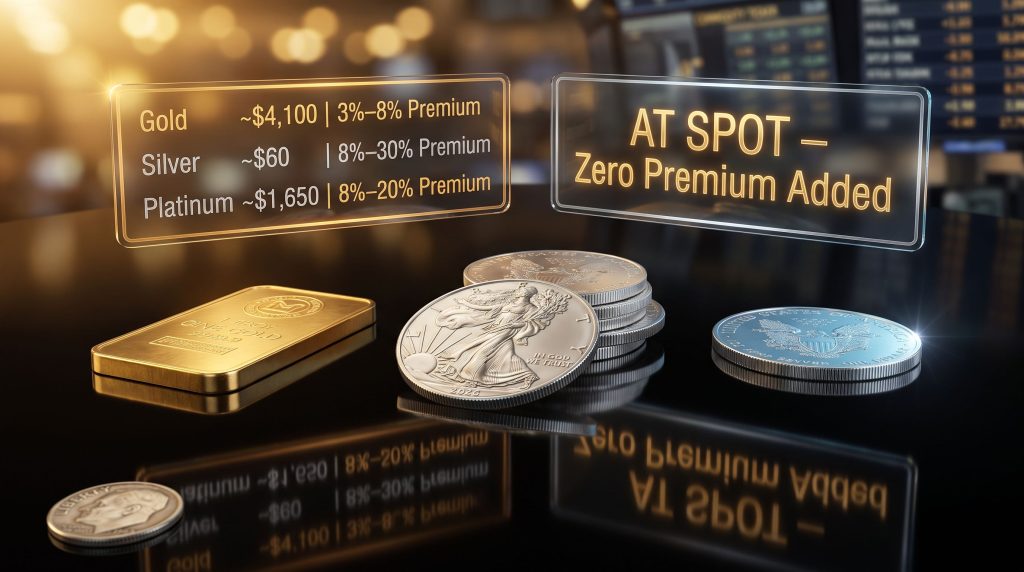
| Metal | Approx. Spot Price (per oz) | Typical Premium Range | Dollar Premium Per Ounce |
|---|---|---|---|
| Gold | ~$4,100 | 3% to 8% | ~$120 to $320 |
| Silver | ~$60 | 8% to 30% | ~$5 to $18 |
| Platinum | ~$1,650 | 8% to 20% | ~$130 to $330 |
Note: Prices and premium ranges are indicative as of the time of writing and subject to daily market movement. Always verify current pricing through live market sources before transacting.
Gold Premium Dynamics
Gold's high absolute price per ounce means that premiums are proportionally modest as a percentage but substantial in dollar terms. A standard one-ounce American Gold Eagle or Canadian Gold Maple Leaf typically carries a 3% to 8% premium, translating to roughly $120 to $320 per ounce above spot at current price levels.
Fractional gold coins introduce a counterintuitive premium dynamic that many investors overlook. A one-tenth ounce gold coin carries a disproportionately higher percentage premium than a full ounce product, because the fixed minting costs are spread across a much smaller quantity of metal. Investors seeking cost efficiency are generally better served by full-ounce formats where the premium-to-metal ratio is most favourable.
Silver Premium Dynamics
Silver operates with inverted economics. Because the absolute price per ounce is far lower than gold, fixed minting and distribution costs represent a much larger share of the total product value. A minting cost that adds $3 per ounce represents less than 0.1% of a gold coin's value but approximately 5% of a silver coin's value at current prices.
American Silver Eagles historically sit at the higher end of the silver premium spectrum, driven by sustained collector and investor demand alongside the U.S. Mint's production constraints. Generic silver rounds and large-format bars typically offer tighter premiums, making them the preferred vehicle for investors prioritising metal exposure over brand recognition.
Platinum Premium Dynamics
Platinum operates in a considerably thinner and less liquid market than either gold or silver. Fewer products, fewer global market participants, and more concentrated supply chains — South Africa accounts for approximately 70% to 80% of global platinum mine supply — mean premiums can run slightly higher than gold on a percentage basis. Larger 10-ounce bars generally carry lower percentage premiums in the 6% to 12% range, while individual coins such as the American Platinum Eagle sit toward the upper end.
Why At-Spot Entry Points Matter More Than Most Investors Realise
For anyone approaching physical precious metals as a long-term store of value or portfolio diversification tool, the cost of entry is not a minor detail. Every dollar paid in premium above spot is a dollar that must be recovered through price appreciation before the position reaches break-even. This is the premium break-even gap, and it is the single most underappreciated factor in physical metals investing.
The compounding effect of premiums across a portfolio:
- A 10% silver premium means spot must rise by more than 10% before any investment gain is realised
- At-spot pricing eliminates this gap entirely, creating immediate intrinsic value alignment
- For dollar-cost averaging strategies where investors accumulate metal over months or years, consistently acquiring at or near spot can meaningfully reduce the long-run average cost basis
- Across a position of several hundred ounces, the difference between a 15% and a 5% average premium represents thousands of dollars in effective cost
Removing the premium does not just save money on a single transaction. It restructures the entire risk-reward profile of a physical metals position by eliminating the built-in performance drag that elevated premiums create.
At-spot pricing is particularly powerful during periods of high spot prices, where even modest percentage premiums translate into large absolute dollar amounts. An investor buying gold at $4,100 per ounce with a 5% premium pays $205 per ounce more than one who secures the same metal at spot. Across multiple ounces, that differential is not trivial. This is why gold as a safe haven only fully delivers on its promise when acquisition costs are kept as low as possible.
The next major ASX story will hit our subscribers first
Can Precious Metals Be Purchased Below Spot? The Full Picture
Below-spot transactions do occur in the physical market, but they are structurally uncommon in legitimate retail channels and arise from specific conditions rather than routine pricing.
Legitimate below-spot scenarios include:
- Dealer inventory liquidations where metal was acquired at a lower historical cost and is being cleared at or below current spot to protect margin as spot prices rise
- 90% silver lot offloading when refiners reduce intake capacity and dealers holding large quantities of pre-1965 coinage face accumulating carrying costs that make below-spot sales preferable to ongoing storage expense
- Bulk institutional transactions between large counterparties where volume discounts create minor discounts to the benchmark price
A Serious Warning: Below-Spot Offers and Fraud
Fraud Alert: Below-spot pricing is one of the most consistently exploited tactics in precious metals fraud. Listings advertising gold or silver at prices substantially below the current market benchmark, with no credible structural explanation, are frequently used to move counterfeit products including gold-plated tungsten bars and silver-plated base metal rounds that are visually indistinguishable from genuine bullion without specialised testing.
Key red flags that should prompt immediate caution:
- No verifiable business registration, physical address, or regulatory oversight
- Prices 15% or more below current spot with no stated structural reason
- High-pressure urgency tactics designed to prevent due diligence
- Absence of any return policy, authentication guarantee, or buy-back commitment
- No independently verifiable customer reviews or third-party ratings
How to Access At-Spot Offers in the Physical Bullion Market
At-spot pricing opportunities exist through several distinct channels, and understanding each one allows investors to position themselves to take advantage when these windows open.
1. Limited-Time Promotional Events
Bullion dealers periodically list products at spot price through time-sensitive promotions tied to market positioning, inventory management, or seasonal demand cycles. These events can run for a full week, 24 hours, or as flash sales lasting only a few hours. Some dealers have offered no-premium windows ahead of major retail events in recent years, creating structured opportunities for cost-conscious buyers.
2. New Customer Acquisition Offers
Many reputable bullion dealers use at-spot pricing as an introductory incentive for first-time buyers. These offers are typically limited by quantity per customer but represent genuine zero-premium acquisition opportunities for investors entering the market. Both web and mobile app platforms may carry distinct at-spot product selections, meaning a new customer can potentially access multiple at-spot products across both channels.
3. Mobile App-Exclusive Deals
Dedicated precious metals retail apps increasingly offer platform-exclusive at-spot or near-spot pricing to reward mobile engagement. These offers can sell out within minutes of notification, making push notification opt-ins the most reliable access mechanism.
Practical Steps to Maximise Access
- Create a verified account with established dealers to unlock member-only promotions
- Enable push notifications on mobile apps for real-time flash sale alerts
- Subscribe to dealer newsletters that distribute special offer announcements directly
- Monitor promotional windows around major market events and retail calendar milestones
- Track your cost basis carefully, recording the spot price at acquisition alongside any premium paid, to maintain a precise picture of your break-even point
Frequently Asked Questions: At Spot Pricing in Precious Metals
What is the difference between spot price and retail price for gold and silver?
The spot price is the live global market benchmark for one troy ounce of a precious metal in its raw, unprocessed form. The retail price reflects the spot price plus a fabrication and dealer premium that compensates for the production and distribution journey. At-spot offers align the retail price with the raw market benchmark by removing that premium component entirely.
Is an at-spot offer too good to be true?
Not when it comes from a credible, established dealer with a verifiable track record. Legitimate at-spot offers exist and are structured as promotional events, new customer incentives, or app-exclusive deals by reputable market participants. The key differentiator is always seller credibility. At-spot offers from unverified sources, particularly those paired with below-spot pricing and no explanation, carry meaningful fraud risk.
Why are silver premiums a higher percentage than gold premiums?
Because silver's absolute price per ounce is dramatically lower than gold's, the fixed costs of minting, packaging, and distribution constitute a far larger share of the total product value. The economics simply work against silver investors on a percentage basis, which is precisely why at-spot silver deals represent exceptional value relative to standard retail pricing.
What products are most commonly offered at spot?
At-spot deals most frequently apply to:
- Generic silver rounds and cast bars from commercial refiners
- Pre-1965 U.S. 90% silver coinage sold in bags or rolls by silver content
- Entry-level gold bars from recognised refiners during promotional windows
- Specific government-minted bullion coins during limited-time events
Can you sell precious metals back at spot price?
Dealers typically purchase metal at below-spot prices to cover authentication, repackaging, and resale margin requirements. The spread between the buy (bid) and sell (ask) price is a structural feature of all physical commodity markets. Investors should factor this buy-sell spread into their total cost-of-ownership calculation when evaluating any physical metals position.
Building a Cost-Efficient Precious Metals Strategy Around Spot Pricing
Understanding what does at spot mean in precious metals is only the beginning. Translating that knowledge into a disciplined acquisition strategy is where the real value is captured. In addition, considering the broader range of gold investment strategies alongside spot-focused tactics will further strengthen long-term portfolio outcomes.
- Establish a baseline premium target for your preferred products and treat at-spot events as benchmark opportunities to compress your average acquisition cost
- Diversify across metals to spread both price risk and premium exposure; gold, silver, and platinum each offer different premium structures and at-spot opportunity profiles
- Consider the choice between physical vs ETF gold when building a diversified position, as ETFs carry no fabrication premium but also no tangible asset ownership
- Prioritise liquid product formats with tight buy-sell spreads, such as widely recognised government coins and generic bars, to maximise resale efficiency alongside at-spot acquisition
- Document every purchase with the spot price at time of transaction and premium paid, creating a precise cost-basis record that informs future strategy decisions
| Concept | Core Insight |
|---|---|
| Spot Price | Real-time global benchmark per troy ounce; the raw market value of the metal |
| At Spot | Zero premium; the retail price equals the raw market benchmark |
| Premium Over Spot | Covers minting, refining, distribution, and dealer margin |
| Below Spot | Rare in legitimate markets; a primary fraud indicator in unverified contexts |
| Best Access Channels | Promotional events, new customer offers, mobile app-exclusive deals |
| Investment Value | Eliminates the premium break-even gap; maximises metal exposure per dollar |
Strategic Takeaway: At-spot pricing is not a gimmick or a loss-leader without substance. For investors who understand how premiums structurally erode purchasing power over time, systematically targeting at-spot or low-premium acquisition windows is one of the most disciplined and financially rational approaches to building a durable physical metals position.
Readers seeking to deepen their understanding of precious metals pricing mechanics, bullion investing fundamentals, and spot price tracking tools may find additional educational value through the APMEX Knowledge Centre at learn.apmex.com, which covers investing guides, buying strategies, and live pricing resources across gold, silver, platinum, and palladium.
All spot price figures and premium ranges cited in this article are indicative at the time of writing. Precious metals are actively traded commodities and prices move every trading day. This article is for educational purposes only and does not constitute financial or investment advice. Always verify current pricing through live market sources before transacting.
Want to Discover the Next Major ASX Mineral Find Before the Broader Market Does?
While cost-efficient precious metals accumulation builds a solid portfolio foundation, Discovery Alert's proprietary Discovery IQ model delivers real-time notifications on significant ASX mineral discoveries — instantly translating complex geological data into actionable investment opportunities for both short-term traders and long-term investors. Explore how historic mineral discoveries have generated substantial market returns and begin your 14-day free trial today to position yourself ahead of the market.