
August 5, 2026
The Permit Bottleneck That Turned a Record Year Into a Warning Sign
When commodity prices rise sharply and production revenues hit historic highs, the natural assumption is that capital investment follows. In mining, that relationship is rarely so clean. The conditions that drive spot prices upward — supply tightness, geopolitical disruption, accelerating demand from clean energy transition — are often the same forces that expose structural weaknesses in producing jurisdictions. Mexico in 2025 illustrated this dynamic precisely: a record-breaking production year unfolding alongside the third consecutive contraction in mining's contribution to GDP, and a sharp pullback in the capital spending that determines whether today's output levels can be sustained tomorrow.
Understanding why this divergence occurred, and whether 2026's projected Mexico mining investment rebound can overcome the permit delays responsible for it, requires looking beyond headline numbers to the mechanics of how regulatory friction converts geological advantage into stranded capital.
When big ASX news breaks, our subscribers know first
Record Revenue, Contracting Capacity: The 2025 Paradox
Mexico's mining-metallurgical production value climbed to a historic high of MX$379.29 billion in 2025, representing a 21.2% increase over 2024. Silver production value surged 34.9% and gold rose 31.8%, driven primarily by elevated global precious metals prices rather than meaningful volume expansion. Industrial metals including copper, zinc, and molybdenum contributed 12.1% growth to overall production value.
These figures paint a picture of sectoral health. The investment data, however, tells a different story entirely.
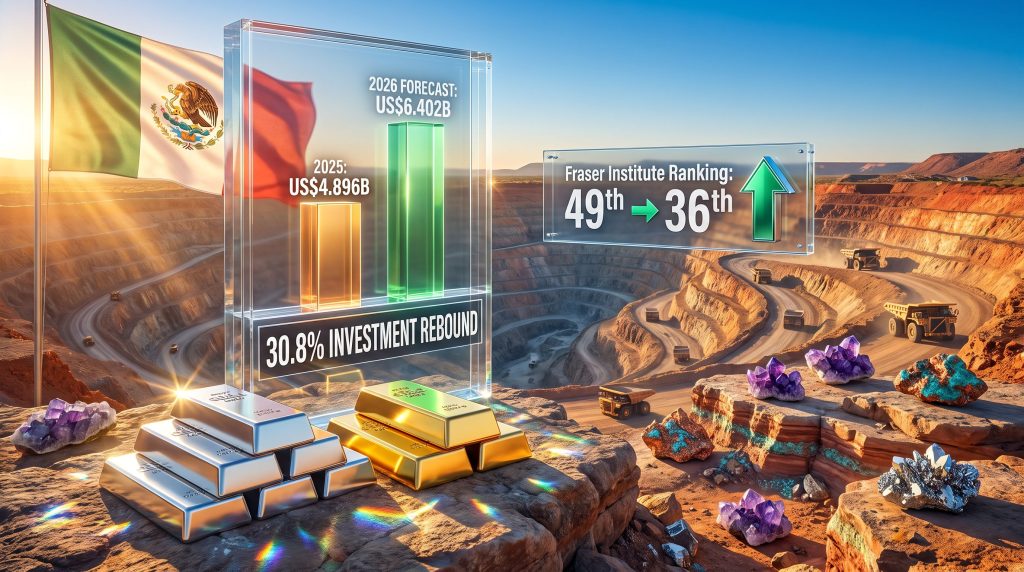
Total mining investment contracted 3.3% in 2025, falling from US$5.063 billion to US$4.896 billion, according to CAMIMEX's 2026 Annual Report. More significantly, the composition of that spending revealed a sector in defensive posture rather than expansionary mode.
The Bifurcated Spending Pattern That Reveals Everything
The headline decline understates the severity of the underlying shift. Disaggregating 2025 investment by category exposes a spending structure shaped almost entirely by regulatory paralysis:
| Investment Category | 2025 Year-on-Year Change |
|---|---|
| New project development | -49.2% |
| Project expansions | -47.8% |
| Community development | -22.4% |
| Clean energy investment | -17.7% |
| Exploration spending | +23.4% |
| Training and productivity | +62.8% |
| Environmental compliance | +55.6% |
| Machinery and equipment | +38.5% |
The categories that fell most sharply share a common characteristic: they require regulatory authorisations to proceed. New project development and expansion spending both require concessions, environmental impact assessments, water use permits, and land-use authorisations. Without those approvals in hand, capital simply cannot be committed.
The categories that grew reflect a different strategic logic entirely. Companies increased exploration spending by 23.4% despite the concession environment, positioning for future deployment when approvals eventually materialise. Training and productivity investment jumped 62.8%, and environmental compliance spending rose 55.6%, signalling that operators are using the regulatory delay period to strengthen operational readiness rather than abandon the market.
This bifurcated pattern is not capital flight. It is capital hibernation, with companies maintaining optionality while waiting for the permitting environment to normalise.
Mining's fiscal contributions still reached MX$78.14 billion in 2025, up 72.3% from 2024, a figure driven mechanically by higher precious metals prices lifting royalty and tax revenues even as underlying investment contracted. This creates a fiscal dynamic worth noting: the Mexican government collected significantly more revenue from mining in 2025 despite the sector investing less, reducing the immediate budgetary pressure to accelerate permit reform even as the structural cost of delay compounded.
Quantifying the Regulatory Bottleneck and Its Investment Cost
The mechanism behind Mexico's mining investment decline is now well documented. Approximately US$11 billion in mining investment is currently immobilised pending regulatory authorisations, according to CAMIMEX President Pedro Rivero, who identified permit bottlenecks in mining as the sector's primary structural constraint.
New concession issuance slowed significantly following the implementation of Mexico's 2023 Mining Law, creating a compounding problem: exploration depends on concessions, development follows exploration, and production capacity follows development. Interrupting the earliest stage of that chain produces consequences that take years to manifest in output volumes, but the investment data captures them immediately.
Where the Approval Process Breaks Down
The permitting bottleneck in Mexico is not a single-point failure. It involves multiple overlapping authorisation requirements, each with its own agency, timeline, and resource constraints:
- Environmental Impact Assessments (MIAs) processed by SEMARNAT represent the most commonly cited single point of delay, with more than 50 MIAs reported as still under review as of late 2025
- Water use permits issued by Conagua compound the timeline, often running concurrently with but independently of environmental review
- Land-use authorisations create a third approval layer, producing situations where a project can clear one process only to stall on another
- 18 major projects representing nearly US$2.8 billion in investment were classified as delayed in a single reporting period, illustrating how quickly stalled approvals aggregate into macro-level capital suppression
Furthermore, as widely reported, these delays are directly threatening billions in otherwise committed investment across the sector. The current administration inherited 176 stalled mining projects at the start of its term. Through an accelerated review process, 110 of those projects had been resolved as of late 2025, with 66 remaining pending. Officials have targeted mid-2026 for backlog normalisation.
Industry executives in Chihuahua placed the total national figure at approximately 160 stalled projects, with roughly 60% already approved and most remaining delays attributed to missing environmental permits specifically.
Economy Minister Marcelo Ebrard has publicly committed to accelerating permit processing in 2026, positioning reliable mineral supply chains as a national economic priority and describing CAMIMEX as one of the government's closest regulatory partners.
The 2026 Rebound Forecast: What the Numbers Actually Assume
CAMIMEX projects total mining investment will reach US$6.402 billion in 2026, representing a 30.8% increase over 2025. The projected breakdown across spending categories shows where the association expects capital to flow:
| Spending Category | 2026 Forecast |
|---|---|
| Maintenance | US$1.113 billion |
| Project expansions | US$976 million |
| Equipment purchases | US$835 million |
| Environmental actions | US$735 million |
| Exploration | US$630.35 million |
| New project development | US$485.13 million |
The most analytically significant line item is new project development, forecast to grow from US$166.8 million in 2025 to US$485.13 million in 2026, a figure that implies more than a tripling of greenfield capital deployment. This category is the most permit-sensitive in the entire forecast. Its realisation depends almost entirely on whether the remaining backlog of stalled projects clears and whether SEMARNAT processes outstanding MIAs at an accelerated pace.
Investors and operators tracking the Mexico mining investment rebound and permit delays should treat that single line item as the most informative leading indicator available. If new project development spending approaches forecast levels by mid-2026, it confirms that regulatory reform is translating into real capital deployment. If it lags, the broader rebound narrative requires significant qualification.
Three Scenarios for Mexico Mining Investment Through 2027
The forecast's credibility depends on several concurrent conditions holding. Three plausible paths forward:
Scenario A: Accelerated Permitting Resolution
- Remaining 66 stalled projects cleared by Q2 2026
- New project spending exceeds US$600 million by 2027
- Fraser Institute ranking improves further, attracting additional foreign capital
- GDP contribution returns to positive territory as new productive capacity comes online
Scenario B: Baseline Partial Recovery (Most Probable Near-Term Path)
- Backlog clears unevenly across project types and states
- 2026 investment reaches US$5.8 to US$6.0 billion, slightly below CAMIMEX's headline forecast
- GDP contribution stabilises but does not recover without new concession issuance at scale
- Fraser Institute ranking holds or improves marginally
Scenario C: Regulatory Reversal
- New friction emerges from 2023 Mining Law implementation
- US$11 billion pipeline remains largely immobilised
- Investment plateaus near 2025 levels
- Mexico cedes competitive ground to regional peers as capital seeks more permitting-predictable jurisdictions
Disclaimer: These scenarios represent analytical projections based on publicly available data and industry association forecasts. They are not investment advice and should not be relied upon as predictions of future outcomes.
Mexico's Improved Investment Ranking and What It Actually Measures
Mexico advanced 13 positions in the Fraser Institute's Investment Attractiveness Index, moving from 49th to 36th out of 68 jurisdictions in the most recent assessment. CAMIMEX Director General Karen Flores described the improvement as a meaningful signal to international capital markets, and the movement is notable for its scale within a single assessment cycle.
The Fraser Institute index combines two components that are worth understanding separately:
- Geological Potential Score reflects a jurisdiction's mineral endowment as assessed by industry geologists and executives. Mexico has consistently scored well on this dimension given its prolific silver, gold, copper, and zinc production history.
- Policy Perception Index measures how much the regulatory and policy environment deters investment relative to geological potential. This component had been a persistent drag on Mexico's overall ranking in prior years, making the 13-spot improvement significant as an indicator of shifting investor sentiment toward the policy environment.
Critically, a ranking improvement reflects current perception rather than confirmed structural change. Sustaining gains will require that permit processing improvements become institutionalised rather than remaining administratively discretionary. In addition, definitive feasibility studies on key projects will need to advance concurrently to demonstrate genuine progress to international capital markets.
Critical Minerals and the North American Supply Chain Opportunity
Mexico's mineral endowment creates strategic positioning within North American supply chain architecture that extends well beyond conventional precious metals analysis. The country produces more than 25 minerals classified as industrial development priorities, with 12 of those minerals formally classified as critical for North American supply chain security.
Those 12 minerals feed directly into 192 production chains spanning manufacturing, electromobility, clean energy infrastructure, and technology hardware. Consequently, critical minerals supply chains from Mexico are not marginal inputs to the clean energy transition; they represent central participation in the materials that North American manufacturing increasingly cannot source domestically.
A comprehensive critical minerals policy framework, if implemented effectively, could attract up to US$43 billion in investment by 2030 and generate an estimated 500,000 jobs, according to industry analysis. Furthermore, critical minerals demand projections continue to rise globally, meaning a bilateral agreement with the United States specifically targeting these supply chains would amplify these projections considerably.
CAMIMEX has explicitly linked the sector's investment outlook to Plan México's industrialisation objectives, and Karen Flores indicated the industry is prepared to commit more than US$14 billion if enabling conditions for project development materialise. The strategic alignment between Mexico's mineral endowment, nearshoring momentum, and North American supply chain diversification creates a genuine policy opportunity that is time-sensitive. Analysts tracking competing jurisdictions across Latin America and beyond note that they are actively pursuing their own permitting acceleration and production expansion timelines.
Why the GDP Contribution Decline Matters More Than the Production Record
Mining's contribution to Mexico's GDP fell 3.2% in 2025, extending a streak to three consecutive annual contractions. This divergence from record production revenues is not a statistical anomaly; it reflects the structural consequence of price-driven revenue inflation substituting for genuine volume growth.
When prices rise without corresponding increases in production volumes and new capacity, measured production value increases while the sector's underlying contribution to economic output stagnates or contracts. New productive capacity has not been added at a pace sufficient to offset the GDP drag from stalled development. Resolving permit delays does not simply unlock capital for shareholders; it is the precondition for reversing a GDP contribution trajectory that has now declined for three straight years.
The next major ASX story will hit our subscribers first
Frequently Asked Questions: Mexico Mining Investment and Permit Delays
Why did Mexico's mining investment fall in 2025 if production value hit a record high?
Investment declined because new project development and expansion spending contracted sharply amid permit delays. Higher precious metals prices inflated production values without requiring new capital deployment, creating the appearance of sectoral health while underlying investment capacity deteriorated.
How much investment is currently blocked by permit delays in Mexico?
Approximately US$11 billion in mining investment is stalled pending regulatory authorisations, according to CAMIMEX data.
What is CAMIMEX's forecast for mining investment in 2026?
CAMIMEX projects total mining investment will reach US$6.402 billion in 2026, a 30.8% increase over the US$4.896 billion recorded in 2025.
How many stalled mining projects has Mexico resolved?
Of 176 stalled projects inherited by the current administration, 110 had been resolved as of late 2025, with 66 still pending and mid-2026 targeted for backlog normalisation.
What is the Fraser Institute Investment Attractiveness Index?
The Fraser Institute ranks mining jurisdictions globally across geological prospectivity and policy environment dimensions. Mexico improved 13 positions, moving from 49th to 36th out of 68 jurisdictions in the most recent survey.
What role do critical minerals play in Mexico's mining investment outlook?
Mexico produces 12 minerals classified as critical for North American supply chains. A comprehensive critical minerals policy could attract up to US$43 billion in investment by 2030 and create 500,000 jobs, positioning Mexico as a central supplier within North American manufacturing realignment.
Want to Track the Next Major Mineral Discovery Before the Market Does?
Discovery Alert's proprietary Discovery IQ model delivers real-time alerts on significant ASX mineral discoveries, transforming complex geological data into actionable investment insights for both new and experienced investors — explore historic discoveries that generated substantial returns and begin your 14-day free trial at Discovery Alert to position yourself ahead of the market.