August 7, 2026
The Geology Is There. The Infrastructure Isn't. Why Mexico's Shale Ambition Faces a Long Road
Few energy transitions reveal a country's structural vulnerabilities quite like the moment it admits how dependent it has become on a neighbour for a basic fuel. Natural gas, the feedstock for power generation, industrial production, and residential heating across Mexico, arrives predominantly from wells drilled just across the Texas border. The domestic alternative exists in the ground. The question consuming policymakers, engineers, and energy investors alike is whether the conditions to extract it can ever be assembled in time to matter.
That question now has a partial answer, and it comes wrapped in conditions stringent enough to serve as a development filter in their own right.
When big ASX news breaks, our subscribers know first
Understanding Mexico's Natural Gas Import Crisis
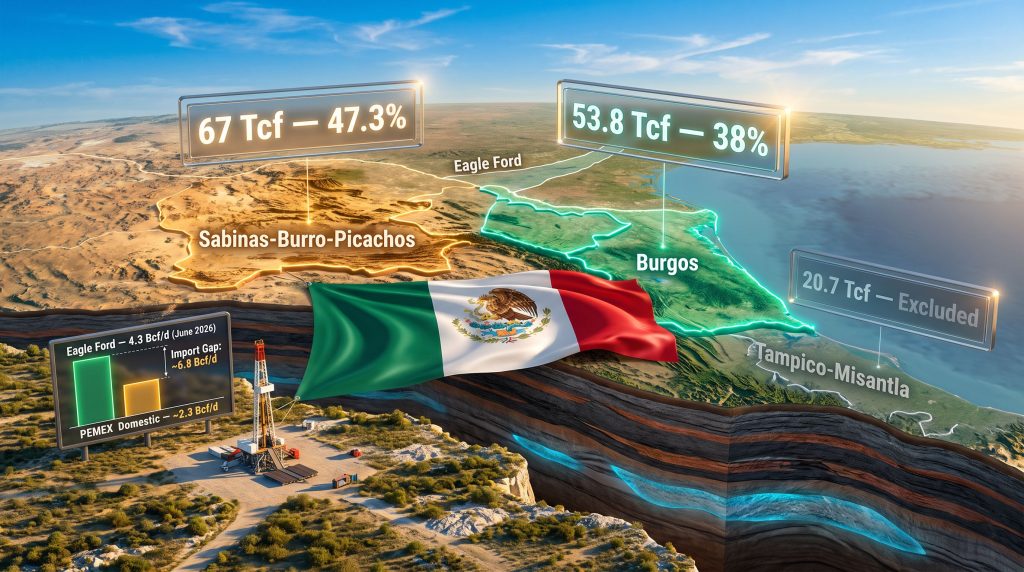
To appreciate why the selection of Mexico shale options to two basins carries such weight, the scale of the import dependency must first be understood. Mexico consumes approximately 9 billion cubic feet per day (Bcf/d) of natural gas nationally. PEMEX, the state energy company, produces roughly 2.3 Bcf/d from domestic sources, leaving an import gap of around 6.8 Bcf/d, equivalent to approximately 75% of total national demand.
That shortfall is filled almost entirely by pipelines running from Texas. For context, Eagle Ford Shale alone, the formation sitting immediately across the border in South Texas and the primary origin point of Mexican gas imports, produced approximately 4.3 Bcf/d in June 2026. That single US basin generates output broadly equivalent to PEMEX's entire national production combined.
PEMEX's 2025 to 2035 Strategic Plan targets domestic gas production exceeding 4 Bcf/d by 2030, a near-doubling that conventional fields cannot credibly deliver on their own. Members of the scientific committee convened to study unconventional gas development acknowledged this reality directly: incremental gains from conventional extraction will contribute, but they will not meaningfully displace US supply at the volumes required.
The unconventional resource base, meaning shale gas and tight gas formations, represents the only plausible pathway to that production target. Furthermore, natural gas price trends in 2025 have added further urgency to this debate, as price volatility reinforces the strategic case for domestic supply. And yet the path from resource estimate to flowing production is considerably longer, more complex, and more politically fraught than the headline numbers suggest.
Mexico's Three Shale Basins: A Comparative Resource Picture
Mexico's unconventional gas potential is distributed across three principal basin systems, each with a distinct geological character, infrastructure profile, and social context.
| Basin | Unconventional Gas Estimate | Share of Total | Primary Characteristic | Key States |
|---|---|---|---|---|
| Sabinas-Burro-Picachos | 67 Tcf | 47.3% | Largest resource base nationally | Coahuila, Nuevo León |
| Burgos | 53.8 Tcf | 38% | Most technically mature; Eagle Ford extension | Tamaulipas (northeast) |
| Tampico-Misantla | 20.7 Tcf | 14.6% | Liquids-rich; Pimienta and Agua Nueva formations | Veracruz, Tamaulipas, Hidalgo |
| Total Estimated | ~141.5 Tcf | 100% |
Together these three systems hold an estimated 141.5 trillion cubic feet (Tcf) of unconventional natural gas, a geologically meaningful resource base by any international measure. The policy decision now concentrating attention is which of these basins can realistically advance toward development, and under what conditions.
Burgos Basin: Mexico's Most Technically Accessible Shale Target
Burgos occupies the northeastern corner of Tamaulipas and shares geological continuity with the Eagle Ford formation across the international border. Key productive formations include the Eagle Ford / Boquillas, La Casita, and Pimienta intervals. This cross-border geological kinship means that the rock properties, well engineering approaches, and productivity expectations established by operators on the US side carry direct relevance to what might be achievable in Mexico.
For this reason, Burgos consistently ranks as Mexico's most technically advanced shale gas target in independent resource assessments. Infrastructure proximity to existing pipeline networks adds to its appeal. The complicating factor is geography of a different kind: northeastern Tamaulipas carries some of the country's most serious organised crime risks, a non-geological variable that shapes operator interest and insurance pricing in ways that no resource estimate can offset.
Sabinas-Burro-Picachos: Largest Resource, Earliest Stage
Spanning Coahuila and Nuevo León, Sabinas-Burro-Picachos holds the largest single share of Mexico's unconventional gas estimate at roughly 47% of the national total. Its scale is its primary attraction. Its limitation is that exploration activity across this system remains at an early stage relative to Burgos, meaning the resource figures carry greater geological uncertainty than the headline Tcf number implies.
An additional layer of complexity arises from Coahuila's political landscape. The state is governed by opposition parties, creating a regulatory and institutional environment that differs from what a federally directed PEMEX-led programme would encounter in a politically aligned jurisdiction. Basin selection, in this sense, is never purely a geological exercise.
Tampico-Misantla: The Basin That Was Set Aside
Tampico-Misantla presents perhaps the most instructive case study in the tension between resource scale and development practicality. According to PEMEX's own Strategic Plan, this basin holds approximately 34.8 billion barrels of prospective shale crude, representing close to 97% of Mexico's total identified shale oil resource. Its Pimienta and Agua Nueva formations are considered the country's most prospective liquids-rich shale targets.
Despite this, the scientific committee recommended excluding Tampico-Misantla from further unconventional development consideration. Ana Gómora, a researcher at the UNAM Faculty of Engineering, confirmed that the exclusion was based on a composite reading of environmental, social, technical, and biodiversity variables rather than any single disqualifying criterion. Population density across the basin corridor, ecological sensitivity, and social protection considerations collectively outweighed the geological upside.
The arithmetic behind this trade-off is revealing:
- Excluding Tampico-Misantla removes roughly 60% of Mexico's total unconventional resource potential when shale oil is counted alongside gas
- When gas alone is considered, the same exclusion removes only approximately 15% of the unconventional gas resource
- The administration's priority is import substitution through gas production, not crude oil volume growth
- Under that framing, the trade-off is arithmetically defensible even if it sacrifices a resource of significant long-term value
This decision effectively parks what may be one of Latin America's largest undeveloped shale oil accumulations in order to protect a gas-first import substitution strategy. Whether that sequencing holds across administrations is an open question that investors in long-duration assets cannot ignore.
The Pre-Exploration Gate: Why Saline Water Determines Everything
The committee's approval of Burgos and Sabinas-Burro-Picachos for further study is conditional in ways that materially alter the development timeline. The central precondition, confirmed by President Claudia Sheinbaum as the immediate next step in the process, is the drilling of research wells to verify the availability, volume, and characteristics of deep saline aquifer formations.
This matters enormously because hydraulic fracturing requires substantial water volumes. José Hernández, Director of the UNAM Faculty of Engineering, placed per-well water requirements at 50,000 to 70,000 cubic metres. The committee's framework mandates that this water must come exclusively from deep saline formations, with a complete prohibition on any freshwater sourced from reservoirs designated for human consumption, agriculture, or livestock.
President Sheinbaum was unambiguous on the consequences of failing to find viable saline water: without confirmed deep saline reservoirs, the possibility of unconventional exploitation in either basin closes entirely. The saline verification drilling is therefore not a parallel track alongside gas exploration. It is a prerequisite that must be satisfied before any production well can be authorised.
The full conditions framework attached to both basins includes:
- Absolute prohibition on freshwater use for hydraulic fracturing operations
- Exclusive sourcing from deep saline aquifer formations, confirmed through dedicated hydrogeological drilling
- Demonstrated hydraulic isolation between saline production zones and drinking-water aquifers
- Minimum 75% water recycling across all operational phases
- Continuous monitoring of surface and groundwater quality before, during, and after each project phase
- Free, prior, and informed community consultation framework with all communities within the area of influence
- An independent scientific monitoring system covering aquifer integrity, environmental impact, and seismic activity
What the Compliance Burden Means for PEMEX and Investors
The financial weight of these conditions lands on an operator that is already financially stretched. PEMEX carries one of the largest debt loads of any national oil company globally, and its capital allocation capacity for new, unproven programmes is constrained.
Previously reported estimates suggest that water treatment systems calibrated to saline-source operations would require an initial capital expenditure in the range of US$5 to US$10 million, with operating cost premiums of approximately US$3 to US$6 per barrel. These figures apply before accounting for the hydrogeological drilling campaigns required to verify saline water availability, a phase with no defined timeline because its duration depends on what is found underground.
The cumulative effect on the development schedule is significant:
- Phase one involves hydrogeological research wells to confirm deep saline water, with no gas extraction authorised
- Phase two requires regulatory framework development, publication of committee findings, and sustained engagement with the 54-member specialist panel
- Phase three involves community consultation processes across both basin areas, followed by independent monitoring infrastructure establishment
- Phase four authorises pilot production wells only after all preceding conditions have been documented and satisfied
PEMEX's own Strategic Plan projected a modest unconventional contribution in the 2026 to 2028 window. However, the phased pre-exploration requirements described above make that timeline extremely difficult to achieve realistically. A definitive feasibility study approach, applied rigorously across both basins, would likely push meaningful production further into the 2030s.
The Benchmark That Frames the Ambition Gap
Understanding Mexico's challenge requires a reference point, and Eagle Ford provides the most direct one. Geologically continuous with the Burgos Basin across the Rio Grande, Eagle Ford has been developed intensively since commercial production began around 2010. By June 2026 it was producing approximately 4.3 Bcf/d of natural gas, a figure achieved through hundreds of horizontal wells, continuous high-pressure fracturing operations, sophisticated water management infrastructure, and sustained multi-billion-dollar reinvestment against steep natural decline curves.
Mexico, across all three unconventional basins combined, has drilled 25 exploratory wells in total. The operational gap between that activity level and the production volumes needed to close a 6.8 Bcf/d import shortfall is not measured in years. It is measured in decades of sustained capital deployment, regulatory stability, and institutional capacity building.
| Metric | Eagle Ford (Texas) | Mexico (All Three Basins) |
|---|---|---|
| Current production | ~4.3 Bcf/d (June 2026) | Negligible unconventional output |
| Exploratory wells drilled | Thousands | 25 total |
| Development timeline | Commercial since ~2010 | Pre-exploration phase not yet complete |
| Water management | Established recycling infrastructure | Saline source not yet confirmed |
| Regulatory certainty | Stable, decades-long framework | Conditional, subject to consultation |
The next major ASX story will hit our subscribers first
The Non-Geological Risk Stack
Beyond hydrology and capital costs, both approved basins carry non-technical risk profiles that no regulatory framework can fully resolve in the near term.
| Risk Category | Specific Factor | Basin Affected |
|---|---|---|
| Political | Opposition governance in Coahuila | Sabinas-Burro-Picachos |
| Security | Organised crime activity in producing zones | Burgos (Tamaulipas) |
| Regulatory certainty | AMEXHI conditional endorsement only | Both basins |
| Civil society | Formal consultation creates organised opposition venue | Both basins |
| Sovereign policy | Campaign pledge to ban hydraulic fracturing remains politically live | Both basins |
AMEXHI, the Mexican Association of Hydrocarbon Companies representing private sector operators, has indicated conditional support for the unconventional gas push but requires long-term regulatory certainty, competitive investment frameworks, and demonstrated physical security in producing zones before committing capital. In addition, shifts in broader oil and gas drilling policy across North America continue to influence how investors assess sovereign risk in emerging shale jurisdictions.
Civil society organisations have maintained sustained pressure on the administration to honour a pre-election commitment to ban hydraulic fracturing outright, and the mandatory community consultation process embedded in the committee's framework creates an institutional venue through which that opposition can be formally expressed.
The regulatory architecture surrounding Mexico's two approved shale basins is simultaneously an enabling framework and a constraint system. Its conditions are comprehensive enough to raise serious questions about whether the pace of development it allows can ever match the pace of the import dependency it is designed to address.
A Geological Detail Worth Understanding: Why Shale Decline Curves Change the Math
One aspect of unconventional gas development that rarely receives sufficient attention in policy discussions is the production decline curve characteristic of shale wells. Unlike conventional gas wells, which can sustain relatively flat production for years, shale wells typically exhibit steep initial decline rates, often losing 60 to 80% of peak production within the first two years of operation.
This geological and reservoir engineering reality means that maintaining any target production level requires not just drilling new wells, but drilling them continuously to replace the volumes lost to natural decline in existing wells. Eagle Ford's 4.3 Bcf/d output is not sustained by the wells drilled a decade ago. It is sustained by ongoing drilling campaigns replacing production as it declines.
For PEMEX, this has a direct financial implication. A programme designed to contribute meaningfully to closing the 6.8 Bcf/d import gap would need to be sustained indefinitely, not just initiated. That sustained capital requirement, combined with pre-exploration compliance costs, community consultation timelines, and security expenditures, describes a programme well beyond current PEMEX financial capacity without private sector co-investment at scale. Consequently, the energy trade war impacts reshaping North American supply chains further complicate the investment calculus for any operator considering long-duration commitments in Mexican shale.
Key Takeaways for Investors and Industry Observers
- Mexico's unconventional gas policy has formally narrowed to two basins: Burgos and Sabinas-Burro-Picachos, together holding an estimated 120.8 Tcf of unconventional gas potential
- The exclusion of Tampico-Misantla removes approximately 97% of Mexico's shale oil resource but only ~15% of its unconventional gas, reflecting a deliberate gas-first import substitution priority
- A mandatory saline water verification phase must precede any production authorisation, functioning as a development gate with an undefined timeline
- PEMEX's capital constraints, combined with water compliance costs estimated at US$5 to US$10 million upfront and US$3 to US$6 per barrel in operating premiums, create material financing challenges
- The operational gap between Mexico's 25 exploratory wells drilled to date and the scale of activity that closed a comparable production gap in Eagle Ford is measured in decades, not years
- Non-technical risks, including political opposition in Coahuila, security conditions in Tamaulipas, and active civil society mobilisation, remain structurally unresolved
Furthermore, independent observers tracking Mexico's shale options across both basins note that the compliance architecture, while environmentally rigorous, may inadvertently extend development timelines beyond what the import substitution strategy can tolerate.
This article is intended for informational purposes only and does not constitute financial or investment advice. Projections, timelines, and resource estimates involve inherent uncertainty and should not be relied upon as the basis for investment decisions. Readers are encouraged to conduct independent research and consult qualified advisers before making any financial commitments.
Want to Stay Ahead of Major Mineral Discoveries Before the Broader Market?
While Mexico's shale ambitions play out over decades, real-time opportunities in the resources sector emerge daily on the ASX — and Discovery Alert's proprietary Discovery IQ model instantly identifies significant mineral discoveries as they are announced, turning complex data across more than 30 commodities into clear, actionable insights. Explore how historic discoveries have generated substantial returns on Discovery Alert's dedicated discoveries page, and begin your 14-day free trial today to position yourself ahead of the market.