July 21, 2026
Mine Waste Is Not Dead — It Is Evolving
Across the global mining industry, a quiet assumption has shaped environmental management for decades: once a mine closes and its tailings are stabilised, the chemistry within those waste deposits gradually settles into a predictable, manageable equilibrium. Monitoring programs are scaled back. Risk registers are archived. Legacy sites fade from active regulatory attention.
That assumption is increasingly difficult to defend.
Beneath the surface of uranium tailings sites, microbial ecosystems have been operating continuously since operations ceased, often for decades. These biological communities do not simply inhabit the waste material passively. They actively transform it, reshaping the oxidation states of metals, altering local acidity, and in some cases mobilising elements that conventional assessments classified as safely contained. The phenomenon of microbes unlock uranium in mine waste is not a theoretical concern limited to laboratory conditions. It is an ongoing geochemical reality with material consequences for environmental management, regulatory compliance, and increasingly, resource recovery economics.
Understanding how this works, and what it means in practice, requires moving beyond the conventional engineering view of tailings as inert disposal material and into the more complex world of microbial geochemistry.
When big ASX news breaks, our subscribers know first
The Chemistry That Determines Whether Uranium Moves or Stays
Oxidation States and the Mobility Question
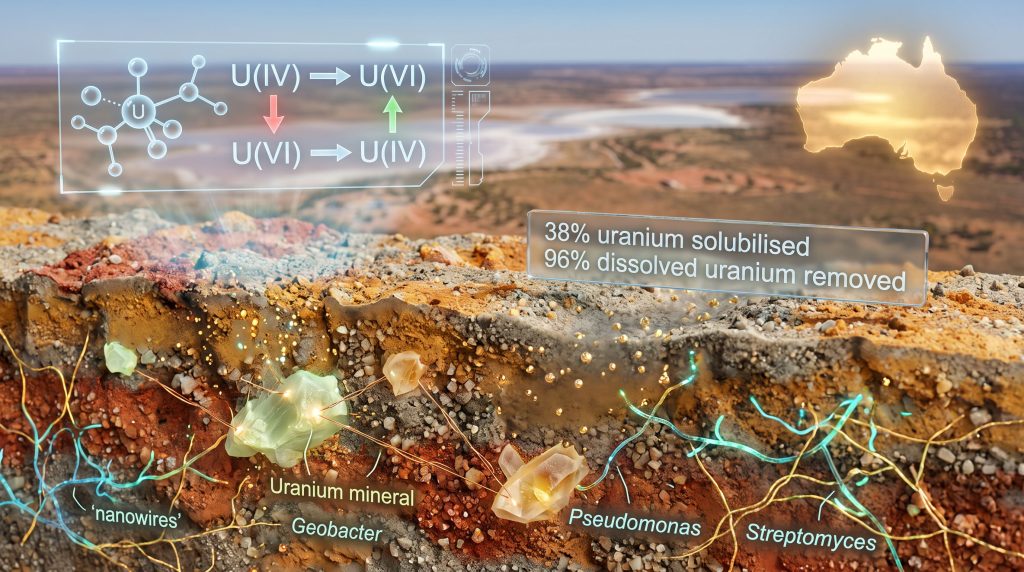
Uranium's environmental behaviour is governed primarily by its oxidation state. In its tetravalent form, U(IV), uranium is largely insoluble and tends to remain locked within mineral matrices. In its hexavalent form, U(VI), it becomes highly water-soluble and capable of migrating through groundwater and soil pore fluids. The transition between these two states is the central variable in any assessment of uranium containment integrity.
What makes mine tailings environments particularly dynamic is that the conditions governing this transition, including pH, redox potential, oxygen availability, and organic carbon supply, are not fixed. They fluctuate in response to seasonal moisture, temperature variation, and, critically, the metabolic activity of resident microbial populations. Furthermore, understanding uranium market dynamics provides useful context for why these findings carry increasing commercial relevance.
Rare earth strategic importance is also evident here, as rare earth elements (REEs) that co-occur with uranium in tailings face analogous speciation dynamics. Their mobility is similarly sensitive to geochemical shifts driven by biological activity, which means that uranium risk assessments that ignore REE co-mobilisation may be substantially underestimating the full contamination profile of a given site.
Why Nanoparticle Formation Compounds the Problem
An additional layer of complexity arises from the capacity of mobilised uranium to aggregate into nanoparticles rather than remaining in purely ionic solution. Uranium-bearing nanoparticles present a significantly greater containment challenge than dissolved uranium ions for several reasons:
- They are small enough to pass through conventional filtration barriers used in monitoring and remediation systems
- They can travel considerably further through soil and aquifer systems than ionic uranium before being retarded or captured
- They may carry co-mobilised REEs, creating multi-element contamination plumes that are difficult to characterise using standard monitoring methods
- Their formation can occur under conditions that would not trigger conventional uranium mobility alerts based on dissolved ion concentrations alone
Research emerging from South Australian tailings sites suggests this nanoparticle pathway has been systematically underestimated in legacy waste risk assessments conducted prior to modern analytical capabilities. This is a significant finding with direct implications for how regulators and operators classify and monitor closed uranium mine sites.
Three Mechanisms by Which Microbes Unlock Uranium
Direct Oxidative Solubilisation
The most direct biological pathway by which uranium is mobilised involves specific bacterial species that oxidise tetravalent uranium to its hexavalent, soluble form through direct electrochemical interaction. This process does not require intermediate chemical reactions with the surrounding mineral matrix. The bacteria effectively act as catalysts for a redox transformation that would otherwise occur far more slowly under purely abiotic conditions.
Once converted to U(VI), uranium enters solution and becomes subject to hydrological transport processes. In tailings environments with even minimal groundwater connectivity, this represents a vector for contamination that extends well beyond the physical footprint of the waste deposit.
pH-Driven Dissolution
A second and less intuitive mechanism operates through microbial alteration of local pH. Pseudomonas fluorescens has been documented as capable of shifting pH within shale mine waste environments from approximately 4.7 to 9.3, an acidic-to-alkaline transition driven by its metabolic outputs.
This pH shift carries direct consequences for uranium mobility. In controlled studies, uranium mobilisation rates rose from 0.016% to 0.9% of total uranium present across this pH range, a roughly 56-fold increase. The scale of this effect varies significantly depending on the buffering capacity of the host material, but it demonstrates that even relatively modest shifts in microbial community composition can produce measurable changes in uranium behaviour across an entire waste body.
This finding challenges the standard assumption in tailings risk modelling that pH stabilisation at closure equates to long-term geochemical stability. Where active microbial communities persist, pH is not a fixed parameter. It is a dynamic output of ongoing biological processes.
Heterotrophic Bioleaching
The third mechanism involves heterotrophic bacteria that metabolise organic compounds whilst simultaneously dissolving uranium from mineral matrices through the production of organic acids, chelating agents, and other metabolic byproducts. This process, known as heterotrophic bioleaching, has been documented across several bacterial genera with notably variable extraction rates depending on strain, mineral substrate, and environmental conditions.
Streptomyces bacillaris has demonstrated the capacity to solubilise up to 38% of uranium from samples containing the secondary uranium mineral jachymovite. This figure is striking in the context of environmental risk assessment, as it implies that nearly four-tenths of the uranium present in certain mineral forms could theoretically be released into solution by a single bacterial species under favourable conditions.
At shorter timescales, Pseudomonas stutzeri and Shewanella putrefaciens dissolved 0.36% and 0.31% of uranium respectively across an 8-day experimental period. Whilst these figures appear modest in isolation, they represent continuous processes operating over years to decades in legacy sites, meaning cumulative mobilisation totals could be substantial. Indeed, recent microbiology research continues to shed further light on the specific biochemical pathways involved in these transformations.
The Microbial Actors: A Functional Profile
Not all microbes in tailings environments drive uranium into solution. A parallel and equally important set of organisms performs the opposite function, converting soluble uranium back into insoluble mineral forms. Understanding both sides of this biological balance is essential for assessing net uranium mobility at any specific site.
| Biological Function | Representative Organisms | Primary Mechanism |
|---|---|---|
| Mobilisation | Pseudomonas fluorescens, Streptomyces bacillaris, Arthrobacter spp. | Direct oxidation, pH alteration, bioleaching |
| Immobilisation | Geobacter metallireducens, Desulfovibrio spp., Shewanella oneidensis, Bacillus spp. | Reductive precipitation to U(IV) |
The Immobilisation Counterforce
Iron-reducing and sulphate-reducing bacteria occupy the opposite functional niche in tailings geochemistry. Species including Geobacter metallireducens, Desulfovibrio, and Shewanella oneidensis convert soluble U(VI) back into insoluble U(IV) through biological reduction, a process that has attracted considerable interest as the basis for engineered in-situ bioremediation strategies.
Field studies have documented native microbial communities removing 96% of dissolved uranium from mine water through this reductive precipitation mechanism. Geobacter metallireducens is particularly notable in this context because it achieves electron transfer to uranium ions through electrically conductive protein filaments — structures sometimes described as microbial nanowires — without requiring direct physical contact with uranium-bearing minerals.
The critical implication of this dual functionality is that the net environmental outcome at any uranium tailings site is not predetermined. It is an emergent property of local microbial community ecology, shaped by available electron donors and acceptors, pH, temperature, and the specific mineralogy of the waste material.
Documented Mobilisation Data: What the Research Shows
The following table consolidates key empirical findings relevant to the question of how effectively microbes unlock uranium in mine waste under different biological conditions:
| Study Parameter | Observed Outcome |
|---|---|
| Pseudomonas fluorescens pH shift | 4.7 to 9.3 (acidic to strongly alkaline) |
| Uranium mobilisation range (P. fluorescens) | 0.016% to 0.9% of total uranium |
| Streptomyces bacillaris bioleaching | Up to 38% uranium solubilised from jachymovite |
| P. stutzeri dissolution (8-day trial) | 0.36% of uranium dissolved |
| S. putrefaciens dissolution (8-day trial) | 0.31% of uranium dissolved |
| Native community immobilisation (field study) | 96% of dissolved uranium removed from mine water |
These data points span a wide range of outcomes, which is itself an important finding. The variance in uranium mobilisation rates across bacterial strains and mineral substrates means that site-specific assessment is essential. Extrapolating results from one tailings body to another, even within the same geographic region, introduces significant uncertainty.
Environmental Risk: When Mobilisation Exceeds Containment Design
Legacy Sites and the Knowledge Gap
Australia holds a substantial inventory of legacy uranium tailings, many of which were closed under regulatory frameworks that predated modern understanding of microbial geochemistry. South Australian sites, in particular, represent case studies in long-term biological activity within waste deposits that were originally assessed using purely abiotic chemical models.
The decades that have elapsed since closure have not rendered these sites geochemically inert. In many cases, the opposite has occurred. Microbial populations have had extended periods to evolve and specialise around the specific mineral substrates available in each tailings body, potentially developing enhanced capacity to interact with uranium and REEs in ways that initial risk assessments did not anticipate.
Standard geochemical risk assessments that exclude biological activity are likely to produce systematically conservative estimates of uranium containment integrity at legacy sites. This is not a minor technical refinement. It is a fundamental gap in the risk modelling framework applied to some of Australia's most radiologically sensitive waste deposits.
Rare Earth Co-Contamination as an Overlooked Variable
REEs co-located with uranium in tailings are subject to the same microbial mobilisation mechanisms but have received far less regulatory attention. The selective bioleaching of REEs from mineral matrices under microbial influence can generate complex multi-element contamination plumes that are difficult to detect using monitoring programs designed primarily around uranium.
This dual-element mobilisation dynamic has a counterintuitive commercial dimension. If REE co-mobilisation can be confirmed and quantified at specific sites, it simultaneously represents an environmental liability and a potential resource recovery opportunity — a tension that is beginning to attract attention within critical minerals demand discussions at the policy level.
The next major ASX story will hit our subscribers first
From Contamination Risk to Controlled Recovery
Bioleaching as a Commercial Pathway
The same biological mechanisms that create regulatory challenges for tailings management can theoretically be engineered into controlled bioleaching operations capable of recovering uranium and REEs from waste material. This is not a purely speculative proposition. The 38% uranium solubilisation rate achieved by Streptomyces bacillaris in laboratory conditions approaches the lower range of conventional acid leach recovery, and does so without the large-volume sulfuric acid inputs that conventional hydrometallurgical processing requires.
The key operational parameters that would need to be managed in a controlled bioleaching system include:
- Selection and inoculation of high-efficiency mobilising bacterial strains
- Active pH management to maintain conditions optimal for target organisms
- Redox potential control to prevent premature reductive immobilisation
- Temperature and moisture optimisation for biological activity rates
- Containment engineering to prevent unintended environmental dispersal of mobilised uranium
Comparing Recovery Approaches
| Recovery Method | Energy Intensity | Chemical Inputs | Uranium Recovery Rate | Environmental Risk Profile |
|---|---|---|---|---|
| Conventional acid leaching | High | Large-volume sulfuric acid | High (greater than 85%) | Significant acid drainage risk |
| Heap bioleaching | Moderate | Minimal | Moderate (30 to 60%) | Lower chemical footprint |
| In-situ microbial mobilisation | Low | None (biological) | Variable (0.016% to 38%) | Requires physical containment |
| Reductive bioremediation | Low | Carbon source only | Not applicable (immobilisation) | Remediation outcome |
The wide variability in in-situ microbial mobilisation rates reflects the current state of the science. However, when considered alongside in-situ leaching benefits more broadly, the biological mechanisms are well understood, even if their optimisation for commercial-scale recovery from specific tailings types remains an active research frontier.
Practical Implications for Operators and Regulators
A Five-Step Management Framework
For mine operators and environmental managers responsible for uranium tailings, the emerging science on microbial geochemistry points toward a structured reassessment of existing management approaches:
- Commission microbiological baseline assessments for all legacy uranium tailings under active monitoring. Standard geochemical testing without biological characterisation is insufficient for sites where microbial activity has had decades to evolve
- Implement continuous redox monitoring to detect shifts toward oxidising conditions that favour uranium mobilisation, rather than relying on periodic sampling programs that may miss transient geochemical events
- Characterise the net functional balance of indigenous microbial communities at each site, distinguishing between sites where mobilising organisms dominate and those where immobilising organisms hold the upper hand
- Evaluate targeted bioaugmentation using immobilising strains such as Geobacter species as a passive long-term containment strategy at sites where natural attenuation is insufficient
- Assess commercial recovery potential at sites with high-grade tailings fractions and documented bioleaching-amenable mineralogy, particularly where REE co-mobilisation has been confirmed
Regulatory Frameworks and Their Limitations
Current tailings management obligations for uranium sites in Australia are administered across multiple regulatory bodies, including the South Australian Environment Protection Authority, the Australian Radiation Protection and Nuclear Safety Agency (ARPANSA), and state mining regulators. Internationally, the International Atomic Energy Agency has developed guidance on biological processes in uranium waste management, though uptake into domestic regulatory frameworks has been uneven.
The scientific findings emerging from South Australian research raise a material question about whether existing risk assessment methodologies are adequate for legacy sites where microbial communities have been operating for extended periods. In addition, mine reclamation innovation is increasingly incorporating biological assessment as a standard element of site closure planning, reflecting a growing recognition of these dynamics.
The Strategic Dimension: Mine Waste as a Living Asset
Rethinking the Economics of Legacy Tailings
As global demand for uranium intensifies in line with the expansion of nuclear energy capacity, and REE demand continues to grow through clean technology supply chain pressures, the economic calculus around legacy tailings is shifting. Material that was once categorised purely as a liability — requiring ongoing management costs and regulatory compliance expenditure — is increasingly being reassessed as a secondary resource with potential commercial value.
Australia's position as a significant uranium producer and holder of substantial REE mineralisation makes this reassessment particularly relevant domestically. The convergence of biological science, critical minerals economics, and environmental liability management is creating conditions in which legacy tailings may be governed, financed, and ultimately processed in fundamentally different ways over the coming decade.
The more significant long-term insight from the research on microbes unlocking uranium in mine waste may not be the environmental risk it identifies, but the commercial opportunity it implies. A tailings body that microbes can unlock biologically may be one that engineered biological systems can unlock commercially, at a fraction of the cost and environmental impact of conventional reprocessing.
This is speculative at present, and commercial viability would depend heavily on site-specific mineralogy, regulatory approvals, and the economics of uranium and REE pricing at any given time. However, the scientific foundation for this possibility is being established in laboratories and field studies right now, and its implications for how the mining industry manages its historical footprint are worth monitoring closely.
This article is intended for informational and educational purposes only and does not constitute financial, investment, or regulatory advice. References to recovery rates, mobilisation data, and commercial potential are based on published scientific research and should not be interpreted as guarantees of outcomes at any specific mine site. Readers with interests in uranium tailings management or critical minerals recovery should consult qualified environmental, legal, and financial advisers. For further context on uranium mine remediation and microbial geochemistry, the International Atomic Energy Agency and the Australian Institute of Mining and Metallurgy publish peer-reviewed resources on these topics.
Want to Know Which ASX Uranium and Critical Minerals Discoveries Are Emerging Right Now?
Discovery Alert's proprietary Discovery IQ model scans ASX announcements in real time, instantly identifying significant mineral discoveries — including uranium and rare earth opportunities — and delivering actionable insights before the broader market reacts. Explore historic discoveries and their remarkable returns, then begin your 14-day free trial to position yourself at the forefront of the next major find.