
August 26, 2026
When Ceasefires Break: The Geopolitical Architecture Behind the Middle East's Latest Flashpoint
There is a well-documented pattern in modern conflict diplomacy: the more geographically contested the enforcement zone, the shorter the half-life of any ceasefire agreement. Maritime chokepoints, in particular, represent some of the most structurally fragile terrain for diplomatic agreements. When military assets, commercial shipping lanes, and rival naval doctrines converge in the same narrow stretch of water, the conditions for ceasefire breakdown are essentially baked in from day one.
That pattern is now playing out in real time. The Middle East ceasefire crumbling after strikes in southern Iran has become one of the most consequential geopolitical developments of mid-2026, with cascading implications across energy markets, global shipping, and risk-sensitive asset classes including Australian equities and the AUD.
When big ASX news breaks, our subscribers know first
The Two-Month Ceasefire and Why It Was Always Vulnerable
The agreement that underpinned the U.S.-Iran ceasefire was never built on structural resolution. It was built on restraint, and restraint has an expiry date when commercial vessels begin taking fire in some of the world's busiest shipping lanes.
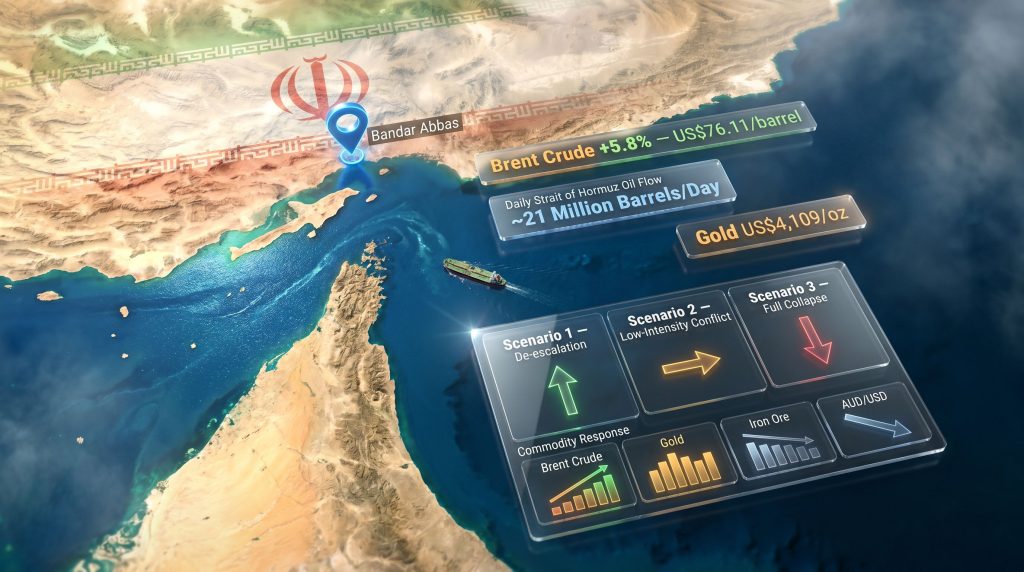
U.S. Central Command confirmed that a series of strikes targeting military, surveillance, and radar installations in southern Iran were launched in direct response to Iranian attacks on three commercial vessels transiting the Strait of Hormuz. The proximity of those installations to Bandar Abbas, Iran's primary naval base and port city sitting directly astride the Strait, was not incidental. It signals that the strategic geography of southern Iran is now an active theatre, not a peripheral concern.
Iranian officials subsequently characterised the two-month-old agreement as effectively void, with the foreign ministry describing the strikes as an act of extreme seriousness. Iran's Revolutionary Guard escalated the language further, indicating a potential complete halt to ongoing negotiations rather than just a military response. That distinction matters enormously.
When a party threatens to exit the diplomatic process entirely rather than simply retaliating militarily, the ceasefire has moved from a tactical breakdown to a structural one. The negotiating architecture itself is now at risk, not just the terms within it.
Ceasefire collapses in contested maritime zones follow a recognisable trajectory: a triggering incident involving commercial shipping, a military response framed as defensive, then a diplomatic rupture in which the original terms become legally contested by at least one party. The current situation tracks that model with near-perfect alignment. Furthermore, the geopolitical risks in mining and energy sectors compound rapidly when such fault lines emerge.
The Strait of Hormuz: Understanding the World's Most Consequential Chokepoint
To understand why these strikes carry market-moving weight far beyond the immediate conflict zone, it is essential to appreciate the Strait of Hormuz not as a geographic feature but as a global infrastructure asset.
| Metric | Data Point |
|---|---|
| Estimated daily oil flow through the Strait | ~21 million barrels per day |
| Share of global seaborne oil trade | ~20-21% |
| LNG volumes at risk | Significant Qatar LNG exports |
| Brent Crude price move post-strikes (8 July 2026) | +5.8% to US$76.11/barrel |
| AUD/USD on 8 July 2026 | US$0.692 |
| ASX 200 futures decline at open | ~40 points (-0.4%) |
Approximately one-fifth of the world's entire seaborne oil supply transits through a waterway that is, at its narrowest point, roughly 33 kilometres wide. Qatar's LNG exports, which are critical to European and Asian energy security, also move through this corridor. The Strait is not a secondary route; it is the primary artery of the global hydrocarbon supply chain.
Commercial vessel attacks in this zone do not merely threaten cargo. They trigger war-risk insurance premium escalation across the entire shipping sector, force rerouting that adds weeks and significant cost to supply chains, and generate a war premium that gets repriced into every barrel of Brent crude within hours of confirmed incidents. Consequently, oil price volatility becomes a systemic concern rather than an isolated market event.
Iranian counterstrike activity targeting U.S. assets across Bahrain, Kuwait, and Jordan introduces what analysts describe as a multi-theatre escalation pattern. When responses begin extending beyond the original flashpoint geography, the conflict is no longer contained, and containment is the prerequisite for ceasefire survival.
Scenario Modelling: Three Pathways From the Current Standoff
Markets do not wait for diplomatic resolution. They price probability distributions across scenarios in real time, and understanding those scenarios is essential for investors with exposure to energy, commodities, and risk-sensitive currencies.
Scenario 1: Managed De-escalation
This base case requires back-channel diplomacy to re-engage quickly, with the Revolutionary Guard standing down from its stated position on negotiations. It would likely see Brent crude retrace toward the US$70-72 range, the AUD recover toward US$0.70+, and risk assets broadly stabilise.
The probability of this scenario has weakened materially. Iran's characterisation of the ceasefire as meaningless and the continuation of CENTCOM's strike posture represent two simultaneous signals pointing away from near-term de-escalation.
Scenario 2: Protracted Low-Intensity Conflict
This is currently the most likely near-term trajectory. Tit-for-tat strikes continue without triggering a formal ceasefire collapse declaration, negotiations stall rather than terminate, and energy markets settle into a sustained war premium.
- Brent crude holds in the US$75-85/barrel range
- Gold maintains elevated gold safe-haven demand at or above US$4,109/oz
- AUD faces continued downward pressure as risk-off sentiment persists
- U.S. natural gas futures sustain upward pressure at US$3.27/gigajoule
- Global shipping insurance premiums remain elevated
Scenario 3: Full Ceasefire Collapse and Regional Escalation
The tail risk scenario involves Iran formally exiting negotiations while Israeli military activity in southern Lebanon intensifies simultaneously. UN Secretary-General António Guterres has already characterised the regional situation as a lesser-fire rather than a genuine peace, suggesting that multilateral confidence in existing arrangements is already fractured.
In a full escalation scenario, the compounding effect of two simultaneous ceasefire breakdowns would be non-linear. Energy markets would not simply add the two risk premiums together; the systemic uncertainty would amplify both beyond their individual weights.
Under this scenario: Brent crude spikes above US$90/barrel, global equity sell-offs accelerate, and the AUD could fall below US$0.67.
How Financial Markets Are Reading the Escalation
The commodity and currency market response on 8 July 2026 provides a detailed picture of how institutional capital is positioning across asset classes in real time.
| Asset | Price Movement | Signal |
|---|---|---|
| Brent Crude | +5.8% to US$76.11/barrel | Direct war risk premium repricing |
| Gold | Holding at US$4,109/oz | Geopolitical hedge demand, not pure risk-off |
| U.S. Natural Gas Futures | Rising to US$3.27/gigajoule | Supply chain anxiety |
| Iron Ore | -0.4% to US$97.85/tonne (Singapore) | Demand-side concern outweighing supply narrative |
| AUD/USD | US$0.692 | Risk-off signal in commodity-linked currency |
| ASX 200 Futures | -0.4% (~40 points) | Compounded by Wall Street semiconductor selling |
One of the more instructive signals here is gold's behaviour. At US$4,109/oz, gold is functioning as a geopolitical hedge rather than exhibiting the pure flight-to-safety dynamic typically associated with equity market panics. This distinction matters: it suggests sophisticated investors are pricing a sustained period of elevated geopolitical risk rather than an acute crisis requiring immediate liquidation of risk assets.
The AUD's decline to US$0.692 reflects a dual compression: Middle East escalation on one side, and Wall Street weakness driven by semiconductor sector selling on the other. For a commodity-linked currency with significant energy and resources export exposure, this convergence of pressures is particularly acute. In addition, the broader Australian share market performance has absorbed these headwinds alongside concurrent global equity weakness.
Australia's Exposure: Energy Tailwinds vs. Demand Destruction Risk
The relationship between Middle East instability and Australian market outcomes is more structurally complex than the simple oil-up/ASX-down narrative might suggest. However, Australian share market performance in mid-2026 reflects exactly this tension between competing commodity signals.
Australian LNG producers benefit directly from elevated energy prices in the near term. Higher Brent crude benchmarks flow through to LNG contract pricing, improving revenue outcomes for exporters. This is the short-term tailwind that often gets missed in the broader risk-off narrative.
However, the iron ore picture tells a different story. The -0.4% decline to US$97.85/tonne in Singapore reflects a more fundamental concern: if sustained Middle East conflict suppresses global economic growth, China iron ore demand for Australian exports contracts significantly. China absorbs the overwhelming majority of Australian iron ore exports, and any slowdown in Chinese manufacturing output would outweigh the supply disruption narrative entirely.
This creates what might be described as the iron ore paradox: energy prices rise on supply disruption fears while iron ore falls on demand destruction fears, and both movements originate from the same geopolitical event.
| Commodity | Short-Term Impact | Medium-Term Risk |
|---|---|---|
| Brent Crude | Strong upside (+5.8%) | Sustained if Hormuz disrupted |
| Gold | Stable safe-haven demand | Further upside in tail-risk scenario |
| Iron Ore | Mild downside (-0.4%) | Demand destruction if global slowdown deepens |
| Natural Gas | Upside pressure | Supply rerouting costs increase |
| AUD/USD | Downward pressure | Stabilises only on de-escalation |
The next major ASX story will hit our subscribers first
The Israel-Hezbollah Dimension: Why Two Fault Lines Are Worse Than One
The Middle East ceasefire crumbling after strikes in southern Iran does not exist in isolation. Concurrent Israeli military activity in southern Lebanon, despite an existing truce arrangement, introduces a second fault line that materially changes the risk calculus.
The structural problem with simultaneous ceasefire fragility across two separate but regionally connected conflicts is that diplomatic resources, international attention, and multilateral institutional capacity become divided. UN-brokered frameworks operate with limited enforcement mechanisms in the best of circumstances. When two separate fronts demand simultaneous management, the probability of both receiving adequate diplomatic attention diminishes significantly.
Regional powers including Saudi Arabia, Qatar, and Turkey retain potential roles in any future stabilisation framework, particularly given Qatar's unique position as both a major LNG exporter transiting the Strait of Hormuz and a historically important back-channel diplomatic intermediary between Western governments and Iranian-aligned actors. Qatar's dual exposure to Hormuz disruption and its diplomatic utility creates an unusual structural incentive for active de-escalation engagement.
Key Indicators for Investors to Monitor
For market participants with exposure to Australian equities, commodities, or global energy markets, the following signals represent the most actionable leading indicators of escalation versus de-escalation:
- Ceasefire status communications from U.S. Central Command and Iran's foreign ministry as primary leading indicators
- Brent crude price trajectory, particularly whether the US$76+ level holds or retreats toward pre-strike levels
- Strait of Hormuz commercial shipping data, where any sustained disruption to vessel transit would represent a significant escalation marker
- AUD/USD movements as a real-time barometer of Australian market risk sentiment
- Multilateral diplomatic re-engagement signals, particularly involving Qatar as a potential intermediary
- Israeli military posture in southern Lebanon, where any formal truce breakdown would activate the second fault line and materially worsen the global risk outlook
This article is for informational purposes only and does not constitute financial advice. Market data referenced reflects conditions as of 8 July 2026. Readers should consult a qualified financial adviser before making investment decisions. For ongoing coverage of how global geopolitical developments intersect with Australian equity and commodity markets, visit The Market Online at themarketonline.com.au.
Frequently Asked Questions: Middle East Escalation and Market Impact
What triggered the latest U.S. strikes on southern Iran?
U.S. Central Command confirmed the strikes were launched in direct response to Iranian attacks on three commercial vessels transiting the Strait of Hormuz, with the military framing its action as targeting surveillance, radar, and military infrastructure in the southern Iranian region near Bandar Abbas.
Why is Bandar Abbas strategically significant?
Bandar Abbas is Iran's primary naval base and port city positioned directly on the Strait of Hormuz. Military installations in this area have immediate relevance to global oil and LNG shipping security, making any strike activity there disproportionately significant for energy markets.
How did oil markets respond to the strikes?
Brent crude surged approximately 5.8% to US$76.11 per barrel, representing a direct war risk premium being repriced into global energy markets within hours of the strike confirmation.
What does Iran's response signal diplomatically?
Iranian officials moved beyond describing a military response, with the Revolutionary Guard signalling a potential complete halt to negotiations. This shifts the breakdown from a tactical military incident to a structural diplomatic rupture, which carries significantly greater market implications.
How exposed is Australia's share market to this situation?
ASX 200 futures fell approximately 40 points (-0.4%) at the open on 8 July 2026, compounded by concurrent Wall Street weakness in the semiconductor sector. The AUD also declined to US$0.692, reflecting risk-off sentiment in a currency that closely tracks global commodity demand conditions.
What is the Israel-Hezbollah connection?
Ongoing Israeli military activity in southern Lebanon despite an existing truce arrangement introduces a second regional fault line. If the Middle East ceasefire crumbling after strikes in southern Iran coincides with a simultaneous Lebanese truce breakdown, the compounding effect on energy markets and global risk appetite would be significantly more severe than either situation would produce independently.
Want to Stay Ahead of the Market Moves Triggered by Major Geopolitical Events?
When escalating tensions in the Middle East send commodity prices surging and risk-sensitive assets like the AUD into retreat, identifying which ASX-listed resource and energy stocks stand to benefit requires both speed and precision — exactly what Discovery Alert's proprietary Discovery IQ model delivers through real-time alerts on significant ASX mineral discoveries. Explore Discovery Alert's discoveries page to understand how major mineral discoveries have historically generated substantial returns, and begin your 14-day free trial today to position yourself ahead of the broader market.