June 27, 2026
The Hidden Architecture of Australia's Fuel Vulnerability
Most economies assume fuel will flow. They plan for price volatility, not absence. Yet the architecture of global oil supply contains a single structural weakness so consequential that its disruption can cascade from the Persian Gulf to a petrol station in Perth within weeks. That weakness is geographic concentration: specifically, the extraordinary volume of crude oil that must pass through one narrow maritime corridor before it can reach the refineries, tankers, and distribution networks that ultimately serve the Asia-Pacific region.
Understanding why the Middle East conflict Australia fuel shock unfolded the way it did requires examining not just the geopolitical trigger, but the entire supply chain that made Australia so exposed in the first place.
When big ASX news breaks, our subscribers know first
Why Australia's Fuel System Was Already Under Stress
The Refining Capacity Retreat
Over the past two decades, Australia made a quiet but consequential structural decision: it largely exited domestic fuel refining. Where the country once operated multiple refineries capable of processing imported crude into usable petroleum products, a combination of aging infrastructure, high operating costs, and competition from larger, more efficient Asian refineries made continued domestic refining commercially unviable for most operators.
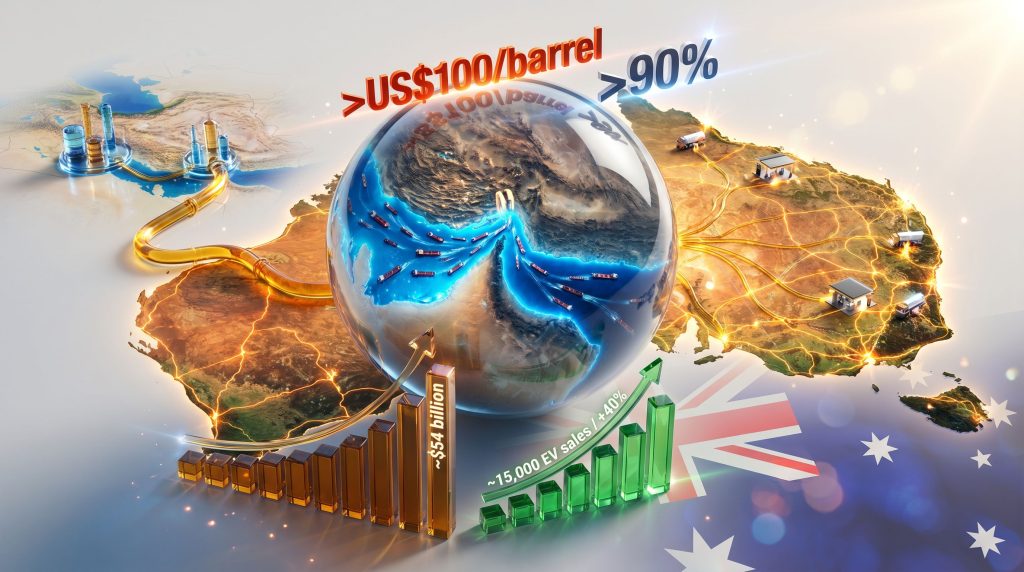
The result is a fuel supply model that now depends on more than 90% of liquid fuel requirements being sourced through imports, with the majority of refined product arriving from Asian refining hubs in Singapore, South Korea, and India. Those hubs are themselves deeply dependent on Middle Eastern crude as their primary feedstock.
This layered dependency creates a compounding vulnerability that is not immediately obvious. Australia is not simply importing oil. It is importing already-refined products from refineries that are themselves importing crude from a region prone to geopolitical instability. Each link in that chain carries its own disruption risk. Furthermore, Australia's energy export challenges compound these vulnerabilities, creating a uniquely exposed position in the global energy market.
The Strait of Hormuz: One Corridor, Global Consequences
The Strait of Hormuz is approximately 33 kilometres wide at its narrowest navigable point. Through this corridor passes roughly 20% of the world's daily oil trade, including the vast majority of crude exported from Saudi Arabia, Iraq, Iran, the UAE, and Kuwait.
For a corridor of such global importance, its physical dimensions are remarkably modest. This concentration of energy trade through a single, geographically constrained passage represents one of the most significant structural risks in the global commodity system.
When military escalation disrupted transit through the strait in early 2026, the immediate effect was not simply a reduction in Iranian exports. The disruption compressed tanker availability across the entire region, rerouted shipping traffic, elevated freight rates, and injected a substantial risk premium into crude benchmarks globally. More than 800 vessels were reported stranded or rerouted in the Persian Gulf, creating cascading delays across the Asia-Pacific supply chain that fed directly into Australian import timelines.
The Hormuz chokepoint illustrates a principle that energy security analysts have long understood: in global commodity systems, geographic concentration creates fragility that no individual country can fully hedge through domestic policy alone.
How the Price Shock Transmitted from the Gulf to the Australian Bowser
The Crude-to-Pump Transmission Mechanism
Global oil pricing operates through a hierarchy of interconnected benchmark systems. The two benchmarks most relevant to Australia's fuel costs are Brent crude, which serves as the global reference price, and the Dubai/Oman benchmark, which is the primary pricing reference for Middle Eastern crude sold into Asian markets.
When military strikes on Iran in late February 2026 disrupted Hormuz transit, both benchmarks surged. An oil price rally had already sensitised markets to geopolitical risk, and crude prices broke above US$100 per barrel for the first time in several years, reflecting not only immediate supply concerns but also a geopolitical risk premium that markets attached to an uncertain and potentially prolonged conflict scenario.
The price transmission did not stop at crude. Asian spot markets for refined petroleum products, including gasoline, gasoil (diesel), and naphtha, repriced simultaneously. When crude input costs rise sharply and tanker availability tightens at the same time, refinery margins and refined product premiums compound the underlying crude price increase. Australian fuel importers, operating with limited strategic reserve depth, absorbed these compounded cost increases with minimal ability to smooth the volatility.
| Price Transmission Stage | Mechanism | Impact on Australia |
|---|---|---|
| Crude oil benchmark surge | Brent/Dubai above US$100/bbl | Higher input costs for Asian refiners |
| Refined product premium expansion | Tight tanker supply and refinery margin pressure | Elevated petrol and diesel import costs |
| Domestic retail price pass-through | Limited strategic reserve buffer | Pump price spikes at forecourts |
| Regional shortage emergence | Supply chain delays from rerouted shipping | Localised fuel access constraints |
Why Distance Did Not Protect Australia
A common misconception is that Australia's geographic remoteness from the Middle East provides some degree of insulation from regional conflict. The reality operates in the opposite direction. Australia's deep integration into Asian fuel supply networks, combined with its near-total dependence on imported refined products, creates a direct transmission channel from Hormuz to the Australian pump that is faster and more complete than many policymakers had modelled.
Unlike countries that hold 90-day strategic petroleum reserves mandated through International Energy Agency membership obligations, Australia entered this disruption with relatively shallow reserve buffers. That structural gap amplified the domestic price and supply impact of a disruption that, in absolute supply terms, affected other economies less severely. Notably, oil price movements during recent trade tensions had already signalled how quickly global shocks transmit to Australian consumers.
Quantifying the Economic Damage
From Fuel Prices to GDP Contraction
The economic consequences of the Middle East conflict Australia fuel shock extend well beyond fuel costs at the forecourt. Modelling of disruption scenarios produced estimates that illustrate the outsized economic exposure created by import dependency at scale.
- A short-duration supply disruption is projected to reduce Australian GDP by approximately $7 billion
- A severe and prolonged conflict scenario carries estimated investment losses reaching $54 billion
- Household consumption is modelled to contract by as much as $70 billion under extended high-price conditions
The sectors most acutely affected are those that are simultaneously fuel-intensive and unable to rapidly substitute alternative energy sources. Transport logistics, mining operations, and agricultural production all share this characteristic. A cattle station in Queensland cannot switch to battery-powered equipment on short notice. A long-haul freight operator cannot restructure its cost base within weeks. These structural rigidities mean that fuel price shocks translate into economic damage more quickly and completely than they would in more energy-diverse sectors.
Inflation, the RBA, and the Policy Dilemma
Elevated fuel costs create a particularly difficult challenge for monetary authorities. Fuel price increases transmit into headline consumer price inflation through two distinct channels: direct transport cost increases for households, and indirect cost pass-through as logistics expenses flow into the prices of virtually all consumer goods.
The Reserve Bank of Australia faces a classic short-term policy dilemma when confronted with a supply-driven fuel shock. A temporary disruption might reasonably be treated as transitory, with the RBA looking through the initial price spike without tightening monetary policy. However, according to recent reporting on Australian inflation and interest rates, a prolonged Hormuz disruption that sustains elevated fuel costs for six months or more would complicate that calculus significantly, potentially requiring the bank to respond to sustained above-target inflation even whilst acknowledging that the underlying cause is a supply shock rather than demand-driven overheating.
Warning: If the Hormuz disruption persists beyond 90 days, the compounding effect on Australian inflation, business investment, and household discretionary spending could substantially exceed the short-term GDP impact projections.
Australia's Policy Response: Three Pillars Under Pressure
Strategic Reserve Expansion
The government moved to extend Australia's petrol stockpile to 46 days of supply, representing an addition of approximately 10 days beyond pre-conflict reserve levels. Executing this expansion whilst the Hormuz closure was actively constraining tanker availability required sourcing from alternative regional suppliers, a logistically complex and commercially costly exercise that illustrated precisely the vulnerability the reserve expansion was designed to address.
Fuel Excise Relief
To partially offset the pump price increases experienced by households and businesses, the federal government reduced the fuel excise by between 26 and 32 cents per litre, depending on fuel type and implementation timing. This measure functioned as a cost-of-living buffer rather than a supply-side solution, providing direct financial relief without addressing the underlying structural dependency that created the shock.
National Cabinet Coordination
Prime Minister Anthony Albanese convened multiple National Cabinet meetings dedicated to managing the crisis, whilst Energy Minister Chris Bowen led efforts to secure supply guarantees from regional trade partners. The government's public communication strategy was calibrated specifically to prevent demand-side hoarding from compounding the supply-side shortage, a dynamic that has historically amplified fuel crises beyond their underlying severity.
The messaging to Australians centred on three clear behavioural objectives:
- Avoid panic buying behaviour that withdraws supply from the system faster than shortages justify
- Continue normal daily activities where fuel remains available
- Conserve fuel voluntarily where practical, reducing aggregate demand pressure on constrained supply
Historical Echoes: Comparing 2026 to Previous Energy Crises
The 1970s oil shocks provide the most instructive historical parallel. The 1973 OPEC embargo and the 1979 Iranian Revolution each produced supply disruptions that forced Western economies to confront their dependency on Middle Eastern crude. Those crises ultimately generated lasting institutional responses, including the establishment of the International Energy Agency and the adoption of mandatory 90-day strategic petroleum reserve requirements for member nations.
| Crisis Period | Trigger | Australia's Response | Long-Term Policy Outcome |
|---|---|---|---|
| 1973–74 Oil Embargo | OPEC supply restriction | Rationing and efficiency measures | Partial IEA participation |
| 1979 Iranian Revolution | Supply shock and price spike | Limited strategic reserve build | Minimal structural reform |
| 2026 Hormuz Disruption | Military escalation affecting transit | Reserve expansion and excise cut | Policy debate ongoing |
What the historical record reveals is a pattern of reactive rather than anticipatory policy. Each disruption exposed structural vulnerabilities; each generated a period of reform discussion; most produced insufficient lasting change to prevent the next disruption from finding the same weaknesses. The 2026 episode may represent a more consequential inflection point, simply because the scale of economic modelling now available makes the cost of inadequate resilience impossible to dismiss.
The next major ASX story will hit our subscribers first
The Policy Debate the Crisis Has Forced Open
Domestic Production vs. Structural Transition
The fuel shock has crystallised a policy debate that had previously operated at a relatively low level of political intensity. Several state premiers have advocated for accelerating domestic oil drilling programmes and revisiting the feasibility of restoring refining capacity within Australia, arguing that import dependency exceeding 90% is strategically untenable regardless of global energy transition trajectories.
The counter-argument, advanced by energy transition economists and renewables advocates, holds that investing in fossil fuel infrastructure entrenches a long-term vulnerability rather than resolving it. Their position is that renewable energy solutions combined with diversified energy sourcing represent a structurally superior resilience strategy, and that the drilling-and-refinery proposals reflect political expediency rather than considered long-term planning.
The EV Acceleration Effect
Among the least anticipated consequences of the fuel shock was a sharp acceleration in electric vehicle adoption. Approximately 15,000 EV sales were recorded in the month following the crisis onset, representing a 40% increase over prior monthly averages. This consumer behaviour shift suggests that price signals at the pump may be achieving what years of government incentive programmes struggled to deliver: a genuine mass-market motivation to exit petrol dependency.
Consequently, the energy transition in mining and broader industrial sectors is now receiving renewed attention as Australia's vulnerability to imported fossil fuels becomes increasingly difficult to ignore.
The 2026 fuel shock may be functioning as an involuntary market signal that accelerates Australia's energy transition timeline, regardless of which side of the policy debate ultimately prevails in parliament.
Three Scenarios for What Comes Next
The outlook for Australia's fuel security sits within a range of plausible trajectories, each carrying substantially different policy and economic implications.
Scenario 1: Rapid De-escalation. Hormuz reopens within 60 to 90 days; global crude retreats below US$100 per barrel; Australian pump prices normalise; the policy reform debate loses legislative momentum as the immediate sense of crisis fades.
Scenario 2: Prolonged Disruption. Conflict persists for six to twelve months; alternative supply routes become operationally entrenched; Australia accelerates bilateral energy agreements with regional partners; domestic fuel security reform gains genuine legislative momentum with cross-party support.
Scenario 3: Permanent Route Realignment. Hormuz does not revert to pre-conflict operational norms; global oil trade permanently restructures around alternative corridors; Australia faces sustained elevated fuel costs and is compelled to undertake fundamental energy infrastructure reform that previous disruptions failed to deliver.
An April 2026 analysis from the US-based Basha Report risk consultancy flagged the possibility that the Strait of Hormuz may not revert to its pre-war operational baseline, raising the probability that scenario three deserves more serious planning weight than conventional optimism typically assigns it.
Key Statistics at a Glance
| Metric | Figure |
|---|---|
| Australian fuel import dependency | Over 90% |
| Global oil trade through Strait of Hormuz | Approximately 20% |
| Crude price threshold breached | Above US$100 per barrel |
| Vessels stranded or rerouted in Persian Gulf | 800+ |
| Current petrol reserve level | 46 days |
| Reserve increase since conflict onset | Approximately 10 days |
| Fuel excise reduction | 26 to 32 cents per litre |
| Short-disruption GDP impact | Approximately $7 billion |
| Severe scenario investment loss | Approximately $54 billion |
| Household consumption impact (severe scenario) | Approximately $70 billion |
| Monthly EV sales increase post-crisis | Approximately 40%, around 15,000 units |
Regardless of which scenario materialises, the Middle East conflict Australia fuel shock has permanently repositioned fuel security on the national policy agenda. The structural vulnerabilities it has exposed, including near-total import dependency, shallow strategic reserves, and a refining base that was systematically dismantled over decades, were known risks before 2026. The question that now demands an answer is whether Australia will treat this disruption as the reform catalyst it represents, or allow the policy window to close once pump prices stabilise.
This article is based on market analysis and economic modelling available at the time of publication. Economic impact projections represent scenario-based estimates and should not be interpreted as definitive forecasts. Energy market conditions remain subject to rapid change. For more detailed analysis of Asia-Pacific petroleum market dynamics, visit Argus Media's Middle East conflict analysis.
Want to Stay Ahead of the Resource and Energy Discoveries Reshaping Australia's Future?
As Australia confronts its fuel vulnerability and accelerates its energy transition, the race to identify significant mineral discoveries has never been more critical. Discovery Alert's proprietary Discovery IQ model delivers real-time ASX mineral discovery alerts, turning complex resource data into actionable investment insights for both short-term traders and long-term investors — explore the historic returns major discoveries have generated and begin your 14-day free trial today to position yourself ahead of the market.